Names
The word ayahuasca comes from Quechua and is usually translated as "vine of the souls" or "vine of the dead." It can refer to either the vine or the drink. Ayahuasca is the name most commonly used in Western countries, though the drink is sometimes called yagé or yajé there as well. Members of the Brazilian religion Santo Daime call it Daime, a name taken from the Portuguese for "give me."
Indigenous peoples have their own names for it: oni among the Shipibo-Konibo, nixi pae among the Huni Kuin, kahpi or gahpi among some Eastern Tukanoan peoples of the Vaupés, and natem among the Shuar.
What it is
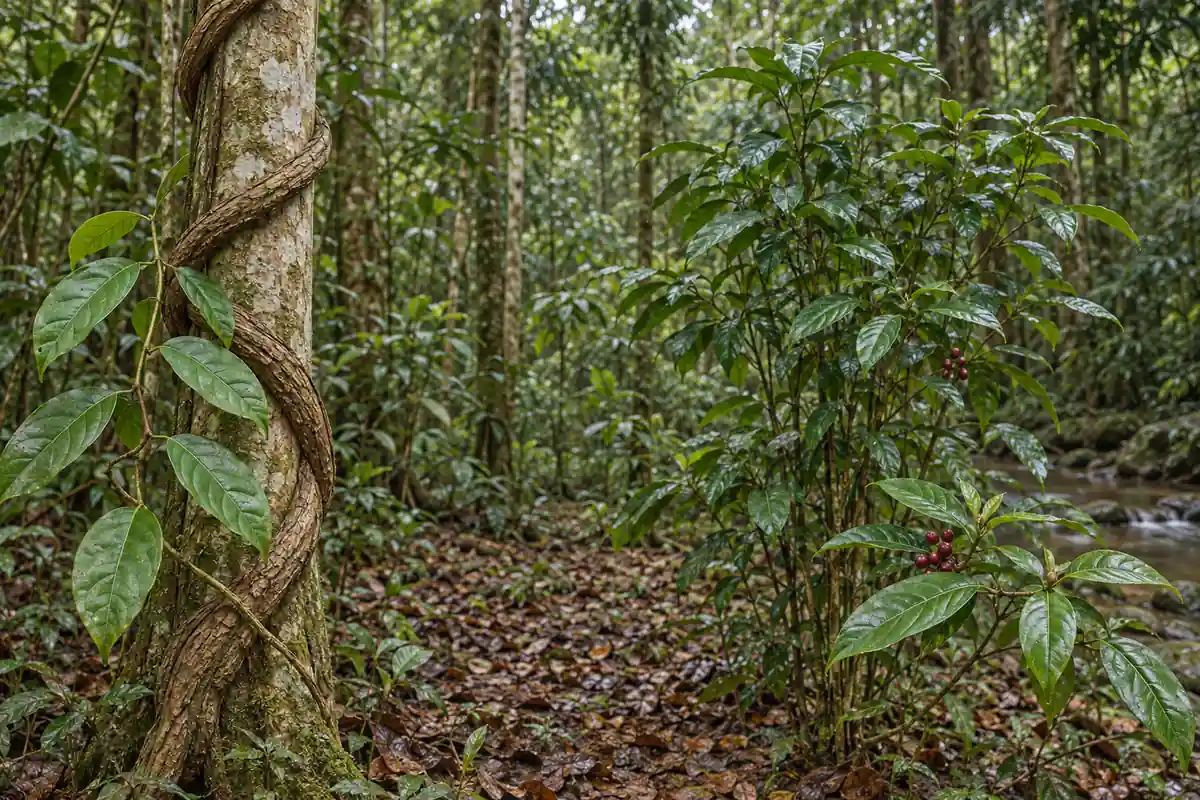
Ayahuasca is a dark, bitter drink brewed from one or more plants. At its base is the ayahuasca vine (Banisteriopsis caapi), a large woody climber with a thick, twisting stem. It grows in the Amazon and in other parts of tropical South America.
The vine is often brewed with a second ingredient, usually the leaves of another plant. The best known of these is chacruna (Psychotria viridis), a shrub in the coffee family. Some brews use chaliponga (Diplopterys cabrerana) instead, a climbing relative of the ayahuasca vine.
Santo Daime members have their own names for the two plants, calling the vine jagube and the leaf rainha ("queen"). Brews differ from one people or healer to the next, and other plants may be added.
How it works
The leaves of chacruna and chaliponga contain DMT (N,N-dimethyltryptamine), a psychedelic compound that works mainly on receptors in brain cells that respond to serotonin, a chemical messenger.
When DMT is swallowed on its own, an enzyme called monoamine oxidase breaks most of it down before it can reach the brain. The vine is what prevents this: harmine and related compounds in the vine, known as beta-carbolines, temporarily block the enzyme.
Beta-carbolines may also play a part in the effects themselves, but that role is less well understood. And because the plants in a brew vary, so does its chemistry.
Effects on the mind
Brews that contain DMT act as classic psychedelics, changing perception, thought and emotion. The effects usually last several hours.
Many people report visions, often with their eyes closed. These can include geometric patterns, landscapes, animals, or figures that people take to be beings or spirits. Others see little. Emotions can grow stronger, and memories or personal concerns can come to the surface. People often come away feeling they have gained insight into themselves or their lives, though that feeling alone doesn't show the insight is true.
The experience can also be challenging. People describe fear, confusion, grief, a sense of losing control, or the feeling of dying. Some lose track of their surroundings, while others stay aware of them. A single session can hold both valued and difficult moments, and no one experience is universal.
In tradition
Who drinks ayahuasca varies from one tradition to another. Among the Shipibo-Konibo of Peru, the healer, known as the onanya, drinks to see what is making a patient ill, and elders recorded in 2024 still held that patients should not drink. Huni Kuin people drink together at night to see what is hidden, including the causes of illness and the intentions of others.
How people understand the drink differs too. The Huni Kuin treat it as a medicine and as a being with its own spirit. Members of Santo Daime, a syncretic Christian religion founded in Brazil around 1930, understand it as a divine being and a teacher. Eastern Tukanoan specialists describe it as a source of knowledge for healing people and the land.
Today
Ayahuasca is now also drunk outside its traditions in many countries, including at retreats. Growing demand has reportedly made wild vines scarcer around some towns in the Peruvian Amazon.
Traditions that use it
A question about this plant
- Ayahuasca: who drinks, and how does it heal? Six of these traditions answer, each in its own way.
Cite this page
Psychoactive Traditions. “Ayahuasca.” Last reviewed 1 November 2026. https://psychoactive-traditions.org/medicines/ayahuasca