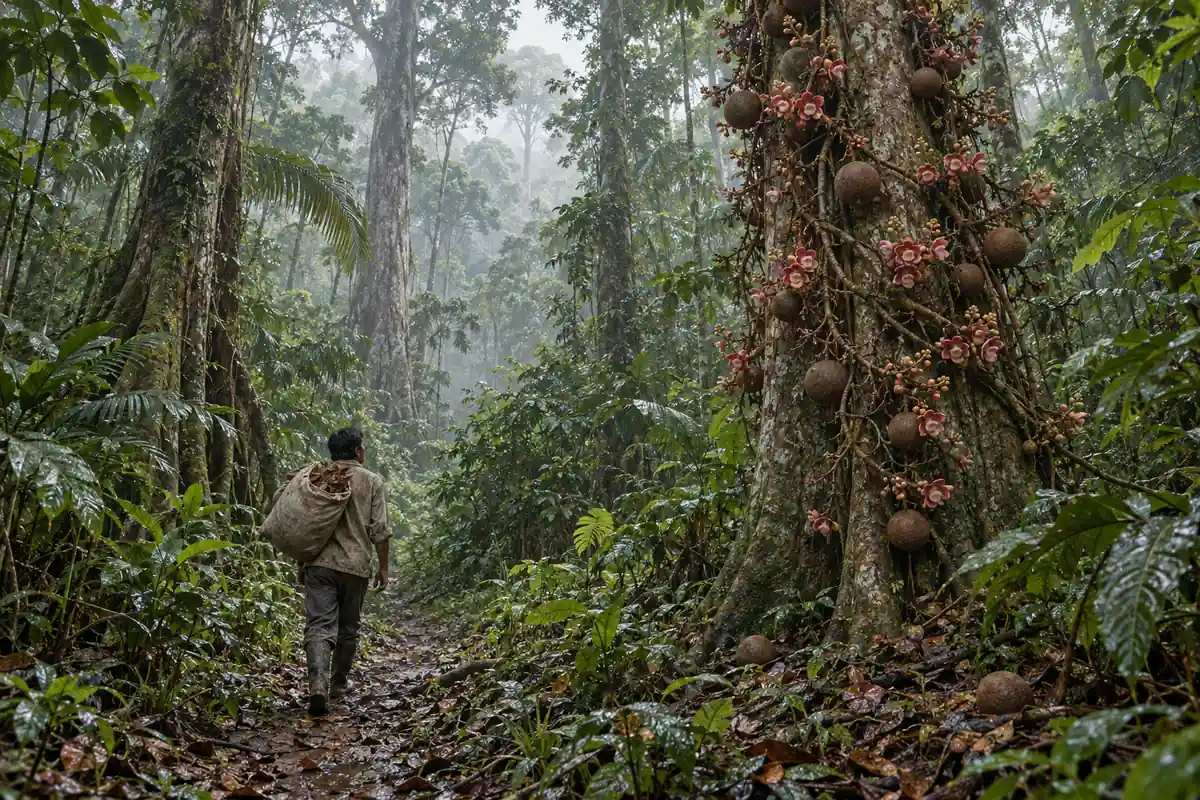
In the river towns and cities of the Peruvian Amazon, including Iquitos, Pucallpa and Tarapoto, some healers of mixed Indigenous and European descent call themselves vegetalistas, "plant specialists." They treat illness, guard against sorcery and prepare remedies, and they say that the plants themselves taught them how. The best known of these plants is ayahuasca, a vine whose name in Quechua is usually translated as "vine of the dead" or "vine of the spirits." It is cooked with the leaves of a shrub called chacruna into a bitter, visionary drink, which healers often simply call la purga, "the purgative." Ayahuasca is only one of the plants the tradition uses, but when an anthropologist asked four vegetalistas near Iquitos in the early 1980s where their knowledge came from, each gave the same answer: La purga misma te enseña, "Ayahuasca itself teaches you." [2, 7, 9]
Plants that teach
Vegetalismo rests on the belief that many plants, perhaps all of them, have a "mother" or spirit, and that some of these spirits will instruct a person who approaches them correctly. Healers call such plants doctores, plantas maestras ("master plants"), or vegetales que enseñan, "plants that teach." In the early 1980s, Iquitos healers counted among them tobacco, toé (a species of Brugmansia), several large forest trees, and many lesser plants. One healer considered the list open-ended. Asked about a mushroom that grows on cow dung, he said, "You see beautiful things. If you keep the dieta it might teach you medicine." [2]
The healers did not agree on everything. One held that only plants that make a person dizzy have a mother. Another rejected this: "The mother of the plant is its existence, its life." A third said that every plant, even the smallest, has one. Some teaching plants bring visions only when combined with ayahuasca, some cause only a "blind dizziness" in which nothing is seen, and some teach only in dreams. Three decades later, a healer in Tarapoto put the matter simply: "For me, all plants are master plants." [2, 7]
The spirits take many forms. They often appear as small, strong, well-formed people, and healers call them doctorcitos, "little doctors," or abuelos, "grandfathers." They show the apprentice how to diagnose an illness, which plants to use, how to blow tobacco smoke, how to suck an illness out of a patient, and how to defend himself. Above all, they teach songs. One healer who trained in San Martín in the 2010s described a long dream in which he walked through a forest and recognized the trees whose bark he had been helping to prepare. A small greenish figure stepped out of a door in each trunk and said, "Ah, I know how to cure such a thing," then sang and showed him the twigs. "Each plant came out, opened up, spoke and taught me." [1, 2]
To the people who practice vegetalismo, this kind of learning is a matter of pride. One Iquitos healer, who never had a human teacher, compared it with Western medicine: "Some doctors believe that vegetalismo is stronger than medicine of study, because they learn by reading books. But we just take this liquid, keep the diet, and then we learn." [2]
The dieta
The phrase "keep the dieta" refers to the practice at the center of the tradition. A dieta combines taking a particular plant with seclusion in the forest, a sharply restricted diet without salt, sugar, alcohol or most animal products, and sexual abstinence. Healers interviewed in San Martín between 2015 and 2017 said these conditions were as important as the plant itself. A saying recorded in the region holds that "the cure is in the dieta." [1]
The healers explained the restrictions in more than one way. One said that a body spared the work of digesting food can give all its energy to taking in the plant's energy. Another spoke of danger and openness: "When a person is in diet, it is like a surgery, so there are very strict conditions in order for it to work and not be dangerous." Going without salt and sugar, he said, puts a person into "a state of sensitivity, of vulnerability, so that the plant can be more effective." The dieta is ended, or "cut," by eating salt again, and he warned against leaving the forest clearing before then: "a motorbike will pass by, you will perceive smells... a person who drinks alcohol may pass by—because you are very open. Once you start eating salt, your energetic body starts to close, little by little." [1]
Breaking the rules, by accident or intent, is called "crossing" the dieta. People say it can bring on rashes, madness and, very rarely, death, and it may require a healer to restore the person's balance. A common remedy is the soplada, in which a trained healer blows tobacco smoke over the person. One healer described the smoke as a bridge between two bodies: the disturbances pass from the patient to the healer, who "has to be prepared for this, to be able to assimilate, to metabolize it... It's as if you have a stronger tube and you can digest what the other person cannot." [1]
Dietas are used for many purposes. Some treat rheumatism, wounds or women's abdominal pains; others build strength or mark a rite of passage. One healer told of an uncle with a broken leg: the bone was set and bandaged, and he was sent "off to diet." Most people never undertake a dieta in order to become healers. In remote rural areas, one healer said, dietas are more familiar than ayahuasca: "You may find that campesinos have experience with dietas, but they do not drink ayahuasca or have never done so. But they do know the dieta." [1]
Healing and learning are not separate, however. Several healers in San Martín began their training while being treated. One discovered his calling during a long dieta prescribed after he broke his leg as a teenager. Another went to the plants with a drinking problem: "When I drank those plants I no longer had any desire for even one beer... I dreamed about my teacher, that we were swimming in the river, I was singing with him, I was healing with him... So I was already beginning to learn, I was given teachings and I was also being healed." A third described a dieta that, twenty years late, brought back his grief for a sister who had died when he was a teenager trying to be "manly, macho." He wept "to the rhythm of the rain." Another healer, a former soldier, said that diets had softened the hardness he brought back from the army: "Now I have patience, more calm." [1]
Healers also say that much of what a dieta teaches never passes through the mind. "This was not being processed by my head, but by my body," one said of learning to blow tobacco and to sing. "The usage of tobacco, the sopladas, the songs, all of that gets prepared and refined in the diets." [1]
Songs, defenses and the danger of the work
The songs that the plants teach are called icaros. In the Iquitos area of the early 1980s, the number and quality of a healer's icaros were considered the best measure of his knowledge and power. There were icaros to strengthen or calm the visions, to call protective spirits, to cure particular illnesses, to reinforce medicinal plants, to attract a lover, to bring rain, and to bewitch. The four healers there sang mostly in Quechua, and two of them said they had learned other Indigenous languages not from people but from the spirits. Healers said that the longer a person keeps the diet, the more icaros he receives. [2]
Healers say the work carries serious risk. In the same period, they spoke often of battles with jealous rival healers and with sorcerers trying to block a cure. These fights frequently took place in dreams, and a healer who lost might never wake up. Each healer therefore gathered an arkana, from a Quechua word meaning "defense." One surrounded himself with a lion, a black panther, an elephant, a mermaid, poisonous snakes and, as a last resort, a school of piranhas. Another posted four armed angels at the corners of his house. A third had four tree spirits carrying guns and, for the greatest danger, a war airplane that would bomb his enemies. Asked how he had obtained it, he said he could not answer; it was "a professional secret." Two of the healers added that their highest defense was Jesus Christ. [2]
In this way of thinking, sorcery causes illness in two main ways: by stealing a person's spirit and throwing it away, or by shooting a magic dart, or virote, into the body. The healer's counterpart to the dart is a phlegm called yachay or mariri, which he receives from the spirits or from a teacher and keeps inside his body. With it he sucks out illness, and a healer who loses it is left at the mercy of his enemies. The anthropologist who studied the four healers judged that darts and phlegm "seem to be the same thing but with different functions": curing, protecting or harming. [2]
The same ambivalence shaped how other people saw healers. Among the urban poor of Iquitos in the late 1960s, people believed that neighbors and relatives might wish them harm, and most healers who cured with ayahuasca also told of clients who had asked them to cause harm. Many said they refused. A separate group of reputed brujos, or sorcerers, was said to take such work and to collect payment in advance, unlike healers, who were paid after the patient improved. Research in Iquitos in the 2000s found healers still describing the drink in double terms. Healers said that apprentices who keep a strict dieta are led "into a place of pure medicine," while someone who wanted to become a sorcerer might eat fish with teeth in order to take on their aggressiveness. [10, 11]
Borrowings and origins
Vegetalismo has always absorbed outside elements. Prayers, Christian saints, perfumes, camphor and commercial disinfectant appear in its practice, and some specialists work mainly with prayer or with Rosicrucian teachings. A musicologist who analyzed one Iquitos healer's recorded icaros in the early 1980s heard Andean scales, Creole folk music and, in one song, the rhythm of the Brazilian baião. The healer said the spirits had taught him every song. The musicologist suggested that the true teachers were "the thousands of popular musicians" of the region. [2, 9]
How long ayahuasca itself has been part of this tradition is disputed. In 1994, the anthropologist Peter Gow proposed that ayahuasca healing among the peoples of the southern Peruvian lowlands was recent, carried upriver from Jesuit mission villages by rubber-boom workers in the early twentieth century. He pointed out, for example, that the healer's blowing of tobacco smoke over each cup of the drink resembles the Catholic Mass. The ethnomusicologist Bernd Brabec de Mori built on this idea in 2011. He found that ayahuasca songs from the Napo River to the Urubamba share a common structure, while other local music varies sharply from one people to the next. He also found that most of the teachers of the Ucayali healers he interviewed had come from downriver. In 2023, the anthropologist Carlos Suárez-Álvarez challenged this account. He cited missionary descriptions, from before 1661, of night-time public healings with singing, blowing and sucking; nineteenth-century reports of a purgative visionary drink among Arawakan peoples; and the depth of Shipibo-Conibo vocabulary for the vine. He concluded that a recent spread of ayahuasca through the region "seems highly unlikely," while acknowledging that his own reading could be debated. Brabec de Mori himself noted that communication with plants and spirits is probably much older than ayahuasca, which he called "but one" of the new elements that Amazonian medicine has taken in. [4, 5]
A tradition among visitors
In 1983, none of the four Iquitos healers had a successor. They complained that young people were not interested in the dieta and abstinence that learning requires, or could not endure them, and that their places were being taken by people with little knowledge of the region's plants, animals and stories. [2]
Within two decades, the setting of the work had changed. By the 2000s, travelers from Europe and North America were coming to Iquitos and Tarapoto in large numbers for ayahuasca ceremonies. Healers who had once moved from village to village now increasingly stayed in one place and received visitors. Many ran named centers with legal registration, regular ceremonies and, in some cases, psychologists on staff. In Iquitos in 2003–2005, the number of people calling themselves shamans grew quickly, and some began their practice after only a few months of apprenticeship. Some healers wore robes and feathered headdresses for foreign groups or spoke of the body's "chakras," a concept from South Asian religion. Some removed Christian images when visitors objected and put them back for Peruvian clients. Others refused to change their dress. At one of the best-known retreats, the healer and apprentices wore ordinary clothes, and guests did not complain. [7, 11]
The healers interviewed in San Martín in the 2010s described a related shift in the diet. "The notion of a dieta as a retreat, aimed to think about your psychological or personal problems... that is more or less a recent notion," one said. Another regretted that outside interest was "almost exclusively focused on ayahuasca." In his view, "ayahuasca is interesting, as a visionary experience... but it is the dieta that actually goes deeper." In Tarapoto around 2012, the director of one center put the purpose of the work in local terms: "The body is like a house. If it gets dirty, you have to clean it... Amazonian medicine helps clean the house, so that you can keep using it." [1, 7]
Researchers have also described what these changes cost local people. Writing in 2011 from years of work around Pucallpa, Brabec de Mori reported that some healers were turning from treating local illnesses to providing visionary experiences for foreigners. As a result, he wrote, families who could not afford or did not trust hospital medicine were left in "a vacuum of medical care." Research in Iquitos noted local resentment of healers' rising fees and worry that competition for clients was increasing accusations of sorcery among healers. [4, 11]
In 2008, Peru's National Institute of Culture declared "the knowledge and traditional uses of Ayahuasca practiced by native Amazonian communities" part of the nation's cultural heritage. The declaration aimed to protect the ritual's sacred character from uses it described as consumerist and taken out of context. The physician from San Martín who drafted the supporting report wrote in 2022 that the regulations needed to give that protection were still pending, while commercial pressure and the risks of irresponsible use continued to grow. [3, 8]
What is uncertain
Several first-hand studies from the past fifteen years describe how these plant healers work today, and they agree with detailed accounts from the early 1980s. Much of the recent work, however, comes from one town and the circle around a single treatment centre, and scholars still disagree about how old the tradition is.
Scholars disagree on whether ayahuasca use spread up the Ucayali only recently, through missions and the rubber boom, or was already well established before the rubber boom. [4, 5]
No historical record found so far shows mestizo ayahuasca use before or during the rubber boom, so the origins of the mestizo form remain unclear. [5]
Some sources hold that plant diets, not ayahuasca, are the heart of the tradition, and that outside interest has inflated ayahuasca's importance. [1, 4]
It is disputed whether the shared musical form of healing songs across the region points to a recent common origin or to an older shared heritage. [4, 5]
One study argues that songs which healers say come from plant spirits draw on the region's popular music. [2]
It is disputed whether Christian elements in ceremonies show that the practice took shape within missions or were added to older practices. [4, 5]
Healers themselves disagree about whether every plant has a spirit "mother" and whether all teacher plants bring visions. [2]
How plant diets actually work, physically or otherwise, has hardly been studied. [1]
The sources do not settle whether the focus on psychological healing is mainly a recent development of therapeutic centres or was always part of community practice. [1]
The effects of tourism are reported but not measured, including possible increases in rivalry and sorcery among healers and the loss of everyday healing for local people. [4, 11]
Scholars disagree on whether knowledge is dying out for lack of apprentices, as reported in the 1980s, or whether healer numbers have grown with tourism, often with shorter training. [2, 8, 11]
It is unclear whether Peru's 2008 heritage declaration protects mestizo practice, because it names native Amazonian communities and its regulations are still pending. [3, 8]
11 sources. Each claim checked by AI against the saved sources; every finding reviewed by Jim Davis beside the cited passage, 30 October 2026. How the articles were checked
Timeline of dated events (16)
- Before 1661Jesuit missionaries record night healing sessions with falsetto singing, blowing and sucking, though no plant is named. [5]
- 1683A missionary describes a brew among the Xibaro that may have been ayahuasca. [5]
- 1737–1738The earliest written mention of ayahuasca that these two studies cite, by a Jesuit, appears in the context of mission villages. [4, 5]
- 1767–1768The Jesuits are expelled from the region. [5, 11]
- 1840sA traveller reports "doctors" using a narcotic or purgative drink among Campa and Conibo peoples. [5]
- Late 1850sA traveller describes healers who drank a purgative vine brew with their patients, sang, and were paid for healing. [5]
- 1858 or 1864Iquitos is founded. [11]
- c. 1860–1920The rubber boom brings mass migration, which some scholars argue spread ayahuasca curing to new groups. [4, 5]
- 1920sCocama people are reported to be only just adopting ayahuasca. [5]
- Early 1980sIquitos healers report that they have no successors and that young people will not endure the long diets. [2]
- 1990s onwardForeign visitors increasingly travel to the Peruvian Amazon for ayahuasca rituals, and "shamanic centres" multiply near Amazonian cities. [6, 7]
- 1992An addiction-treatment centre combining Amazonian plant medicine with psychotherapy opens in Tarapoto. [1, 6]
- 2000sThe Tarapoto centre turns increasingly toward Catholic elements, partly, one researcher suggests, in response to accusations abroad that it was a sect. [6]
- 2005France adds the plants used in ayahuasca to its list of banned substances. [6]
- 24 June 2008Peru declares the traditional knowledge and uses of ayahuasca by native Amazonian communities part of the nation's cultural heritage. [3, 8]
- 2022Regulations to give the declaration practical effect are reported as still pending. [8]
Sources
CSL-JSON imports into Zotero, Mendeley and other reference managers.
O'Shaughnessy, D. M. & Berlowitz, I. (2021). Amazonian Medicine and the Psychedelic Revival: Considering the "Dieta". Frontiers in Pharmacology 12: 639124.
A peer-reviewed journal article (2021) by two psychology and medicine researchers, based on interviews with eight trained healers in San Martín in 2015–17. It describes the many uses of plant diets, their rules, and their relation to ayahuasca, and argues that diets are central but understudied.
Luna, L. E. (1984). The concept of plants as teachers among four mestizo shamans of Iquitos, northeastern Peru. Journal of Ethnopharmacology 11(2): 135-156.
A classic peer-reviewed ethnography (1984) by an anthropologist, from fieldwork with four mestizo healers around Iquitos in 1981–83. It covers plant teachers, diets, icaros, the transmission of power, cosmology, the healers' worries about having no successors, and a musical analysis of icaros.
Instituto Nacional de Cultura (Peru) (2008). Resolución Directoral Nacional N° 836/INC, 24 June 2008. English translation by a Tarapoto therapeutic centre, posted on bialabate.net.
Peru's National Institute of Culture resolution of June 2008 declaring traditional ayahuasca knowledge national heritage, read in an English translation made by a Tarapoto treatment centre. It is the legal milestone and the official framing of ayahuasca's cultural value.
Brabec de Mori, B. (2011). Tracing Hallucinations: Contributing to a Critical Ethnohistory of Ayahuasca Usage in the Peruvian Amazon. In B. C. Labate & H. Jungaberle (eds.), The Internationalization of Ayahuasca, pp. 23-47. Zürich: LIT Verlag.
A book chapter (2011) by an ethnomusicologist who did fieldwork in the Ucayali valley in 2001–06. It argues from mission records, word origins and song structure that ayahuasca use spread south relatively recently, and it criticises tourism's effects on local healing.
Suárez-Álvarez, C. (2023). The Age of The Onanya - regarding the spread of ayahuasca use throughout the Ucayali basin. Tipití: Journal of the Society for the Anthropology of Lowland South America 19(2): 335-360.
A peer-reviewed journal article (2023) by an independent anthropologist with fieldwork from 2007 to 2023. It re-reads missionary and traveller records and Panoan vocabulary to argue that ayahuasca use in the Ucayali predates the rubber boom, directly contesting source 4.
Dupuis, D. (2018). Prácticas en búsqueda de legitimidad: el uso contemporáneo de la ayahuasca, entre reivindicaciones terapéuticas y religiosas. Salud Colectiva 14(2): 341-354.
A peer-reviewed ethnographic article (2018) by an anthropologist after 18 months of fieldwork in 2008–13 at a Tarapoto treatment centre. It traces how the centre blended local healing practice with psychotherapy, New Age ideas and Catholicism, and how legal pressures abroad shaped it.
Echazú Böschemeier, A. G. (2013). Biossocialidades e o valor terapêutico da ayahuasca per se em dois centros da alta amazônia peruana. Vivência: Revista de Antropologia 41: 99-111.
A journal article (2013) by a doctoral student in anthropology, from 2012 fieldwork at two therapeutic centres near Tarapoto. It contrasts a treatment model with a family-run healer's centre serving foreign visitors, and records healers' views that all plants can teach and that healing is "cleaning".
Giove Nakazawa, R. A. (2022). The Ayahuasca ritual: Peruvian national cultural heritage and its possible integration into the primary health system. Revista Cultura y Droga 27(33): 17-41.
A journal article (2022) by a physician who co-founded a Tarapoto treatment centre and drafted the report behind the 2008 heritage declaration, of which only part was available. It summarises ritual practice, the risks of shamanic tourism, and the regulations still missing.
Luna, L. E. (2003). Ayahuasca: Shamanism Shared Across Cultures. Cultural Survival Quarterly 27(2).
A magazine essay (2003) by an anthropologist who also leads ayahuasca sessions himself. It defines mestizo plant healers among other ayahuasca practitioners and traces the spread of ayahuasca to Brazilian churches and non-Amazonian practitioners.
Dobkin de Rios, M. (1970). Banisteriopsis in Witchcraft and Healing Activities in Iquitos, Peru. Economic Botany 24(3): 296-300.
A peer-reviewed ethnographic article (1970) by an anthropologist, from a year of fieldwork in an Iquitos slum in 1968–69. It documents ayahuasca use in both healing and witchcraft among the urban poor and interprets beliefs about witchcraft.
Fotiou, E. (2010). From Medicine Men to Day Trippers: Shamanic Tourism in Iquitos, Peru. PhD dissertation (Anthropology), University of Wisconsin-Madison. 381 pp.
An unpublished doctoral dissertation in anthropology (2010), available only as excerpts, based on 17 months of fieldwork on ayahuasca tourism in Iquitos in 2003–05. It covers kinds of healers, plant diets, staged "authenticity", sorcery, and the effects of tourism on local practice.
Related
Cite this page
Psychoactive Traditions. “Vegetalismo plant dieta.” Last reviewed 30 October 2026. https://psychoactive-traditions.org/traditions/mestizo-ayahuasca