The Shuar, a people of about eighty thousand, live in the forests of Ecuador's southeastern Amazon and in Peru's Loreto region. They use many plants that alter perception, among them wild tobacco and several kinds of Brugmansia. The most consequential is natem, a bitter drink made from the ayahuasca vine, Banisteriopsis caapi. People drink it to see, to heal, and to seek guidance on important decisions. Accounts from the 1990s and 2000s describe parents giving a newborn a little natem within days of birth, so that the child can begin learning to tell the physical world from the real one: the world of visions. [1]
What the drink reveals
For the Shuar, what a person sees, feels, and perceives under natem is as real as waking experience. Like a night's dreams, it shapes what that person does afterward. In 2014, when filmmakers and anthropologists worked in the community of Shaime in Zamora-Chinchipe province, the community's healer put the idea plainly. Only in dreams and visions, he said, are the true nature of people and the essence of things revealed; the waking world holds illusions, falsehoods, and lies. He added that Shuar spirits do not show themselves to people who do not share the Shuar understanding of the world. [1]
His patients described visions as something that does more than predict the future: it helps create it. Receiving revelations from spirits in this state is called wuimektinyu, "the seeing." People reported seeing mountains, waterfalls, rivers, and forests; pigs, hens, snakes, and toucans; relatives both living and dead; and spirits and demons. In the early twentieth century, seeing nothing at all was taken as a bad omen. [1]
Through the 1990s and 2000s, natem marked each stage on the way from childhood to adulthood. Children drank it to seek Arútam, an impersonal power, and to gain strength, speed, and the courage they would need as hunters. They also drank it to see the face of a future husband or to learn how many children they would have. Adults drank it to work through their problems, to set social rules, and to stay in contact with the world of myth. Faster remedies, such as manioc beer, chili, and tobacco, served for pressing needs; natem was kept for matters that called for reflection. When tension within a household lasted longer than usual, the head of the family might decide that everyone would drink together. [1]
Seeing was not the same as understanding. A person who could not interpret a vision took it to the elders, who held the oral tradition. By the 2010s, elders and healers were considered to have lost much of this skill. In the 1930s, by contrast, the ethnographer Rafael Karsten had described true masters in the explanation of dreams and visions. [1] The written record of the drink itself may reach back much further. In 1683 a Jesuit missionary described "Xibaro" sorcerers who drank a juice of herbs mixed with guayusa and tobacco, boiled down until little was left. One scholar reads this as an early ayahuasca brew, though the identification is not certain. [5]
Meeting Arutam
An earlier account calls Arútam an impersonal power; a Shuar man speaking in 2008 described it very differently. In his talk, he called Arutam an all-powerful holy spirit, able to take any form, and "the hope for the Shuar." A boy's encounter with it could begin during a violent storm. A father would tell his son, "Today is your day," and the boy would walk into the forest carrying the spear his parents had made for him when he was small. In his path a monster would appear, so vast it could darken the universe. The boy could not show fear. Driving in the spear, he would say, "Chaii Apachi Iwitkata," which the speaker translated as "Give me your power." The monster then became a beautiful image and told him about his future. When the boy came home, his father kept him outside the house while preparing natem. The two then went together to a sacred place in the forest, where, under the drink, Arutam appeared again and continued to speak of what was to come. "After this," the speaker said, "the child will have a long life." [1, 4]
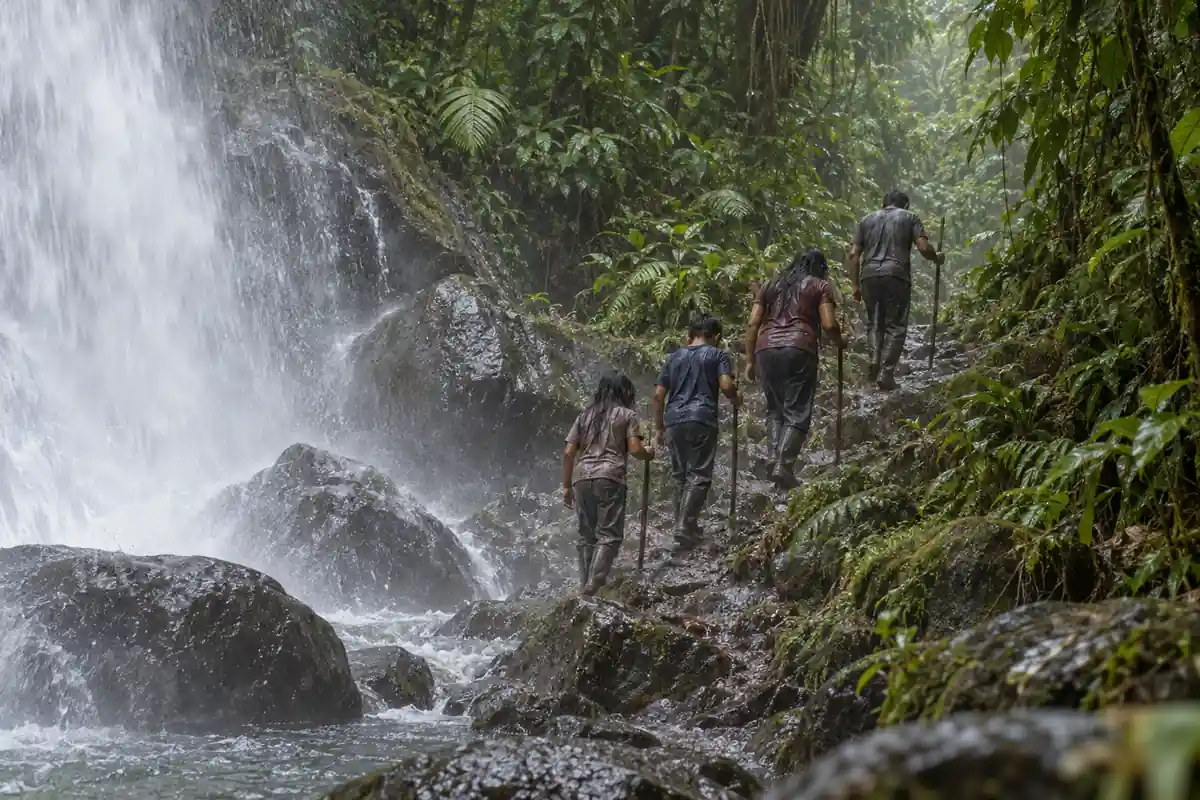
He also described how families went once or twice a year to sacred waterfalls, which are understood as Arutam's house. Everyone drank natem the night before. In the morning a leader sang for permission to enter: "Father Arutam, come with my children and open your doors." Under the falling water, people shouted and struck the rocks with walking sticks, as if knocking on doors. Anyone who saw an image there had to stay silent and ask it for power. On the way out, no one could look back. People walked quickly in a line with their eyes on the ground, because tripping meant an unfavorable judgment from Arutam: "you probably won't live many years." [4]
A night of healing
In the Shuar understanding, many illnesses are invisible arrows that sorcerers and evil spirits shoot into a person's body. The same spirits that cause illness, people say, can also cure it. [1]
In Shaime in 2014, healing took place after sunset in the healer's house, in complete darkness. Shuar healers do not work with light, and he allowed torches to be lit only once, for the filming. He sat bare-chested on a carved wooden stool, wearing a brightly colored headdress and geometric necklaces. He explained that this appearance imitated the demons, iguánchi, so that the spirits would come. [1]
He began with tobacco, which in Shuar medicine is as indispensable as natem. Its spirit is understood to take possession of the healer and show him the illness, the way to cure it, and how much natem each patient should drink. He also smoked cigarettes from a community shop. Shamans, he said, no longer distrusted cigarettes as something "received from an enemy." A cigarette could instead be "an element for enjoyment," as he had learned from the colonists. After drinking natem, he hummed and whistled his songs of power to call his tséntsak, spirits in the form of arrows. He sang under his breath so that no one could steal his songs. In one song he repeated we, we, we, "I, myself." A two-holed cane flute drove off bad spirits, and a one-stringed musical bow made soft tones that are thought to please the demons. [1]
Patients drank as well. Vomiting, which usually followed, was welcomed as a cleansing. Leaning over the patient, the healer shook a bundle of leaves from a plant believed to have magical power over the head, the back, and the place where the illness lay. The bundle's pointed tip, called inéi, "tongues," is understood to hold the plant's soul. In the visionary state he could see the arrows lodged in the patient's body. He sprayed the patient with tobacco and scented water, then sucked hard at the affected spot. The arrow took material form as a stone in his mouth, and he spat it out beyond the walls of the house. That physical object was the sign that the patient had been cured. [1]
The session ended around midnight, and the hour carried meaning. Healers who heal, the tsuakratin uwishín, work with natem only until midnight. Those who work after midnight, the wawekratin uwishín, cause harm and send their own arrows into people. A third kind of specialist, who divines the future and finds lost or stolen things, also works before midnight. [1]
The clinic and the cost of medicine
In 2004, electricity reached Shaime, and so did a Ministry of Public Health clinic, staffed on weekdays by a doctor and a nurse. Many residents had assumed that the clinic would take over all health care. Ten years later, many were dissatisfied, because they now felt they had to buy pharmaceuticals for illnesses that had never required them before. Their reluctance did not come from doubting the clinic. Many said that its medicines cured them reliably. The main problem was price. For the community's most common afflictions, which included parasites, diarrhea, flu, and snakebite, people kept going to the healer, and serious cases went to hospitals in the cities. [1]
The healer's standing rested on more than medicine. He was involved in the community's political life, and people treated him as an ethical and spiritual adviser. Patients traveled to him from towns across Loja and Zamora-Chinchipe. Among them were young Shuar who had moved to the cities for work. They said natem reconnected their urban lives with the Shuar understanding of the world and gave them certainty about the questions those lives raised. They placed particular weight on visions of the future. When they were about to leave home for a long time, or wanted to know what lay ahead in work or family, the healer's interpretation shaped what they decided. [1]
Tsunki and the making of a healer
The healer's power has a source in myth. Tsunki is a water spirit linked to rivers and anacondas. Singers interviewed between 2010 and 2019 described Tsunki as the origin of all shamanic power. In the myth, a young hunter marries Tsunki's daughter and lives beneath the water with her family. Her father gives him his strength, and the hunter becomes the first uwishín. For a healer, "becoming Tsunki" means acquiring tséntsak, or the power to suck out the tséntsak of a sorcerer. The shaman's sexual abstinence is described as a love relationship with a woman of another world, possibly Tsunki. In one family in Zamora-Chinchipe, men said Tsunki had appeared to them during natem visions and always remarked on her shining beauty. [2]
One woman uwishín in Morona Santiago said that in her diagnostic and healing rituals she usually whistles songs that call Tsunki, or whistles them only in thought. [2] Accounts differ on the place of gender in this work. The Shaime healer held that the spirits living in natem and tobacco are the souls of men, so only men may prepare and grow them. He said that if he planted natem without first abstaining from sex for some days, the plant would soon dry up. [1, 2]
In Kayamas, a Shuar community in Morona Santiago, accounts gathered in 2018 and 2019 describe how a person becomes an uwishín. Many come to the work after surviving a snakebite or a grave illness. Some are driven by the wish to answer a sorcerer who harmed a relative. The apprentice drinks natem with a teacher, receives the teacher's songs and arrows, and at first feels sharp pains through the body. For months afterward the apprentice avoids pork and beef, kills no animals, and abstains from sex. People in Kayamas distinguish the penker uwishín, a "good healer" who cures and undoes spells, from the yajauch uwishín, a sorcerer who is widely feared. The community's uwishín said he had felt his calling at about thirty, after seeing how many sick people came to the community looking for a healer. [6]
Healers have valued power from beyond their own people. Shuar admired the shamans of the neighboring Canelos because they were said to possess the arrows of white people. [5]
Natemamu and the visitors
By 2019 and 2020, a Shuar family in Morona Santiago was hosting foreign visitors, most of them from the Czech Republic, for Natemamu, a rite lasting ten to twelve days. Shuar dictionaries translate the word as "the rite in which natem is taken." The family described it more simply as "a shower with natem." The cycle included a march through the forest with bathing at a waterfall, drinking tobacco juice, and four days of drinking natem made from the vine alone. During those days, the intended effects were vomiting and diarrhea, together with emotional release. The family's uwishín understood the rite as a way to bring a person's life into harmony through deep physical purification, catharsis, and insight. [3]
Visitors said they came for authentic guidance, intense experience, and a simpler life. "I left all my responsibilities behind me," one said. "I can concentrate on myself and concentrate on the way the medicine will lead me." The uwishín saw the difference between his guests and local people in other terms. "They come in an unconscious state," he said. "They have strong egos and it makes it difficult." With visitors, his role resembled that of a mentor. He sometimes called himself a "master" who could show the proper use of the plants because he had already walked that path. Local people continued to come to him during the same weeks, especially for illnesses attributed to sorcery. With them he drank the plants himself and treated them by sucking out the harm. [3]
The rite had changed to suit its new participants. The march had been shortened, the diet relaxed, and each visitor decided how much to drink. Electric bulbs hung in the oval ceremonial house, which was still built of palm wood and leaves. Gas stoves were sometimes used, but during the four central days the drink was made over an open fire. San Pedro cactus, coca, and a sweat lodge had been added to the program. Participants were asked to stay off the new Wi-Fi, because contact with the outside world "could take us back." When a German documentary maker filmed a ceremony, the uwishín welcomed him, but several participants objected. "The rite itself does not belong on television," one said. Asked whether the rite had changed over time, the uwishín said it had not. He appears to have meant its core: the walk through the forest, the tobacco, and the natem. The researcher adds that such claims can also be read as part of selling the rite as a commodity. [3]
Kayamas today
In Kayamas in 2018 and 2019, the community's uwishín held certification from the Interprovincial Federation of Shuar Centers. He treated mal de aire, fright, snakebite, sterility, and other complaints. He performed rituals at night and healings on Tuesdays and Fridays. His account of natem differed from the Natemamu model. He said he does not cure people with the drink: only the master and the apprentice drink it. An older woman who also treated people in the community, a curandera, drew a line between healers on the same point: the uwishín prepares and drinks natem, while a curandera heals with medicinal plants alone. [6]
In January 2019, university students led a pilot tourism route through Kayamas called "the Path of the Uwishín," with a walk among medicinal plants, a demonstration of how natem is made, and cleansings for the visitors. Shuar healers have also set down their own conditions for this kind of attention. A code of ethics written by the Council of Shuar Uwishín holds that knowledge of the medicinal plants is an ancestral heritage. It is not to be passed to just anyone, and it should be revealed only to those who merit it. [6]
What is uncertain
Several first-hand studies from the last dozen years describe Shuar healers in southern Ecuador using natem, and they broadly agree on what happens in a healing session. Each study, however, looks at a single community or healer, and one of them describes a ritual reshaped for paying foreign visitors.
Sources disagree on whether patients drink natem: one healer gave it to patients [1], while another healer's account says only the healer and apprentices drink it for curing [6]. [1, 6]
Sources disagree on who may become a healer or handle natem: one healer said only men may prepare and grow it [1], while other accounts describe a woman healing shaman and say women now take part [2, 6]. [1, 2, 6]
Accounts classify healers differently, into three kinds (healing, harming and divining) [1] or into two (healing and harming) [6]. [1, 6]
Which plants are added to the brew differs between healers and between written accounts, and no source settles what is typical [1, 3, 6]. [1, 3, 6]
It is unclear how far the tourist version of the multi-day natem rite still matches local practice: the host healer denies that it has changed, while the researcher saw a shortened forest walk, a lighter diet and newly borrowed elements [3]. [3]
How old natem use among the Shuar is remains open. One source repeats an archaeology-based claim that Amazonian peoples in Ecuador have used ayahuasca for at least 5,000 years [1], and the earliest written description that may refer to the brew comes from a 1683 missionary report whose meaning is debated [5]. [1, 5]
One source says present-day healers and elders have lost much of their skill in interpreting visions, but this has not been studied directly [1]. [1]
Southern Shuar areas are less studied than northern ones, so it is uncertain how well older northern ethnography applies to them [2]. [2]
Whether the cost of clinic medicines is pushing people back to traditional healers beyond the one community that reports it [1]. [1]
Missionary writers recorded much of the older Shuar religious material and coloured it with Christian interpretation, which affects what is now taken as tradition [2]. [2]
6 sources. Each claim checked by AI against the saved sources; every finding reviewed by Jim Davis beside the cited passage, 30 October 2026. How the articles were checked
Timeline of dated events (14)
- At least 5,000 years ago (as claimed from archaeological evidence)Amazonian peoples in what is now Ecuador were reportedly drinking ayahuasca [1]. [1]
- 1683A missionary reported that Jivaro (Shuar-related) sorcerers drank a cooked juice of herbs with guayusa and tobacco, possibly the earliest description of the brew [5]. [5]
- By the 1930sExpert interpreters of dreams and visions were reported among the Shuar [1]. [1]
- 1964The Interprovincial Federation of Shuar Centres was founded. It later issued certificates allowing healers to practise [6]. [6]
- Late 1960sThe family of the healer studied in source 1 settled at Shaime, and the community was formally founded on 26 September 1974 [1]. [1]
- From the 1970s, and more so after 2000Revival movements led some communities to restart initiation rituals [2]. [2]
- 1 October 1976The Kayamas community was founded [6]. [6]
- "Decades ago" (as of 2020)Shuar began offering natem healing ceremonies on the global tourist market [3]. [3]
- 2004Electricity and a government health centre reached Shaime, changing how residents use traditional healing [1]. [1]
- July–August 2014A participatory documentary on natem in Shaime was filmed. It was presented at an international ayahuasca conference in Ibiza on 26 September 2014 [1]. [1]
- From 2014Tourism activity began in Kayamas [6]. [6]
- Over the decade before 2020In one tourist setting, prices for the multi-day natem rite rose and the rite was adapted to visitors' stamina [3]. [3]
- 5 January 2019A pilot tourist route built around the healer's practice, including a cleansing ritual, was run in Kayamas with university students [6]. [6]
- January 2020A foreign documentary maker filmed natem ceremonies in a tourist-hosting community, which unsettled some participants [3]. [3]
Sources
CSL-JSON imports into Zotero, Mendeley and other reference managers.
Marín Gutiérrez, I., Allen-Perkins Avendaño, D. & Hinojosa Becerra, M. (2015). El documental etnográfico-participativo 'Natem, la bebida sagrada de los shuar'. Gazeta de Antropología 31(1), artículo 10.
A peer-reviewed article (2015) by three university researchers in communication and education, describing their participatory documentary made in one Shuar community in 2014. It gives the most detailed first-hand picture of night healing sessions with natem and tobacco: song, removal of invisible "darts", kinds of healers, the healer's standing in the community, use by young urban migrants, and the influence of the state health centre. Its general Shuar background draws on older literature.
Bammer, N. (2023). “Becoming” Tsunki: the concept of change and transformation in the gender imagery of Shuar ánent. Somanlu: Revista de Estudos Amazônicos 23(2): 138–156.
A journal article (2023) by a musicology doctoral researcher, based on fieldwork in 2010–2019 in two southern Shuar provinces, about magical songs and the water spirit Tsunki. It explains how healers gain healing and "dart" power through Tsunki, notes natem visions and a woman healer's practice, and describes revival movements and missionary influence on recorded tradition. Natem healing itself is not its focus.
Salibová, D. (2020). Ayahuasca ethno-tourism and its impact on the Indigenous Shuar community (Ecuador) and Western participants. Český lid 107(4): 511–532.
A journal article (2020) by an anthropology researcher, based on three months of fieldwork in 2019–2020 living with a Shuar healer's family that hosts foreign visitors. It documents a multi-day natem rite sold to tourists, the material and procedural changes this has brought, and how locals still consult the healer for illness.
Anank Nunink Nunkai (2010). Meeting Arutam. Cultural Survival Quarterly (web), 9 June 2010; excerpted from a talk at Ringing Rocks Foundation, 26 September 2008.
An excerpt from a 2008 public talk by a Shuar community member, published online in 2010 by an Indigenous-rights organisation. It gives an insider account of seeking the spirit Arutam, including drinking natem with one's father and purification at waterfalls.
Suárez-Álvarez, C. (2023). The Age of the Onanya: regarding the spread of ayahuasca use throughout the Ucayali basin. Tipití 19(2): 335–360.
A journal article (2023) by an independent scholar on how ayahuasca use spread in the Peruvian Ucayali basin, mainly concerning the Shipibo-Conibo. For the Shuar it contributes a possible 1683 missionary description of the brew and cites earlier ethnography on Shuar healers preferring ayahuasca for curing. It describes the general regional setting rather than Shuar practice.
Illescas, F. E. & Romero Lozano, J. (2019). Revalorización de la medicina ancestral como herramienta para la creación de productos turísticos en la comunidad Kayamas del cantón Gualaquiza. Undergraduate thesis, Escuela de Turismo, Universidad del Azuay, Cuenca.
An undergraduate tourism thesis (2019) by two students at the University of Azuay on the Kayamas community. It contributes interviews with the local healer, a midwife and a healer-woman, an inventory of medicinal and sacred plants, the healer's described training and healing steps, and a pilot tourist route. It is descriptive and in places contradicts itself.
Related
Cite this page
Psychoactive Traditions. “Shuar Natem (Ayahuasca) Healing.” Last reviewed 30 October 2026. https://psychoactive-traditions.org/traditions/shuar-natem-ayahuasca