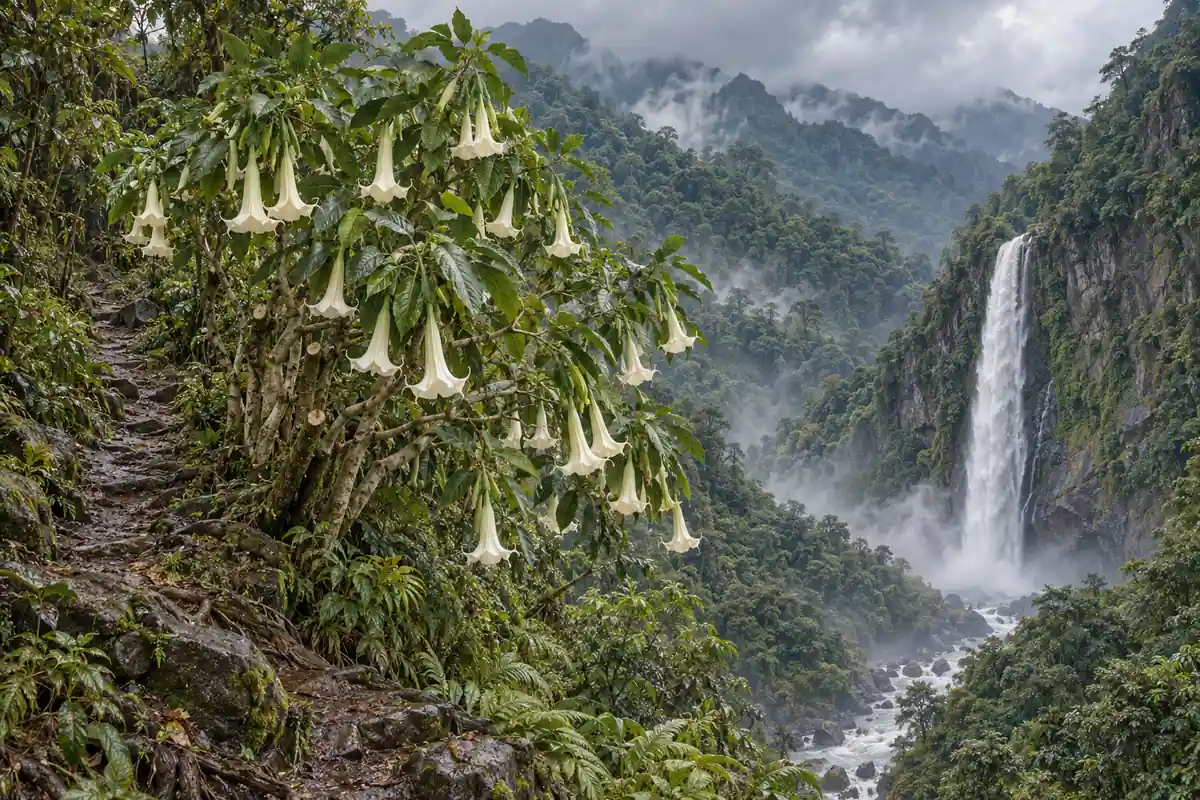
The Shuar, Ecuador's second-largest Indigenous group, live on the forested eastern slopes of the Andes and in the provinces of Morona Santiago, Zamora Chinchipe, and Pastaza. The strongest of the plants they use for visions is maikiua, a species of Brugmansia known in Spanish as floripondio and in English as angel's trumpet. A juice of the plant is drunk after fasting, often in the hope of meeting Arutam, a power that Shuar describe as present in waterfalls, the forest, and people themselves. A person who meets it is expected to return stronger and surer of the path ahead. [1, 3–5, 7]
A word that resists translation
Arutam has been translated as "ancient specter," and one scholar of Shuar myth traced it to words meaning, roughly, beings who have lived since long ago. Missionaries classified Arutam as a god. An Ecuadorian art student who lived with a Shuar family in December 2013 concluded that people used the word god mainly to make themselves understood by visitors. They themselves, she wrote, understood Arutam as a supernatural force. [1, 5]
She had come hoping to give Arutam an image, so she asked members of the family what it looked like. One man said it was "only a spirit that lives in each person. It's what you see, the trees, everything." Another pictured "a little old man with a long white beard, with a cane," as his grandmother had described. A third, pressed a second time, said, "I can't tell you if it has a form or a face, it's only something you feel." One man compared it to the Catholic or Christian God, and a woman of sixty said, "It's everything you see, girl, everything in the forest." Others said they did not know. A small child answered with a shy smile and a hug, and a younger one hid behind the door. [1]
A 1986 account of Shuar beliefs gives a more systematic picture. It distinguishes an eternal Arutam, which passes a special force to human beings, from Arutam wakán, "the spirit of our ancestors," whose power comes from the eternal one. This universal power appears through figures such as Etsa, the sun, and Tsunki, who is associated with water and health. Arutam is said to dwell in waterfalls, riverbanks, high mountains, rocks, and trees. It also dwells in the anaconda and the jaguar, in lightning and the rainbow, and in three plants: tobacco, natem (the vine brew also called ayahuasca), and maikiua. [6]
The strongest plant
Maikiua is one of several plants the Shuar use. A botanical study from the early 1990s found natem to be the most frequently used hallucinogen, with tobacco juice drunk during natem healing ceremonies. Maikiua was the strongest of them and was considered very dangerous. [7]
Natem and maikiua have also been tied to different purposes. In the 1950s, shamans in the interior drank natem to enter a trance and call on their spirit helpers, whether to cure or to bewitch. Maikiua was tied to another: a man seeking protection from violent death went to a sacred waterfall on a vision quest, often aided by the drink. [5]
Protection from violent death
Shuar speak of their history as one of resistance. A revolt in 1599 forced the Spanish from the region, and missionaries, settlers, and soldiers made gradual inroads only in the twentieth century, a process that sped up with the building of jungle airstrips in the mid-century decades. The most detailed older account of the quest comes from 1956–57, when an anthropologist recorded life among Shuar in the uncolonized interior. He called them by the older outside name, Jívaro. [3, 5]
In the interior he described, households lived far apart, each fortified and self-governing, with no formal authority to settle disputes. Wrongs, real or imagined, led to retaliation. A death from illness was often attributed to a particular shaman, whom the relatives of the dead person might then single out for killing. In his interpretation, the arutam soul gave people a sense of security in this setting. The ancestral soul behind a vision later entered a man's body and gave him kakarma, a supernatural power that protected him from violent death and increased his strength. [5]
That power shaped how men met each other. Two acquaintances meeting on a trail spoke in a loud, formal style meant to impress each other with their arutam soul power. Strangers engaged in a more ritualized exchange called enermartin. Each took a turn as speaker, stamping back and forth and thrusting a shotgun or lance in rhythm while using phrases whose meaning was usually unknown to the speakers themselves. [5]
Going to the waterfall
The 1986 account describes the meeting itself. A person seeks out Arutam's dwelling, usually beside a waterfall, fasts, and drinks tobacco juice. One who has faith, it says, will encounter Arutam at midnight amid thunder and lightning and must touch it with the hands. The next day Arutam appears in dreams as an old person who identifies himself as an ancestor. The sign of having received it is a gradual change in the person's character. [6]
In the rite as described in a chapter published in 2022, the power of Arutam is represented by the waterfall, tuna, where the force of Tsunki shows itself. Family and community consider a first journey to the waterfall necessary for an adolescent boy. A ritual leader called a wea directs the journey to and from what the chapter calls the symbolic waterfall. The young man must show courage, decision, and firmness, and his food and drink are strictly regulated. The aim is an encounter with Arutam at some point in the rite. Whatever comes of it, he keeps the result secret. [4]
The chapter describes this first encounter as the beginning of "rational life" for both young men and young women, who then set out to find their own identity and understand themselves. Initiation is understood to start much earlier, when children receive plants and with them the protection of the force each plant represents. The chapter, of which only the summary was available for this article, speaks of a "renaissance" of Arutam spirituality. [4]
Accounts vary on maikiua's place in the quest. A 1986 description mentions only tobacco juice, and a more recent one names tobacco or maikiua, which is said to strengthen the seeker's spirit. The plant can help bring about the encounter, but in these accounts the goal is the meeting with Arutam. [4–6]
Women's part in the tradition is described differently across periods. In the 1950s, women sometimes acquired arutam souls, but they were less often targets of assassination, and the need for one was not felt to be as urgent. Their religious life centered on their gardens and on Nunkui, the female spirit who was asked to help the crops. The student was told in 2013 that men's and women's plants differ, that women have rituals of their own, and that grandmothers hold a long history with plants of which grandfathers know nothing. [1, 5]
Waterfalls also figure in less formal practice. In 2013, members of the family the student stayed with bathed under one as a way of greeting Arutam, standing before it calmly and asking for strength to continue on their way in the forest and in life. [1]
Protection that can be lost
In the 1950s, an arutam soul could be taken. One recording from those years is of a man under the influence of natem who was trying to capture the arutam of an enemy, which was thought to wander while its owner slept. At night he beat a log drum in a rhythm peculiar to this purpose. [5]
The 1986 account shows the same impermanence. A person may hold up to two arutam souls, but not forever, and when the spirits leave a body they raise wind, thunder, and lightning until they enter someone else. A person with Arutam is described as powerful and outstanding at everything, with an orderly and healthy life. A person without it feels low, weak, and ill, wants to sleep during the day, does not like to work, and in time falls sick and dies. There is also a bad Arutam, yajaúch Arutam, which carries great anger in its heart. Someone who acquires it dies young or becomes a hunter of his own brothers, destroying family and community. [6]
In 2013, one man told the student about an uncle who had died three months earlier and traced the death to fear of Arutam. The uncle had been walking in the forest when strong wind, lightning, and a storm came. Frightened, he shouted at the sky to leave him in peace, saying he did not need its spirit, and he died soon afterward. "He died because he did not believe in Arutam," the nephew said. "That storm that was coming was Arutam, and he was afraid of it. You must not be frightened of Arutam, it only wants to give us strength." [1]
Seeing first, then remembering
Among the family the student stayed with, what a person sees under the plants was described as something lived later. Visions were like dreams that a person could recall as life went on. One man who had taken floripondio in the forest as a boy said he saw there everything that would happen in his life. "For me, these things I already saw are only making me remember," he told her, "and now it falls to me to live them." [1]
The same man said that someone who has taken the plant more than once "controls it" and can take it alone. He had done so shortly before her arrival, because his life had become somewhat confused, and "many things became clear." Another man explained that when you take the plant you speak with the trees: "they are people, you converse and they tell you things." The first man called the trees "people who know a great deal," the grandfathers and ancestors. [1]
Remembering also ran through how people in this family learned. "I learned by watching my mother," one man said. "She never taught me anything, she only took me with her into the forest." He told the student he would not teach her either. Given a tree to fell for her lunch, she had to recall what she had seen him do. She came to see this as part of a wider understanding of life as something recalled. [1]
The missionaries' influence appears in how Arutam is now spoken of. In 2013, the family said a prayer of thanks to Arutam before a farewell meal. When she asked about it, one man said that the Spanish had never conquered the Shuar but that missionaries came, and "they were the ones who created sin for us." Their grandparents, he said, had not believed in such things. She took this explanation, with Arutam as God, to be the simplest way of explaining the matter to someone from the capital. Another man described the exchange on his own terms: "We fit Western culture to ours, we keep only what serves us, the rest is theirs. But they did not change our minds." [1]
Visions and the mine
Another anthropologist, who began fieldwork among Shuar in southeast Ecuador in 2015, met a similar confidence in foreknowledge, gained through natem and maikiua. Shamans told him that the plants let people "know what will happen, how it will happen, and why things will happen." People might consult natem about a job offer or university studies. One woman learned from it that she would live with her future husband in a region far from her mother's land. A later visionary dream showed that the marriage would not last: "I saw another man standing next to me as I grow old." She said this in front of her husband, as a plain matter of fact. Such accounts are not treated with the secrecy the adolescent rite requires, though the sources do not explain how the two fit together. [3, 4]
In the 1960s, as the Ecuadorian state expanded into their lands, the Shuar founded the first Indigenous federation in Latin America. [3, 5] Since the early 2000s, industrial mining has gradually changed daily life in Shuar territory. Mirador, Ecuador's first and largest industrial copper-gold mine, opened in 2019. By 2015 the mood in the region was already bitter. Some communities remained cautiously hopeful about mining, while others, along with the Shuar Federation, opposed it outright. Activists have reported harassment and threats. People on different sides still share a reliance on visionary knowledge. Opponents of the mines use it to plan actions, choose their timing, and decide whom to trust. "Shuar, like other peoples in the world, can learn from our history and past experiences," one shaman said, "but only we can make history when we fulfill our visionary dreams." [3]
Others work from inside the system. One Shuar man employed at Mirador set out to form unions among the small contractors through which the company had avoided the existing union. He knew the risks. He also said he knew he would succeed, because a dream brought on by maikiua had told him so. Courage of this kind, conveyed by the Spanish word valor, is prized in Shuar ideas of personhood and leadership. People who have acquired visionary ability are expected to speak loudly and step forward. [3]
When the anthropologist saw him again around 2023, he and his wife had separated, and she took this as confirmation of what she had seen. He had returned to the mine after a long break and found conditions no better. Two foreign workers had been killed in a landslide the week before. "I came back just in time," he said, and he asked for the name of a good labor lawyer in the capital. The anthropologist voiced his concern about the dangers, and the man dismissed it. "Next time you visit, we should go drink natem with my uncle," he said. "You'll see that it will all be fine." [3]
What is uncertain
Recent first-hand accounts show that Shuar people still turn to powerful plants for visions, strength and guidance, and older studies describe the quest for arutam in more detail. The recent picture rests on the words of a small number of people, mainly in one family and one mining area, so we do not know how common the quest is today.
Sources differ on what arutam is: a god, a force beyond definition, an ancestral soul, or a universal power with several forms. [1, 5, 6]
Community members asked directly gave different answers about arutam's nature and form, and some said they did not know. [1]
The main purpose of the quest varies by source, from protection against violent death to self-understanding, courage and knowledge of the future, and no source settles whether this reflects change over time or different emphases. [1, 3, 4, 5]
Sources differ on which plant is central to seeking arutam, with some naming maikiua, one naming tobacco and another either of the two. [4, 5, 6]
It is unclear how often maikiua is used today compared with the more commonly used natem. [3, 7]
Whether a real waterfall is essential is unclear, since sources describe a sacred waterfall, a symbolic one, or an experience elsewhere in the forest. [1, 4, 5]
Accounts differ on whether the experience is led by a ritual guide or can be undertaken without one. [1, 4]
Women's part is unclear, since sources say variously that young women also make a first encounter, that women only sometimes acquire arutam, and that women have separate plant rituals, which no source describes. [1, 4, 5]
Sources do not fully agree on when in life each plant is first given. [1, 4]
One source says the result of the experience is kept secret while others report people speaking about their visions, and no source explains where the limits of that secrecy lie. [1, 3, 4]
Whether people who now drink maikiua to guide life decisions see this as the same arutam quest is unsettled, because the recent account centred on such decisions never mentions arutam. [3]
No source measures how widely the quest is practised today or how far it has declined or revived. [1, 3, 4]
How often maikiua causes harm is not settled, although it is regarded as very dangerous. [7]
6 sources. Each claim checked by AI against the saved sources; every finding reviewed by Jim Davis beside the cited passage, 30 October 2026. How the articles were checked
Timeline of dated events (13)
- Mid-16th centurythe Spanish Empire began colonizing Amazonia but never fully controlled Shuar territory. [3]
- 1599a major uprising, reportedly with very heavy Spanish losses, forced the Spanish out of the region. [3, 5]
- For nearly 300 years after 1599the Shuar were little troubled by outsiders. [3]
- "The present century" (the 1900s, as written in 1973)missionaries, settlers and soldiers gradually moved into Shuar country. [5]
- The twenty years before 1973jungle airstrips sped up colonization and began to alter Shuar economy, society and culture. [5]
- 1956-57traditional life, including the waterfall quest, still persisted in the uncolonized eastern interior, before these changes had reached all Shuar people. [5]
- 1960sas the Ecuadorean state expanded into their lands, the Shuar founded the first Indigenous federation in Latin America. [3]
- Early 2000sforeign investors and the Ecuadorean government began planning industrial mining, and survey teams started hiring local people. [3]
- 2012Shuar people joined a national protest prompted in part by a deal allowing industrial copper mining. [3]
- December 2013a Shuar family offered thanks to Arutam in a prayer before a farewell meal, a habit one member linked to the arrival of missionaries. [1]
- By 2015the mood in the mining region had turned bitter, with communities divided over mining. [3]
- 2016Shuar demonstrators burned down a mining camp on Indigenous land. [3]
- 2019the first and largest industrial copper-gold mine in Ecuador opened on Shuar ancestral lands. [3]
Sources
CSL-JSON imports into Zotero, Mendeley and other reference managers.
Suasti Balseca, Pamela Carolina (2014). «Creando Arutam, el espíritu de la selva, a través de un libro de artista». Disertación de grado, Carrera de Artes Visuales, Facultad de Arquitectura, Diseño y Artes, Pontificia Universidad Católica del Ecuador, Quito. Director: José Luis Macas.
A visual-arts degree thesis in diary form by an Ecuadorian art student (2014), based on living with a Shuar family in December 2013, which gives community members' own words on Arutam, visionary plants and oral stories, along with the author's personal response.
Vacas-Oleas, Sebastián (2024, 15 February). Reading the Future of an Amazonian Mine. SAPIENS. https://www.sapiens.org/culture/ecuador-mining-shuar-indigenous-resistance/
A public essay by a social anthropologist in an online anthropology magazine (2024), drawing on fieldwork since 2015, which shows maikiua and natem visions guiding courage, life decisions and political action amid industrial mining, and supplies much of the historical timeline.
Juncosa Blasco, José Enrique (2022). El renacimiento de la espiritualidad de Arutam: enlaces pedagógicos, territoriales y epistémicos. In Antropologías hechas en Ecuador. Antología (Volumen II), pp. 319-336. Quito: Editorial Universitaria Abya-Yala. ISBN 978-9978-10-651-8.
A book chapter by a researcher in a group studying missions and Indigenous peoples (2022), read only as an abstract, which presents the first encounter with Arutam as a socially accepted form of education and notes a ritual guide, the waterfall as a symbol, and secrecy about the result.
Harner, Michael J. (1973). Music of the Jívaro of Ecuador. Liner notes to Ethnic Folkways Library album FE 4386. New York: Folkways Records (Smithsonian Folkways archive). Recordings made in eastern Ecuador, 1956-1957.
Album notes by an anthropologist to recordings he made in eastern Ecuador in 1956-57 (published 1973), which give the fullest older account of the waterfall quest with maikiua, the protection arutam was believed to bring, and its place in speech, music and feuding.
Delgado Súmar, Hugo E. (1986). Cultura (cosmovisión) y salud entre los Shuar [de las provincias de Morona Santiago, Pastaza y Zamora Chinchipe]. Serie Apuntes de Medicina Tradicional N° 59a. Ayacucho/Lima: Ministerio de Salud, Instituto Nacional de Medicina Tradicional (Peru). Electronic edition 1999.
Working notes from a Peruvian government institute of traditional medicine (1986, electronic edition 1999), which outline the Shuar view of the universe and the soul, the kinds and dwelling places of Arutam, and the signs of having or lacking it, without showing any fieldwork of their own.
Bennett, Bradley C. (1992). Hallucinogenic plants of the Shuar and related indigenous groups in Amazonian Ecuador and Peru. Brittonia 44(4): 483-493. https://doi.org/10.2307/2807199
An article by an ethnobotanist in a botany journal (1992), read only as an abstract, which identifies the main Shuar visionary plants and describes maikiua as the strongest and very dangerous, with natem the most frequently used.
Related
Cite this page
Psychoactive Traditions. “Shuar Arutam Quest with Maikiua.” Last reviewed 30 October 2026. https://psychoactive-traditions.org/traditions/shuar-arutam-brugmansia