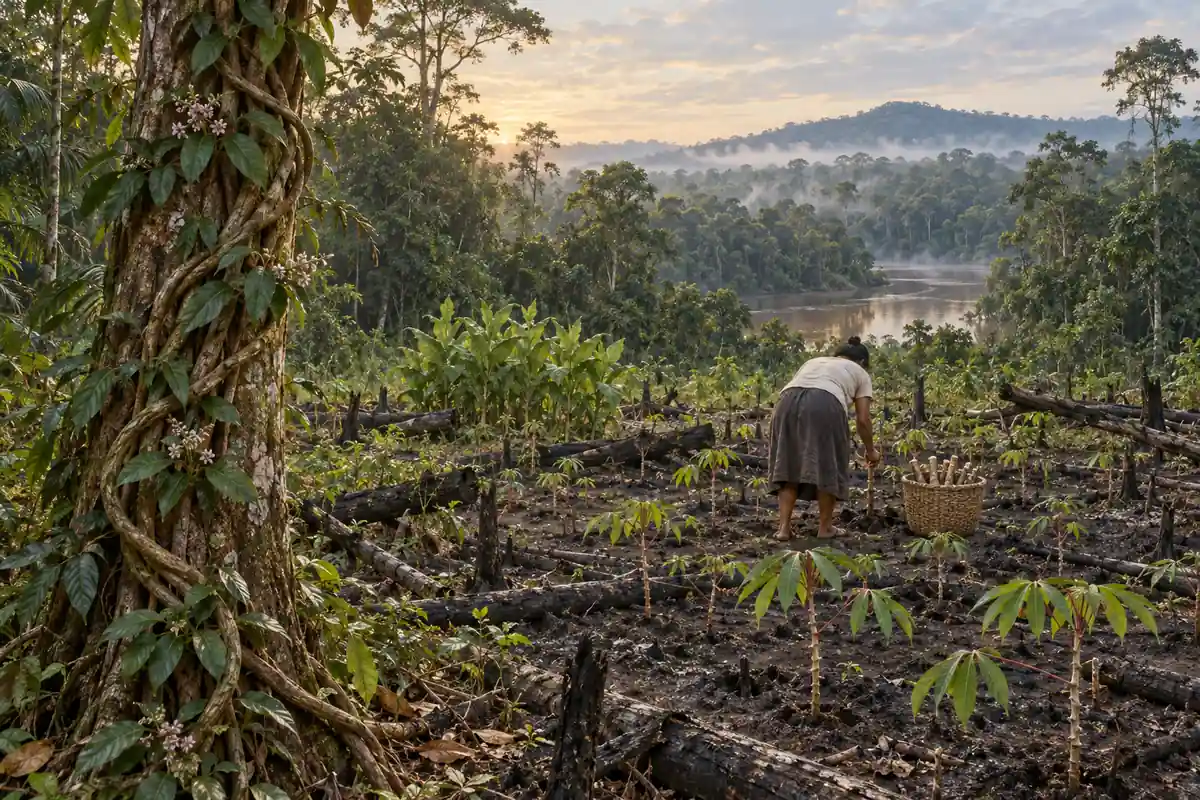
In the northwestern Amazon, Eastern Tukanoan peoples live along rivers in Colombia and Brazil. They include the Barasana, Makuna, Tatuyo, Eduria, Bará, Tuyuka, Tukano and Desana. Many drink a bitter preparation made from the ayahuasca vine Banisteriopsis caapi, called yajé in Colombian Spanish, kahpi in Tukano and gaapi in Desana. It is drunk in ceremonies throughout the year, during the initiation of boys, and in the training of specialists who heal people and the land itself. Desana elders used to call the vine "the food of the kumuã," the knowledgeable men who lead that work. [3, 5, 7]
A drink that carries knowledge
Among the Desana of the Upper Rio Negro, gaapi is understood as "branches, veins of life." In Desana narratives, the ayahuasca vine came from the bodies of primordial beings associated with the Sun and Thunder, and its branches are their blood vessels. A Desana author who wrote about the drink in 2019, drawing on what his father had taught him, said he hoped his relatives would come to know who they are, where they came from and how their ancestors sought knowledge, "because the one who brings memory is gaapi." [5]
On the Colombian side of the border, the peoples of the Pirá Paraná name yajé alongside coca and tobacco as sacred plants that were given at the origin for the care of the territory. In 2010 their association described how knowledge-holders come by their power. That power is not given by other people. It comes from the Jaguars of Yuruparí, the spirit owners of knowledge, through a lifetime of taking part in rituals, keeping food restrictions, fasting, and consuming yajé, coca and tobacco. Elders there said that yajé and "Old Tobacco" must always be respected: "They are the source of knowledge." [3, 4]
Tukano kumuã in Brazil, who call themselves Yepamahsã, describe the same relationship in their own terms. Kahpi, coca powder and tobacco allow a specialist to travel through the cosmos and reach knowledge held by the waimahsã. These beings live in every domain: the forest, the water and the air. Like people, they have houses, gardens and pets, but they can be seen only by specialists, or by ordinary people in dreams. In this view, the creator first passed knowledge to the waimahsã, so human knowledge is held at second hand. During ceremonies with kahpi and snuff, the specialists say, the houses of the waimahsã inside waterfalls, hills and lakes open to the participants, and ancestors appear and teach through conversation. The Tukano describe the ability to communicate with these beings, whether through kahpi or through dreams, as being "owner of the night." [7]
Inside a ceremony
The Desana author's account describes how the specialist shapes the experience of others. The kumu who prepares the drink smokes a cigar as he works. As he understands it, the smoke places into the drink both the effects that participants will later feel and the visions that will "generate knowledge" in them. The vessel that holds the drink is understood as the anatomy of the gaapi being, with channels for blood, wind and water, and the gourd from which it is served is likened to a woman's body and to the breast that nourishes humanity. According to the kumuã, gaapi alone does not produce complete visions. Tobacco, coca powder and manioc beer accompany it, and the gaapi being is present in all of them. [5]
One person serves: he gives the drink first to the specialists, then to everyone else, and afterward passes coca and tobacco and blows snuff. Women serve manioc beer. When the drink is "giving good effect," young men play and dance with panpipes while others sing the gaapi songs. The kumuã explain that when singers and players are at their best, it is the gaapi beings themselves who sing and play, "not the person of this world." In this account, a person who drinks "becomes, at the same time, of this world and of the other world." Not everyone sees the intended visions; some, the account says, see nothing and feel only dizziness or fear. [5]
Accounts of dance rituals among the Barasana and neighboring peoples describe the bodily side of the experience. The drink is accompanied by copious manioc beer, and drinkers vomit heavily. Sounds, colors, patterns and smells run together as each sensation sets off others. A drinker is typically one of a line of dancers dressed in the same feather ornaments, singing and moving in unison "as a single body," while other groups of men chant, play wind instruments or laugh aloud. [6]
Among the Tukano in Brazil, kahpi is drunk at two of the four great exchange feasts of the year, those held for fruit and for fish. At these feasts it is restricted to men, though manioc beer is shared by all. Women have their own ceremonial roles. The most respected is the yʉʉgo, a woman trained from childhood under restrictions of her own, who stands in the middle of the circle and joins her voice to the men's dance songs. She drinks a small amount of kahpi, enough to find the right tone and to sing without stopping. The kumuã note that such singers are now rare at feasts. [7]
Healing a living territory
On the Pirá Paraná, in Colombia, healing extends well beyond the individual body. The people of the river describe their territory as a great communal house and also as "a human body that breathes, feels and has organs." Those organs are sacred places that hold the vital energy feeding all living beings around them. The knowledge-holders, collectively called kubua, act as mediators between people and the spirit owners of these places, of the origin houses of animals and plants, and of the seasons. [3, 4]
This work follows a ceremonial calendar that the people regard as an ancestral law. The year has four great seasons, marked by constellations: the season of cultivated crops, the season of Yuruparí, the season of wild fruits, and the season of the Worm-Jaguar, which is considered the most dangerous. Each season brings its own fruits, fish runs and illnesses, and each has its rituals. When a knowledge-holder performs one, he drives off the illnesses of that season and "sweetens" wild fruit, game and fish so that people can eat them safely. Knowledge-holders speak of "filling the coca gourd of the wild fruits" and renewing "the tobacco plant of the fish." In addition to the four main rituals, more than ten smaller ones are held. [4]
Illness belongs to the same order. According to the association's account, sickness comes from failing to keep the ecological calendar, from ignoring the diets and restrictions a knowledge-holder prescribes after a healing, or from disrespecting sacred sites. Here yajé has a particular place. The Jaguars of Yuruparí, specialists who guard the leader of the great ritual and see "what is invisible to others," deepen their knowledge through the visions yajé brings. In this way they prepare to identify where an illness came from, and they heal by retracing the history of its origin in order to remove it. [3, 4]
Collective rituals are described as "days of dancing and celebration," open to children, elders, women and men. The master of dances sings songs that name places on the ancestral journey. In one Pirá Paraná language these dances are called "bird of yajé," the bird whose song brings joy to the place where it lives. As the association's text puts it, if the healers worked without the dances, "it would be a sadness." [3, 4]
Hee Biki: becoming newborn
Yuruparí, the most restricted part of this tradition, can be described only as its practitioners have chosen to summarize it publicly. In their account, before human beings existed, Yuruparí was an anaconda who lived as a person. To leave an ordered knowledge for humanity, he sacrificed himself. A palm grew from the ashes of his fire, and from it were made sacred trumpets holding all the power of the origin. On the Pirá Paraná, each ethnic group still keeps its own pair. The knowledge-holders call them "the bones of our grandfathers." [1, 3, 4]
Around the age of ten, boys pass through the Hee Biki ritual, held in the Yuruparí season between March and May. During the ritual, the trumpets are used and yajé is drunk. These, the people say, are what actually purify and protect against illness, and through yajé "the knowledge of healing can be acquired." Afterward the initiates are considered newborns. During a period treated as sacred time, they must keep strict rules of diet and behavior called bedire. The word, elders explain, means at once "diet," "advice," "norm," "order" and "rule." In earlier times, they recall, the boys were not scolded constantly; at the end of the great ritual they were given "simple and exemplary words" meant to serve them for the rest of their lives. [3, 4]
The rite belongs to men. Women, children and outsiders may not see or touch the trumpets. Women nonetheless play essential parts around it. Certain women past menopause act as godmothers to the initiates and are the only people allowed to prepare their food. Knowledge about caring for children, pregnant women and food is passed among women. The association places women's work as "sovereign rulers over the kingdom of cultivated foods" at the base of the health of the whole system. [1, 3, 4]
The specialists
Hee Biki begins what the Pirá Paraná peoples call "the real path of knowledge," along which only those who keep the restrictions rise to become knowledge-holders. The roles of these knowledge-holders depend on one another. The maloca owner coordinates ceremonies. The Yuruparí healer, the "Great Healer of the World," convenes Hee Biki. The master orator recounts the history of the world. The master of dances leads songs. The Jaguars of Yuruparí protect the officiant, and the food curers care for mothers and children. An association survey counted more than two hundred knowledge-holders along the river. [3, 4]
Among the Tukano in Brazil, the specialists are the yai, the kumu and the baya. Their formation traditionally began before birth and continued through cleansing, seclusion, restrictions on food and sex, and drinking kahpi and taking snuff to make first contact with the waimahsã. A young man's visions under a special kahpi were understood to show which of the three paths suited him, or that he was suited for none of them. [7]
Contact, change and a deliberate low profile
The Pirá Paraná peoples trace a long weakening of this system. Contact came through rubber, skins and coca booms, and through Catholic missions and schooling, which reached them toward the end of the 1960s. People were moved out of multifamily malocas into mission-designed settlements. The association later judged that some of these settlements stood on sacred places, and it held this responsible for more accidents, illness and conflict. [4]
Many of the younger leaders grew up in boarding schools, and "very few were initiated at an early age, as tradition indicates." In recent years some of them have entered the traditional path as adults, through research of their own. Present-day knowledge-holders say that a few decades ago there were still shamans who held all the knowledge of the Jaguars of Yuruparí. None of their successors holds it all, so they must always seek one another's support. One knowledge-holder warned that when rituals are performed incorrectly, people say "the shaman is the one finishing off the people." [4]
On the Brazilian side the losses have been deeper. The yai has almost disappeared from the region, and the few remaining kumuã have taken on that role as well. A newer specialist, the bahsegʉ, heals with tobacco but has not had access to the waimahsã, and his work is confined to the household: births, naming, and blessing food. The Pirá Paraná peoples say that nearly everywhere else in the larger region the sacred instruments have been lost, and that they are almost the only ones still performing the rituals they consider necessary "for healing the world." The Tukano account in Brazil, however, describes the sacred instruments still being played at fruit and fish feasts and at initiation. [3, 7]
The renewal on the Pirá Paraná has been organized from within. After Colombia's 1991 constitution recognized the country as multiethnic, the communities formed ACAIPI in 1996. They mapped their territories, recorded origin histories in their own languages, defined the ecological calendar of each group, and rebuilt their schools around that calendar, so that taking part in seasonal rituals now counts as schoolwork. Women raised their own concerns in these meetings. An older woman lamented that girls sent away to secondary school no longer learn to keep a garden, prepare rituals or sing for dances: "Education from the maloca is what we are missing." In 2010 the knowledge was recognized as national heritage, and in 2011 UNESCO inscribed it on its Representative List. [1, 3, 4]
The communities accepted recognition while also asking the world to keep its distance. Their nomination states that the rules left by the ancestors "often imply not publicly exposing certain areas of our traditional knowledge" and that "it is important to keep a low profile." Non-Indigenous people may not take part in Yuruparí rituals. Outsiders may not research the sacred instruments or sites. Tourism is refused until traditional governance is fully organized. The same documents set out the communities' opposition to gold mining, since minerals in sacred places are held to sustain the life of the territory. They also record unease among knowledge-holders, who see the constellations passing on schedule while trees flower out of season. "We do not understand what is happening," they wrote, "but we know these are external forces," and they said they would have to look for a way to adapt from within traditional knowledge. [3, 4]
In 2018, twenty-eight researchers from all the river's ethnic groups completed documents on sacred places and territorial governance, written in their own languages and in Spanish and intended as teaching material for future generations. One of the association's leaders presented the work to the UNESCO convention. The roughly two thousand people who live along the river continue to follow the ritual calendar, which they describe as a law given at the beginning of time and still in force. [3, 8]
What is uncertain
Indigenous communities and Indigenous scholars have described these ceremonies in their own words within the last fifteen years, from both the Colombian and the Brazilian sides of the region. Much of the knowledge is kept private on purpose, and outsiders are not allowed to research the central initiation rites.
The Colombian community documents say the sacred instruments and their rites survive almost only on the Pirá Paraná, while the Brazilian Tukano account describes the instruments still being played at ceremonies, so the true range of the practice is unclear. [3, 7]
Basic figures disagree: the community documents give about 2,000 people in 17 communities over some 540,000 hectares, while the news report gives 20 communities, about 700,000 hectares and a listing date of 2010 rather than 2011. [3, 4, 8]
Elders report that few of the younger leaders, who grew up in Catholic boarding schools, were initiated at the traditional age and that good apprentices are hard to find, but no source measures how many people are actually being trained today. [4]
On the Brazilian side, one specialist role is said to be practically extinct and a newer, more limited kind of healer has appeared; no source shows how this changes the ceremonies themselves. [7]
Elders say the ritual calendar no longer matches the seasons and that they do not understand why, which leaves open how the ceremonies will adapt. [4]
Women's own knowledge and their view of the rites they are barred from are described only briefly, and no study looks at them in depth. [3, 4]
Because outsiders are barred from researching the sacred instruments and sacred places, almost nothing about these core elements can be checked independently. [3]
The meanings of the origin stories are open to different readings, and the scholar who analyses them says no single interpretation is correct. [6]
No source reports whether pressure from gold mining on sacred places has been held back since the safeguarding measures were adopted. [4, 8]
7 sources. Each claim checked by AI against the saved sources; every finding reviewed by Jim Davis beside the cited passage, 30 October 2026. How the articles were checked
Timeline of dated events (20)
- From the beginning of the 20th centurycontact with outsiders through rubber, balata, skins and coca booms, together with missions and schooling, weakens traditional authority and changes where people live. [4]
- Towards the end of the 1960scloser contact with the Catholic Church brings formal schooling and resettlement into mission-style villages. [4]
- 1984one of the Tukano specialists who co-authored the 2018 book takes up practice after his father's death. [7]
- 1990sthe departmental government builds health posts that sideline traditional seasonal healing. [4]
- 1991Colombia's new Constitution recognises the country as multi-ethnic and gives Indigenous peoples room to govern themselves. [3, 4]
- 1996the Pirá Paraná communities form their association of captains and traditional authorities, supported by a conservation foundation. [3, 4]
- Since 2001the association develops an Environmental Management Plan and its own research, including the ecological and ritual calendars. [3]
- 2003the association creates its own education office, and the Ministry of Culture begins funding community research groups (through 2007). [4]
- 2006 and 2008Colombia signs and then ratifies the UNESCO convention on intangible heritage; Law 1185 of 2008 sets up national safeguarding plans. [3]
- April 2007the association begins running its community primary schools, with the school year adapted to the ritual calendar. [4]
- Second half of 2009the first community meetings discuss nominating the tradition. [3, 4]
- April 2010a regional assembly decides to seek UNESCO listing. [3]
- May to June 2010meetings are held with each ethnic group along the river to define safeguarding measures. [3, 4]
- July 2010the Special Safeguarding Plan is completed. [4]
- 2010one upper-river community decides to move away from a sacred place on which it had settled. [4]
- 5 August 2010the tradition is entered on Colombia's national list of intangible heritage. [3]
- 2011UNESCO inscribes the "Traditional knowledge of the jaguar shamans of Yuruparí" on its Representative List. [1, 3]
- August 2015a gathering of Tukano specialists is held in Brazil as part of the collective book project. [7]
- 2017–2018the association carries out research on its sacred geography in response to mining threats. [8]
- 2018the association reports on its safeguarding work to a UNESCO meeting. [8]
Sources
CSL-JSON imports into Zotero, Mendeley and other reference managers.
UNESCO Intangible Cultural Heritage. 2011. Traditional knowledge of the jaguar shamans of Yuruparí (Colombia), inscribed in 2011 (6.COM) on the Representative List of the Intangible Cultural Heritage of Humanity, element 00574. https://ich.unesco.org/en/RL/knowledge-of-the-jaguar-shamans-of-yurupari-00574
UNESCO's online listing page for the element (2011). It records the inscription and gives a short official summary of the healing calendar, the sacred trumpets, boys' initiation and women's knowledge.
Colombia (Ministerio de Cultura) with ACAIPI. 2011. Nomination file No. 00574 for inscription on the Representative List of the Intangible Cultural Heritage of Humanity in 2011: Traditional knowledge of the jaguar shamans of Yuruparí (Hee Yaia Keti Oka). UNESCO, Intergovernmental Committee, sixth session, Bali. https://ich.unesco.org/doc/src/00574-Nomination_form.doc
The UNESCO nomination file prepared by Colombia's Ministry of Culture with the Pirá Paraná association (2011). It describes, in the communities' own voice, the specialists' roles, the ritual calendar, the use of yajé at initiation, the consultations behind the nomination and the community's rules on secrecy.
ACAIPI (Asociación de Capitanes y Autoridades Tradicionales Indígenas del Río Pirá Paraná) and Ministerio de Cultura de Colombia. 2010. Plan Especial de Salvaguardia de la manifestación Hee Yaia Keti Oka, el Conocimiento Tradicional (Jaguares de Yuruparí) para el Manejo del Mundo de los grupos indígenas del río Pirá Paraná (Gran Resguardo del Vaupés, Amazonia Colombiana). Pirá Paraná, Mitú, Bogotá. 90 pp. https://mincultura.gov.co/direcciones/patrimonio-y-memoria/Documents/04-jaguares-de-yurupari.pdf
The association's Special Safeguarding Plan, written with the Ministry of Culture (2010). It is the most detailed community account of the specialists, the seasonal rituals, the threats from mining, schooling, tourism and climate change, and the measures adopted, with elders' statements.
Desano, Jaime Diakara. 2019. Wame: Gaapi, a bebida cósmica dos Desana. Mundo Amazónico 10(1): 13–37. Portuguese translation by Justino Rezende, Israel Dutra, Dagoberto Azevedo and João Paulo Barreto. https://doi.org/10.15446/ma.v10n1.76159
A journal article by a Desana teacher and anthropology graduate, drawn from his master's dissertation and his father's teaching (2019). It gives a first-hand account of the cultural meaning of the yajé drink, the specialists' roles and its place in initiation and ceremonial exchange in the Upper Rio Negro of Brazil.
Hugh-Jones, Stephen. 2019. Thinking through Tubes: Flowing H/air and Synaesthesia. Tipití: Journal of the Society for the Anthropology of Lowland South America 16(2): 20–46. https://digitalcommons.trinity.edu/tipiti/vol16/iss2/2
An interpretive journal essay by a senior anthropologist with long experience in the region (2019). It reads the region's myths and ritual through ideas of the body, flutes, music and ornament, adding scholarly context but no new first-hand observation.
Barreto, João Paulo Lima; Santos, Gilton Mendes dos; Dias Jr., Carlos Machado et al. (with kumuã co-authors). 2018. Omerõ: constituição e circulação de conhecimentos Yepamahsã (Tukano). Manaus: EDUA / Núcleo de Estudos da Amazônia Indígena (NEAI), Universidade Federal do Amazonas. Copy at Instituto Socioambiental: https://acervo.socioambiental.org/sites/default/files/documents/tkl00014.pdf
A collective book by Tukano anthropologists, non-Indigenous researchers and Tukano specialists, published by a Brazilian university press (2018). It sets out the origin narratives, healing practice, the seasonal ceremonies and specialist training, including how training has changed since the missions.
El Espectador. 2018. El conocimiento indígena de los chamanes jaguares del Yuruparí llega a la Unesco. El Espectador (Bogotá), Ambiente, 7 June 2018. https://www.elespectador.com/ambiente/el-conocimiento-indigena-de-los-chamanes-jaguares-del-yurupari-llega-a-la-unesco-article-793092/
A Colombian newspaper report (2018). It covers the association's research on its sacred geography and its presentation to UNESCO, giving figures that differ from the community documents.
Related
Cite this page
Psychoactive Traditions. “Eastern Tukanoan Yajé and Yuruparí.” Last reviewed 30 October 2026. https://psychoactive-traditions.org/traditions/tukanoan-yaje