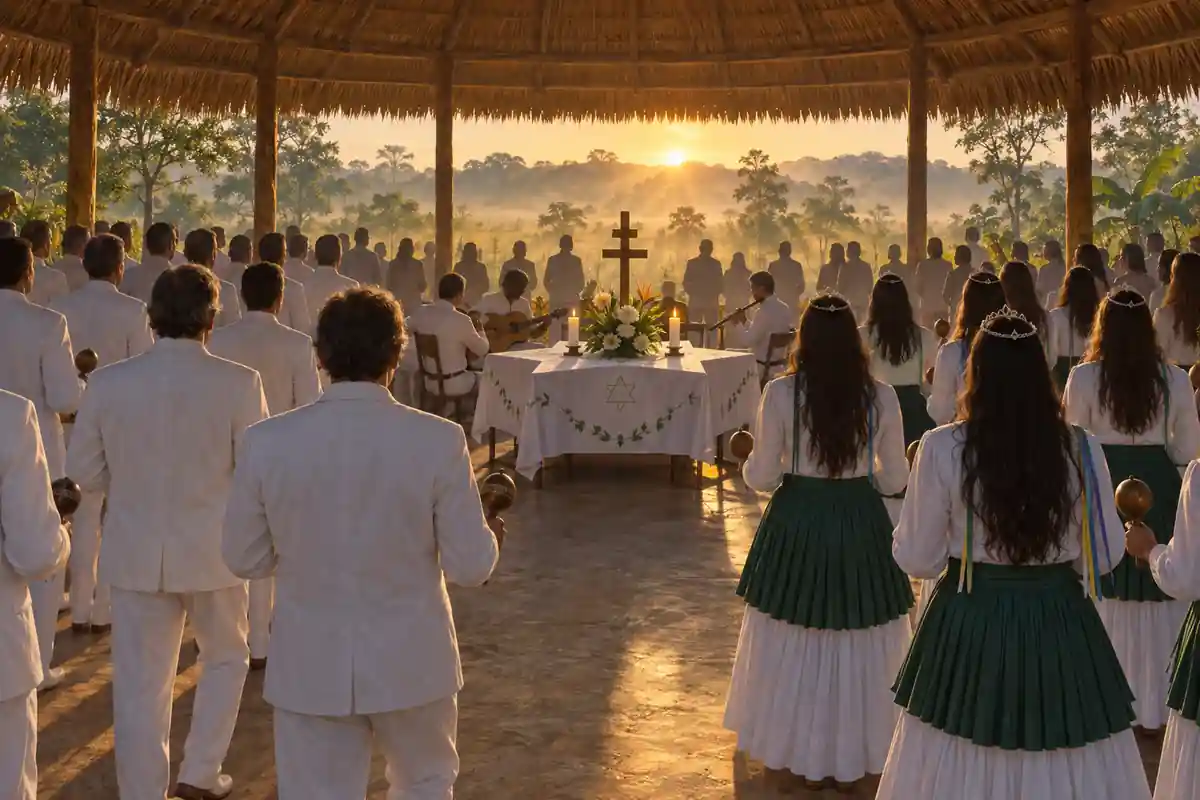
Santo Daime is a Christian religion that took shape in the 1930s in Acre, on Brazil's western Amazon frontier. Its founder, Raimundo Irineu Serra, was a descendant of enslaved people from the northeastern state of Maranhão. He came to the region as a young man looking for work as a rubber tapper. Its members drink ayahuasca, a brew of a forest vine and the leaves of a shrub that Indigenous and mestizo peoples of the region had long used. They call it Daime. In Portuguese the word sounds like dai-me, "give me," as in the invocations that run through the religion's hymns: give me light, give me strength, give me love. People drink it standing in rows, often through the night, singing hymns they believe were received from the spiritual world. They seek healing, teaching, and closeness to God. [1, 8]
A Vision in the Forest
Irineu Serra first drank ayahuasca around 1914, near the borders with Bolivia and Peru, after two brothers from his home region introduced him to it. According to the accounts his followers tell, he soon went alone into the forest for eight days. There he drank the brew, ate only unsalted manioc, and avoided speaking to anyone. During this retreat he saw the moon approach with an eagle at its center, and from within the moon a woman appeared. At first she was called Clara; later she was known as the Queen of the Forest and Our Lady of Conception. She gave him a mission. His first hymn, "White Moon," refers to the vision, and the moon and eagle became lasting symbols of the religion. [1, 8]
The pattern was a familiar one in the region. Mestizo healers known as vegetalistas also withdrew into the forest, kept strict diets, and said they learned directly from the spirits of "teacher plants," each of which was believed to have a protective "mother." Irineu Serra's Queen of the Forest fits that tradition, but he understood her as the Virgin Mary. The identification may have mattered: his doctrine left no room for the magical attacks, "darts," and love charms of vegetalista practice, whose healers could be feared for their power to harm as well as to heal. [8]
Irineu Serra moved to Rio Branco in 1920 and served in the territorial police force until 1932. On May 26, 1930, the first official work, or trabalho, took place in his home, with two other people present. His healing reputation drew others: first from Rio Branco's Black community, later from other groups, and eventually from members of the local elite. By then he was known as Mestre Irineu. [1, 2, 8]
He did not insist on a new label for himself. After his death, his widow corrected a man who called himself a daimista. She said she preferred the term the Mestre used for himself: uasqueiro, an ayahuasca drinker. [1, 2, 8]
The Teacher in the Cup
For Daimistas, ayahuasca is not a substance that produces an experience. It is a divine being. The presence within it is called Juramidam and is understood as the spirit of Christ. Around 1970, a São Paulo esoteric organization with which Mestre Irineu's group had been affiliated objected to the drink being served at its meetings. He replied, "If they don't want my Daime they also don't want me. I am the Daime and the Daime is me." [1]
The Daime is also a teacher. One elder who had followed Mestre Irineu since the 1960s put it plainly: "The Daime is the teacher. Whoever takes Daime and asks to learn, it teaches." A hymn sung in southern Brazil calls it "the teacher of teachers" and "the Master of all teachings." [2, 9]
The teaching arrives in two forms. One is the miração, the visionary experience the drink can bring. Daimistas are at times reluctant to describe their mirações, and the reports that have been collected stress that they are not static pictures. They can include unfolding geometric patterns, encounters with spiritual beings, travels to other realms, and the natural world seen shining with divine light. A researcher in southern Brazil noted that miração means more than seeing. It can involve hearing, touch, smell, and taste, and it carries emotional weight. [1, 9]
The other form is the hymn. Hymns are said to be "received" from the astral, the higher spiritual plane, by Mestre Irineu and, later, by others. His collection, O Cruzeiro (The Cross), is the foundation of the doctrine, and its final hymns are sung at the close of many works as a summary of his teaching. Some Daimistas speak of the hymns as a Third Testament. The religion's core principles of Harmony, Love, Truth, and Justice come from these hymns and from its early esoteric affiliation. Daimistas say theirs is a "musical doctrine" whose hymns show their full strength only when sung under the effect of the drink. [1, 8, 9]
Works, Uniforms, and the Current
Ayahuasca and hymn come together in the work. The major festival works mark Catholic holidays, the birthdays of elders, and other occasions for celebration. They begin in the evening and can last six to twelve hours. Initiated members, called fardados, "the uniformed ones," wear white: long pleated skirts and simple tiaras for women, and white suits with a navy tie for men. Everyone stands in assigned rows around a central table that holds a double-armed cross, men on one side and women on the other, arranged by height, age, and marital status. They dance simple steps back and forth, shaking rattles and singing. Daimistas believe that a "current" of force forms and circulates through the room, both around the table and downward from the astral. A person who leaves their place must follow a set route so as not to cut it. [1, 8]
The order is strict, and its insistence on small details often irritates newcomers. When the researcher MacRae observed the religion around 1990, participants were expected to avoid sex and alcohol for three days before and after a work. Newcomers attended an explanatory talk first. Experienced members served as "guardians" who helped anyone in difficulty, including those who vomited, a common effect of the drink. One church leader described an all-night work this way: "It's the great opportunity for cleansing and transformation, where all, in brotherhood, standing shoulder to shoulder in the current of energy, spend up to twelve hours singing and voyaging internally." At dawn, he wrote, come "happiness, the Sun rising, an embrace, the blessing, the hand shake, many questions answered." [8]
Other works are quieter. On the fifteenth and thirtieth of each month, members hold a concentração, a seated session built around a long period of complete silence. The Holy Mass is sung for the dead without instruments or dancing; the Alto Santo line does not drink Daime at the Mass. The preparation of the drink, called the feitio, is itself a ritual and is often considered the most important one, because every other work depends on it. [1, 8]
Illness, Merit, and the Spiritual Cure
Healing has been central from the start. Mestre Irineu sometimes recommended the Daime as a remedy. Followers also say he used it to discover remedies, learning in a miração which herbs would treat a particular illness. Most Daimistas understand illness, physical or mental, as the outward sign of a spiritual imbalance, which they trace to actions in past lives or to a person's present state of mind. [1, 2]
Many of the religion's founding figures arrived as patients. Sebastião Mota de Melo, a rubber tapper and Spiritist healer from Amazonas, came to Mestre Irineu in 1965 with a chronic liver illness. During a single session he saw himself outside his body while two men "resplendent like fire" removed his organs and extracted "three nail-sized insects" they said had caused his illness. He became one of Mestre Irineu's leading disciples. Earlier, in 1962, a merchant whose eldest son was gravely ill had come to the founder after doctors in Rio Branco and Afro-Brazilian healers had failed. The family say the son was cured on the night of São João. The merchant later said he himself was not healed by his first Daime "because he was very full of wickedness." With his second, he watched in a miração as he was operated on spiritually. [1, 2]
Mestre Irineu later gave that merchant charge of the Daime in town, so that sick people who could not make the journey to his rural center would still have access to it. The instructions, as the man recalled them in 1993, became a rule for the healing house that grew from this mission: "Do not offer Daime to anyone, but do not refuse anyone who seeks it." If a sick person could not come, he was to go to them, give the Daime, "and give at least two hours of assistance." His own rules for healing works were spare. The sick person is not touched. Someone who falls unconscious is only kept comfortable, "because often they are receiving a cure or an operation." Nobody drinks water during the work, "because it cuts the miração." In the 2000s and 2010s that house hosted dozens of people who stayed to work in exchange for meals, most of them seeking help with dependence on alcohol or other drugs. [2]
In this understanding, a cure is not always the removal of symptoms. Around 2008, the leader of a church in southern Brazil said that "99% of the people who come to the Daime come with spiritual problems." He described illness under a "Law of Merit": illness is something a person "has to go through in this life," and cure, too, is something one comes to deserve. He told of a young man with terminal cancer who regained weight over several works. During one session, the young man and his mother saw at the same moment that he was going to die. "The Daime changed my head," the young man said. "What God has for me, I receive." After his death, the leader said, his family saw him at a work, dressed in white. He had not been cured in the body, the leader explained, but had received "the spiritual cure." [9]
The difficult parts of the experience belong to this process. Daimistas call physical distress, vomiting, and sudden fear the peia, a word meaning a whipping or a punishment, and understand it as cleansing and discipline. One woman at the same church said she had found release from long sorrow through visions of past lives. "In the Daime it's like this," she said. "Everything is wrong and everything is right. … At first you don't understand what you feel. The understanding comes later." [9]
Two Lines After the Founder
After Mestre Irineu died in 1971, disputes over leadership divided his followers. People now usually speak of two main lines. Alto Santo, the cluster of churches that descend from his original center, remains in Acre and keeps no branches. CEFLURIS, founded by Padrinho Sebastião's group after a break in 1973–74, became the larger and more eclectic line. In 1980 Padrinho Sebastião led followers deeper into the forest. After a company claimed the first settlement, they moved again in 1983, this time to a tributary of the Purus River, where they founded Céu do Mapiá. He and his son spoke of building a New Jerusalem in the forest. [1, 2, 8]
The lines differ over mediumship. Mestre Irineu gradually moved away from spirit possession. Alto Santo still disapproves of it, and one early follower recalled that Mestre Irineu "was completely against incorporation, because the Daime doesn't send anyone to tell you; it shows you itself." CEFLURIS, by contrast, increasingly took in influences from the Afro-Brazilian religion Umbanda, including works in which mediums receive "suffering spirits" who come seeking charity. Starting in the mid-1970s, Padrinho Sebastião also used cannabis, which he called Santa Maria, as a feminine counterpart to the Daime. Police raids followed, and CEFLURIS eventually stopped approving it for ritual use. [1, 2, 8]
CEFLURIS also spread far beyond the forest. In the 1970s, young travelers from Brazil's southern cities reached Padrinho Sebastião's community and carried the doctrine home. The first church outside the Amazon opened in Rio de Janeiro in 1982, and others followed in Europe, Japan, and the United States. The newcomers changed the religion in turn. In 1989 MacRae observed that urban Daimistas had largely stopped using tobacco, which had once played a role in the tradition. On the canoe journey to Mapiá, visitors from the south marveled at the river dolphins, while local people regarded the animals as a bad omen. At Mapiá, where local eating habits prevailed, people joked that the way to call someone boring was to call them "macrobiotic." [1, 8]
Law and Heritage
In 1985, a division of Brazil's Health Ministry put the ayahuasca vine on the list of banned substances without consulting the federal narcotics council. The council's working group visited Santo Daime and União do Vegetal communities and drank the brew themselves. It found that decades of religious use had caused no noticeable social harm, and that members' moral standards were, if anything, "particularly rigid." The ban was lifted in 1987. A later resolution, which became binding in 2010, set norms for religious use that the ayahuasca religions had drafted with researchers. It forbade selling the drink and restricted use to religious purposes, recommending that therapeutic use stay on hold until its safety could be tested. At a congressional hearing that year, a federal judge who had led the drafting group defended the resolution. At the same hearing, a health regulator said more studies were needed and warned of risks for minors, older people, and people with mental disorders. In the United States, a 2009 federal ruling barred penalties for Santo Daime's sacramental use in Oregon. In 2013 it was described as legal in the Netherlands and contested in several other countries. [1, 2, 6]
Since 2008 the question has shifted from drugs to culture. Alto Santo, together with Barquinha and União do Vegetal, asked the national heritage institute to recognize the religious use of ayahuasca as part of Brazil's cultural heritage. The institute declined. CEFLURIS, now called ICEFLU, objected that it had not been consulted and that Indigenous peoples had been left out. Indigenous leaders in Acre have since claimed the role of the drink's original keepers. They question the "traditional" label given to the religions and ask what knowledge should be shared with outsiders at all. [7]
The Present
ICEFLU marked fifty years in 2024 and took "integration" as its watchword for the year. Its newsletter from that period reported regional preparation gatherings, a mental-health department for member churches, and a working group of uniformed women from 32 churches who met to discuss violence against women in their own communities. The group described such situations as "unfortunately common in our spaces, as in all of society." Céu do Mapiá has around a thousand residents. In May 2026, the community marked the death of the widow of Padrinho Sebastião, whom it called its matriarch, a year after it had celebrated her hundredth birthday. [3, 4, 10]
At Alto Santo, the founder's widow continues to keep his original center. In January 2026, Rio Branco formally declared the center an entity of public utility, and his small wooden house is being restored as a memorial. A member of the community stressed that the founder's hymns speak of a "Free Center," a "House of Knowledge," and the "House of the Queen of the Forest," but never of a church. "He didn't create churches," he said. "He founded an esoteric center, so much so that to this day we are forbidden, by a service decree left by the founder, to invite people to take part in hinários or concentration sessions." [5]
What is uncertain
Several detailed studies describe the religion's rituals and healing practices, two of them from roughly the last fifteen years, and the churches also publish their own accounts. The early history rests mostly on followers' recollections, and the original branch of the religion is much less studied today than the larger branch that spread worldwide.
Sources disagree on the founder's birth year: a baptismal record says 1890, while older accounts give 1892. [1, 8]
The timing of the founder's arrival in the Amazon and of his first contact with the brew is given differently, ranging from about 1909–1914 to the late 1910s or early 1920s. [1, 8]
Who introduced the founder's circle to the brew is unclear: one account treats a name as a person, another as a spirit that person channelled. [8]
Reports on the earliest period are few and have taken on the character of founding myths. [8]
The date of the split after the founder's death is given as 1973, 1974 or 1975. [1, 2, 8]
The cause of that split also varies between sources: a dispute over responding to police persecution, a quarrel over flying a flag at a ritual, or demands to hand over the brew. [1, 2, 8]
Whether spirit possession belonged in the founder's practice is disputed: the original branch rejects it, the larger branch has embraced it, and followers of one healing house disagree among themselves. [1, 2, 8]
Whether early healing sessions involved spirit mediums is argued over by scholars. [1]
What counts as a cure is defined spiritually, so a person who dies can still be said to be healed, and no source assesses health outcomes independently. [2, 9]
Brazilian rules allow religious use only and leave therapeutic use on hold until safety studies are done. A health regulator called for more research, especially for minors, older people and people with mental illness. [2, 6]
Indigenous groups question whether the ayahuasca churches deserve the "traditional" label in moves to recognise the brew as cultural heritage, and no settlement is reported. [7]
How many people practise today is not known; the only figure is an older estimate of no more than 11,000 ayahuasca users in all of Brazil. [1]
Present-day ritual life in the original branch, which has no branch churches and forbids inviting outsiders, is barely studied. [5]
10 sources. Each claim checked by AI against the saved sources; every finding reviewed by Jim Davis beside the cited passage, 30 October 2026. How the articles were checked
Timeline of dated events (37)
- 1890 (baptismal record) or 1892 (older accounts)the founder is born in north-eastern Brazil. [1, 8]
- 1909 or 1912the founder migrates to Acre to work as a rubber tapper. [1, 8]
- c. 1914 (or late 1910s)the founder first drinks ayahuasca in the Brazil–Bolivia–Peru border region and has the vision that founds his mission. [1, 8]
- c. 1916 / 1920san earlier ayahuasca group, the Circle of Regeneration and Faith, is active in a frontier town, with the founder taking part. [1, 8]
- 1920the founder moves to Rio Branco and joins the territorial police, serving until 1932. [1, 8]
- 26 May 1930the first official ritual ("work") is held in the founder's home. [1, 5, 8]
- 1935–1940the doctrine takes its present form and the founder's hymn book is gathered. [8]
- 1945land granted by the state governor becomes the founder's center (Alto Santo). [1, 5]
- 1961key disciples join an esoteric society, and several liturgical features come from this link. [1]
- c. 1970the founder breaks with the esoteric society over its refusal to serve the brew. [1]
- 1965the future leader of the breakaway branch seeks healing from the founder and joins. [1, 2, 8]
- 1966the founder entrusts a follower with a healing post in the city, which later becomes a healing house. [2]
- 6 July 1971the founder dies. [1, 2, 8]
- 1973–1975a large group leaves the founder's center and forms the eclectic branch (CEFLURIS), which holds its first official work in 1975. [1, 2, 8]
- mid-1970scannabis is brought into some rituals of the breakaway branch. [1, 8]
- 1980the breakaway community moves deep into the forest to Rio do Ouro. [1, 8]
- October 1981police raid the community and destroy its cannabis plots; cannabis is later dropped from official rituals. [8]
- November 1982the first Santo Daime church outside the Amazon opens in Rio de Janeiro. [1, 8]
- January 1983the community resettles at a new forest site, which becomes the branch's headquarters village. [1, 2, 8]
- 1985a Health Ministry division puts the brew's vine on the list of banned substances. [1, 7, 8]
- 26 August 1987the Federal Narcotics Council removes the vine from the list after a two-year inquiry. [1, 8]
- 1988an anonymous complaint triggers a new police inquiry in Rio de Janeiro. [8]
- May 1989new statutes for the branch are approved at a meeting of church leaders. [1, 8]
- 20 January 1990the breakaway branch's leader dies and his son takes over. [1, 8, 10]
- June 1992the Narcotics Council unanimously reaffirms the legality of religious use. [8]
- June 1997the healing house holds its first healing work in a dedicated building. [2]
- 1998the healing house is registered as its own center, and the breakaway branch reorganises legally as ICEFLU. [2, 10]
- 2004–2006a working group including both Santo Daime branches drafts ethical rules for religious use, and the national drugs council approves them in 2006. [1, 2]
- 2008the healing house formally leaves the larger branch. [2]
- 2008the national heritage institute refuses a request to recognise the religious use of the brew as heritage. [7]
- 19 March 2009a US federal judge bars drug authorities from penalising sacramental use by an Oregon Santo Daime church. [1]
- January 2010the working-group rules become binding nationwide as a government resolution. [1, 2]
- May 2010a parliamentary hearing discusses a bill to annul that resolution. [6]
- 2011a meeting co-organised by the larger branch criticises the heritage request for leaving out other groups. [7]
- 2024ICEFLU marks 50 years and revives regional brew-making gatherings. [4]
- 16 January 2026the founder's original center is officially declared an entity of public utility. [5]
- May 2026the widow of the breakaway branch's founder dies aged about 100. [3]
Sources
CSL-JSON imports into Zotero, Mendeley and other reference managers.
Williams, A. (2013). Santo Daime. World Religions and Spirituality Project (WRSP).
Encyclopedia-style reference entry by a religious-studies writer, 2013. It gives the fullest summary of history, beliefs, rituals, healing and legal status, and partly derives from source 8.
Moura, J. L. P. de (2018). As origens de uma casa de cura do Daime: o Pronto Socorro Espiritual Raimundo Irineu Serra. Marupiara (Universidade do Estado do Amazonas), 3(3): 171–193.
Journal article by a university lecturer who lived eight years with a Daime healing house, 2018. It traces the house's origins through members' recollections and describes present-day healing works, the ritual calendar and the regulation debate.
ICEFLU (n.d.). Santo Daime – The Doctrine of the Forest (home page). Centro de Documentação e Memória, ICEFLU.
Undated home page of the larger branch's documentation center. It presents the church's self-description and current news, including the 2026 death of its matriarch.
ICEFLU, Departamento de Comunicação (2024). Santo Daime Informa, 34ª edição (abril 2024).
Newsletter of the larger branch, April 2024. It shows current institutional life: the 50th anniversary, regional brew-making gatherings, a social and health fund, and a women's group addressing violence.
Apple, C. (2026). Alto Santo: berço da doutrina do Daime é reconhecido como entidade de utilidade pública no Acre. Brasil de Fato (opinion column 'Psicodelia Brasileira'), 3 March 2026.
Opinion column by a writer who has followed the religion for nearly a decade, 2026. It reports a visit to the founder's preserved home and its new official recognition, and notes that the original branch has no branches and forbids inviting people.
Agência Câmara / Comissão de Segurança Pública e Combate ao Crime Organizado (2010). Juiz defende atual regulamentação sobre chá do Santo Daime. Câmara dos Deputados, 27 May 2010.
Parliamentary news report on a public hearing, 2010. It records the views of a judge, doctors, a church health coordinator and a health regulator on the brew's safety and its regulation.
Antunes, H. F. (2020). Is Ayahuasca Cultural Heritage of Brazil? Chacruna Institute, 28 July 2020.
Policy essay by an anthropologist, 2020. It traces the disputes over recognising ayahuasca use as national heritage, including Indigenous challenges to the churches' claim to tradition.
MacRae, E. (1992). Guiado pela lua: xamanismo e uso ritual da ayahuasca no culto do Santo Daime. São Paulo: Brasiliense. English e-book edition: Guided by the Moon: Shamanism and the Ritual Use of Ayahuasca in the Santo Daime Religion in Brazil. NEIP.
Book-length study by an anthropologist who took part in a São Paulo church and visited the forest headquarters, 1992. It covers the regional healer background, founding history, rituals, social controls on use, and the 1987 and 1992 government reviews.
Greganich, J. (2010). Cura e reencarnação: o processo de 'cura espiritual' no Santo Daime. Ciencias Sociales y Religión / Ciências Sociais e Religião, 12(12): 107–129.
Journal article by a social anthropologist based on fieldwork in a southern Brazilian church in 2008–2009, published 2010. It analyses "spiritual healing" and reincarnation beliefs through members' accounts and a case study.
ICEFLU (n.d.). O que é o Santo Daime – Introdução. Centro de Documentação e Memória, ICEFLU.
Undated introduction page from the larger branch's website. It gives the church's official account of its origins and history and its rules: use only on calendar dates, and no sale of the brew.
Related
Cite this page
Psychoactive Traditions. “Santo Daime Ayahuasca.” Last reviewed 30 October 2026. https://psychoactive-traditions.org/traditions/santo-daime