The Huni Kuin, whose name means "real people," live in villages along the rivers of the Brazilian state of Acre and across the border in Peru. In 2024 their own federation counted about 16,000 people in some 116 villages in Brazil, with roughly 2,400 more in Peru. Their language, hãtxa kuin, belongs to the Pano family. Outsiders long called them Kaxinawá, a name they increasingly reject. [1]
At the center of much of their ritual life is a drink prepared from the Banisteriopsis caapi vine and the leaves of a Psychotria shrub. Elsewhere it is known as ayahuasca; the Huni Kuin call it nixi pae, often translated as "enchanted vine" or "vine of force." One Huni Kuin leader explained that while the vine is still growing in the forest it is called huni, and once prepared it becomes nixi pae, which he translated as "thread of light." The Huni Kuin regard the drink as a medicine and a path of physical, mental, and spiritual healing. They drink it together at night, guided from beginning to end by song. [1, 2]
The vine that was a man
The Huni Kuin explain the drink through the story of a hunter, usually called Dua Busen. In a version told on the Purus River, he saw animals walking about wearing earrings. Then he saw a woman rise from a lake, beautiful and covered in design. She was an anaconda. He went to live with her beneath the water, where a leaf changed his perception so that he saw the anaconda people as people. He married her and had children.
When the anaconda people held a nixi pae ceremony, his wife warned him not to drink, but he insisted. Under the drink's force his vision changed, and he saw his in-laws as snakes. He screamed in terror, offended them, and fled back to his human family. Later, while gathering genipap to paint a newborn child, he stepped into a river, and the anacondas caught him and broke his bones. His kin saved him, but he knew he would die. On his last night he taught his people how to find and prepare nixi pae, and he sang until morning. From his buried body grew the vine and the leaf. Only one small boy, Nambua, stayed awake all night listening, and so he learned the songs. Nixi pae songs still invoke him; in them the anaconda calls him "my adoptive son." [4, 1]
The story explains why the drink is treated as a being and not as a substance. The vine is described as the blood or urine of Yube, the ancestral anaconda. The name Yube connects many beings: the ancestor who became the vine, the moon, the great old anaconda that is the most powerful of spirit beings, and the shaman who masters the ritual. To drink nixi pae is to live again the hunter's passage into another world. In the words of a 2024 account, Huni Kuin epistemology recognizes ayahuasca as "a holder of a spirit (yuxin), much like every living being in the cosmos." [4, 2]
Drinking to see
Asked why they take nixi pae, Huni Kuin on the Purus River in the 1990s and 2010s most often gave one answer: to see. The drink reveals what is normally hidden, above all what nonhuman beings are doing to a person. In Huni Kuin thought, illness often originates in the blood of game animals. Every person and animal has yuxin, a term variously translated as soul, spirit, or double. The yuxin of an animal that has been killed and eaten may take revenge, especially in dreams, when a person's own yuxin are dispersed. [4, 3]
One such effect is nisun: dizziness, headache, and in strong cases fainting. It is felt especially by young hunters who have killed male animals. People say a person may first feel nisun under the drink. This, they say, is the first step toward discovering what the body spirit of an animal can do to one's "eye soul," the soul that resides in the heart and eyes and is responsible for perception. In visions, people say, the doubles of game throw their skins and ornaments over the hunter's eye soul and trap it in a new body. If nothing is done, the hunter will run off into the forest and slowly become the animal. For this reason, ceremonies were traditionally held for hunters, and during them a hunter could see from the animal's point of view and recognize the aggression he had committed. [4, 2]
Nixi pae is also used to find hidden causes of a different kind. A shaman may drink to discover whether someone has placed a spell on a sick person and, if so, who did it. On the Purus, the patient was painted with red achiote, sat beside the shaman, and drank a little so that the shaman could see the patient in visions. Visitors, Indigenous or not, were invited to drink as a way of revealing their intentions. Because a powerful singer can turn the force of the song against a rival, a shared ceremony could become a contest of strength. By his own account, one Purus ritual specialist visiting another river was put under a spell by an envious shaman during the session itself. He spent three days and nights running through the forest until a boa constrictor helped him find his way out. [4]
An older record from Peru shows the drink in a related setting. In 1966, on the Curanja River, Huni Kuin men drank nixi pae once or twice a month, from dark until two or three in the morning, and never alone. The visions were understood as the experiences of one's dream spirit: portents of the future, reminders of the past, news of distant people and events. When neither the shaman nor the herbalist could cure an illness, men drank so that spirits might reveal its cause, a new chant for healing, or a warning that the patient could not be saved. Inexperienced men sat on a log, each one wrapped around the man in front of him, because the group kept every drinker in touch with the real world. One man described a vision of the nixi pae people threatening him with arrows that, they told him, "would not kill me, only make me more drunk." The vision ended with a village dancing the fertility dance, gardens full of manioc and plantains, and many pregnant women: "I knew we would be well and have plenty to eat." [6]
The songs that lead the way
People who have studied these ceremonies agree that the songs, called huni meka, do far more than accompany the experience: they guide it. They are sung in shenipabu hãtxa, "the language of the ancients," a metaphorical speech in which nothing seen is called by its everyday name. One Huni Kuin singer said that what is sung is not what is seen; it is an image of what the spirit beings are doing to the person. The songs do not tell a story with a beginning and an end; they set images side by side. [1, 4]
That guiding role is clearest in healing. On the Purus, healing depends on the song. The eye soul, lost among image-beings, cannot sing for itself, so the singer leans against the shivering body of the person in distress and sings in the plural voice of Yube. One such song repeats lines meaning "I long for your body" and "thinking of your body, come up and join me," calling the person's yuxin back. A specialist described what happens when the eye soul is trapped: "your thought is caught in a hole, a locked pot." The song brings it "back to your head, back to your body." Rubbing a fragrant leaf under the nose or taking tobacco snuff may ease a frightening vision, but people say only the right song can truly change it. Vomiting is considered good, because it expels substances charged with harmful yuxin agency. [4]
The singers who lead a night therefore work with a repertoire organized by what each song does. The song master who leads the artists' collective MAHKU divides the huni meka into three groups. Pae txanima songs "call the force," using the word for the drink's effect. Dautibuya songs come with the visions and lead participants along "the paths of the anaconda." Kayatibu songs lower the force as the ceremony draws to a close. A specialist on the Purus described a four-part sequence: calling songs, stabilizing songs, songs to see, and songs to send away. He added that the whole cycle of calling and undoing is also present within each single song. Singers do not follow the order strictly: a night must open by calling the force, but afterward the leader moves between groups, lowering a session that has too much "pressure" or calling more force when it is faint. [1, 4]
Many songs are built on the vowels "A" and "E." One Jordão River healer linked them to the creation of the world, when the first breath of the earth brought forth a male voice and a female voice. He said of the creator spirits, "We know the name, but no one has ever met it. What we have of our yuxibu is our voice." One singer explained these repeated syllables as simply "the sound of the music," the singer's accompaniment in the absence of instruments. On another occasion the same singer said, "Each sound has a different light," and associated each with its own color and its own kind of vine. [1]
Each song has a known source, a person living or dead who "thought" it, and most are traced back to the first ancestor who learned them among the anaconda people. A Purus specialist explained that the source sings through the singer: "In the vision that you sing, it isn't you who is singing; what comes out is the voice of the person that died a long time ago and used to take nixi pae." Learning the songs is demanding. The student must seek out a master, who tests his desire and endurance, and the student's body must be prepared. That same specialist recalled how his first teacher, whom he had paid with a battery, had asked him: "You take nixi pae? And how do you sing to take away the drunkenness? … Nobody takes it without knowing how to sing!" A song specialist, a txana, is named after a bird known for imitating other birds, and the title requires long study and an initiation. [4, 1]
A ceremony in a Purus village
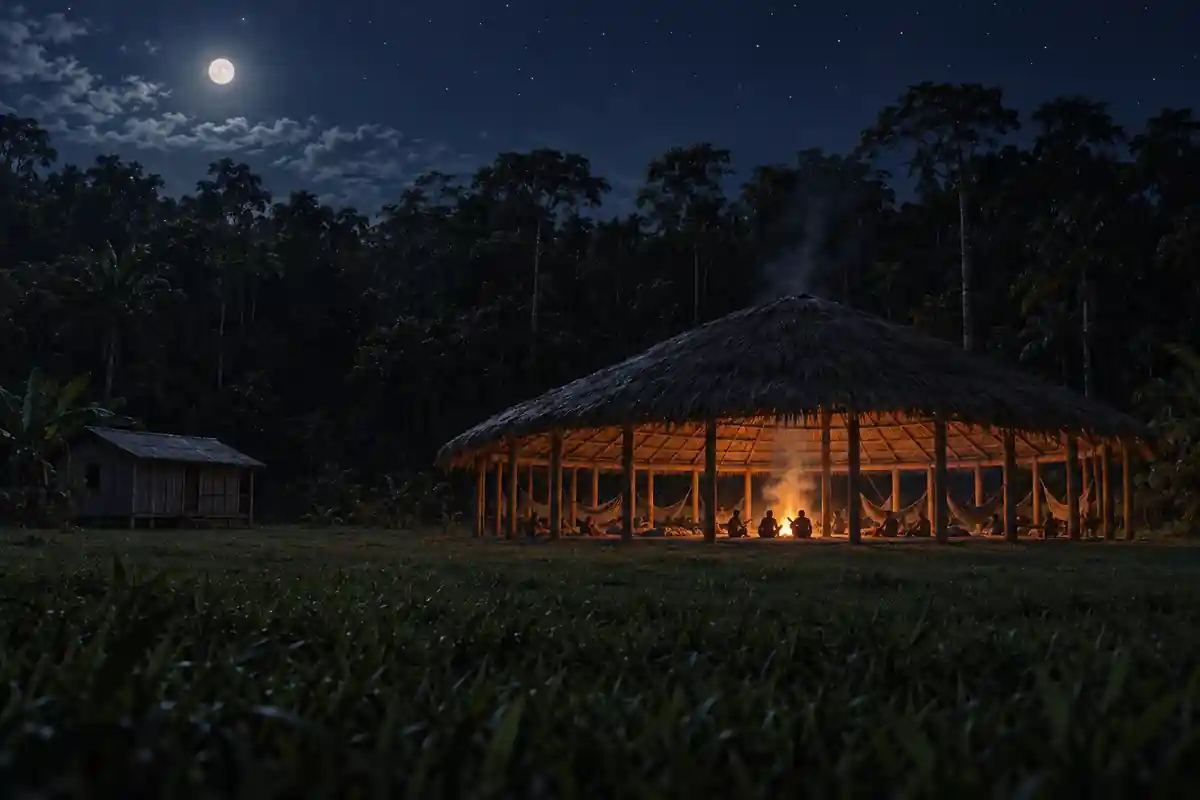
In 2020, visitors joined a three-day ceremony in a community of the Alto Rio Purus Indigenous Land. Before it began, the oldest resident told the story of the vine's origin. Each night the whole community, children included, gathered in the longhouse around a fire, lying in hammocks and on mattresses. The shamans sang and played guitar and percussion. Residents explained that ceremonies are held regularly and for different purposes: to sharpen hunters' skills, to heal the sick and undo poisoning spells, to make people more aware of their surroundings, to test the intentions of relatives and strangers, and to celebrate. Who takes part, and in what, varies from place to place. In this community only young men were invited to take a stronger snuff that tested their resilience. On the Purus, few Huni Kuin women admitted to drinking, while on the Tarauacá, Jordão, and Envira rivers more women were drinking and singing each year. [2, 4]
Using nixi pae to uncover the causes of illness was common in that community. On the second night, one of the visitors, a physician, was asked to help the healers attend to community members who had come for guidance. She later described intuitions about two people, which they confirmed. The Huni Kuin did not understand these as intuitions but as her presence, under the shamans' guidance, in the spiritual dimensions opened by the drink and the snuff. The healer who co-wrote the account described the healer's work this way:
> For those of us who work with healing practices, ayahuasca is a teacher… For the healer, ayahuasca functions as a passport… Throughout the ceremony, the person's life is revealed like an open book, enabling the healer to guide and direct energies through chants, rapé blows, and prayers.
In this view, the outcome is never uniform; it depends on the preparation and intentions of the person drinking, on how the shaman conducts the ceremony, and on the portals that open during it. [2]
Rivers that went different ways
Huni Kuin divide their own history into periods. The Time of the Malocas came before contact with outsiders. The Time of the Raids followed, when rubber and caucho bosses invaded their lands and killed and scattered people. Then came the Time of Captivity, of forced labor on the rubber estates; the Time of Rights, beginning in the 1970s, when territories were demarcated; and the present New Time, Xinã Bena, a time of transmission from elders to the young and of alliances with outsiders. [1]
These events shaped the ceremonies differently on different rivers. Early in the twentieth century, after taking revenge on a rubber boss, one group fled as far as the headwaters of the Curanja River in Peru. Their descendants, many of whom later resettled on the Brazilian Purus, kept up community life and the transmission of ritual knowledge. Yet over roughly fifteen years these same communities converted en masse to evangelical Christianity. By 2014 only two of the thirty-six Huni Kuin villages on the Alto Purus resisted conversion. One of them was founded by people who had left Peru to escape evangelical influence, as a village where no preacher may settle. Their stated purpose was to make strong again "the thinking bodies" of their kin, which is also one of the main reasons for drinking nixi pae. [4]
On the Jordão River the direction was reversed. In the late 1980s, Jordão leaders frequented Santo Daime, the Christian ayahuasca religion founded in Acre. About ten years later they replaced its influence in their home rituals with their own nixi pae songs, sung in their own language. On the Jordão, shamanism is now practiced openly and visibly. One Jordão song master, who began compiling songs with elders in the 1990s, described an earlier period when the language itself was "locked": "Until 2000, we were locked… In 2000 we began unlocking our language." His father, he said, had kept the songs "inside his heart" through the rubber years. [4, 8]
The new conditions of teaching are debated between the generations. Some complain that school programs built on the principle that all knowledge should be public bypass the proper chain of transmission from master to student. They say this is impoverishing the learning of the songs. [4]
The Jordão song master's work led to MAHKU, the Huni Kuin Artists' Movement, which paints the beings and visions of the huni meka. He calls his method of explaining the songs in Portuguese pôr no sentido, "putting into sense." He insists that "it is not translation." Rather, it is a way for students and others to follow the songs and their paintings. In 2024 the collective painted a 750-meter mural titled "Mirações," meaning visions, for the Venice Biennale. It includes the alligator Kapetawã, who in Huni Kuin narrative carried the first people across a great river on his back until someone fed him another alligator. Those who did not cross became the Huni Kuin; those who did became the outsiders, nawa. After telling this story, one elder concluded: "The foreigners are our half split off long ago." [8, 1]
From the forest to the city
Early in the 2000s, young Huni Kuin men from the Jordão began leading nixi pae ceremonies in Rio de Janeiro and São Paulo. Since then, Huni Kuin from several rivers have conducted them across southern Brazil and in many countries, including England, Spain, the Netherlands, Russia, Israel, India, and South Africa. Ceremonies have also been held in museums alongside installations by the Brazilian artist Ernesto Neto. In the 2020s, ceremonies at venues near Rio lasted about nine hours, from ten at night until after dawn, around a fire that was kept burning until morning. For about three hours the leaders sang huni meka with voice and rattle alone. Then guitars and drums joined them for newer songs, and sometimes songs for the spirit guides of Afro-Brazilian religions. [3, 7, 4, 1]
Urban participants describe their own reasons. One organizer in Rio spoke of a "cure for individualism" and said the cities need "the cure of the txais," the Huni Kuin, while the Huni Kuin need the resources of the cities. Another participant repeated something she had heard Huni Kuin say during the work: "It is not me, or you, or the pajé, or anyone who is doing the healing; it is the medicine." A Huni Kuin leader on the Humaitá River called this "the cure of the forest reaching society," and added that "transforming knowledge is not losing tradition." [3, 7]
The same organizer named the dangers. Two young men who carried the drink to Europe were arrested and deported, she said: "Imagine an Indian leaving the village, where that drink is the most sacred thing, and arriving in another country where it is a drug." Disputes arose early. In 2005 a rival Indigenous leader accused the young men in the cities of "selling the tradition." Huni Kuin were also among the Indigenous groups who claimed, in the 2010s, that their grandfathers had first given ayahuasca to Santo Daime's founder. [3, 7]
Brazil's 2010 resolution permitting ritual use of ayahuasca was drafted without Indigenous participation. Only later did Indigenous peoples press to be included in recognizing the drink as national cultural heritage. In January 2026, the president of the Federation of the Huni Kuin People of Acre spoke at a public hearing in Acre on industrial production and online sales of the brew. He objected that authorities draw no distinction between transport for ceremony and transport for trade: "An Indigenous spiritual leader does not transport tons of ayahuasca for a ceremony." Indigenous leaders carrying the drink abroad have faced airport seizures, prosecutions, and deportation. Meanwhile, Indigenous peoples were due to gather in Girona, Spain, in September 2026 for a world forum on how the drink should be regulated and who should be recognized as holding its knowledge. [7, 5]
What is uncertain
Several recent first-hand studies describe these all-night ceremonies, their guiding songs and their healing aims, both in Amazonian villages and in city venues. Most of the detail, however, comes from ceremonies held for city audiences and from short visits, and how long the practice goes back is still debated.
Scholars disagree over whether ayahuasca use among Huni Kuin and their neighbours is long-established or spread relatively recently. [9]
Claims that Huni Kuin elders first gave ayahuasca to the founder of Santo Daime could not be corroborated. [7]
Sources differ on who drank in the past. Some say it was mainly young hunters guided by older shamans, or initiated men only. A city participant recalls that only shamans used it, and only for occasional consultations. [2, 3, 4, 6]
Women's participation varies by river: few women on the Purus say they drink, while more drink and sing on the Tarauacá, Jordão and Envira. [4]
Sources classify the song cycle differently. One scheme has three groups (calling the force, visions, lowering the force); another has a four-part sequence (calling, stabilising, seeing, sending away). Both stress that the order is not strictly fixed. [1, 2, 4]
The meaning of the wordless refrains in the songs is uncertain even to researchers who translated them with Huni Kuin singers. [1]
How far ceremonies for outsiders have changed village practice has not been closely studied; city ceremonies add guitars, other instruments and songs from other traditions. [1, 3]
Whether holding paid ceremonies for outsiders is legitimate is disputed, including among Indigenous leaders. [3, 7]
Indigenous leaders say authorities fail to tell ritual transport of the brew apart from commercial trade, and that they are the ones targeted. [5]
Widespread evangelical conversion on the Purus leaves open how far ceremonies continue in many villages there. [4]
The healing results described in the village account rest on the authors' own experience and have not been checked independently. [2]
9 sources. Each claim checked by AI against the saved sources; every finding reviewed by Jim Davis beside the cited passage, 30 October 2026. How the articles were checked
Timeline of dated events (24)
- Early 20th centuryHuni Kuin scatter to several rivers after killing their rubber boss on the Envira; one group retreats to the Curanja headwaters in Peru. [4]
- Early 20th centuryrubber tappers who founded Santo Daime learn ayahuasca use from Indigenous peoples of the region, reportedly including Huni Kuin. [1, 4]
- c. 1905–1906Huni Kuin informants give a myth about drinking the brew and meeting spirits, the earliest Huni Kuin account cited. [9]
- Until the late 1940sthe Curanja group lives without direct contact with non-Indigenous people. [4]
- From the 1950sProtestant missionaries live among the Peruvian Huni Kuin on the Curanja. [4]
- 1966on the Curanja, men are recorded drinking the brew in night-long group sessions about once or twice a month. [6]
- From the 1970sa Jordão Indigenous land is freed from debt bondage to rubber bosses, and families begin returning from Peru to the Purus. [1, 4]
- Recollected in 2014from 1975 the Huni Kuin language was suppressed; from 1984 festivals and speaking it resumed, and it opened up further after 2000. [8]
- Late 1980sJordão families attend Santo Daime. [4]
- About ten years after the late 1980sJordão families give their own nixi pae songs priority again in home ceremonies. [4]
- From the 1990sa Huni Kuin song master compiles nixi pae songs with elders. [1, 8]
- 2002 or 2005 (sources differ)the first Huni Kuin men settle in Rio de Janeiro and São Paulo to lead ceremonies for city people. [3, 7]
- October 2005an online controversy erupts over charging for these ceremonies. [7]
- 2006–2007a book of nixi pae songs and a recorded song collection are published. [1, 4, 8]
- 2009a university course leads to the project that becomes the Huni Kuin artists' collective, MAHKU. [4, 8]
- 2010Pano Indigenous representatives ask the Ministry of Culture to include Indigenous peoples in the process of recognising ayahuasca as national heritage. [7]
- 2010a Huni Kuin leader publicly claims that his grandfather introduced ayahuasca to the founder of Santo Daime. [7]
- 2011 or 2013 (sources differ)the artists' collective that paints the nixi pae songs is founded. [1, 4]
- 2012the collective exhibits at a Paris foundation. [1, 4, 8]
- From 2014Huni Kuin lead ceremonies inside art installations in museums abroad. [4]
- 2014only two of the 36 Huni Kuin villages on the Brazilian Alto Purus are found to be resisting evangelical conversion. [4]
- By 2016Huni Kuin ritual leaders travel a route of ceremonies across many countries in Europe and beyond. [3]
- 2024the collective's mural of vision-song beings is shown at the Venice Biennale. [1]
- By January 2026Indigenous leaders report seizures of the brew and prosecutions while industrial-scale commercial production goes on. [5]
Sources
CSL-JSON imports into Zotero, Mendeley and other reference managers.
Bomfim, L. C. (2025). Cantos xamânicos Huni Kuin: cerimônias de ayahuasca, cosmologias e pontes entre mundos. Revista Vórtex 13: 1–35, e8946.
An ethnomusicologist's journal article (2025), based on attending Huni Kuin-led ceremonies at urban multi-ethnic venues from 2018 to 2024. It gives the fullest recent description of ceremony structure, the three groups of songs, the ideas of "force" and visions, and the origin myth.
Resende, A. V. de S., Txanawa Inu Bake & Carrijo, F. B. (2024). Nixi pae and its transcendental connection: An ethnographic essay on ayahuasca rituals in a Huni Kuin community in Brazil. Etnografia. Praktyki, Teorie, Doświadczenia 10: 291–300.
A journal essay (2024) co-written by a family physician, a researcher and a Huni Kuin healer apprentice. It describes a three-day village ceremony on the Alto Purus in 2020, the origin myth, the range of ceremony purposes and the healer's view of healing.
Meneses, G. P. (2018). Medicinas da floresta: conexões e conflitos cosmo-ontológicos. Horizontes Antropológicos 24(51): 229–258.
A doctoral anthropologist's journal article (2018), read in part, based on fieldwork from 2012 to 2016. It traces how nixi pae and related forest medicines moved into cities and abroad, and records non-Indigenous participants' views and doubts about claims of unchanged ancestral use.
Lagrou, E. (2018). Anaconda-becoming: Huni Kuin image-songs, an Amerindian relational aesthetics. Horizontes Antropológicos 24(51): 17–49.
A long-term ethnographer's journal article (2018), read in part, on Purus River Huni Kuin. It contributes translated ceremony songs, the song sequence, the origin myth, history since the rubber era, and evangelical conversion alongside revival on other rivers.
Minuano, C. (2026). Ayahuasca no marketplace. CartaCapital, online 15 January 2026; print edition no. 1396, 21 January 2026.
A news magazine report (2026) on the commercial trade in ayahuasca. It covers Indigenous leaders' complaints of selective enforcement and the legal uncertainty in Brazil and Europe.
Der Marderosian, A. H., Kensinger, K. M., Chao, J.-M. & Goldstein, F. J. (1970). The use and hallucinatory principles of a psychoactive beverage of the Cashinahua tribe (Amazon Basin). Drug Dependence 5: 7–14.
A pharmacology and anthropology paper (1970) based on 1966 fieldwork on the Curanja in Peru. It describes who drank, how often, and what visions people reported, and gives a chemical analysis of a Huni Kuin brew.
Labate, B. C. & Coutinho, T. (2014). “O meu avô deu a ayahuasca para o Mestre Irineu”: reflexões sobre a entrada dos índios no circuito urbano de consumo de ayahuasca no Brasil. Revista de Antropologia 57(2): 215–250.
Two anthropologists' journal article (2014), read in part. It describes Huni Kuin and other Indigenous groups entering the urban ayahuasca scene, disputes over charging and over origins, and the heritage debate.
Mattos, A. P. de & Ibã Huni Kuin (2017). Por que canta o MAHKU – Movimento dos Artistas Huni Kuin? GIS – Gesto, Imagem e Som – Revista de Antropologia 2(1): 61–82.
An article (2017), read in part, co-written by a university researcher and a Huni Kuin song master. It gives a community account of researching, explaining and painting the vision songs, and the song master's memories of his language being suppressed and later revived.
Suárez-Álvarez, C. (2023). The Age of the Onanya – regarding the spread of ayahuasca use throughout the Ucayali basin. Tipití 19(2): 335–360.
An independent scholar's journal article (2023), read in part. It challenges the view that ayahuasca use in the wider Ucayali region is recent, drawing on mission and travel records and word origins, including an early Huni Kuin myth.
Related
Cite this page
Psychoactive Traditions. “Huni Kuin Nixi Pae Ceremonies.” Last reviewed 30 October 2026. https://psychoactive-traditions.org/traditions/huni-kuin-ayahuasca