"In the old days, only doctors drank, so they could see the illness. It is not the oni that cures, but the medicinal chants that do so." That is how a woman whose grandfather was a respected healer explained it in 2014. Her words may surprise anyone who thinks of ayahuasca as something the patient drinks. [4, 5]
The Shipibo-Konibo are one of the largest Indigenous peoples of the Peruvian Amazon. Most of their roughly 150 communities lie along the Ucayali River and its tributaries, though many families also live in the cities of Pucallpa, Yarinacocha, and Lima. Their healers, the onanya, drink oni, the visionary brew known in Spanish as ayahuasca, to find the cause of a patient's illness. Traditionally, the patient did not drink it at all. [4, 5]
The one who knows
The Shipibo word for the ayahuasca vine is nishi, which also means simply "vine." The drink is usually called oni. Healers recognize several varieties of the vine, each with its own medicinal qualities. One variety looks just like the others but is said to have no visionary or toxic effect at all. Its name is "brother-in-law." [2]
The most important words in this vocabulary all circle back to knowledge. Onanya comes from onan, "to know," and is usually translated as "the one who has knowledge." Linguists have tied oni to the same root, and also to the Proto-Panoan word for "person." In Shipibo-Konibo, joni means human being. In the related Cashinahua language, huni names both the brew and people. The anthropologist Carlos Suárez-Álvarez concludes from this that ayahuasca, people, knowledge, and health all meet in a single figure: the healer. [2, 4]
Above the onanya ranked the meraya, master healers who are now spoken of mostly in the past tense. The stories told about them are remarkable. People describe a meraya who sat inside his mosquito net, smoking tobacco and singing in a high falsetto. When a curious boy lifted the net, he found nobody inside, yet everyone could still hear the voice. A meraya didn't need ayahuasca to travel this way. Still, the type has not entirely disappeared. In the 2000s, one researcher met two healers whom their peers considered meraya. Both cured without drinking or giving ayahuasca, and one did without tobacco too. [1, 3]
The healers have formally rejected the word "shaman." In 2018 their own association adopted onanya as its official name and turned down "shaman" as an imported term that didn't fit their history. A woman from a healing family remembered that her grandfather had disliked the word for another reason: it sounded like chama, an insult mestizos once used against Shipibo people. [4, 9]
Schooled by plants
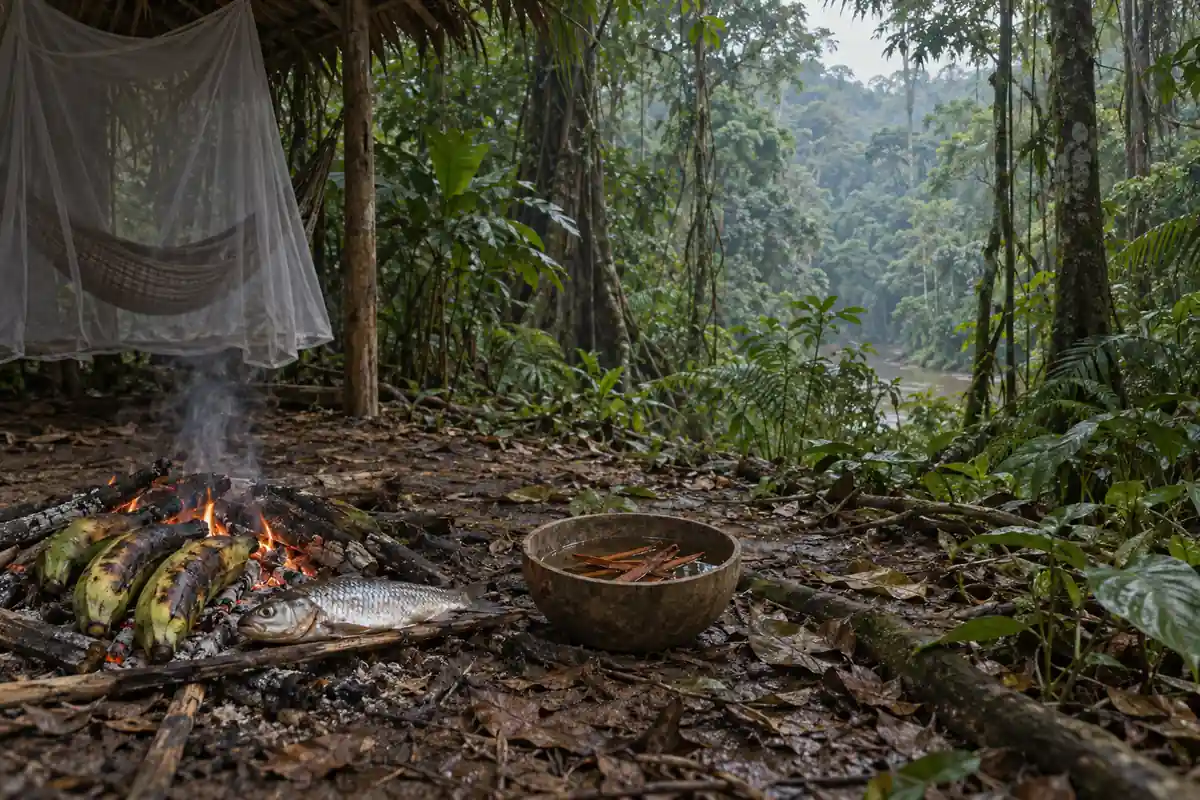
Most people learn a trade from a teacher, but an onanya learns mainly from plant spirits. The training is a diet, called sama in Shipibo and dieta in regional Spanish, and it is demanding. The aspiring healer withdraws from the community, often alone in the forest for months, and drinks or bathes in rao, plants believed to hold knowledge and power. Salt, sugar, chili, alcohol, sex, sun, and rain are all off-limits, and the apprentice lives on river fish and roasted green plantain. The reasoning behind the dieta is unusual. Healers explain that the human body gives off an unpleasant smell. As the plant enters the blood and changes that smell, the plant's spiritual owner, its ibo, may come close enough to teach. Westerners generally think of the ibo as the plant's spirit. [4, 7]
These ibo usually appear in dreams, in human form, and they expect to be taken seriously. One healer described dieting with the bark of a tree associated with herons in order to become as skilled a fisherman as the bird. When his dreams changed, he understood that he could become a healer, and he kept going. After several months, the tree's spirit appeared to him: "He was a person like us, wearing a white robe, with white skin. The only oddity was that he walked with his hands behind him, hopping like herons. It was a bit funny, but if you mock him, he won't teach you anything." [4]
The songs arrive the same way, and they take time. An elder healer said in 2024 that at the start of a dieta "you sing badly." The songs feel ill-fitting, as if they don't yet belong to the body. "After one year, two years, they are already part of you. We don't learn quickly." The dieta also changes how a healer sees. Healers say the plants make a dieter's eyes "become like those of the spirits," able to see inside a patient. Through dieting, a healer gains a kano, a connection or path between worlds. One elder woman spoke of becoming that connection herself. [7]
Dieting isn't only for healers. Patients dieta too, and so do people who want to get better at an ordinary skill. In the healer's way of thinking, someone with an ailment is in much the same position as an apprentice: both must restrain themselves, keep apart, and let the plants do their work. Shipibo people have "cured" a boy to make him a good hunter, and an artist to improve her invention of designs. Breaking a diet's rules, however, brings a sickness of its own, called kopia. [3, 8, 13]
The healer drinks, the song heals
An onanya understands illness broadly. Healers speak of yora (body), shinan (thought and feeling), and kaya (soul) as closely joined. Illness can come from heavy food and excess, which fill the body with bad air and make thought restless. It can also come from envy and anger, or from sorcery sent by an enemy. [5, 7, 13]
Working out which of these is to blame is the job of the healing session, which takes place at night. First the healer whistles over the drink. One healer explained that the vine comes from a dangerous forest, and that the whistling "civilizes" it and turns it toward healing. Then the healer drinks and watches. In a conversation recorded in 2024, the elder woman healer described a slow process of looking. Things appear one after another until the cause of the illness emerges, and the singing that follows both reveals it and removes it. [4, 7]
Healers are clear that what they see is not their own invention. One elder said that when he drinks, he places an invisible crown on his head, which he called both a "song crown" and a "medicine crown." He compared it to a radio announcer's headphones, or to listening on a mobile phone. When the song comes, "a light from above, like a big lighthouse, illuminates your head." He was just as direct about where the song comes from: "We don't make it ourselves. Nobody teaches you the song; the people of the medicinal plants teach you." Healers compare these encounters to watching television, and they treat what the plant spirits say as true. [7]
The songs are called bewa or rao bewa, and ikaro in regional Spanish. In the healers' understanding, the songs do more than describe: they summon plant spirits, open the "good world" from which healing flows, and pull illness out of the body as the healer names it. Two researchers who recorded sessions in 2024 noticed that the songs seldom say who is acting. They read this as a sign that healer, spirits, and medicine are understood to act together. [4, 7]
In both sessions the researchers recorded, the healers were treating a young apprentice whom they diagnosed as a victim of sorcery. He later reported a full recovery. Healers also call on God. A couple from a healing family wrote in 2021 that their grandfather insisted, "in the end, it is God who cures the patients." [5, 7, 13]
All of this explains why elder healers object to giving patients the drink. "We are the ones who have to drink to know what the patient is sick with," one said in 2024. "When we give it to them, we harm their minds instead of healing them quickly. The patient should not drink." The elder woman made the same point: patients "have not dieted," and they have no connection to the spirit worlds. [4, 7]
Can you sing a design?
The Shipibo-Konibo are also famous for kené, the geometric designs women paint and embroider on cloth and pottery. Peru declared kené national heritage in 2008. Many people, inside and outside the community, associate the designs with ayahuasca visions. Some writers went further and claimed the designs could be sung as healing songs. In the 2000s, a Shipibo educator and a European ethnomusicologist put that idea to the test by interviewing 133 Shipibo singers. Not one of them could "sing designs." Women artists told them again and again, "The design came from my own idea." [3, 10]
The researchers did find one older song that had been sung to help listeners invent designs. In their reading, the meraya did not hand down fixed patterns but instead "cured" the ability to imagine them. Healers do speak of seeing designs around a patient's body, and healing songs mention designs as a sign of beauty and restored health. The anthropologist Luisa Elvira Belaunde suggests that the plants that make design visions possible include not only ayahuasca but also piri piri, which women use to "cure" their eyes. [3, 10]
The songs received the same recognition as kené eight years later, in 2016, when Peru's Ministry of Culture declared the Shipibo-Konibo-Xetebo ikaros national heritage at a request backed by the Ucayali federation of native communities. The resolution makes clear that these songs are not sung only by healers. Mothers nursing their children sing them, as do people fishing or seeking love, and they are sung for the dying. [5, 6]
How old is the practice?
How long the Shipibo have been drinking ayahuasca is still disputed. Some healers say their ancestors have drunk it since time immemorial. The origin stories vary. In one, the Inka gave ayahuasca to the Shipibo. In another, a powerful healer from downriver became the vine after his death, and his wife became the leaf plant. Scholars disagree as well. In 2011 Bernd Brabec de Mori argued that ayahuasca reached the Ucayali less than three hundred years ago. He based this on teachers from downriver, borrowed words, and a song form shared by several peoples. In 2023 Suárez-Álvarez responded. He pointed to the richness of Shipibo terms for the vine, to observers in the 1920s who saw "even boys" learning to drink it, and to reports that the neighboring Cocama were at that time only beginning to use it. On that evidence, he judged a recent adoption "highly unlikely." Both men acknowledge that the evidence is thin. [1, 2, 4]
Foreign visitors, and a union of healers
From the 1990s onward, foreign visitors came to the Ucayali in growing numbers looking for ayahuasca, and many Shipibo healers now also hold ceremonies abroad. These developments have changed the practice in several ways. Healers who work with visitors usually give them the drink. Some families have used the income from this work to build centers near Pucallpa. In 2019 two sisters who work as healers at their mother's center described treating many women with histories of sexual abuse, including abuse by other healers. They said that women trust them more than male healers. [4, 8, 12]
Some healers have adapted the practice with real care. One healing family requires foreign patients to take part in video-call conversations, with an interpreter, before they travel, and to begin the dieta at home. "I don't give ayahuasca because they ask me," one of its healers said in 2024. "They have to go through the process." In this family's view, the depth of healing lies "in dieting with plants and total abstinence," not in the drink. [8]
Others worry about the cost to local care. One elder healer admitted that he had taken up ayahuasca with tourists to earn more, adding that "curing a witchcraft patient is much more difficult than giving ayahuasca to foreigners." In the 2000s, Brabec de Mori observed that some younger practitioners no longer studied how to treat local illnesses. He saw families caught between hospitals they distrusted or couldn't afford and healers who no longer treated them. The two sisters also criticized foreign apprentices who dieta for a few months and then call themselves maestros: "To work well with the plants, you have to diet a minimum of one or two years." [1, 4, 12]
In 2018 a respected woman healer was killed by a Canadian visitor. Afterward, the Shipibo council called the first convention of traditional healers. That August, the convention founded ASOMASHK, the association of onanyabo, and issued the Yarinacocha Declaration. The declaration called Shipibo healing "anti-colonialist," stated that healing and self-determination "must move forward on the same path," and proposed training young Shipibo, who are outnumbered by foreign apprentices. In 2019, after another healer was shot, the association protested that it had not been invited to an international ayahuasca conference in Spain. It asked that events using its ancestral medicine seek its consent. [9, 11, 12]
By 2024 the association counted about 152 members, among them healers, midwives, bonesetters, and artisans. Its president described slow talks with regional health officials, who changed so often that "each conversation is like starting over." He spoke of the hope for an intercultural hospital: "Bring us help, but without conditions; we want to be heard." Before entering an alliance with a European organization, the association's board did something fitting: they drank ayahuasca together, to see what intentions lay behind the offer of help. [8]
What is uncertain
Several detailed recent studies, some written with Shipibo-Konibo healers and their families, describe how this healing works today, though much of that material comes from one researcher and his in-laws. How old the practice is and where it came from are still hotly debated, because the argument rests on scattered old mission and travel reports.
One account holds that ayahuasca use on the Ucayali is less than 300 years old and spread through missions and the rubber boom, while another argues it was well established long before the rubber boom and may predate the missions. [1, 2, 4]
The sources disagree on the direction the practice came from: one says from Kukama and mestizo neighbours downriver, another points to Arawakan neighbours upriver. [1, 2]
One study reports that numerous Shipibo-Konibo healers learned from Kukama or mestizo teachers, but other fieldwork found that most learned from their own family elders. [1, 2]
The sources disagree on whether Shipibo-Konibo ayahuasca songs closely resemble those of neighbouring groups, and on whether any resemblance shows a recent shared origin. [1, 2]
The word for the highest-ranking healer is traced by one author to a Kukama surname and by others to a Shipibo-Konibo root meaning "to find" or "to visit". [1, 2]
The same 1861 traveller's account is read by one author as mentioning no hallucinogen and by another as describing healers who drank the brew with their patients. [1, 2]
Recent accounts from healers' families say that in the past only the healer drank the brew, while the 2016 heritage declaration describes patients drinking it too, and some healers now give it to foreign patients after a period of preparation. [4, 5, 7, 8]
The national heritage texts link the geometric designs to healing songs, but one study found that none of the 133 singers it interviewed could "sing the designs". [3, 5, 10]
Whether the link between the designs and ayahuasca visions is old, or was mostly built for the tourist market in recent decades, is disputed. [3, 10]
The heritage declaration names one supreme water serpent, while long-term fieldwork describes many serpent guardians of particular lakes and rivers. [4, 5]
Claims that ayahuasca tourism has left local families without healers to care for them are made repeatedly, but no source measures this. [1, 4, 12]
No source examines health outcomes beyond the reports of healers and their patients. [7, 8, 13]
13 sources. Each claim checked by AI against the saved sources; every finding reviewed by Jim Davis beside the cited passage, 29 October 2026. How the articles were checked
Timeline of dated events (22)
- Before 1661Jesuit missionaries in Maynas describe night-time healing sessions with falsetto singing, blowing and sucking, without naming any plant. [2]
- 1669The capital of the Maynas mission is founded, first settled with Shipibo and Shetebo people brought from the Ucayali. [2]
- 1683A missionary describes a boiled brew among Jivaroan people that one author reads as an early ayahuasca preparation. [2]
- 1737 or 1738A Jesuit writer gives the first written mention of ayahuasca, used for divination and healing. [1, 2]
- 1768Another Jesuit describes ayahuasca as a harmful plant used for bewitchment. [1]
- c. 1790The Franciscan mission at Sarayacu is founded; one account dates the development of the present design style to mission settlements like it. [1, 3]
- 1807A missionary records a Conibo healing session using sucking and tobacco smoke, with no brew mentioned. [2]
- 1843–1847A traveller reports Conibo healers using a "narcotic" to enter a trance and confer with a spirit protector. [1, 2]
- 1850sA missionary describes a public Shipibo ritual led by a tobacco-smoking specialist, with no ayahuasca mentioned. [2]
- 1861A traveller's account is published that one author reads as Campa healers drinking an emetic vine brew with their patients and another reads as mentioning no hallucinogen. [1, 2]
- c. 1860–1920The rubber boom moves large numbers of people up the Ucayali, a movement one account proposes spread ayahuasca use. [1]
- 1870Geometric designs are first mentioned by a European writer. [3]
- 1920sAn ethnographer reports that ayahuasca use is part of learning sorcery among the Shipibo, Conibo and Shetebo, while the Cocama are only beginning to adopt it. [2]
- 1923–1925The same ethnographer records a highly developed Shipibo design art. [3]
- 1930sThe Kakataibo adopt ayahuasca from the Shipibo-Konibo. [2]
- 2001–2006A survey of 56 ayahuasca healers in the Ucayali valley finds that most of their teachers came from downriver. [1]
- 2008The Peruvian state declares the kené designs national cultural heritage in April, and the traditional knowledge and use of ayahuasca national heritage two months later. [10, 11]
- 2016The Ministry of Culture declares Shipibo-Konibo-Xetebo íkaros (healing songs) national cultural heritage. [5, 6]
- 2018A Shipibo-Konibo healer is murdered by a foreign tourist. [9, 11]
- 19 August 2018The first convention of Shipibo-Konibo healers forms a healers' union, adopts the term onanya in place of "shaman", and issues the Yarinacocha Declaration. [9, 12]
- January 2019The healers' union is legally registered. [11]
- May 2019Another healer is shot, and the union and the Shipibo-Konibo-Xetebo governing council issue a pronouncement on the globalization of ayahuasca. [11]
Sources
CSL-JSON imports into Zotero, Mendeley and other reference managers.
Brabec de Mori, B. (2011). Tracing hallucinations: contributing to a critical ethnohistory of ayahuasca usage in the Peruvian Amazon. In B. C. Labate & H. Jungaberle (eds), The Internationalization of Ayahuasca, pp. 23–47. Zürich: LIT Verlag.
An ethnomusicologist's book chapter (2011), based on fieldwork from 2001 to 2006, arguing that ayahuasca use on the Ucayali is recent; it draws on healers' teacher lineages, terminology, song structure and mission records, and warns of tourism's effects on local care.
Suárez-Álvarez, C. (2023). The Age of the Onanya: regarding the spread of ayahuasca use throughout the Ucayali basin. Tipití: Journal of the Society for the Anthropology of Lowland South America 19(2): 335–360.
An independent anthropologist's peer-reviewed journal article (2023), drawing on fieldwork from 2007 to 2023, that rebuts the recent-origin view; it re-reads mission and traveller reports and finds that healers mostly learned from family elders.
Brabec de Mori, B. & Mori Silvano de Brabec, L. (2009). La corona de la inspiración. Los diseños geométricos de los Shipibo-Konibo y sus relaciones con cosmovisión y música. Indiana 26: 105–134.
A journal article (2009) by an ethnomusicologist and a Shipibo co-author, based on interviews with 133 singers; it finds no evidence that designs can be sung, judges the designs likely older than ayahuasca use, and argues that the link between designs and visions was built recently for the market.
Favaron, P., Williams, K. & Bédard, A.-A. (2026). Oni pae mera: Ayawaska among the Shipibo-Konibo and the crisis of western universalism. Journal of Psychedelic Studies 10(2).
A peer-reviewed article (2026) by a researcher married into a healer family, with two co-authors, based on 15 years of fieldwork; it covers healer-only drinking, initiation diets, songs as the healing force, and a critique of tourism and neo-shamanism.
Ministerio de Cultura del Perú (2016). Resolución Viceministerial N° 068-2016-VMPCIC-MC: Declaran a los Íkaros del pueblo shipibo-konibo-xetebo como Patrimonio Cultural de la Nación. El Peruano, Normas Legales, 22 June 2016, pp. 590255–590257.
A Peruvian Ministry of Culture resolution (2016) declaring the íkaros national heritage; it describes song types, healer ranks, diets and the healing ceremony as presented in the heritage request.
Actualidad Ambiental (2016, 22 June). Ministerio de Cultura declaró a los íkaros como Patrimonio Cultural. Sociedad Peruana de Derecho Ambiental.
An environmental news site's report (2016) summarising the íkaros declaration; it is derived from source 5 and adds nothing new.
Favaron Peyón, P. M. & Zariquiey, R. (2026). Palabra, visión y vínculo: ontología y performatividad del canto medicinal shipibo-konibo. Lexis 50(1): 417–457.
A peer-reviewed linguistics article (2026) by the researcher behind source 4 and a linguist, with Shipibo co-investigators; it analyses healing songs recorded in 2024 and healers' interviews, treating song as an act that heals.
Biaggi Ortega, R. G. (2025). Los onaya, espíritus y otros mundos: caminos de sanación en el chamanismo shipibo-konibo contemporáneo. MA thesis in Anthropology, Pontificia Universidad Católica del Perú.
A master's thesis in anthropology (2025), read only in excerpts, on one healer family; it covers dream work during diets, giving the brew to foreign patients after preparation, and the healers' association's dealings with the state and foreign groups.
Shipibo Conibo Center of New York (n.d.). Union of Healers, with an English translation of the Yarinacocha Declaration (19 August 2018). shipiboconibo.org.
An undated web page from a New York–based Shipibo cultural centre, with a translation of the 2018 Yarinacocha Declaration; it records the union's founding, its preferred terminology and its concerns about appropriation.
Belaunde, L. E. (2012). Diseños materiales e inmateriales: la patrimonialización del kené shipibo-konibo y de la ayahuasca en el Perú. Mundo Amazónico 3: 123–146.
A journal article (2012) by the anthropologist who wrote the 2008 design heritage dossier; it covers women's design-making, the plants that help them see designs, and a comparison of the 2008 heritage declarations for the designs and for ayahuasca.
ASOMASHK & COSHIKOX (2019). Pronouncement of the Shipibo-Konibo-Xetebo Nation on the Globalization of Ayahuasca. English text published by the Shipibo Conibo Center of New York.
A pronouncement (2019) by the Shipibo-Konibo healers' union and governing council, responding to attacks on healers and their exclusion from an international conference, and calling for their consent to be sought.
Aronovich, A. A. (2019, 6 March). Shipibo women healers on the challenges and opportunities of the ayahuasca boom. Psymposia.
An interview article (2019) by a medical anthropology researcher with two women healers who run a family centre; it covers "false masters", passing knowledge to young people, and reciprocity with foreign visitors.
Favaron, P. & Bensho, C. (2021). Benshoanon: el proceso curativo de la medicina tradicional del pueblo indígena shipibo-konibo. Maguaré 35(1): 159–178.
An article (2021) by a member of a Shipibo healer family and her husband, the same team as sources 4 and 7, read in part; it covers the healer–patient relationship, diagnosis through visions, and therapy through diet.
Related
Cite this page
Psychoactive Traditions. “Shipibo-Konibo Oni Healing.” Last reviewed 29 October 2026. https://psychoactive-traditions.org/traditions/shipibo-konibo-ayahuasca