Names
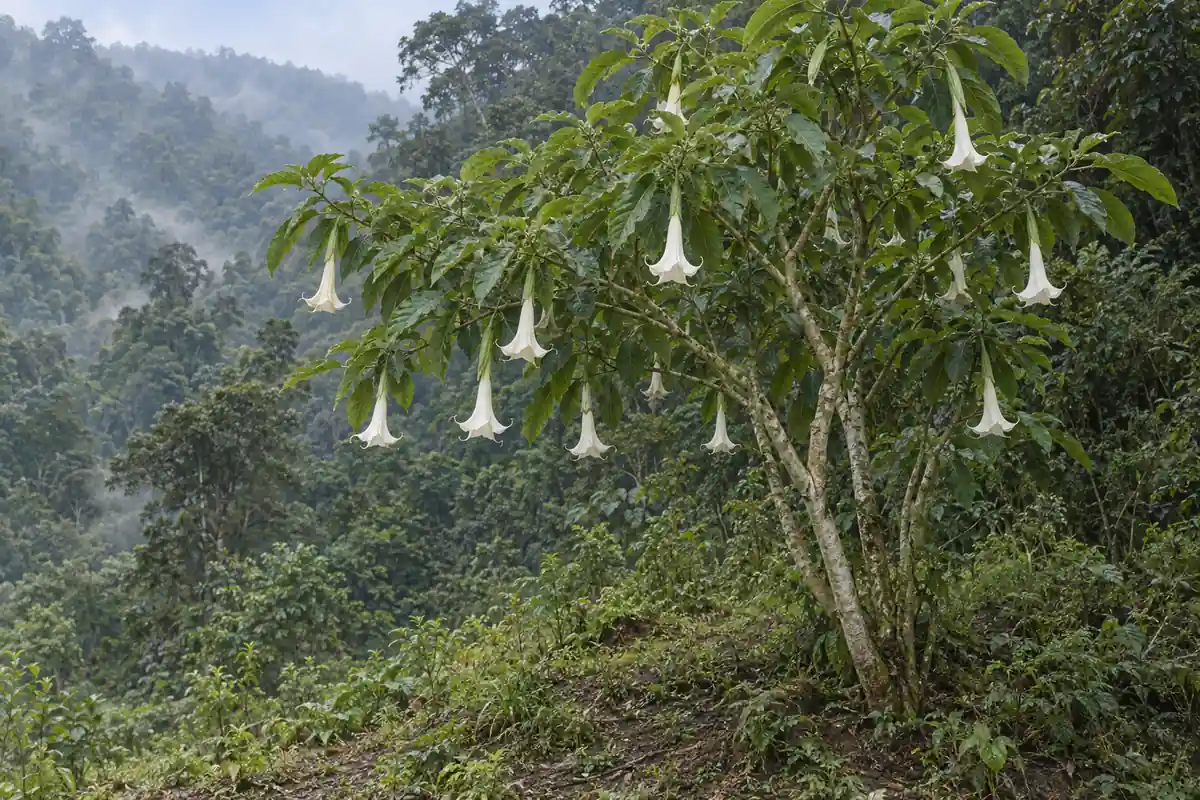
In English it's called brugmansia or angel's trumpet, a name that describes its hanging, trumpet-shaped flowers. It's also known as tree datura, a holdover from when these plants were grouped with their relatives, the thorn apples (Datura).
The Shuar call it maikiua (also spelled maikua). In Spanish it's widely known as floripondio, a word for a large, showy flower, and this is the usual equivalent of "angel's trumpet." The Kamëntšá and Inga have their own names for individual cultivated forms, but they group them under the Spanish borrachero or borrachera, which roughly means "intoxicant." Mestizo people of the Peruvian Amazon call it toé. It goes by other local names as well.
Brugmansia is the scientific name for a genus, a group of related species, and it isn't always certain which species a given local name refers to.
What it is
Brugmansia grows as a large shrub or small tree. It belongs to the nightshade family and is native to South America. Its long flowers hang downward and are often fragrant in the evening.
Which plant is used depends on the community. Among the Shuar and Peruvian mestizo healers, the species is usually identified as snowy angel's trumpet (Brugmansia suaveolens). In Colombia's Sibundoy Valley, people use cultivated forms of a hybrid angel's trumpet (Brugmansia × candida). One of these, called "Culebra" (Spanish for "snake"), has long, narrow leaves and deeply divided flowers; it was once classified as a separate genus. Another form there, "Guamuco," is probably red angel's trumpet (Brugmansia sanguinea).
How it's taken varies too. In the Shuar vision practice, people drink a juice of the plant after fasting, while in the Sibundoy Valley it has been used both as a drink and in other forms.
How it works
The main active compounds are scopolamine (also called hyoscine) and the closely related hyoscyamine, which is also reported as atropine. Both are tropane alkaloids, a family of plant chemicals, and the mix of the two differs from species to species and from plant to plant.
Both compounds block acetylcholine, a chemical messenger the brain uses for attention and for forming memories, at some of the sites on nerve cells where it acts. Interrupting these signals is thought to contribute to the confusion and memory gaps people report. Exactly how this leads to hallucinations isn't fully understood.
Effects on the mind
Brugmansia is a deliriant, not a classic psychedelic. It brings on a confused state in which people may not realize that what they're perceiving isn't real. They may see or speak with figures who aren't there, in encounters that can seem as solid as ordinary life.
People may also lose track of where they are, who is present or what is happening. Many accounts describe fear, agitation and losing contact with their surroundings. Afterward, their memory of the experience may be patchy or missing.
Experiences vary from person to person. Within the traditions that use brugmansia, visions and dreams may be sought out and valued as encounters or as guidance.
In tradition
Brugmansia's place differs sharply from one people to the next.
It may be drunk in search of an encounter. Shuar people on Ecuador's eastern Andean slopes who drink maikiua are often hoping to meet Arutam, a power they describe as present in waterfalls, in the forest and in people themselves. Someone who meets it is expected to come back stronger and surer of the path ahead.
Simply having the tree growing nearby can matter too. The Kamëntšá and Inga of the Sibundoy Valley have long kept named forms of it in house yards and gardens, and some of them believe it offers spiritual and energetic protection.
Some healers treat the plant as a teacher. In the Peruvian Amazon, mestizo healers known as vegetalistas count toé among the "master plants" they say teach them to cure illness and defend against sorcery. Kamëntšá and Inga healers, for their part, learn from borrachero as a sacred plant alongside yagé (ayahuasca, a brew made from the vine Banisteriopsis caapi).
Today
Outside these traditions, brugmansia is grown mainly as an ornamental plant in warm climates. Botanists regard its species as extinct or nearly so in the wild in South America, where they survive mainly in cultivation.
Research has centered on the plant's botany and chemistry, while the traditional preparations have been little studied. On its own, scopolamine is used in studies of memory in humans and animals, because it temporarily disrupts memory.
Traditions that use it
Cite this page
Psychoactive Traditions. “Brugmansia (angel's trumpet).” Last reviewed 4 November 2026. https://psychoactive-traditions.org/medicines/brugmansia