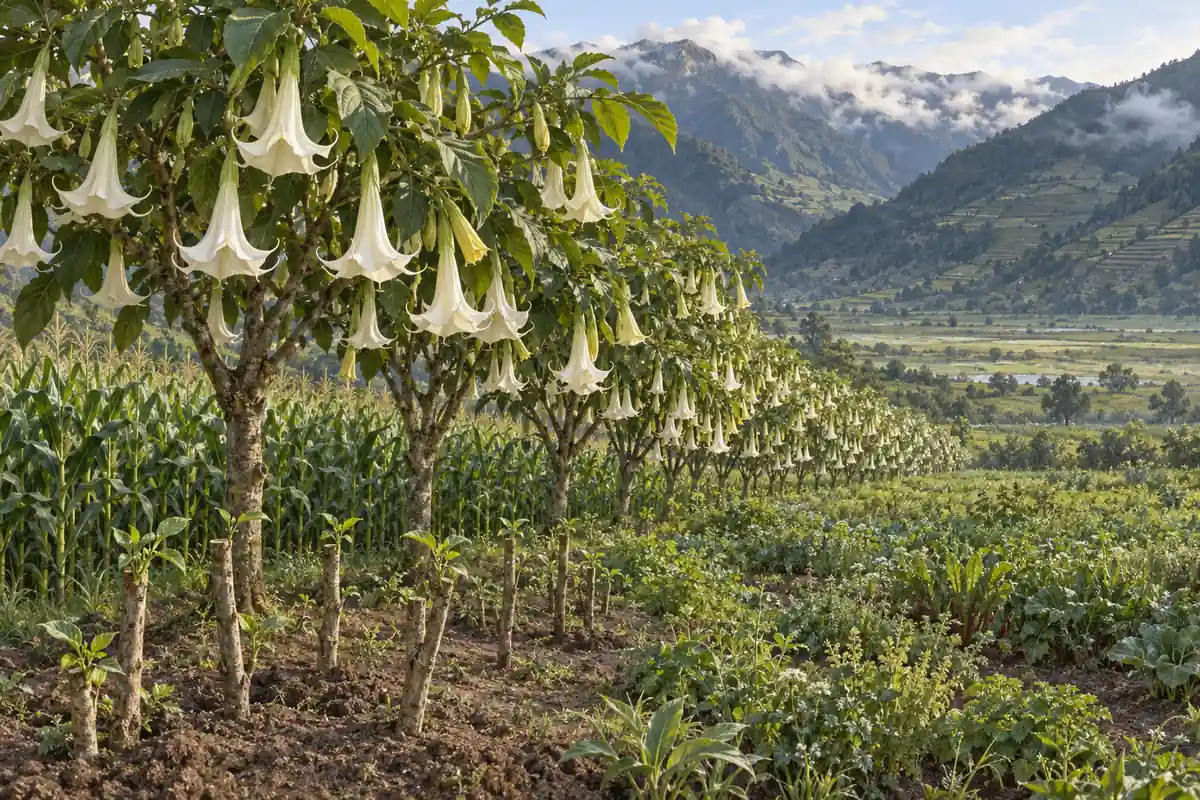
The Sibundoy Valley is a small, high basin, about 2,200 meters above sea level, on the Amazon-facing slope of the Andes in southernmost Colombia. Two Indigenous peoples have shared it for centuries: the Kamëntšá, who speak their own language, and the Inga, whose language is a northern form of Quechua. Both grow tree daturas, shrubs and small trees of the genus Brugmansia that carry long, hanging, trumpet-shaped flowers. In the valley the plants are called borrachera or borrachero, the "intoxicant." People treat aches and swellings with them, plant them as protection, and a few healers have used them to see what is otherwise hidden. In 1963 a botanist working in the valley counted roughly a thousand trees of the most common kind alone. They bloomed four times a year in hedgerows, house yards and the edges of cornfields, and everywhere their white flowers dominated the view. [2, 9]
A plant that lives only with people
Tree daturas do not grow wild in the Sibundoy Valley, or anywhere else as far as botanists know. They grow only where people plant them. The seeds are rarely viable, and in the valley every tree is raised from a cutting. Each year, before maize and beans are sown, people clear their gardens and prune the trees, then push the cut branches into the soft ground to root. Over generations, this practice has produced a set of clones that geneticists now call cultivars: plants that exist only alongside humans and whose form and chemistry people have changed over a long time. [2, 9]
The valley holds more variety in these trees than any other known place. In the early 1960s the botanist Melvin Bristol identified about a dozen named cultivars there, several of them found nowhere else. He also observed that people paid little attention to the flowers, however large and beautiful. They recognized and valued the trees by their leaves, and the varieties they had kept and multiplied were the ones whose leaves were strangely narrow, notched, twisted or stunted. [9]
The names come from three languages, and they describe what people see in the leaves. In Kamëntšá, one cultivar is ngunsiana, "hummingbird." According to one Kamëntšá man, its leaf resembles the tail and wings of the valley's long-tailed hummingbird; in Inga it is quinde, with the same meaning. A stunted tree with tiny, ragged leaves is munchira, Inga for "caterpillar," because its leaves look chewed. A cultivar with long, thin leaves is culebra in Spanish and mutscuai in Kamëntšá, "snake." Another, with yellowish leaves, carries the name of a small deer that lives near the marsh at the center of the valley. One with unusually thick young stems is called amarón, a Spanish name for the boa. The Kamëntšá regard the word borrachera itself as part of their own language, not a Spanish borrowing, which suggests how long it has been in use among them. [9]
Owned, guarded and handed down
Very few people in the 1960s could name all of these trees. An ordinary landowner might have several of the common white-flowered kind and none of the rarer ones. [9]
The rare cultivars were few in number: Bristol estimated that several had fewer than twenty trees each. One was known in a single garden, and its owner considered it the most toxic of all. Bristol could not tell whether the trees were scarce because they had come into cultivation recently or because their owners guarded them closely. One medicine-man told him that he could not afford to be seen near an unusual borrachera in another man's garden. [9]
Earlier accounts point toward guarding. Richard Evans Schultes, the Harvard ethnobotanist who first described the snake-leaved borrachera in the 1940s and 1950s, found that among both the Kamëntšá and the Inga its use was limited to a few practitioners, who tended the trees with special care. The plant appeared to be the hereditary property of certain families and passed to the eldest son together with the secrets of its use. Some of what a healer knew, Schultes was told, was passed to an apprentice only while the apprentice was "under the protection" of the plant. For the healer in whose garden Schultes first saw the snake-leaved tree, it was too sacred and too dangerous for strangers to approach. [2, 7, 9]
Decades later, the same reserve persisted. An anthropologist who walked the valley in the 2010s with an Inga healer was shown five named varieties along a short path, each identified by its flower color and leaf shape. Special varieties, however, were kept in private gardens and exchanged only among healers. When he asked whether these had different effects, the healers changed the subject or denied it. He knew borrachero was a sensitive topic and did not ask about specific uses. [1]
What the plant does
In the early 1960s, people in the valley used borrachera as medicine and to alter the mind in about equal measure. Most medicinal uses were external. Leaves were applied or used in baths for rheumatic pain, swollen infections, boils, colds and the skin disease erysipelas, and some cultivars served against worms. The yellow-leaved tree was given to hunting dogs, people said, to help them find game. One man planted the fruit of the common borrachera with his maize so that grubs would not eat the seed. This was the only use of the fruit Bristol encountered. [9]
Drinking borrachera, Bristol found, was not limited to medicine-men in those years. Healers held neither all the trees nor all the knowledge, though Bristol thought it likely that in many cases they directed how the drink was prepared. The people who had taken it described the experience in very similar ways. It stunned them and took away their senses. Their mouths and throats became so dry that for many hours they could neither swallow nor speak. Objects seemed to move nearer and farther away, and some people saw animals they feared. One woman said the plant made her feel stronger and younger. Asked to compare, people said they preferred yagé, more commonly known as ayahuasca, which they found more pleasant. [9]
Snakes appear in these accounts. A Kamëntšá man who recorded his acquaintances' experiences in 1960 described one of them seeing pastures "full of all kinds of snakes" that came up the slopes and "coiled to bite me." One medicine-man who had never taken the snake-leaved borrachera said he expected that it would show him "ugly things, snakes." [9]
On one question the records disagree. Schultes, working in the 1940s and 1950s, described the snake-leaved borrachera as reserved for very important or difficult cases of divination, prophecy and healing, with an intoxication lasting days. Others who visited in the 1950s heard similar accounts. Bristol, a decade later, found no one in the valley who had used that cultivar this way. A prominent medicine-man who owned perhaps a quarter of all the snake-leaved trees in the valley regularly drank yagé and had tried other borracheras, but he had never taken this one and knew no one who had. No one Bristol spoke with named divination as a reason for taking any borrachera. He noted that people often did not say which borrachera they meant, and that visitors could easily assume the famous one. He also noted that neither he nor others had recorded people's exact words, which would have made a firmer judgment possible. [2, 9]
The question of divination does not end with Brugmansia: the word borrachera also names a red-flowered shrub of the genus Iochroma. In 1974 a Kamëntšá medicine-man told Schultes that, besides using it for physical ills, he sometimes took it for especially difficult diagnosis, prophecy or divination. He did so when the other borracheras, which he considered weaker, had failed, because it might leave him ill for at least a day. Healers in "the old days," he said, used it much more often. Two years earlier, his son had said that its flower contained "a mystery." [3]
Between the mountains and the forest
The Kamëntšá and Inga live where the Andes meet the Amazon, and their healing draws on both. For the Kamëntšá, nature is full of beings other than humans. In the words of one Kamëntšá scholar, rivers, clouds, wind and great rocks, things that look inert from outside, "are endowed with a heart." Training as a healer rests on learning from sacred plants, chiefly yagé and borrachero. The anthropologists Carlos Pinzón and María Clemencia Ramírez saw a meaning in this pairing. Kamëntšá healers work through yagé, a plant of the lowland forest, and through datura, a plant of the Andes, and together the two "express what they are: mediators between highlands and lowlands." [5]
The pairing also appears in Kamëntšá myth. In one version, told by a Kamëntšá healer, the world began in darkness. Yagé climbed into the sky and entered an immense borrachero flower, which became the sun. From it came men bearing music and color, and from these came light, understanding and language. [5]
Neither main ingredient of yagé grows readily in the cold valley, so highland healers have long traveled to the lowlands to drink, learn and obtain the brew. They carried their own plants down and brought others back. "People from Sibundoy come to the lowlands to learn yagé and bring their own plant and take other plants," a lowland healer said in the 2010s. "It has always been that way." The white borrachera he grew had come to him through another healer as a cutting from a respected Siona elder, and he supposed it had originally come down from the highlands. Another lowland healer said the Kamëntšá had reached the valley "from far away" long before yagé arrived there, and "brought borrachero and the knowledge to use it." [1, 4]
The exchange continued in small ways. During that fieldwork, a lowland visitor brought yagé to a highland healer. After tasting it, the healer gave fresh herbs, glass beads for craftwork and a harmonica in return. He also cut a stalk from a white borrachera uncommon in the lowlands and handed it over: "Put it in the ground and that will grow." [1]
Highland healers' dependence on the lowlands has also changed how borrachero is regarded. Among lowland healers in the yagé networks in the 2010s, borrachero was ranked below yagé, as a medicine and not a plant of power, though some highland healers counted it a master plant. Because yagé was easier to manage, highland healers increasingly preferred it. Borrachero was left to a few experts, or to those who wished to show their experience. Lowland healers sometimes said that highland healers corrupted their yagé with borrachero, a practice they considered the work of sorcerers. One of them warned that a visitor "has to be always careful when going up into Sibundoy." Highland healers, for their part, often named lowland teachers as the source of their power. [1]
Guardian of the land
Outside ceremony, borrachero has another role in the valley. A Kamëntšá interviewee, speaking in 2024, recalled his grandfather's account of borrachero trees planted as boundary markers between family plots. "Instead of separating," he said, the trees "denote a sort of meeting point," a sign that neighbors had agreed to care for the place and to respect one another. "For us, it is not necessary to build a stone wall to demarcate a property." [2]
He also remembered an elder whose stories connected the plant with altering the course of water in the high mountains, with protecting sacred places, and with coming to know plants of the mountain that a person walking there would not normally notice. He called borrachero "a guardian plant" and said that what it tells people is "that we must protect the territory in any way we can." Researchers working with Kamëntšá healers reached a similar conclusion: the valley's Brugmansia and its local hybrids still shape how individuals and the community decide to manage their land. [2, 8]
Across the region, the plant is held to protect in other ways too. People in Sibundoy plant it to keep out intruders and people with bad intentions. In lowland towns of Putumayo, a borrachero at the door often marks the home of a healer, and the plant is understood to guard against witchcraft and evil spirits. Healers there use it in baths to clean away bad luck. Older women herbalists in Sibundoy have said that the plant, kept close to a sleeper, brings dreams whose messages should be heeded. [1, 2, 4]
Elsewhere in Colombia the same tree is mostly feared. In cities it is associated with burundanga, scopolamine used by criminals to make victims compliant, and parents warn children not to sleep under it. In the city of Manizales, a police commander once proposed destroying the plant altogether. Yet toxicology tests in robbery cases attributed to borrachero have often found prescription sedatives instead. [1, 2, 4]
In Sibundoy itself, by the mid-2020s, Brugmansia flowers were painted on the town's walls, and residents grew the trees in small front yards. The snake-leaved borrachera that Schultes found in a healer's garden eighty years earlier had become a symbol of cultural revival for younger Kamëntšá. The same interviewee, asked what people should understand about the plant, said: "The important thing is to have clear and transparent intentions with it. To think well and to do well." [2]
What is uncertain
Close botanical and field studies from the mid-1900s describe the valley's many kinds of tree datura and their uses in detail. A few recent first-hand accounts confirm that the trees are still widely grown and valued, but they say little about how healers use them today.
Early reports said medicine men used the plant for divination and prophecy, but a later year-long field study met no one who gave those reasons and found no one who had used the most famous variety this way. [9]
Lowland healers accuse highland healers of mixing borrachero into yagé and treat this as sorcery, and an older account quotes a highland healer endorsing the practice; how common it actually is remains unknown. [1, 4]
Sources disagree on how much the plant is still used. One calls it marginal and left to a few experts, the same source says Kamëntšá and Inga healers still use it commonly, an overview says the knowledge is dying out, and a recent essay calls it a symbol of cultural revival. [1, 2, 4]
It is unclear whether the specially kept varieties differ in strength or only in appearance, because owners avoided the question. [1, 9]
The plant's origin in the valley is disputed. One botanist argues it was brought in from outside, an overview cites the view that the valley is its homeland, and healers say it came with the ancestors or from the highlands. [1, 4, 9]
The unusual leaf shapes of several varieties may come from inherited traits, from a virus, or from both. [9]
The origin of the distinctive "snake" variety is unknown, and it may be a hybrid. [9]
Reports conflict on whether a second red-flowered plant also called borrachera is used for its effects on the mind. [3]
How far the plant is really behind criminal drugging in Colombian cities is disputed, and one source reports that tested cases often involved prescription sedatives instead. [2, 4]
No recent study has measured how many people use the plant or for what; the one survey-based study is available only as a brief undated abstract. [8]
Women's knowledge of the plant is described as largely private and has barely been studied. [1]
8 sources. Each claim checked by AI against the saved sources; every finding reviewed by Jim Davis beside the cited passage, 29 October 2026. How the articles were checked
Timeline of dated events (14)
- 900–200 BCa stone carving from elsewhere in the central Andes is claimed to show the plant's flowers, possibly the earliest known depiction. [1]
- 1535Spanish forces first enter the Sibundoy Valley, followed by missionary campaigns against healers' practices. [5]
- 1541 or 1542a Spanish conquistador passes through the valley along one of its trails (the two sources give different years). [5, 9]
- 1935a Colombian botanist collects the earliest known specimen of the valley's unusual tree datura varieties. [9]
- 1942a Harvard ethnobotanist first records the "snake" borrachero, which Kamsá and Inga healers grow for its effects on the mind. [2, 7]
- 1942, 1946 and 1953return visits by the same botanist gather more material and reports of use. [9]
- 1953the "snake" variety is first grown in easily accessible gardens. [7]
- 1955the "snake" variety is described as a new plant genus, which draws scientific attention to the valley's borracheros. [2, 7]
- Within five years after 1955chemical analyses of the "snake" variety find scopolamine to be its main active compound. [9]
- 1962–63a 13-month field study records twelve named varieties and estimates their numbers, from about a thousand trees of the common kind to a single owner's trees of the rarest. [9]
- 1969the "snake" variety is reclassified as a cultivated form of tree datura rather than a separate genus. [9]
- 1974a healer reports that a second red-flowered "borrachera" plant is used for difficult cases only when the other borracheros fail. [3]
- Fieldwork reported in 2021highland healers still exchange borrachero cuttings with lowland healers, including in trades for yagé. [1]
- By 2025the streets of Sibundoy carry murals of borrachero flowers, and the plant is described as a symbol of cultural revival and a "guardian plant". [2]
Sources
CSL-JSON imports into Zotero, Mendeley and other reference managers.
Echeverri-Sanchez, Hernando Alberto. 'Los Caminos de la Medicina': The life of medicinal plants from the forest of Amazonia to the urban markets. PhD thesis in Anthropology, University College London (UCL Discovery eprint 10079590; corrected version). Chapter 3, 'Borrachero', pp. 103-125.
A 2021 anthropology PhD thesis by a researcher who did fieldwork among healers in Putumayo and Sibundoy. It describes growing and naming varieties, exchanging cuttings between highland and lowland healers, protective planting, external medicinal uses, and the plant's lowly standing next to yagé, although the author chose not to ask about specific uses.
Castelblanco, Felipe. 2025. 'Borrachero Thinking' (English version of 'Borrachero, "Teufelsatem", Engelstrompete: Was möchte diese Pflanze von uns?'). In Unter Pflanzen, ed. Kathrin Meyer and Yvonne Volkart, pp. 96-103. Bad Homburg: Museum Sinclair-Haus. ISBN 978-3-945674-15-4. FHNW repository, doi:10.26041/fhnw-14636. CC BY 4.0.
A 2025 illustrated essay by an artist-researcher in a German museum exhibition magazine, based on several years of walks in the valley with Kamëntšá collaborators. It contributes a Kamëntšá account of borrachero trees as boundary markers marking agreement between neighbours and as guardians of territory, a geneticist's view of the plant's dependence on people, and notes on present-day murals and plantings.
Schultes, Richard Evans. 1977. 'A New Hallucinogen from Andean Colombia: Iochroma fuchsioides.' Journal of Psychedelic Drugs 9(1): 45-49. (Copy hosted by the MAPS Psychedelic Bibliography.)
A 1977 journal article by a Harvard ethnobotanist on a second, red-flowered plant also called borrachera. It shows the plant grown beside tree daturas in a healer's garden, used for difficult cases and for physical ailments, gives its Kamsá names, and lists specimen records from 1942 to 1972, including a retracted report.
Ronderos Valderrama, Jorge. 2006. 'El borrachero, pasado y presente en Colombia: mitos, creencias, prácticas y usos en sociedades indígenas, rurales y urbanas.' Cultura y Droga 11(13): 251-272. Manizales: Universidad de Caldas.
A 2006 workshop paper by a Colombian drug-culture researcher in Cultura y Droga, read only in part. It gives an overview of borrachero in Colombia, names Sibundoy healers as the leading experts and calls their knowledge endangered, quotes an older report on mixing borrachero with yagé, and disputes the plant's link to criminal drugging.
Marín Valencia, Alejandro. 2018. 'Yajé, chamanismo Kamëntsá y nuevos chamanismos urbanos: mitopoiesis y decolonización.' Revista Cultura y Droga 23(26): 67-96. doi:10.17151/culdr.2018.23.26.5.
A 2018 peer-reviewed article by an anthropologist on Kamëntšá yagé healing and urban neoshamanism, drawing on fieldwork from 2008 to 2017. It names borrachero alongside yagé as a sacred plant of healers' training and records an origin myth that links the two plants, but it is mostly about yagé.
Schultes, Richard Evans. 1955. 'A New Narcotic Genus from the Amazon Slope of the Colombian Andes.' Botanical Museum Leaflets, Harvard University 17(1): 1-11. doi:10.5962/p.168494. (BioStor copy on the Internet Archive.)
A 1955 Harvard botanical leaflet, read only in part, that formally described the "snake" borrachero as a new genus cultivated by Kamsá and Inga. The available part is mostly the botanical description, and its ethnographic passages are known through quotations in sources 2 and 9.
Sepúlveda Varón, Álvaro René, and Magdalena Peñuela Uricoechea. n.d. 'Influencia de las plantas enteógenas en procesos territoriales y de resistencia cultural. Estudio de caso: usos tradicionales del género Brugmansia, en la etnia Kamëntsá, Valle de Sibundoy - Colombia.' Conference abstract (etnobiología section), hosted by FLACSO Ecuador. 2 pp.
An undated two-page conference abstract by Colombian ethnobiologists reporting participatory research, 110 surveys and interviews with Kamëntšá and Siona healers. It claims that tree daturas and their local hybrids still shape decisions about land and cultural resistance, but gives no detail.
Bristol, Melvin L. 1969. 'Tree Datura Drugs of the Colombian Sibundoy.' Botanical Museum Leaflets, Harvard University 22(5): 165-227. (BioStor copy on the Internet Archive; BHL part 168369.)
A 1969 Harvard botanical paper based on the author's 13 months of fieldwork in 1962–63, and the fullest study available. It covers twelve named varieties with their Kamsá, Inga and Spanish names, numbers, propagation only by cuttings, medicinal and mind-altering uses, guarded ownership, doubts about earlier divination claims, and chemistry.
Related
Cite this page
Psychoactive Traditions. “Kamëntšá and Inga Borrachero.” Last reviewed 29 October 2026. https://psychoactive-traditions.org/traditions/kamsa-inga-borrachero