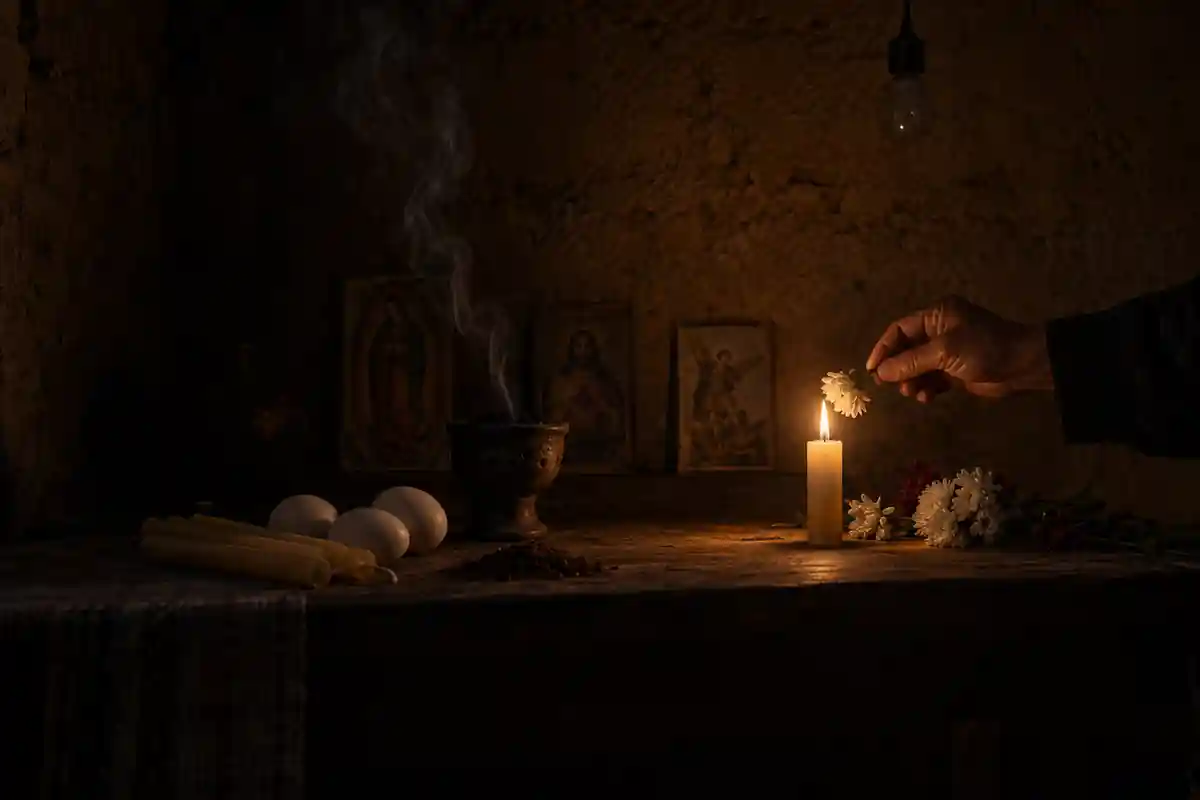
The Mazatec people live in the Sierra Mazateca, a mountainous region in the north of the state of Oaxaca, in southern Mexico. For generations they have eaten several species of Psilocybe mushrooms in a night ritual, which they hold to heal the sick, to find what has been lost, and to answer questions that cannot be settled any other way. A ritual specialist guides it, and the patient and close family attend. In Spanish it is called a velada, a night vigil. The Mazatec phrase behind the word, tsakjena kón ka'oña, means "staying awake together." [1, 10, 12]
Most of what has been written about the velada comes from Huautla de Jiménez, the region's main town, and from neighboring municipalities such as Santa María Chilchotla and San José Tenango. The written record runs from the late 1930s to the present. The ritual's basic elements have changed little over that time. What has changed, sometimes sharply, is the world around it. [2, 10, 12]
The little ones that sprout
Mazatecs call the mushrooms ndi xijtho, "the little ones that sprout." They also call them niños santos (the holy children), "the Saint," or "the little things." In everyday speech people often use Honguito, "little mushroom." The diminutive expresses deference and treats the mushroom as someone with a personality of its own. At a 2020 public forum, one Mazatec speaker put it plainly: "For us, the mushroom is a very sacred being. It is a deity because it has a spirit, it has a voice, and it is a sentient being." He described the mushrooms as a gift sent with the thunder at the start of the rains, so that people can "heal the ills that afflict us or recover our shadow that is lost." [4, 12]
The anthropologist Antonella Fagetti has worked in several Mazatec communities since 2007. People there distinguish three kinds of mushroom:
- the derrumbe, which grows from the earth; - the San Isidro, which grows in sugarcane waste and manure; - the pajaritos, "little birds," which grow on rotting tree trunks. [12]
People in these communities trace the mushrooms' origin to Christ. Where his blood and saliva fell, on the cross and along the paths he took to escape his persecutors, mushrooms sprang up. Some people therefore call the velada a mixa, a mass, at which the body of Christ is eaten. The mushrooms are counted in pairs, and each pair is a man and a woman, Jesus and the Virgin Mary. A mushroom left without its partner, people say, will go looking for it during the night. [12]
That Christian identity seems to have been layered onto an older one after missionaries arrived and learned what the mushroom meant to the Mazatecs. The Honguito gradually came to be identified with the Christian God, yet it kept its own character. People stress that "He is the one who speaks and makes speak." He shows, teaches, and tells the truth. He also judges and reprimands those who have broken social norms. "The Honguito is wisdom," one ritual specialist said, and that is why his words are received as just and true. [12]
Illness, spirits, and the reasons for a vigil
Researchers recorded a Mazatec account of the person in Huautla between 2007 and 2012. In that account, a person has two parts: yao na, the body, and sen, the spirit or image. The spirit can leave the body during sleep, serious illness, accidents, or a ritual with the mushrooms. Illness also has two sides. Besides bodily illness there is spiritual illness, which includes emotional upset or a hard problem: anything that threatens a person's physical and emotional stability. [3, 10]
The landscape itself is full of agents. The chikones, the Owners, live in hills, springs, caves, and rivers, and they own the land, the water, the trees, and the animals. People must ask their permission or pay them when entering their territory. Those who pollute water, cut trees without leave, or hunt too much may be punished. A chikon can trap the spirit of an offender, who then falls gravely ill.
Envy is another source of harm. In recent fieldwork in Chilchotla and Tenango, most people who described their veladas had turned to the mushrooms to rid themselves of a spell. Such spells were said to be cast by a sorcerer, a tje'e, out of envy or revenge, often in disputes between relatives and neighbors. The sorcerer, people say, can also work through the Honguito. [3, 4, 12]
The mushrooms are not taken out of curiosity. People seek a velada for four main reasons:
- to treat a serious illness that other medicine has not cured; - to locate a missing person or object; - to "straighten the fate"; - to find a way through a difficult problem.
Usually other remedies come first: burning candles, a cleansing, or a payment to the chikon who holds a person's spirit. It is the specialist who decides whether a case calls for the mushrooms. María Sabina, the best-known Mazatec healer, was surprised late in life that foreign visitors came to her "to encounter God." For her and her community, the little ones had always been used for the gravely ill and for people seeking answers. [10, 12]
Because the mushrooms are sacred, secrecy surrounds them. Strangers should not see them before the ritual, because a stranger's gaze is believed to contaminate them and weaken their effect. Plans for a velada are kept quiet so that the sorcerer responsible for the illness does not find out. [4, 12]
Seeing with one's own eyes
When other remedies have failed, the specialist may advise the afflicted person to discover the cause for themselves, to "see with their own eyes" who or what is responsible. This is the reason for staying awake together. Seeing personally also protects against unscrupulous practitioners who might use the mushrooms to report false truths. At the start of the ritual, the patient asks the Honguito, or God, to reveal what they want to know, to "enlighten" them. Some specialists call the ceremony suerte, "luck," because that night reveals the fortunes of the people present, and sometimes of absent people. [1, 12]
The ritual takes place indoors, at night, usually in the specialist's home. The table on which the altar stands is a sacred plane: its four corners correspond to the cardinal directions, and it faces east, the place associated with the beginning of life and the source of all good things.
The altar holds images of the Virgin of Juquila, the Virgin of Guadalupe, the Sacred Heart, Saint Michael, Saint Jude, and Saint Martin. Prayers also call on the Owners: the Owner of the Hill, the Mother of Water, Mother Earth. Copal resin burns in a censer, and its smoke purifies both the mushrooms and the participants. A ground tobacco called San Pedro is traced in crosses on their arms and joints. It is "hot because it is fire," balancing the coldness of mushrooms born from the earth. One specialist explained: "tobacco must be used so that all three work: tobacco, God, and the Honguito." [1, 10, 12]
After the mushrooms are eaten, the electric light is turned off. In one practice, the last candle is put out with a flower from the altar. The Honguito needs darkness and silence to speak. If a dog barks or a rooster crows, people say, it "gets scared and leaves," returning only when the room is quiet again. Light distracts from the visions. Participants describe watching images as if at a film in which they are both audience and actors. [10, 12]
Through the night the specialist prays, sings, whistles, claps, and sometimes dances. They may eat the mushrooms alongside the patient, or only one of them may eat while the other guides or reports. The specialist feels the patient's body for the illness, massages the place where it lies, and symbolically carries it out the door. Everyone present prays, including companions who have not eaten, because they are there to help. "I speak to the Mushrooms, or the Mushrooms speak to me," one specialist said; "that is why I know everything about a person who is afflicted and how they will be cured." [1, 10, 12]
What the Honguito asks
In Huautla, Mazatecs call the night's experience the "sacred journey." Everything done during the night, and everything the patient must do afterward, is understood to be indicated by God during that journey. Ignoring those instructions is "as if you were playing with God and the mushrooms," and the ceremony is then wasted or even harmful. Sometimes the instruction is to see a physician or to have surgery. In the gravest cases, God indicates that the patient will die and that nothing remains but to wait. [10]
Release from harm often has a physical form. Mazatecs hold that a sorcerer sends a harmful force called "air." "Taking out the air" may come with vomiting or the expulsion of water, and vomiting is taken as a sign that healing has begun.
The Honguito's work also reaches beyond the patient. A participant may be told to heal someone else present, or someone in another room. Some people who have been in trouble with their neighbors are ordered to go and apologize. In the Mazatec view that Fagetti and Roberto Mercadillo describe, the Honguito prefers that a person ask forgiveness rather than return the spell and keep the feud alive. When a person is trying to give up drinking or drugs, it tends to show them a better future rather than reprimand them. [12]
The work does not end at dawn. Participants are told to rest and to pay attention to their dreams. In the morning they gather before the altar to describe them. If a dream carries a bad omen, the specialist performs a cleansing or a reading with an egg, copal, or a beeswax candle.
Restrictions follow for some days:
- sexual abstinence; - staying at home where possible; - not sharing food or drink with anyone outside the household.
People explain that the spirit is weak after the journey and can be frightened out of the body. The Honguito remains inside, one woman specialist said, because it "is searching for the affliction." One velada is often not enough. The Honguito may ask for several more, and in serious cases for so many that a person may remain in "treatment" for life. [10, 12]
This longer sequence of preparation, vigil, and restriction is part of the treatment as Mazatecs understand it. Writing in 2014, the ethnographer Fabiola Minero noted that most visitors from abroad took part only in the night itself. [10]
Those who know
The specialist is the chjota chjine, "person who knows." Some carry other titles: "the one who fixes," "the one who guides," or "the one who knows the word." Specialists are understood to be chosen by a higher power. The call can come in three ways:
- in dreams; - through a ritual death, a trance lasting hours in which the chosen person visits God or the Virgin; - through an illness that must be cured with the holy children.
A person can also seek the role, but acceptance then comes during trance. Training takes years of practice alongside other specialists. One Mazatec speaker said in 2020 that it requires renouncing sexual desire, because the specialist is always in contact with the sacred. Each specialist develops their own methods, which can include reading candles, cards, copal, or maize. [1, 3, 4, 6, 12]
Language is at the center of this gift. As a girl around 1900, María Sabina watched a healer treat her uncle and heard him speak and sing in a language unlike the one he used every day. Years later, she recounted, she was healing her sister when she saw the Principal Beings gathered around a table. A glowing white book appeared on it. One of them told her: "This is the Book of Wisdom. It is the Book of Language. All it contains is for you." [7]
After 1957
Outsiders first witnessed a velada in 1938. In 1955 the American banker R. Gordon Wasson attended one led by María Sabina, and in 1957 he described it in Life magazine. That same year the Swiss chemist Albert Hofmann isolated psilocybin from the mushrooms, and the compound later entered pharmaceutical production. According to María Sabina's own later account, she agreed to receive Wasson because a municipal official asked her to: "It is true that before Wasson, no one spoke so freely about the children. None of our people revealed what they knew about this matter. But I obeyed the municipal trustee." [1, 2, 7, 9, 12]
Through the 1960s and 1970s, young visitors arrived in large numbers looking for the mushrooms and for her. At one point the army closed the access road on presidential orders. The people of Huautla at first paid the newcomers little attention, but grew angry when they saw sacred practices used without respect. María Sabina bore much of the cost. People in her community resented her for having "revealed" the secret, her house was burned, a son was killed, and she died poor in 1985. In her last years she told her biographer that the holy children had lost their purity and no longer lifted her as before. [3, 5, 7, 12]
In the communities Fagetti and Mercadillo studied, more recent fieldwork tells a different story: the elements María Sabina described are still observed, and people say the Honguito has not lost its force (ng'anío). [12]
The tradition has not held steady everywhere. In the Puebla portion of the Sierra Mazateca, a 2018 study found that people in one community had stopped using the mushrooms out of fear. They said that "if you are not careful, they go to your head." Instead they used the seeds of the Virgin, the seeds of a morning glory. Across Mexico, researchers have found mushroom use moving into the home, without a specialist, or fading altogether. [2]
Holy children in a market
Another kind of change came through the market. From the 1970s onward, the mushrooms took on an exchange value, first traded for goods and then sold for money. People Mazatecs call neoshamans began holding ceremonies mainly for visitors. Many in the community regard them as charlatans, chiefly because they skip the full process of diagnosing the illness.
In 2015 Huautla was named a "Magical Town," and the municipal government promoted an image of mystical Huautla built around María Sabina. Most of those who attend the annual María Sabina festival are visitors, and many residents view it with disdain. By 2020, Mazatec speakers were also reporting a shortage of mushrooms over the preceding nine years. They linked it to changes in land use and outside demand. [3, 4]
Visitors come for many reasons, and some have built ties of godparenthood with Mazatec families over years. The speakers at the 2020 forum did not object to their presence, but asked for respect. People should not "think that by paying money they can demand that the ceremony be adapted to their expectations. For us, the ceremony is priceless because it is something sacred."
Their concerns extended to scientists. Some reported mycologists collecting samples without community permission. Others asked why the knowledge behind a growing psilocybin industry had never been acknowledged or repaid. Writing in 2026, a Mazatec sociologist from Huautla argued that Western science had reduced a whole body of Mazatec knowledge "to a single molecule." He added that most Mazatecs are occupied with food, housing, and protecting their land. For them, passing on knowledge "is not a project. It is daily life." [3, 4, 8, 9]
In the Sierra Mazateca in 2026, the rains between July and September still sent families into the woods to gather edible mushrooms for tamales and broths. They also gathered the sacred varieties (derrumbe, santitos, and San Isidro) for healing carried out within the intimacy of the family and guided by a traditional healer. A Mazatec man from Mazatlán Villa de Flores described the experience as "in no way a psychedelic trip," but "a process of introspection." He regretted that in some places the practice had become a business: "they already sell you the service: lodging, food, and everything." [11]
What is uncertain
Several detailed first-hand accounts from roughly the last fifteen years describe the night-time healing ceremony, and they agree on its main features. The most thorough of them come from a small circle of researchers working in a few highland towns, and much recent writing is about tourism rather than the ceremony itself.
Sources disagree on how long the food and sexual restrictions before and after a ceremony last, and on whether the restrictions before it are required or only advised. [4, 10, 12]
Sources differ on which mushroom species are used: one names three main kinds, others list six, and one says at least ten. [1, 3, 7]
It is disputed whether the paid ceremonies offered to tourists belong to the tradition or depart from it. Community voices call many such providers charlatans, while one researcher points out that some of them have real traditional knowledge. [3, 4]
Mazatec writers disagree on whether outsiders can properly take part. Some say healers rarely receive outsiders; others say outsiders can join if they come with responsibility and respect. [4, 8]
No source settles how far back the Mazatec ceremony itself goes. Claims of ancient Mesoamerican roots rest on general regional evidence, and the written record of Mazatec practice starts in the late 1930s. [2, 6, 7, 12]
It is unclear how and when the mushroom came to be identified with the blood of Christ. One source ties this to the arrival of missionaries; another places Christian elements within a longer Mesoamerican blending. [6, 12]
No study has examined how the ritual setting and the mushroom's chemistry together affect healing; the claims of effectiveness rest on ethnographic reports. [1, 12]
How widely the practice continues across the whole Mazatec region is not known: in at least one Mazatec town in Puebla, people reportedly no longer use the mushrooms. [2]
Reports of mushroom shortages and overharvesting have not been backed by any ecological study. [2, 4]
Some writers warn against treating the Mazatec as the only or original keepers of this knowledge, since several other peoples also use the mushrooms. [2, 9]
12 sources. Each claim checked by AI against the saved sources; every finding reviewed by Jim Davis beside the cited passage, 30 October 2026. How the articles were checked
Timeline of dated events (19)
- c. 1900María Sabina, as a young child, sees a healer hold a mushroom ceremony to cure her uncle. [7]
- 1920sResearchers show that teonanácatl, described in the 16th century, was a mushroom. [12]
- 1938 (one source gives 1939)Outside researchers first witness or record a Mazatec mushroom ceremony. [2, 3, 12]
- 1953, or 1955 by other accountsGordon Wasson meets María Sabina in Huautla de Jiménez. [2, 5, 6, 7, 9]
- 1957Wasson's article in Life magazine makes the ceremony known worldwide, initially hiding María Sabina behind a pseudonym. [1, 3, 9]
- 1957Albert Hofmann identifies and synthesises psilocybin and psilocin from the mushrooms. [1, 2, 9]
- 12–13 June 1958A ceremony led by María Sabina is recorded; its chants are published in 1974 as a book with a record. [2, 12]
- Early 1960s (five years on, by one account)Wasson brings Hofmann to Huautla. [9]
- 1960s, with a peak of euphoria around 1969Large numbers of hippies and other visitors arrive in search of the mushrooms. The army at one point closes the access road. [3, 5]
- Since the 1970sMushrooms and ceremonies enter a commercial market, first traded for goods and later sold for money. [4]
- 1977María Sabina's life story, told to Álvaro Estrada, is published; in it she says the mushrooms have lost their power. [2, 12]
- After the Wasson encounter, undatedMaría Sabina faces anger in her community; her house is burned and a son is killed. [7]
- 1985María Sabina dies in poverty. [7]
- Annually, mid-JulyThe town council holds a María Sabina festival, attended mostly by tourists. [3]
- In the nine years before 2020A researcher with long fieldwork reports a constant shortage of mushrooms, linked to changes in land use and to foreign demand. [4]
- 2015Huautla de Jiménez becomes a "Pueblo Mágico" (a government tourism label), and ceremonies are promoted further as a tourist product. [3]
- In the five years before 2020"Facilitators" begin coming to learn ceremonial techniques to offer outside the region. [4]
- 2021Researchers, including a Mazatec archivist, publicly call for reparations to Mazatecs over patents on psilocybin. [9]
- 2021A program supporting Indigenous-led projects is launched, coordinated by a Mazatec scholar. [8]
Sources
CSL-JSON imports into Zotero, Mendeley and other reference managers.
Caynas Rojas, S. & Mercadillo, R. E. (2024). Cognición extendida y símbolos de la velada mazateca con hongos psilocibios. Andamios 21(54): 179–210. Universidad Autónoma de la Ciudad de México.
Journal analysis by two neuroscience researchers (2024). It reviews published ethnography of the ceremony to argue that its symbols shape psilocybin's effects, and notes that no study has examined that interaction. It is built mainly on sources 12 and 2.
Fagetti, A., Mateos Segovia, E. & Reinoso Niche, J. (2023). Cartografía etnográfica del uso ritual y terapéutico de hongos del género Psilocybe en México. Elementos 131: 71–82. Benemérita Universidad Autónoma de Puebla.
Survey by an anthropology team (2023). It maps the ritual use of the mushrooms in Mexico from the 1940s to the present, with brief fieldwork in 2020–21, and discusses decline, tourism and threats to the mushrooms. It shares an author with 12.
Piña Alcántara, S. (2019). Turismo y chamanismo, dos mundos imbricados: el caso de Huautla de Jiménez, Oaxaca. Cuicuilco 26(75): 43–66. Escuela Nacional de Antropología e Historia.
Journal article by an anthropologist (2019), based on about 12 years of fieldwork in Huautla de Jiménez. It covers healers' knowledge in outline, the growth of tourism and commercial ceremonies, and community views of them.
García Flores, I., Acosta López, R. & Piña Alcántara, S. (2020, 12 November). Niños Santos, Psilocybin Mushrooms and the Psychedelic Renaissance. Chacruna Chronicles.
Web talk by two Mazatec community members and a long-term resident psychologist, with an anthropologist (2020). It gives first-person descriptions of how a ceremony is conducted, its secrecy and its rules, together with concerns about tourism, shortages and outside researchers.
Fernández Rodríguez, A. G. & Higuera Bonfil, A. (2022). El papel de los enteógenos como imaginario social en la mazateca: Huautla de Jiménez, Oaxaca. Antrópica 8(15): 161–174. Universidad Autónoma de Yucatán.
Photo essay by two anthropologists (2022), based on fieldwork in 2018–20. It includes an interview with a Mazatec healer on the role of Catholic saints in the ceremony, and images of a ceremonial space.
González Romero, O. S. (2022, 10 February). Mazatec Shamanic Knowledge and Psilocybin Mushrooms. Chacruna Chronicles.
Web essay by a researcher (2022). It outlines healers' paths to the role, the plants they use, the ritual "table", the giving of mushrooms in pairs and the mixing of Mesoamerican and Catholic elements, drawing mainly on earlier writings.
González Romero, O. (2021, 27 May). María Sabina, Mushrooms, and Colonial Extractivism. Chacruna Chronicles.
Web essay by the same researcher (2021). It retells María Sabina's life from her published testimony and examines the Wasson encounter and its unequal power.
García Cerqueda, O. (2026, 21 October). Indigenous Reciprocity Beyond Romanticization. Chacruna Chronicles (first published in MAPS Bulletin XXXVI).
Web essay by a Mazatec sociologist and historian (2026). It argues against romanticizing Mazatec knowledge and discusses who may represent the community and what fair exchange should mean.
Leite, M. (2021, 12 February). Researchers Demand Reparations to Mazatecs for Mushroom 'Spirit'. Chacruna Chronicles (translated from Folha de S.Paulo blog Virada Psicodélica).
Journalist's report (2021) on calls for reparations to Mazatecs over psilocybin patents. It summarizes the Wasson and Hofmann history and quotes concerns about treating the Mazatec as the only source of this knowledge.
Minero Ortega, F. (2014). Sacred Journey into the Presence of God. Ritual Use of Sacred Mushrooms among the Mazatecs of Oaxaca, Mexico. In Horák, M. et al., A Reader in Ethnobotany and Phytotherapy, pp. 142–150. Mendel University in Brno.
Book chapter by an ethnologist (2014), based on fieldwork from 2007 to 2012. It describes the ceremony in three stages (preparation, the night itself and later restrictions), the healer's actions and participants' accounts.
Briseño, P. (2026, 9 August). Recolección de hongos de Oaxaca, entre tradición de sanación y la cosecha. Excélsior.
Newspaper report (2026) on the mushroom-gathering season in Oaxaca. It notes family-based healing use and quotes a Mazatec man regretting that the ceremony has been turned into a business.
Fagetti, A. & Mercadillo, R. E. (2022). Experiences With Sacred Mushrooms and Psilocybin In Dialogue: Transdisciplinary Interpretations Of The "Velada". Anthropology of Consciousness 33(2): 385–411. American Anthropological Association. doi:10.1111/anoc.12163. Cached copy is the Early View PDF; page locators are converted to the issue pagination (issue page = Early View page + 384).
Peer-reviewed journal article by an anthropologist and a neuroscientist (2022). It draws on fieldwork from 2007 to 2021, three observed ceremonies and patient testimonies to describe the ceremony's setting, rules, healing process and beliefs, and compares them with clinical research on psilocybin.
Related
Cite this page
Psychoactive Traditions. “Mazatec Mushroom Velada.” Last reviewed 30 October 2026. https://psychoactive-traditions.org/traditions/mazatec-mushroom-velada