Names
In Western countries, they're usually called magic mushrooms or shrooms, and sometimes sacred mushrooms.
The Mazatec of Mexico call them niños santos, Spanish for "holy children," and, in Mazatec, ndi xijtho or ndi xi tjo, "little ones that sprout." The Zapotec of El Peral, also in Mexico, call their mushroom Ni’to be’ya, or "holy mushroom." Among Basotho healers, Psilocybe maluti goes by koae-ea-lekhoaba. Other local names exist too, some of them for single species.
There's no single scientific name for these mushrooms, though most belong to the genus Psilocybe. When it comes to matching a community's mushroom with a scientific species, some matches are firm and others are only probable.
What it is
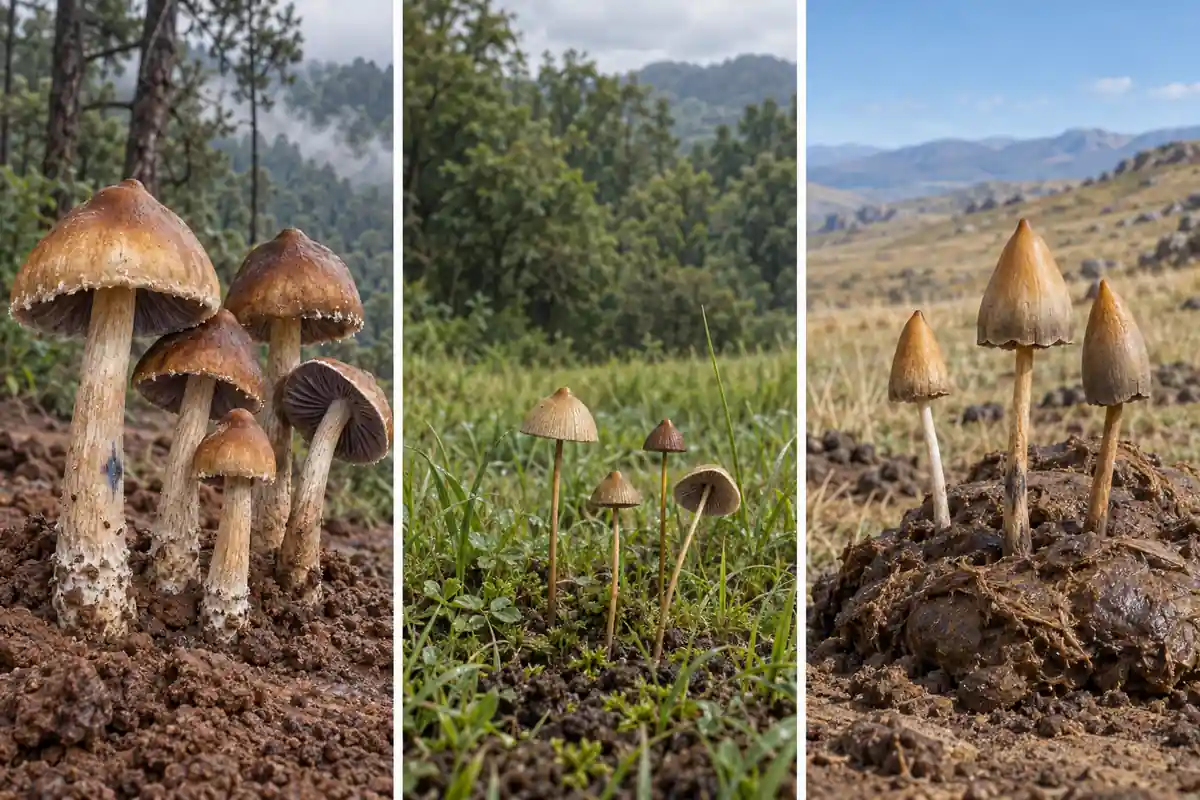
Psilocybin mushrooms are grouped by their chemistry: more than 100 species produce psilocybin (4-phosphoryloxy-N,N-dimethyltryptamine). They're found on several continents and, depending on the species, grow on soil, dung, or decaying plant matter. Many are small and brownish with slender stems, and many turn bluish where they're bruised.
The mushrooms differ from one tradition to the next. The Mazatec eat several species, among them derrumbe (Spanish for "landslide," Psilocybe caerulescens) and pajaritos (Spanish for "little birds," Psilocybe mexicana). The Zapotec of El Peral eat a holy mushroom that has been identified, from collected specimens, as Psilocybe zapotecorum. Some Basotho healers use Psilocybe maluti, a golden-capped mushroom that was named by scientists in 2024.
How it works
Psilocybin itself is thought to be largely inactive. The body converts it into psilocin (4-hydroxy-N,N-dimethyltryptamine), and that's what is responsible for most of the effects. Psilocin closely resembles serotonin, one of the brain's chemical messengers, and it acts especially at one of serotonin's docking sites on nerve cells: the serotonin 2A receptor. Brain-imaging studies show that psilocybin changes how activity in different brain regions is coordinated, but just how these changes produce the experience isn't fully understood.
Effects on the mind
Psilocybin mushrooms are a classic psychedelic. When eaten, they alter perception, mood, and thought, usually for several hours. People often report shifting colors and patterns, imagery seen with the eyes closed, and a distorted sense of time. Emotions can grow intense, and personal memories may surface.
Some people describe awe, deep meaning, or a loosening of the boundary between themselves and the world. Others report fear, confusion, or suspicion, or feel they're losing their grip on reality, and a single session can hold both extremes. Awareness of one's surroundings can fade, though people usually remember the experience afterward. What happens is shaped by expectations and setting. And while an insight may feel certain, that feeling doesn't show that it's true.
In tradition
Both Mexican traditions turn to the mushrooms for knowledge, though in different settings. The Mazatec eat them during a night vigil guided by a ritual specialist, the chjota chjine, while Zapotec residents of El Peral eat them at home at night. The Mazatec hold that the mushrooms find what is lost and let people "see with their own eyes" the answer to a hard problem. In El Peral, people put questions to the mushroom, such as whether a border crossing will succeed.
All three traditions also treat these mushrooms as a medicine. The Mazatec hold that they heal illness of body or spirit. In El Peral, the mushroom is taken to name an illness and who is behind it. And some Basotho healers use it against illness and curses. Those healers also add it to initiation brews that are said to sharpen the dreams and visions through which ancestral spirits communicate, though in one small interview study, other healers didn't recognize it.
Today
Psilocybin mushrooms are now also used well beyond these traditions. Researchers, for their part, mostly study the purified compound rather than the mushrooms themselves. Clinical trials are testing psilocybin, given alongside psychological support, as a treatment for depression.
Among the Mazatec, fieldwork published in 2022 found that the basic elements of the vigil were still being observed. In El Peral, fieldwork from 2021 to 2024 found the practice still alive but declining, as mushrooms grew scarcer and young people turned away.
Traditions that use it
Cite this page
Psychoactive Traditions. “Psilocybin mushrooms.” Last reviewed 1 November 2026. https://psychoactive-traditions.org/medicines/psilocybin_mushrooms