Names
Mazatec names include ska María Pastora and the shorter ska Pastora, "leaves of the Shepherdess." Spanish names used among the Mazatec include hojas de la Pastora, which means the same thing. Two others name Mary: hojas de María Pastora, "leaves of Mary the Shepherdess," and hierba de María, "Mary's herb." Several of these names refer to the leaf, and there are other names and spellings as well.
In Western countries, the plant usually goes by salvia or diviner's sage. The short name can be confusing, since Salvia is also the genus of the true sages, including garden and kitchen sages. The second word of its scientific name, Salvia divinorum, means "of the diviners."
What it is
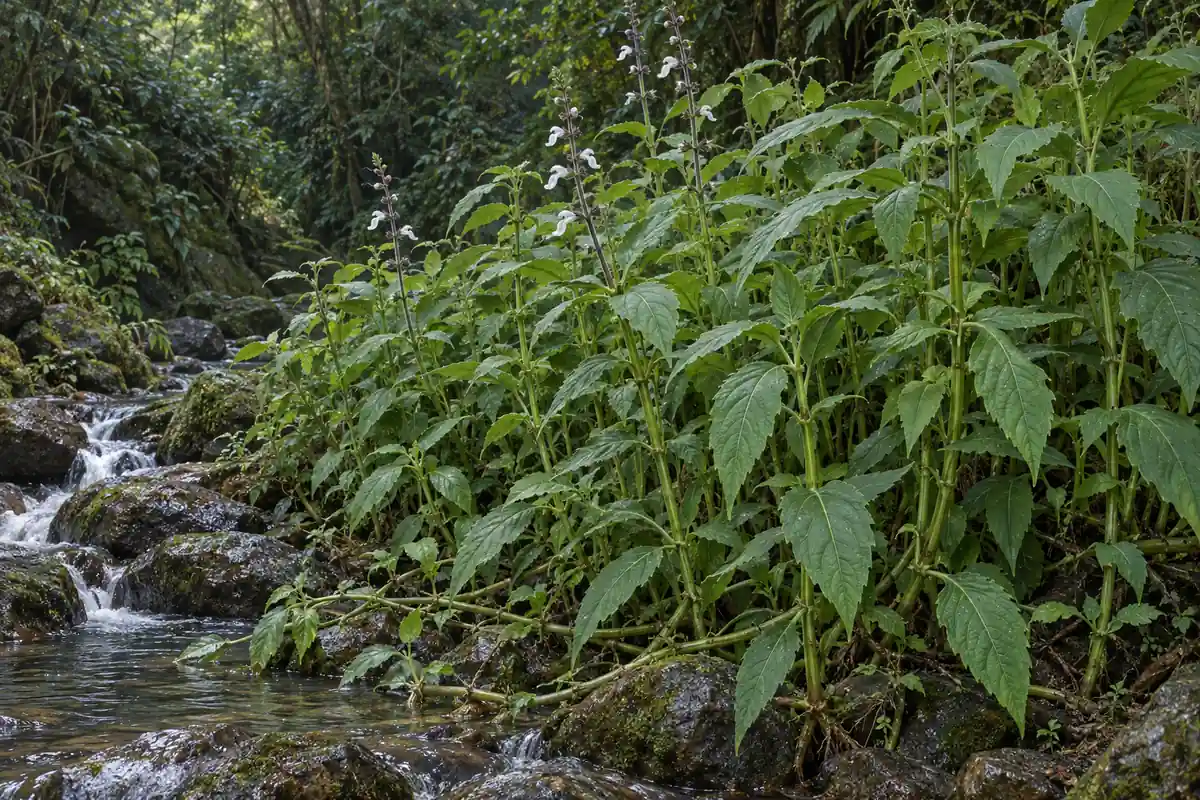
Salvia divinorum is a leafy perennial herb in the mint family. It has large green leaves and square, hollow stems, and it can grow more than three feet tall. It blooms only occasionally, but when it does, its white flowers sit in violet cups.
The plant is associated with the moist, shaded forests of the Sierra Mazateca in northern Oaxaca, Mexico. It rarely produces seed and spreads mainly when its stems take root. Botanists aren't sure whether truly wild populations exist, since the known stands may have been planted, and how the plant originated is also an open question.
Only the leaf is used as medicine, and Mazatec practice uses it fresh.
How it works
The main active compound is salvinorin A, a type of plant chemical called a diterpene, which is concentrated in tiny glands on the leaf.
Laboratory studies show that salvinorin A attaches to and activates kappa-opioid receptors, which are docking sites on nerve cells. These receptors are part of the brain's opioid system, but they are distinct from the receptor mainly associated with opioid painkillers. Classic psychedelics act mainly on a serotonin receptor. Salvinorin A doesn't, and that is a key reason it's classed apart from them. Just how its receptor activity produces the experience isn't fully understood.
Effects on the mind
Salvia divinorum is usually described as an atypical hallucinogen with dissociative qualities, meaning it can loosen a person's connection to their surroundings and to their sense of self.
Experiences vary widely. Some people report only quiet shifts in perception, thought, or mood. Others describe a changed sense of their body and of space, such as being pulled or twisted, merging with objects, or being somewhere else entirely. Some laugh uncontrollably, and some value a feeling of calm or insight.
Difficult experiences can include fear, confusion, and losing track of where they are or what is happening. With the fresh leaf, the effects usually last about an hour, though reports vary.
Much of this detailed description comes from people and studies outside the Mazatec setting, so it may not reflect what Mazatec patients report.
In tradition
In the Sierra Mazateca, Mazatec healers and patients use the fresh leaves in night ceremonies held before an altar, and some speak of the plant as a female doctor. The leaves are used to help the patient discover what broke their balance and caused an illness, or to find something that has been lost. They are also used for everyday ailments. Fieldwork published in 2018 describes this as a living practice.
Today
The plant is now also used well beyond the Mazatec setting. Research centers on salvinorin A. Small studies in volunteers have described its effects on perception and brain activity, and animal and laboratory studies use it and related compounds to explore the kappa-opioid system. This work is still at an early stage and has not established any medical use.
Traditions that use it
Cite this page
Psychoactive Traditions. “Salvia divinorum.” Last reviewed 1 November 2026. https://psychoactive-traditions.org/medicines/salvia_divinorum