Names
In Western countries, the medicine usually goes by morning glory seeds or ololiuqui. It also has several local names:
- *Ololiuhqui: Nahuatl for "round thing." The word refers specifically to the round seed of the Christmas vine, though it's often used for both species. - Badoh: a Zapotec name. The black seeds of the Mexican morning glory are called badoh negro. - Semilla de la Virgen: Spanish for "seed of the Virgin" - Yukú iá sií:* Mixtec for "herb of the virgin"
The seeds come from two species: the Christmas vine (Ipomoea corymbosa, also known as Turbina corymbosa or Rivea corymbosa) and the Mexican morning glory (Ipomoea tricolor). Many older sources call the latter Ipomoea violacea, but that name properly belongs to a different species.
What it is
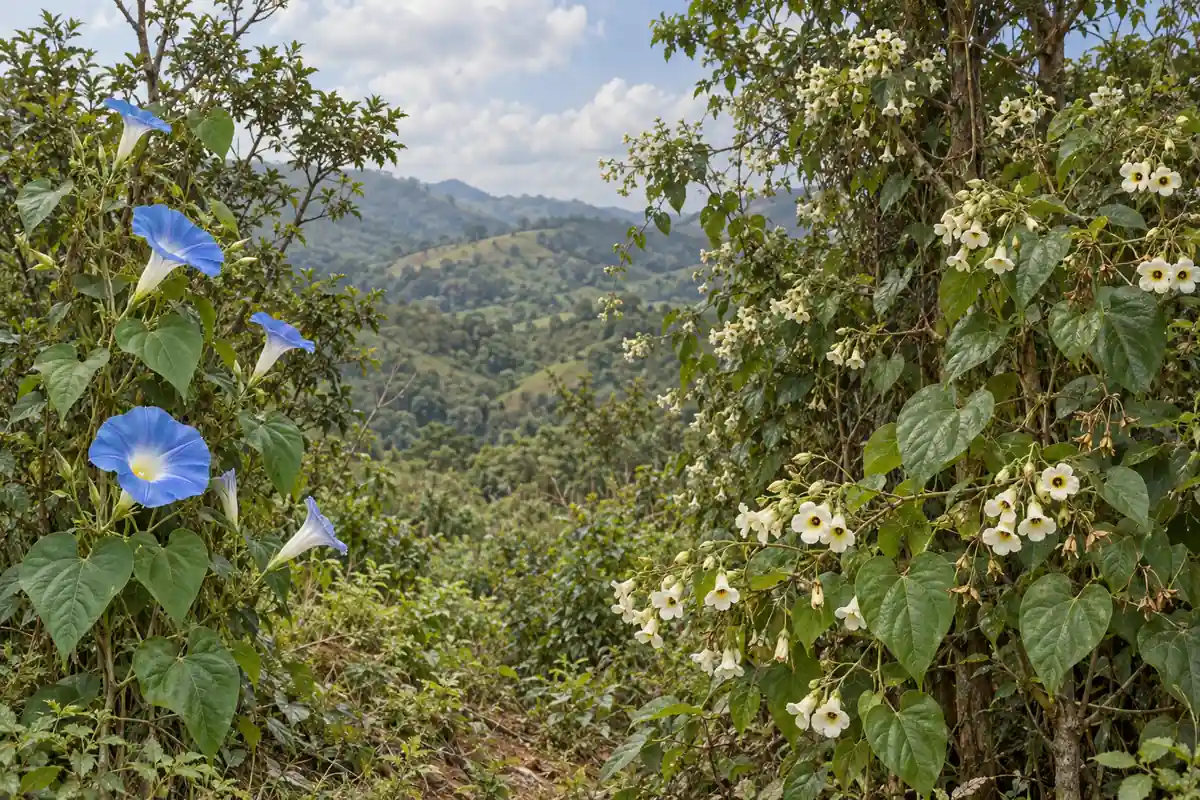
Ololiuqui is the seed of either of two climbing vines in the morning glory family. Both grow in warm parts of the Americas, including Mexico, and both have funnel-shaped flowers and often heart-shaped leaves.
The easiest way to tell them apart is by their flowers and seeds. The Christmas vine has clusters of white flowers and small, round, brown seeds. The Mexican morning glory's flowers are typically blue to purple, and its seeds are long, angular and black.
In the Oaxacan seed tradition, people take the seeds as a drink.
How it works
The seeds' main active compound is generally considered to be LSA (lysergic acid amide, also called ergine), a chemical relative of LSD (lysergic acid diethylamide). LSA belongs to the ergot alkaloids, a family of compounds named after ergot (Claviceps purpurea), a fungus that grows on rye and other grains.
Both species contain LSA and related alkaloids, but laboratory studies indicate that the vines don't make these compounds themselves. Instead, the compounds come from a fungus (Periglandula) that lives in close association with the plant and passes to the next generation through its seeds.
LSA is thought to act on receptors for serotonin, one of the brain's chemical messengers, but it has been little studied. It's also unknown how much of the experience comes from LSA and how much from the other alkaloids.
Effects on the mind
Ololiuqui is usually grouped with the psychedelics, substances that change perception, mood and thought. Much of what we know about it comes from a small number of older self-experiments and personal reports rather than from controlled research.
People describe a dreamy, drifting state in which their sense of time and surroundings changes. Some report vivid imagery, heightened emotion or a sense of meaning. Others describe apathy, emotional detachment or a feeling of unreality, and some experiences are difficult, bringing anxiety and confusion.
The experience varies from person to person, and in some older studies, volunteers given the seeds felt little or nothing. It's generally reported to last several hours, though how long it lasts in ceremonial use isn't well documented. Some people report a sense of having received an answer, but that sense isn't evidence that the answer is true.
In tradition
In the mountains of Oaxaca, Zapotec, Mixtec, Mazatec and Chinantec communities have used the seeds to find out why someone is sick, who is responsible, and where a lost thing has gone. The most recent evidence comes from fieldwork in two Mixtec villages in 2010. People there said that the herb itself speaks through the drinker, naming the fright or malice behind an illness. That account comes from those villages and shouldn't be assumed to hold for every community. At the time, two elderly women in one of the villages were still known as specialists. No later fieldwork has been reported, so it's unclear where the practice stands today.
Today
Morning glory seeds are also used outside these traditions, including in Western countries. Research has focused mainly on the seeds' chemistry, and few controlled studies have been done in people, so the scientific evidence on their effects is still limited.
Traditions that use it
Cite this page
Psychoactive Traditions. “Ololiuqui (morning glory seeds).” Last reviewed 1 November 2026. https://psychoactive-traditions.org/medicines/ololiuqui