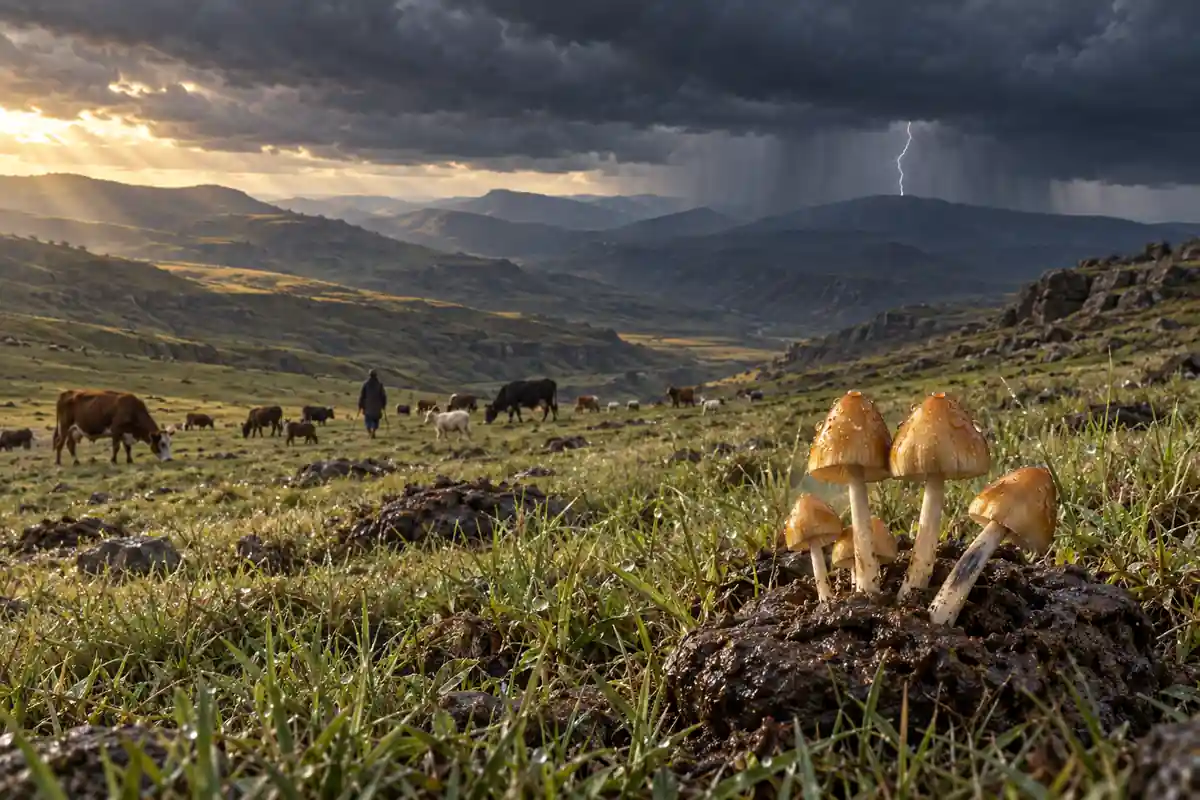
The Basotho live in the mountain kingdom of Lesotho and in neighboring South Africa. Their traditional healers remain a regular part of life in Lesotho, where about 90 percent of people identify as Christian. Some of these healers use a golden-capped mushroom that grows in cattle dung and darkens when bruised. Mycologists named it Psilocybe maluti in 2024. Healers add it to brews that are said to sharpen the dreams and visions through which ancestral spirits communicate, and they also use it against illness and curses. It has no widely reported name of its own: koae-ea-lekhoaba, the term given for it, applies to most other mushrooms as well. [1, 3, 6, 8]
A calling through sickness
In Sesotho a healer is a lethuela, although the Zulu-derived word sangoma is also used: by one study's account it is more common, and by another's it is used with non-Sotho people because it is more familiar. Healers are understood to gain their abilities by communicating with ancestral spirits, and few describe choosing the work. Spirits are said to demand that a person begin initiation by striking them with a sickness that may include bodily pain, vivid dreams, and voices. The cure is to find a gobela, a spiritual teacher. Refusal, healers say, makes the sickness worse and ends in death. [3, 6]
Healers interviewed in Lesotho in 2013 and 2019 described this experience in detail. One man was 22, out of work, and hungry when his ancestors appeared in a dream and told him to go home and find a teacher. He refused. Pain spread through his muscles, he heard voices no one else could hear, and his sight began to fail. Only when he was nearly blind did he begin training, and during it his sight returned. Another healer had heard spirits since she was six but felt no calling until she was fifty, married and a mother. "Ancestors always have their reasons, maybe only at 50 I was really ready," she said. [6]
Training lasts anywhere from several months to a year or more. Initiates commonly live in the teacher's home, abstain from sex, and obey completely. They pray, drum, and dance at set intervals through the day. One healer recalled walking on her knees to her teacher as a show of humility and surrender to the spirits' will. Training ends with a public graduation, where the new healer must show the ability to summon spirits, diagnose sickness, and find hidden or lost objects. [3, 6]
Dreams also shape what a healer learns about plants. For instruction in a particular plant to begin, an initiate typically must see the plant in a vision or dream and describe it to the gobela, who takes this as a sign that the ancestors want the initiate to learn it. Some teachers also hold back parts of their knowledge, and healers go on learning from one another after graduation. As a result, what passes from one generation to the next varies widely, and no single agreed body of plant knowledge exists. [3]
The brew that thins the veil
Healers across southern Africa's Bantu-speaking groups give initiates a foamy brew of herbs, creepers, stems, and bark. Xhosa and Zulu healers call it ubulawu, and most healers in the recent Basotho interviews called it sethoto. It has no fixed recipe, since different spirits may call for different mixtures. Initiates take the foam repeatedly, including before sleep and during the night, and some vomit it back up. Healers say this makes dreams and visions more vivid and memorable. They commonly describe it as thinning the veil between themselves and their ancestors, so that the spirits can speak more fluidly. [3]
In interviews conducted in 2025 and 2026, five healers independently said that P. maluti goes into sethoto. Four had taken it during their own initiation or given it to initiates, and the fifth knew of others who had. They described the same purpose: stronger dreams and visions, and a way through "blockages" in training. [2, 3]
One healer gave a fuller account of his own initiation. Colors grew more vibrant, which he took as a sign that the brew was helping him "open a portal" or "thin a veil." The main evidence came in sleep, when his dreams became nearly as real as waking life. He met ancestors he had never known in life, and their presence often startled or frightened him. They pointed out plant medicines to discuss with his gobela and revealed where lost objects lay. Eventually, he said, he could hear the door of his hut open when they arrived and close when they left. [3]
He also made clear where the mushroom stood. He counted other ingredients as essential and treated P. maluti as a supplement. Other descriptions of sethoto show that many brews contain no mushroom at all. The mushroom often appears with Boophone disticha, a toxic but strongly hallucinogenic bulb known locally as leshoma, so its part in these dream experiences is hard to separate from the bulb's. Psilocybin is the psychoactive compound associated with this group of mushrooms, but how much of it P. maluti contains has not been established. [2, 3]
Illness and its causes
Many people have practical reasons to go to a healer. There is roughly one healer for every 500 people in Lesotho and one doctor for every 40,000. Many cannot afford doctors' fees or imported medicines, and healers may accept crops as payment. Healers in Lesotho told an earlier researcher that body, mind, and soul fall ill together. A physical sickness often has a cause beyond the body, such as mistreated ancestors, a curse, or an imbalance in the soul. Part of the healer's work is to uncover that cause, and ancestors may be consulted even when witchcraft is suspected. [3, 6]
Ethnographers have described a ceremony built around such a search. A person seeking the source of a misfortune drinks a B. disticha brew and looks into a mirror, where ancestors are said to send visions that answer the question. This is the ritual that first drew outside attention, and the mushroom's place in it remains uncertain. The 2024 report said P. maluti could go into this brew and that healers interpreted what the patient saw. In the later interviews, no one explicitly described that combination. One healer did have patients take the mushroom and gaze into a mirror over several sessions to reach their "higher selves" and discover the nature of their ailment. The healer described heaviness and overwhelming emotion, followed by eventual relief. The researchers thought B. disticha was probably also involved, and they concluded that this use is rarer than first suggested, though the original report may still be correct. [2, 3]
Seven healers in the recent study said they used P. maluti for physical, mental, or spiritual problems, categories that can be hard to separate. Two applied it to wounds or incisions. Two used it for what they called "food poisoning," a condition in which a curse makes the victim dream of eating poisoned food and wake up sick. Some of these healers used the Sesotho term khatello ea maikutlo, which means depression in clinical settings but is used colloquially for a range of troubles, from low mood to spousal abuse. One healer described a woman who had lost a great deal of weight because of her mental problems and who, in the healer's account, was cured. [3]
Two healers reported treating addiction, in one case a patient addicted to methamphetamine. The researchers use clinical words such as "addiction" and "epilepsy" here because these interviews carried no explicit spiritual framing, though they note that further work may reveal a more local understanding. Healers also disagreed about the mushroom's limits. One gave it for epilepsy and asthma. Another said psychoactive substances like P. maluti should not be used for epilepsy or brain injuries, and that Western medicine is better suited to those cases. [3]
Protection against curses is a further use. Five interviewees used the mushroom for this purpose, carrying it as a charm, bathing with it, or applying it to wounds. They said it could guard against or remove curses, particularly those that take the form of lightning. The researchers suggest this may connect to the folk belief that mushrooms tend to sprout where lightning has struck. [3]
Healers and the churches
Early missionaries condemned Basotho beliefs, yet in 2019 most healers interviewed were active church members. Many open their healing with a prayer to Jesus. They reasoned that he must be Molimo, the Great Ancestor, because he appeared to his followers after death and only a powerful ancestor could do so. The same word, Molimo, is used for God. The president of the Christian Council of Lesotho said that healers "have a gift from God" and that "rejection comes from a lack of wisdom." Acceptance is uneven: one healer moved through several churches before finding one that welcomed her, while another was accepted by a priest who later came to her for medicines. [6]
One medicine among many
Basotho healers draw on a very large pharmacy. One survey counted 303 plant species used medicinally, and mushrooms have mostly gone unrecorded in such surveys. P. maluti entered the scientific record through a short passage in the 2024 paper describing the species, based on information from a Basotho healer. That passage gave koae-ea-lekhoaba as the mushroom's own name. Later interviews found that the word refers to mushrooms more broadly. [1–4]
The later study, led by a researcher working with a Basotho healer and translator, interviewed 34 people. One healer was excluded on suspicion of falsifying information. Of the remaining 25 healers, 15 identified the mushroom from photographs and confirmed that it grows in dung and darkens on contact. Eight of them reported using it themselves, and five more knew only of others' use. Six of the eight non-healers also knew the mushroom, and three spoke of other people's use. The authors describe the use as sporadic, and they caution that their small, referral-based sample cannot show how common it is across all healers. [3]
Their findings differ from the patterns drawn from Indigenous American traditions, where large ceremonial doses, specialist administration, and a central cultural role for the substance have often been emphasized. The researchers found no reliable evidence of large doses of P. maluti. The lead researcher contrasts Mazatec use, in which large doses were taken in a single session, with Basotho use of smaller amounts over longer periods, often mixed with other psychoactive plants. Whereas specialists in the Americas historically tended to take such substances on a client's behalf, patients here often take the mushroom themselves. The mushroom also appears to hold no higher standing than other plants and fungi in the healer's repertoire. [2, 3, 7]
Herd-boys
Outside healing, five people interviewed spoke of recreational use by herd-boys, the adolescents who graze cattle, sheep, and goats. One healer, who did not use it in his practice, recalled taking it as a snuff with his friends when he was young. He remembered enhanced colors, a burst of energy, and "crystals" erupting from the ground. A woman recalled that she and other girls once rolled it into cigarettes for herd-boys, although she never saw any intoxicating effect. [3]
Such use may be undercounted. Some herd-boys recognized the mushroom but said they knew nothing of its effects. One named another person as a regular user, and that person then denied ever hearing of any use. The researchers suspect stigma may be part of the reason, noting one healer's comment that the mushrooms were "like a drug" and "should be used carefully." [3]
How old the practice is
Basotho healers say knowledge of the mushroom has been passed down for many generations, but no pre-colonial records exist that could confirm it. The earliest written accounts of Basotho religion come from French Protestant missionaries who arrived in 1833. [3, 6]
The evidence available is indirect. One healer said he learned about the mushroom from his grandmother, who, as he recalled, was initiated with it as a child around 1955. That was two years before a Life magazine article made Mexican mushroom ceremonies famous among Western readers. Two unrelated people in their mid-to-late sixties recalled taking part in or witnessing recreational use in their adolescence, which the researchers place around the 1970s. P. maluti looks unlike Psilocybe cubensis, the species commonly grown and eaten in the West, so the researchers think visitors bringing that species would be unlikely to have inspired interest in this one. The healers also showed no awareness of other psychoactive mushrooms, and no apparent knowledge of such use elsewhere, although the researchers do not entirely rule that out. [2, 3, 5]
The longer history of psychoactive plants in southern Africa, particularly B. disticha among Khoisan peoples, makes older mushroom use possible, though the authors call such conclusions speculative. A 2025 newspaper article on the wider evidence had noted that the Lesotho report, if confirmed, would be the only direct evidence of traditional hallucinogenic use of this class of psychedelic outside the Americas. The team now claims that status for the Basotho case, based on self-reports and limited direct observation. [2, 3, 5]
After the 2024 report, popular accounts spoke of ancient traditions rediscovered, sometimes going far beyond the evidence. Fieldwork since then has described a more scattered practice, known to some healers and unknown to others, that varies from teacher to teacher. Work is continuing on the question of age. Researchers say only chemical traces of P. maluti on an old animal horn, snuff box, or similar object could establish long use, and they are preparing to test artifacts held at a museum in Cape Town. [2]
What is uncertain
One detailed interview study from 2025–26, not yet formally reviewed by outside experts, describes this practice, and almost everything else traces back to it or to a short 2024 report by some of the same people. It shows that some healers and other Basotho know and use the mushroom, but how common and how old the practice is remain unclear.
No source can say how old the practice is, because there are no pre-colonial records and the earliest dated evidence is personal recollection. [2, 3]
Healers say knowledge of the mushroom has passed down for many generations, but the case for use before colonial contact remains speculative. [3]
The 2024 report that the mushroom is added to a mirror-gazing ritual using a hallucinogenic bulb was not independently confirmed by later interviews, so this use may be rare. [2, 3]
The researchers disagree in their own accounts about how familiar the mushroom is, with a grant page calling healers near-unanimously familiar while the study found that 15 of 25 healers identified it. [3, 7]
The small, non-random sample cannot show how common each use is or whether uses differ by region. [3]
Most accounts are self-reports rather than observed use, so some common features may have gone unmentioned and some claims may be partly invented. [3]
Recreational use may be under-reported because of stigma, but several herd-boys did not know the mushroom's effects and one man denied the use another person attributed to him. [2, 3]
Sources differ on the name koae-ea-lekhoaba, which earlier coverage ties to the mushroom or to a tea made from it, while the later study says it refers to mushrooms in general. [3, 4, 8]
The psilocybin content of this species is unknown, and its part in the reported effects is hard to separate from that of the other plants used with it. [3]
Conditions described with clinical terms such as addiction or epilepsy may have a more culturally specific meaning that further study could reveal. [3]
Healers seemed unaware of psilocybin mushroom use elsewhere in the world, but the study could not fully rule out outside influence. [3]
Whether other southern African communities use native psilocybin mushrooms has not been investigated. [7]
8 sources. Each claim checked by AI against the saved sources; every finding reviewed by Jim Davis beside the cited passage, 30 October 2026. How the articles were checked
Timeline of dated events (9)
- About 60,000 years agothe bulb Boophone disticha, later used as a hallucinogen and now often combined with the mushroom, was in non-hallucinogenic use, according to traces found on arrowheads. [3]
- 1833Christian missionaries arrived in Lesotho, beginning a long period of pressure on Basotho beliefs. [6]
- Around 1955, as recollected by a healerhis grandmother was initiated with the mushroom. [2, 3]
- 1957an article in Life magazine by R. Gordon Wasson popularised psilocybin mushrooms in the West, which makes it the benchmark for asking whether Basotho use came first. [2, 5]
- Around the 1970s, estimated from recollectionstwo unrelated people, now in their 60s, took part in or witnessed recreational use during adolescence. [2, 3]
- 2021a citizen mycologist found the mushroom and sent it to specialists for identification. [4, 8]
- 2024scientists formally described Psilocybe maluti and published the first report of its traditional use. [1, 4, 8]
- 2025–2026the first in-depth fieldwork took place, beginning with six weeks of interviews from July 2025 and followed by a further four weeks. [2, 3]
- 23 April 2026the results were released as a preprint and summarised in an essay by the lead author. [2, 3]
Sources
CSL-JSON imports into Zotero, Mendeley and other reference managers.
van der Merwe, B., Rockefeller, A., Kilian, A., Clark, C., Sethathi, M., Moult, T. & Jacobs, K. (2024). A description of two novel Psilocybe species from southern Africa and some notes on African traditional hallucinogenic mushroom use. Mycologia 116(5): 821-834.
Journal article from 2024 by university scientists, citizen mycologists and a Basotho healer, read only as an abstract; it names and describes the species and reports its traditional, spiritual use for the first time.
Stark-Elster, E. (2026). In Lesotho, the mushroom speaks. Unpublishable Papers (Substack), 23 April 2026.
Essay from 2026 by the preprint's lead author, an anthropology PhD student, adapted from source 3; it adds the story of the fieldwork, reaction to the 2024 report and quotation from that report, but no independent evidence.
Stark-Elster, E., Sethathi, M., van der Merwe, B., Nayak, S. M., Yaden, D. & Singh, M. (2026). Psilocybin mushroom use among Basotho healers and non-healers in southern Africa. SocArXiv preprint (OSF), 23 April 2026.
Preprint from 2026 by anthropologists, a healer-researcher, a mycologist and psychedelic researchers; it is the main evidence for who knows and uses the mushroom, for what purposes, and for the arguments about the practice's age.
Stellenbosch University (2024). Two new species of Psilocybe mushrooms discovered in southern Africa. Press release reproduced by ScienceDaily, 8 July 2024.
University press release from 2024, based on source 1; it adds the history of the mushroom's discovery and how the healing information was gathered, with no new evidence of use.
Singh, M. (2025). The ancient psychedelics myth: 'People tell tourists the stories they think are interesting for them'. The Guardian, 1 May 2025.
Newspaper long read from 2025 by an anthropologist who later co-authored source 3; it gives the sceptical global context on ancient psychedelic use and treats the Basotho report as still unconfirmed.
Podolecka, A. (2021). Spiritual healers in the Basotho society: An overview of 'traditional' beliefs in Christianised Lesotho. Studies in African Languages and Cultures 55: 159-184. doi:10.32690/SALC55.7
Journal article from 2021 by a researcher of religion, based on fieldwork in 2013 and 2019 with over 30 healers; it describes healers' calling, training and relationship with Christianity, but does not mention the mushroom.
Elster, E. (2025). Native psilocybin use in Southern Africa. Manifund grant page (ACX Grants 2025), created 29 October 2025.
Grant page from 2025 by the lead author of source 3; it gives an early summary of the fieldwork and future plans, and its claims of near-unanimous familiarity and a 2023 documentation date differ from sources 3 and 1.
Cassella, C. (2024). New species of magic mushrooms discovered in Africa are unknown to science. ScienceAlert, 12 July 2024.
Science news article from 2024, based on source 1; it retells the discovery and adds anecdotal detail on healer types and the reported ritual use, with no independent reporting.
Related
Cite this page
Psychoactive Traditions. “Basotho healers' Psilocybe maluti.” Last reviewed 30 October 2026. https://psychoactive-traditions.org/traditions/basotho-psilocybe