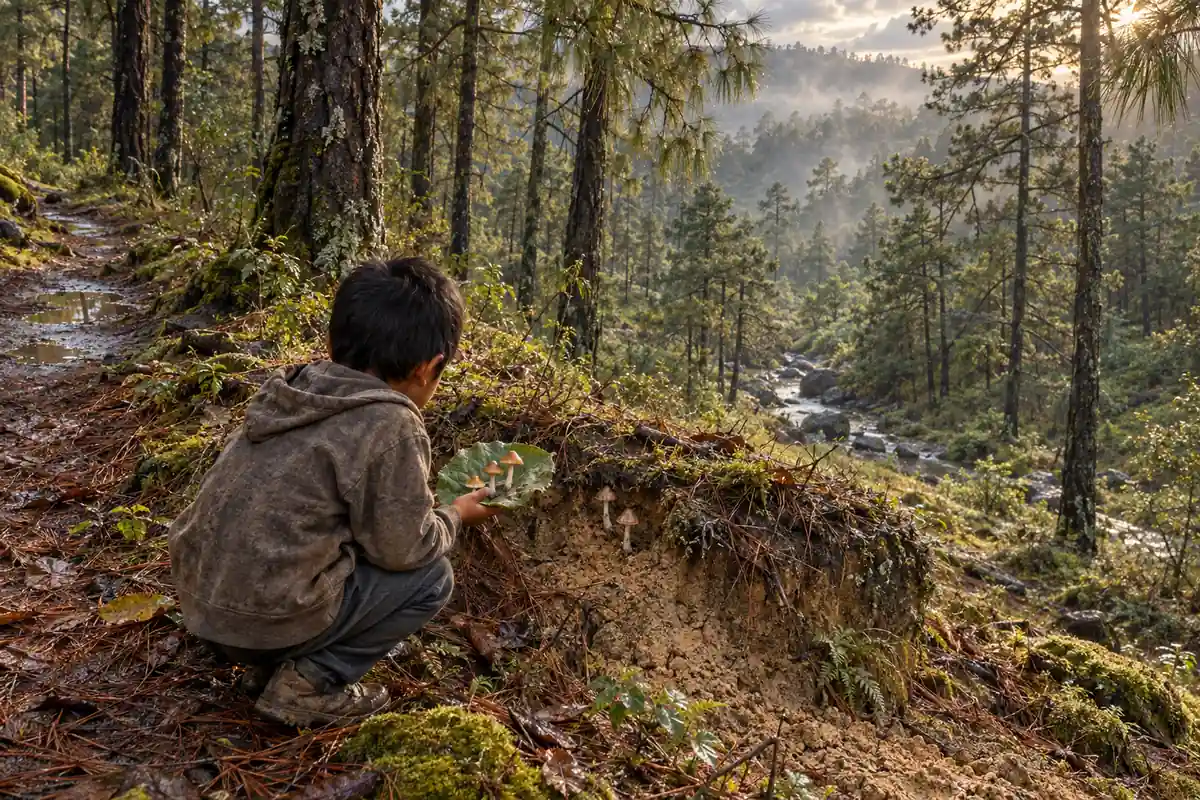
El Peral is a Zapotec farming village of about 160 people in the pine-covered highlands of San Antonino El Alto, in the Valles Centrales region of Oaxaca, Mexico. Its residents grow vegetables, flowers, peaches, apples, and blackberries. In July, after the rains, some of them gather a small, blue-staining mushroom, Psilocybe zapotecorum. They eat it at night, in silence, to ask it questions. A woman may ask whether her husband in the United States will come home. A young man may ask whether he will make it across the border. A sick person may ask what illness they have and who is behind it. Residents say the mushroom answers: "it will tell you everything." [1]
A holy mushroom with several names
The mushroom has several names in El Peral. In Spanish it is often called hongo borracho, "drunken mushroom," because its effects resemble drunkenness. Older residents reject that name, saying these are not drunken mushrooms but hongos santos, holy mushrooms. People also call them nanacates or nanacatitos, words that come from the Nahuatl term for mushroom. In the local Zapotec they are ni'to be'ya or ni'to be, which means "holy mushroom." Be'ya is the Valles Centrales Zapotec word for mushrooms in general. [1]
During fieldwork from 2021 to 2024, every specimen that residents showed researchers, whether fresh, dried, or in a phone photograph, was the same species. Whatever name they used, people spoke of the mushroom with respect and affection. Even residents who had married into the village from elsewhere and had never eaten it called it medicine. Most villagers knew the mushroom, but no one held a special office for it. Bakers, merchants, homemakers, and farmers all knew how it was used, and the people who sold it were simply known in the community. [1]
A mushroom that speaks
In El Peral, people speak of the mushroom as a person. "Mushrooms feel," one woman said, and "the mushroom is very smart." It is the mushroom that talks during the night, names the remedy, and gives the answer. It can also become angry if things are done badly. For this reason, an older woman explained, "before consuming these mushrooms, you should ask their permission and talk to them." [1]
People mainly consult the mushroom "to know something," which means seeing what lies ahead before a decision that could shape a life. Many men from the area have migrated north for work, and one of the most common questions is whether a crossing will succeed. "Before you go to the United States, the mushroom tells you whether you are going to pass or not," a resident said. Women have asked about husbands living in the United States. An elderly woman remembered handing a dose to a woman from a nearby village who wanted to know whether her husband would return from the north. He did not, she said, because he had formed an attachment to another woman there. People have also consulted the mushroom about disputes over land. [1]
The mushroom is also used for healing, and here it works first as a diagnostician. "It is like a medicine, it is a cure, it tells you what illness you are suffering from or why that happens, where it went wrong and why there is illness," one woman explained. In El Peral, illness is understood as punishment for a past mistake or as the result of harm wished by another person. "When someone hurts you, the mushroom tells you who is behind it," another woman said. "That person holds a grudge against you." The mushroom is used against the evil eye, fright, sadness, and lovesickness, and it can reveal who wished harm on a person or on their children. "The Nanacate cures everything, like the evil eye," a resident said. "It also helps with lovesickness, telling you whether you are loved or not." [1]
Some people say the mushroom also teaches the body. During the night it may show where and how to massage an injured limb, or what movements will restore a stiff joint. An older woman said the mushroom shows who is to become a healer: it says "let me see your arm," and then it massages you and shows you how to heal it. [1]
Who picks the mushroom
Because the mushroom speaks, the person who picks it shapes what it will say. All the residents interviewed agreed that mushrooms take on the personality of the person who picks them. "If a child cuts them, a child talks to you, if an adult cut them, an adult talk to you," one man said. "If an angry man cuts it, the Nanacatito will also be like that," said the same elderly woman. An angry or rude picker can bring aggressive visions. A serious picker, child or adult, causes a different problem: "the mushroom will not speak." The person may see things but will not hear the message or get an answer. [1]
For this reason, people prefer mushrooms gathered by cheerful, talkative children. Such mushrooms are expected to be lively and communicative, and to give clearer answers. A sick person must never pick their own mushrooms. "If you get sick, you can't cut the mushroom yourself, someone else has to give it to you," one woman said. Children are often sent into the forest after school to gather on behalf of someone who is ill. Some gatherers make the sign of the cross when they find a mushroom, so that the person who eats it will not suffer and to thank God for finding it. [1]
Finding the mushroom also takes more than skill. People say that even someone who knows the usual places and walks far into the forest may miss mushrooms that are there if it is not that person's time or they are not meant to find them. Even those who gather for sale sometimes come home with nothing. [1]
Children come to know the mushroom early, walking with their parents through forests and along streams. Everyone in a family, from children to grandparents, knows where the mushrooms grow and when. Learning to eat them comes later, and the age varies. Some residents recalled their parents showing them the practice in their teens. Others learned only as adults, because they had been afraid, even though they had watched adults eat mushrooms all their lives. Several of the oldest residents remembered people coming from other municipalities to be cured by their parents, and said they learned by watching, "although with fear." [1]
A night consultation
Consultations take place at home, at night. "They are eaten at night, in the silence, because with noise you can't hear what they say," one woman explained. Most households keep an altar with Catholic images and fresh flowers, often dedicated to Saint Michael the Archangel. Residents say the saint does not shape the visions. Children, whose souls are considered pure, pass the mushrooms through copal smoke in front of the altar. "The children pass the smoke and you make the questions to mushrooms," a woman said. [1]
The person then speaks aloud to the mushrooms "just as if they were a person," explaining why they will be eaten and asking permission, "so that they don't scare you." The mushrooms are chewed for a long time and only with the front teeth, never the molars, and residents connect bad effects with chewing the wrong way. This custom had not been recorded among other peoples. [1]
No guide or healer is needed, which sets El Peral apart from the Mazatec ceremonies made famous after 1957. A guide is called only when someone is afraid or does not know the practice. Usually a companion waits in another room, silent, ready to help if the person becomes frightened. The companion also listens for anything said aloud during the night, which helps with interpretation afterward, since details can be forgotten. The mushroom itself may say that no one should stay nearby, in which case the companion must leave the room or the house. The greatest danger is leaving the house. People say that under the mushroom's influence the chaneque, a mischievous spirit that looks like a child, may lead a person into the wilderness, and they might never find their way home. For this reason the consumer may be locked in. [1]
Residents described few other rules. Fasting and sexual abstinence are not required. Some older people avoid certain days of the week or month, though others did not agree. Mushrooms should not be eaten with alcohol. Pregnant and nursing women may eat them, and a mother often eats them herself to learn what is wrong with a sick child. Women nearing menopause should not. The mushroom is classed as hot in the Mesoamerican system of hot and cold, so after eating it a person should not go outdoors, where cold air can cause the illness called el aire. People compared the mushroom to mezcal: both can be medicine, and both, used too much, can become a vice. [1]
What the night shows
The effects last several hours. People described warmth, laughter, and sadness, sometimes all in one night. One woman called them "emotional whirlwinds," in which shame, happiness, and sadness come together. Others said the mushroom "massages" them from inside, a feeling of well-being they could not fully explain. When things go well, a conversation begins. "It depends on how the person is," an older woman said. "The mushroom starts talking and tells them what illness they have, who is harming them and what type of remedy they can use." [1]
What the night shows must be read correctly. Heavy weeping can mean grief to come: "When they cry a lot, something is going to happen to them," the same woman said. Snakes and other feared animals are signs of malice, a person's own or someone else's. "Sometimes you see snakes when someone has done harm to you," another woman said. People who are not ill or have no need of a consultation are said to suffer. Someone who has done wrong may be scolded by the mushroom, which shows them the evil inside them so that they feel it in their body. Bad nights are uncommon, but some people stop eating mushrooms after visions of monsters or death. Households keep simple remedies on hand: water sprinkled on the face, a drink of milk, and an atole of burned corn "so that they don't stay crazy." [1]
Fewer rains
The mushroom grows only in the rainy season. "The Nanacatitos are born when it rains for three days or three nights," an older woman said. Too much rain stops them as well: "if it gets too wet or if the swamp turns green, the mushrooms don't come out, they get embarrassed." They prefer "ugly places, like sandy or collapsed earth." People have heard that dried mushrooms are sold in other places year-round, but they say the effect is not the same. So consultations in El Peral mostly happen in July. [1]
Every resident interviewed said the climate has changed. "It doesn't rain like it used to," one man said. National rainfall records show some decline in El Peral since 2020, though not a statistically significant one. Over the five years before the study, people said, mushrooms had become much harder to find, and both their use and sale had declined sharply. Some blamed deforestation. Others pointed to the damage done to the whole forest: "The Nanacate wants there to be animals and everything, but people destroy everything. That is why it is born where the squirrel and the deer pass." People do not think picking many mushrooms harms them, as long as they are put to good use. Picking mushrooms that will not be used, however, is thought to reduce future harvests. The elderly woman put the consequence plainly: "When we run out of mushrooms and they don't grow anymore, there will be no one to look for them, so they won't be used anymore." [1]
One village among many
These customs belong to one village. Zapotec people live across five regions of Oaxaca and speak 62 recognized variants of their language, many of them very different from one another. Zapotec mushroom use was first documented far to the south, in the Sierra Sur, where in the 1950s mushrooms were eaten in night ceremonies led by a healer or by the head of a family or community. There the same species was called piule de barda, among other names. In other Sierra Sur communities, mushrooms are called "masters of the rain" and linked to the lightning. The neighboring Valles Centrales village of San Miguel Mixtepec uses P. zapotecorum to treat illness and to consult about family and social problems that are hard to resolve. The El Peral study, published in 2025, documented the practice in the Valles Centrales, following a 2020 undergraduate thesis on San Miguel Mixtepec. [1, 3, 6]
Elsewhere in Oaxaca, mushrooms have become a business. Since the 1960s visitors have traveled to the Mazatec town of Huautla de Jiménez, and San José del Pacífico in the Sierra Sur now receives hundreds each rainy season. People in El Peral know this, and they do not object to outsiders eating mushrooms. "God places mushrooms in the mountains so that everyone can use them," one woman said. They add that the mushrooms are for healing, not entertainment. The village also keeps to itself: its traditional authorities declined even to host a wild-mushroom exhibition, saying the community lacked the capacity to receive visitors. [1, 3]
In El Peral, pickers sell their own mushrooms, wrapped in leaves of the San Pablo plant, in the village and nearby towns, with no middlemen. Buyers usually come looking for medicine for ailments that doctors have not cured. But demand has fallen, according to one of the village's older pickers: "Now only older people believe that the Nanacatito is useful for healing." [1]
Who will keep it
Adolescents in El Peral consider themselves Zapotec and understand the language, but they prefer not to speak it. They call the mushrooms simply "mushrooms" or "drunken mushrooms" in Spanish. The young people interviewed said they ate mushrooms to feel or see things, at any time of day, without ritual. One young man's mother had him eat mushrooms to heal a contracture in his arm, and during the night he saw the exercises he needed to recover and stop feeling pain. Still, he called the other beliefs about the mushroom the beliefs of the abuelos, the grandparents, as village elders are known. Older residents warn: "For those who have too much fun with it, it no longer speaks well." [1]
The practice also ends in families that leave Catholicism. Those who convert to other faiths stop eating the mushroom, the same older picker explained. "It only speaks to those who believe it." [1]
Residents were eager to talk about the mushroom, often with pride, and they spoke more freely about it than about edible mushrooms. Many saw the study as a chance to record knowledge they believed was fading. "Young people no longer consult, they no longer believe, and, because of that, all of this will disappear." [1]
What is uncertain
One recent, detailed study, based on three years of interviews and observation in a single village, is almost the only direct account of this practice. The other sources describe mushroom use in other Zapotec areas or across Mexico, or are general overviews.
No source shows how old the practice is in this village; the 2025 study calls itself the first formal record for the region. [1]
Residents blame scarcer mushrooms on less rain and deforestation, but official rainfall records show only a slight, non-significant drop since 2020. [1]
Residents disagree on how often the mushrooms may be taken: some say only once a year, others as often as needed. [1]
Beliefs about which days to avoid were mentioned often by older adults but were not shared by everyone. [1]
Whether the community also classes these mushrooms as toxic is unresolved and would need a study of local classification. [1]
How widespread the practice is in other Valles Centrales communities has been little studied, beyond a 2020 undergraduate thesis on San Miguel Mixtepec. [1, 3]
Zapotec mushroom practices differ by region and may not be generalised. A Sierra Sur Zapotec village showed no sacred-mushroom use, and Sierra Sur Zapotecs use other species. [1, 4, 5]
Whether the tradition will continue is open, since young people mostly use the mushrooms recreationally and treat the old beliefs as their elders' views. [1]
The researchers note they cannot assume the whole community agrees with the views they recorded. [1]
Links between this mushroom species and pre-Hispanic artworks and codices rest on one author's interpretation. [2]
7 sources. Each claim checked by AI against the saved sources; every finding reviewed by Jim Davis beside the cited passage, 29 October 2026. How the articles were checked
Timeline of dated events (12)
- Pre-Hispanic times (as interpreted)ceramic, stone and metal pieces and codices are read as showing this mushroom species or close relatives. [2]
- 16th century (given as 1530 or 1569–1582)Fray Bernardino de Sahagún records sacred mushrooms that cause drunkenness; he called them by the local Spanish name "drunken mushroom". [1, 2, 6]
- 1578Fray Juan de Córdova's Zapotec vocabulary, compiled in Tlacochahuaya in the Valles Centrales, lists Zapotec words for mushrooms that intoxicate. [4, 6]
- 1955–1957researchers document Zapotec mushroom use in the Sierra Sur. [1, 3]
- 1956the species now used in this village is collected and named from the Zapotec region of Oaxaca. [2]
- From 1957psychedelic tourism begins drawing visitors to a Sierra Sur Zapotec town, a trend that has not reached this village. [1]
- 1958Zapotec people at the species' original collection site call it "Christ's crown". [2]
- 1975Mexico adopts an international drug convention with an exemption for traditional Indigenous use of sacred mushrooms. [5]
- 1984Mexico's General Health Law prohibits non-traditional use of the mushrooms' active compounds. [5]
- About the five years before 2021–2024residents report that use and sale of the mushrooms fell sharply. [1]
- 2021–2024a community assembly approves the study; in 2023 a mushroom-cultivation workshop is given in return. [1]
- Before 2025village authorities decline a mushroom exhibition, showing their reluctance to receive visitors. [1]
Sources
CSL-JSON imports into Zotero, Mendeley and other reference managers.
Haro-Luna MX, Ruan-Soto F, Ramírez-Cruz V, Amaya-Pérez J, Guzmán-Dávalos L (2025). Current use of holy mushrooms of the genus Psilocybe in a Zapotec community in Oaxaca, Mexico. IMA Fungus 16: e148070, pp. 1–29.
Peer-reviewed journal article (2025) by university mycologists and ethnobiologists working with a long-resident local collaborator. It is the only first-hand account of present-day practice, based on fieldwork from 2021 to 2024 with 30 residents and on identified specimens. It covers local names, the mushroom as a speaking being, divination and healing, the role of child gatherers, beliefs about the picker, decline, young people's recreational use and attitudes to outsiders.
Guzmán G (2012). New taxonomical and ethnomycological observations on Psilocybe s.s. (Fungi, Basidiomycota, Agaricomycetidae, Agaricales, Strophariaceae) from Mexico, Africa and Spain. Acta Botanica Mexicana 100: 79–106.
Taxonomic and interpretive journal article (2012) by a leading Mexican mycologist, available only in part. It redefines the species used in the village and its wide range, records a Zapotec common name, and interprets pre-Hispanic art and codices as depicting it.
Fagetti A, Mateos Segovia E, Reinoso Niche J (2023). Cartografía etnográfica del uso ritual y terapéutico de hongos del género Psilocybe en México. Elementos 131: 71–82.
Review article (2023) in a university science magazine by anthropologists. It maps recorded ritual and healing mushroom use across Mexico, including Sierra Sur Zapotec communities but not the Valles Centrales. It notes large gaps in recent data and causes of decline such as religious change, loss of interest and tourism.
Venegas Ramírez Y (2013). Etnomicología zapoteca de San Pedro Mixtepec, Sierra Sur de Oaxaca, México. Master's thesis (Maestría en Ciencias en Recursos Naturales y Desarrollo Rural), El Colegio de la Frontera Sur.
Master's thesis (2013) on the mushroom knowledge of a Sierra Sur Zapotec town, available only in part. It documents names, beliefs and uses of wild mushrooms, finds no sacred-mushroom species there, and cites a colonial Zapotec vocabulary compiled in the Valles Centrales.
Ermakova A (2021). Psychoactive Mushrooms in Mexico: Overview of Ecology and Ethnomycology. Chacruna Institute for Psychedelic Plant Medicines.
Online article (2021) by a researcher, published by a nonprofit focused on psychedelic plants. It gives a general overview of Mexico's psychoactive mushrooms and their ecology, lists Zapotecs among user groups, and summarises their legal and conservation status.
Guzmán G (1959). Sinopsis de los conocimientos sobre los hongos alucinógenos mexicanos. Boletín de la Sociedad Botánica de México 24: 14–34.
Overview article (1959) by a young Mexican mycologist. It brings together colonial references, including Zapotec terms for intoxicating mushrooms, and lists the groups then known to use them, including Sierra Sur Zapotecs. It also gives local names and general ceremonial features.
López-García A, Gómez-Hernández M (2025). Hongos de Oaxaca: biodiversidad, tradición y sabor. Elementos (BUAP), accepted manuscript (received 16 June 2025, accepted 5 September 2025).
Accepted popular-science article (2025) by ethnomycologists, available only in part. It surveys Oaxaca's fungal diversity, the history of ethnomycology and wild edible mushrooms, and adds little on this tradition.
Related
Cite this page
Psychoactive Traditions. “Zapotec Holy Mushrooms of El Peral.” Last reviewed 29 October 2026. https://psychoactive-traditions.org/traditions/zapotec-mushroom