Names
The best-known name is yopo, also recorded as niopo, and both forms are reported from the Orinoco region. The medicine is also linked to cohoba, a name early Spanish accounts recorded in the Caribbean, although identifying that Caribbean powder with this tree rests on later scholarship. These names can refer to the snuff, the seeds or the tree, which scientists call Anadenanthera peregrina.
Yanomami names include hisioma or sisioma in Yanomamö. On the Upper Ocamo, the seed used in yopo has been reported as ebena, a word also used more broadly for hallucinogenic snuff. The Piaroa name is recorded as yu̧huä̧ in Venezuela and as ñuä̧ in Colombia's Matavén forest.
What it is
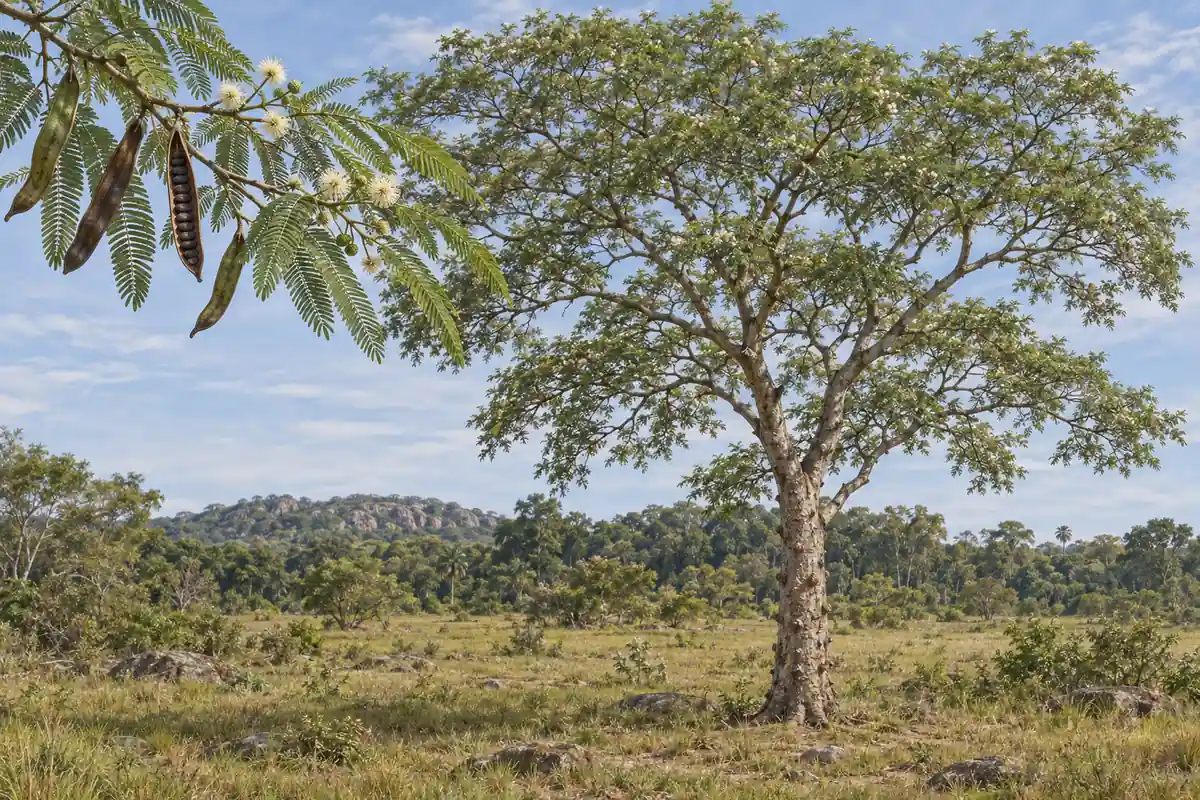
Yopo is a powdered snuff, inhaled through the nose, made from the seeds of a medium-sized tree in the pea family. The tree's bark is rough and often knobbly, its leaves are feathery, and its flower heads are small, round and pale. Flat, leathery pods hold its thin, dark seeds. It grows across northern South America, including the Orinoco basin, as well as in parts of Brazil and in the Caribbean. Within that range it grows mainly in seasonally dry tropical areas, including open savanna country.
Practice differs from one people to another. Piaroa shamans often take yopo together with caapi (Banisteriopsis caapi), tobacco (Nicotiana) and the bark of a plant they call dädä. Yanomami languages have names for yopo seeds, and a seed snuff has been reported among some Yanomami groups. Yanomami shamans, however, are best documented using yãkoana, a different snuff made from the resin of virola trees (Virola).
How it works
The main active compound in the seeds is bufotenin (5-hydroxy-N,N-dimethyltryptamine), which takes its name from the toads (Bufo) whose skin it was first found in. Some samples also contain small amounts of DMT (N,N-dimethyltryptamine). Both compounds resemble serotonin, one of the brain's chemical messengers, and lab studies show that bufotenin binds to the nerve-cell receptors that serotonin acts on.
Animal studies suggest that bufotenin gets into the brain poorly, and how much of yopo's effect it explains has been debated.
Compounds of this family are largely broken down in the gut by an enzyme called monoamine oxidase. Taking them through the nose bypasses much of that breakdown, although the enzyme also acts elsewhere in the body. Caapi contains harmine (7-methoxy-1-methyl-β-carboline), which blocks the same enzyme. How this affects the Piaroa combination has not been well studied.
Effects on the mind
Yopo is generally described as a psychedelic, a medicine that alters perception, thought and emotion. Scientific descriptions of the experience are few and rest largely on individual reports.
According to those reports, which include self-experiments with pure bufotenin outside any tradition, effects begin within minutes and fade within about an hour or so. People describe vivid colors and patterns, visions, and a changed sense of space and of themselves. Some value a feeling of entering another place or of gaining insight, while others report fear, confusion or loss of contact with their surroundings. The experience varies between people and occasions, and taking other plants alongside the snuff may change it.
In tradition
The Piaroa are forest farmers who live along tributaries of the middle Orinoco. Their shamans take yopo to enter a realm where the causes of illness and misfortune can be seen and fought.
Yanomami shamans, who live on both sides of the Brazil–Venezuela border, work with yãkoana, the virola snuff, and understand it differently. In their account, the powder is food for the xapiri, images of beings from the first time. Shamans see and call down the xapiri to heal the sick, fend off harm and hold up the sky.
By the mid-2000s, Piaroa masters of yopo had become rare, though masters of songs remained common.
Today
Yopo is now also used on a small scale outside its traditions. Research has focused mainly on the chemistry of the seeds and on laboratory and animal studies of bufotenin. The snuff itself has received little clinical study.
Traditions that use it
Cite this page
Psychoactive Traditions. “Yopo snuff.” Last reviewed 1 November 2026. https://psychoactive-traditions.org/medicines/yopo