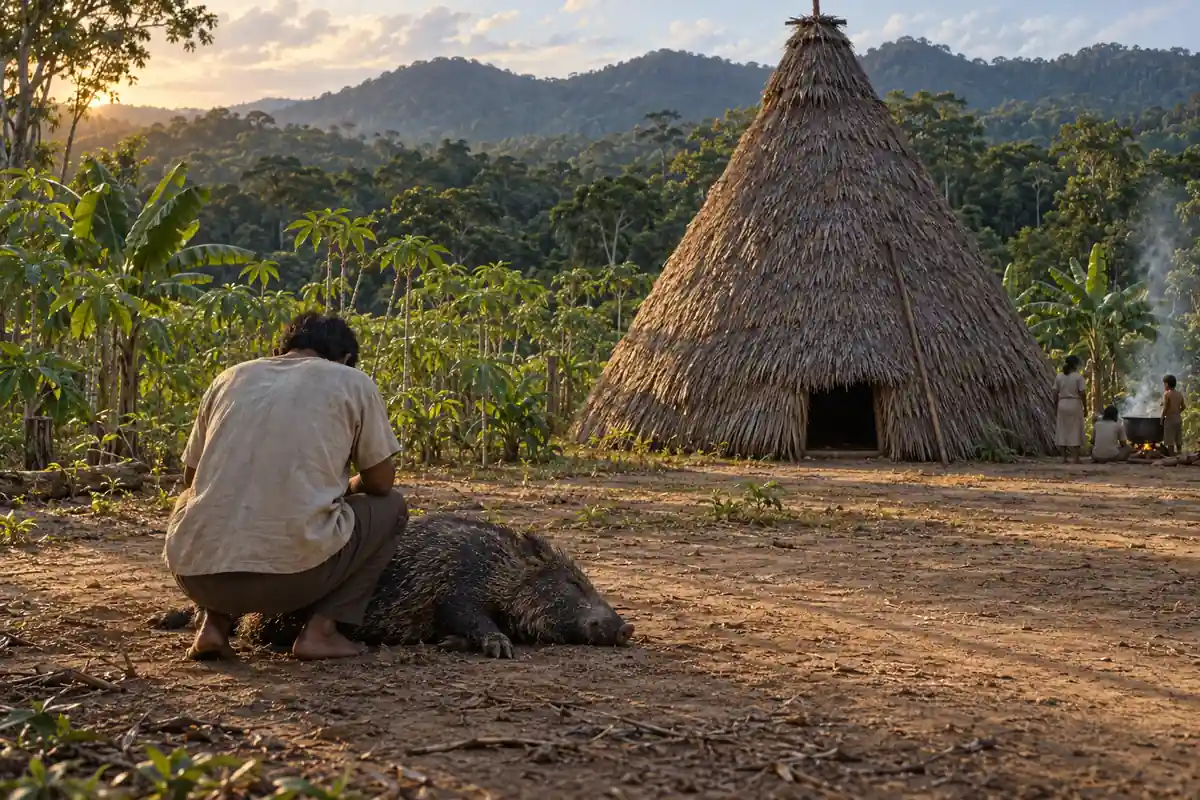
The Piaroa are forest farmers of the middle Orinoco basin. They live along its tributaries in southern Venezuela and in the neighboring Colombian department of Vichada, and many call themselves Huottüja or U̧wo̧tju̧ja̧, "people with knowledge." Their shamans take yopo, a snuff made from the seeds of the Anadenanthera peregrina tree, often together with two other plants. With it they enter a realm where the causes of illness and misfortune can be seen and fought. Much of this work is woven into ordinary life. In communities that keep the older practices, the meat of a large animal is not simply cooked and eaten: a shaman first sings and blows over it, because Piaroa understand that animals carry diseases that would otherwise pass into whoever eats them. [2, 5]
A Snuff That Does Not Teach
When Piaroa shamans speak of the substances that open the visionary world, they name three. The first is yopo, called yu̧huä̧ in Venezuela and ñuä̧ among the Piaroa of Colombia's Matavén forest. The second is caapi, the vine Banisteriopsis caapi. The third is dädä, the bark of a shrub tentatively identified as a species of Malouetia. Tobacco accompanies all three, usually as large cigars shared at night. Taken together, these plants produce strong visions and sounds. Shamans interpret them through their knowledge of myth and of the social situation surrounding a patient. In the shamanic communities where the anthropologist Robin Rodd apprenticed between 1999 and 2002, shamans took yopo and caapi several times a week. [2, 3, 5]
The Piaroa word for what a shaman gains through this work is märipa, his power to cure or to harm. Shamans think of märipa as a matter of degree rather than something a person either has or lacks. It grows from natural talent and years of effort. The shaman Rodd studied with stated the order of agency plainly: "Yopo is not a teacher. It is the shaman that sees. The yopo helps the shaman to see but it is the shaman that uses the yopo to divine." In this understanding, plants have neither power nor knowledge of their own. Other Amazonian peoples speak of plants as teachers or divinities, but Piaroa shamans place power and responsibility in the person who uses yopo. [2]
That person may be one of two kinds of specialist. The meyeruwa, "master of songs," prevents illness through night chants and blessed water and is often described as a "good shaman." The yuhuaruwa, "master of yopo," has the greater power to heal and to harm. He is also the highest ritual authority, and a master of songs must train for years under one to reach that rank. Skill with visions separates the two, and it also separates capable masters of songs from failed ones. [2, 5]
Gods Who Could Not Stop
Piaroa myths explain why such power needs careful handling. In one account, dädä came first. The primordial mother Tseheru, also called Chejeru, grew inside the pulp of dädä that her parents had eaten, and her brother Wahari, who went on to make the Piaroa world, was conceived the same way. Through yopo and dädä visions, Wahari learned to make tools, houses, canoes and weapons. In the myths, the creator gods were the greatest shamans who ever lived. [2]
They were also the worst users of yopo. Anamei, after she discovered the snuff, worked carefully with it, and by doing so she became "the wisest being in the world." Wahari, given his first taste, wanted more and stole it from her. "Then began the time of many problems," one shaman said. Wahari showed yopo to his father-in-law Kuemoi, and the two became rivals. Kuemoi took ever larger amounts and became frightening and absurd. He screamed instead of speaking, ran in circles, raged and laughed, and moved at night. Finally he turned into an evil spirit. Wahari ended as a buffoon who died in a creole jail. One of the eldest gods, Ohuoda'e, had understood what neither of them heeded: life could exist only as long as visions were short, and those who stayed too long in the vision world might never return. [2]
The same rivalry produced disease. To outdo Kuemoi, Wahari invited the animals to a feast and stole their culture: their instruments, their languages and their tools. The master of the animals punished him by striking at his favorite creation, the Piaroa. From then on, animals could reproduce inside the people who ate them. Tseheru pleaded for them and found a remedy. She set Wahari's words into songs that could be sung by those who know how to use yopo. As long as people keep singing the memory of Wahari's folly and of each animal's culture, they will not die from eating game. This story explains why, in communities that keep the older practices, a shaman sings over game before it is eaten. A version recorded in the Cataniapo basin in the 2000s tells it differently. There, Wahari created diseases in a fit of anger, and his sister gave the Piaroa dädä so that they could cure them. Versions vary, but nearly all trace illness to uncontrolled feelings in the time of creation. [1, 2, 5]
Illness and the Sung Cure
Health, in Piaroa terms, means more than an absence of bodily symptoms. One word, adiwa, means both "good" and "tranquil." A healthy person has a calm, good spirit and, in Piaroa words, "lives well with his relatives." Illness is a disturbance of that balance. It may come from contagion, as people say common colds do. It may come from breaking a rule, such as eating unblessed food or looking at a sacred mountain. Or it may come from attack. Specific animals bring specific ailments: monkey meat brings a vertigo-like illness, and the giant anteater harms children's speech. Forest spirits called märimü shoot crystals through blowguns into a victim's chest. In the 1980s and 1990s, a mild illness might be blamed on the sick person's own transgression. A grave, chronic or degenerating one was attributed by close kin to shamanic aggression, while distant kin blamed the sick person's transgressions. [1, 5]
For the Piaroa, the person consists of a body and an a̧'cua̧ru̧hua̧, a vital force or spirit that can leave the body in dreams or under a spell. When the spirit is harmed, a shaman must intervene, because the spirit outlives the body and its healing matters more. In simple cases the shaman bathes the patient in tobacco smoke, draws out the illness, which takes the form of a quartz crystal or stone, and shows it to those present. Harder cases call for night-long sessions of song. Periods of singing alternate with silent rest, during which the shaman and his companions take more of the plants to strengthen their visions. Shamans say their songs "always have their language," even when no words can be made out. The songs call on Chejeru, recount myths, name the places where creation happened, and describe the animal whose disease is being removed: its sounds, movements and owners. In this, the cure echoes Tseheru's remedy, which made the memory of each animal's culture the protection against its disease. The gravest cases are treated by day at river rapids, where the patient is bathed and the session ends in a ritual fight with the harmful beings. [2, 5]
The cure takes place in the märipä pabare, whose doors of entry and exit lie at the setting and the rising of the sun. Its first level lies at the mountaintops. Almost anyone who takes the sacred plants can reach it, and from there one sees past, present and future, though only trained shamans can read what they see. Above the clouds lies the battlefield where illness is fought. Only experienced masters of yopo can go there, and it is the most dangerous place for healer and patient alike. The highest level belongs to the gods alone. Rodd, drawing on neuroscience, has proposed that the plants place shamans in heightened states of mind that sharpen their reading of the social tensions around an illness. This is his interpretation, not one the shamans themselves offer. [5]
A shaman's verdict can also end treatment. A Piaroa health auxiliary working in the Cataniapo basin in the mid-2000s explained: "If the yuhuaruwa says 'the spirit is already dead,' well, then all that is left is to cry. Even though you see him alive, however grave he is, through the spirit one knows he is already dead." In such cases the patient and family often refuse hospital treatment and prefer a death at home among close kin. The shaman's task then becomes guiding the spirit toward its ancestors and keeping enemies away from the family. [5]
Peace at Home, War Unseen
If grave illness is the work of enemy shamans, then the battlefield above the clouds is never quiet. This sits uneasily with the Piaroa's reputation. Travelers since 1800 have described the Piaroa as gentle, and physical violence is nearly absent from their daily life. Children traditionally played no competitive games. A difficult child might be made to breathe the smoke of caraña resin, which is thought to calm. Yet in Mansutti's fieldwork in the Sipapo, Autana and Parguaza regions between 1983 and 1997, a Piaroa community appeared as "a ritual fortress" in a permanent state of war, one waged by shamans in the invisible world. [1]
The logic of that war follows social distance. Piaroa call the people they share a household or a region with chawaruwa, "owner of my drink." Among close chawaruwa, shamanic attack is unthinkable. Danger grows with distance. It peaks with Piaroa who live far away and with the closely related Mako, or Wirö, who speak a mutually intelligible language and share the same ritual division of labor. Very different neighbors such as the Ye'kwana are thought less dangerous. [1, 3, 5]
No shaman admits to attacking, and each one strikes only to defend against attacks he presumes. Blame shifts with the speaker's vantage. When a death occurs, the grieving family blames an outside shaman, while distant relatives blame the dead person's own transgressions. When a prestigious shaman suffered a stroke, the shamans treating him concluded that a neighboring sorcerer had struck. Piaroa who lived farther away said he was being punished for stealing a sacred "mother stone" of the fish. Some families moved great distances to escape an enemy shaman, and in the mid-twentieth century several young women reached Colombia's Matavén forest this way. [1, 3, 5]
Rodd describes the same condition from inside an apprenticeship. Every visionary experience requires defense. Shamans carry a wild boar's tooth to cut up spirits and deflect sorcerers. Divination and community healing need shamans whose task is to guard the space. Mansutti argued that this standing struggle, and the "frequent states of anxiety" it produced, meant that Piaroa pacifism should be redefined. In his view the Piaroa control physical violence while practicing shamanic violence, which they consider more deadly. [1, 2]
Living by the Law
A power that can kill is not handed over lightly, and the discipline begins with the body. Freire and Zent described a rite held at the end of the rainy season, in which boys around the time of puberty join adults in the märipa teäu. After a hunt and a day and night of chanting by the shamans, the initiates are stung from head to foot by ants and wasps. Some have their tongues pierced with a stingray spine, and they drink from the sacred plants. The rite is meant to test tolerance of pain and to purify and strengthen the body. It also identifies boys with the mental and spiritual capacity to become shamans. Apprentices and shamans may not eat sweet or salty food. There is no rule against women learning, but Rodd found little evidence of women reaching the higher levels. [2, 5]
Above all, a shaman must keep what his teachers call "the law." At Rodd's initiation, his teacher said: "You must never use your powers to do harm to others. This is the most important rule to understand. This is our law. The Piaroa law. The criollos have never wanted to learn this law. This is why we do not give them yopo." No one gave a precise definition of the law. In practice it also meant not losing control and causing harm through jealousy, greed, lust or anger. Piaroa call the madness of a shaman whose unmastered knowledge has poisoned his will kerau. A man who had known Rodd's teacher in his youth said: "He wasn't bad… He was out of control. He learned when he was very young," and used his powers "to take advantage of others." [2]
Excess yopo is the clearest sign of a shaman going wrong. A man from the upper Parguaza described a feared shaman this way: "He is always taking yopo… He walks with a twitch, head down, stomping his feet, and never in a straight line." The description echoes Kuemoi. In an earlier account, a master of songs lost his role after repeatedly reciting a chant wrongly under the influence of yopo. Rodd's own teacher, criticized by a relative for his heavy use, answered that "your family has to come first: grandparents, children, and the house… it's the same with rum. You can't go drinking every day." The same restraint governs tobacco. One senior shaman said it "is to be shared and should be passed slowly and calmly between friends." Snatching a cigar can be read as greed. [2]
A Changing Practice
Until the 1960s most Piaroa lived in small, mobile settlements in the forested uplands, avoiding outsiders. Epidemics of malaria, measles and smallpox killed more than 500 people in 1946–47. Protestant New Tribes missionaries, who combined conversion with medical care, arrived the same year. In the decades that followed, the great majority of Piaroa moved to larger, permanent settlements near clinics, missions and roads. In these settlements, leadership passed to younger people who spoke Spanish, and shamans took on advisory roles. By 2011 there were around 19,000 Piaroa in Venezuela and about 2,000 in Colombia. Mansutti suggested that evangelical Christianity spread so quickly because it let communities keep prayer as a source of fertility while curbing aggressive sorcery. Many Piaroa told Freire and Zent that the märimü spirits grew less harmful after the missionaries came and shamanism declined. [1, 2, 5]
By the mid-2000s, masters of yopo had become rare. In one basin, about 500 people knew of only one. Elders blamed conversion and the distractions of modern life, which, they said, kept young people from concentrating on long training. Many elders also linked the decline of shamanism to depleted rivers, scarcer game, and rising drinking and violence among the young. Masters of songs, though, remained common. Few Piaroa admitted to consulting shamans, yet most did so frequently. A shaman's diagnosis often decided whether a patient went to the clinic, and in some evangelical villages the pastor took on that role. Medicine and shamanism rarely conflicted, and some resident doctors got along well with local shamans. Rodd reported calls, around 2011, for the initiation system to be streamlined to suit present conditions. He also found that people recognized as shamans held considerable political influence. [2, 5]
Among the Piaroa of Colombia's Matavén forest, the work of rebuilding is described through ukuo, the word of the elders, meaning respect and the sacred. In 2003 a respected leader there urged young people to keep consuming the proper substances that make "beautiful and healthy" bodies and to sustain respectful relations with beings that are not human. Residents say evenings that were once spent listening to elders around the mat are now spent watching television. They describe ukuo as fractured but not broken. Some of the young men who heard that leader now coordinate their people's life plan, working under the guidance of the ritual specialists. [3]
What is uncertain
Anthropologists have studied yopo shamanism in some depth, including one researcher who trained with a shaman. Most of that first-hand fieldwork is twenty or more years old, though, and little recent work shows how shamans practise today.
Whether the Piaroa should still be called a "peaceful" people is disputed, because their shamans are described as waging constant invisible warfare against enemies. [1, 2]
Sources disagree on whether there is a clear split between illnesses for doctors and illnesses for shamans; the health report says diagnosis is fluid and rejects such a split. [5]
The boys' initiation ordeal is linked by some authors to the great masked festival, while others report it as a separate event. [5]
Claims that shamanic songs preserve an ancestral language have never been tested by systematic study. [5]
Women face no formal bar to becoming shamans, but no source shows them reaching the highest levels, and the reasons are unexplored. [2]
The sources agree that high-level shamans have become fewer, but no territory-wide count shows how far the decline has gone. [2, 5]
People disagree about the causes of a shaman's own misfortunes, such as whether an injury was a rival's attack or a warning for breaking shamanic ethics. [2]
A museum blog says the healer blows the snuff into the patient's nose, which none of the ethnographies describe. [8]
Shamanic practice among the Piaroa of Colombia has been little studied compared with Venezuela. [3]
8 sources. Each claim checked by AI against the saved sources; every finding reviewed by Jim Davis beside the cited passage, 30 October 2026. How the articles were checked
Timeline of dated events (14)
- Second half of the 17th centuryJesuit missionaries make the first written references to the "Pearoa". [3, 5]
- 17th–18th centuriesneighbouring groups subject the Piaroa to slave raids; later accounts credit their survival partly to the fear their aggressive shamanism inspired. [1]
- 1799–1804a friar in contact with the Piaroa reports that they "have no war with anyone". [1]
- 1937 and 1946the Catholic Church and then the New Tribes Mission arrive in Piaroa territory; many people later link the decline of shamanism and of spirit attacks to the missions. [5]
- 1946–1947epidemics of malaria, measles and smallpox kill more than 500 Piaroa. [5]
- Mid-20th centurymigrations toward the rivers begin, often explained by the migrants as flight from enemy shamans. [1, 3]
- From the 1960sthe state draws people down from the highlands toward health posts and schools, and most Piaroa move to riverside villages and towns. [2, 5]
- April 1968a ritual session of solo male chanting with a rattle, myth narration and yopo inhalation is recorded for a French sound archive. [7]
- Until the early 1970scommunal-house headmen recite chants to prevent illness. [2]
- 1984the first Piaroa Congress meets and adopts the name Huottüja ("people with knowledge"). [3, 5]
- 1994at a later Piaroa Congress, communities close a sacred mountain to tourists after an epidemic attributed to malign forest spirits. [5]
- 2006the New Tribes Mission is banned in Venezuela. [2]
- By the mid-2000sone high-level shaman is known in a river basin of about 500 people, though lesser song-masters remain common. [5]
- By the 2010sas fewer people take on the arduous training, there are calls to streamline shamanic initiation. [2]
Sources
CSL-JSON imports into Zotero, Mendeley and other reference managers.
Mansutti Rodríguez, A. (2003). Piaroa: Los guerreros del mundo invisible. Antropológica 99-100: 97-116.
A Venezuelan anthropologist's journal essay (2003), based on fieldwork from 1983 to 1997, arguing that Piaroa shamanism amounts to a symbolic war. It contributes the two kinds of specialist, how suspicion rises with social distance, the origin of sorcery in myth, and the role of shamans in maintaining resources.
Rodd, R. (2018). Piaroa Shamanic Ethics and Ethos: Living by the Law and the Good Life of Tranquillity. International Journal of Latin American Religions 2: 315–333.
A journal article (2018) by an anthropologist who apprenticed to a Piaroa shaman from 1999 to 2002 and revisited in 2011. It covers shamanic ethics ("living by the law"), the place of yopo in myth and practice, the dangers of overuse, and local voices on shamans' conduct.
De la Hoz, N. J. (2019). Ukuo e identidad entre los u̧wo̧tju̧ja̧ de Selva de Matavén, Orinoquia colombiana. Mundo Amazónico 10(2): 38-69.
A journal article (2019) by a biologist and anthropologist after long collaborative fieldwork from 2003 with the Piaroa of Colombia's Matavén forest. It contributes the community ideal of respect and sacredness, an outline of shamanic training with yopo among the plants of power, shamanic roles, and elders' recollections of settlement history.
Huottuja Foundation (n.d.). About the Huottuja-De'aruhua. huottuja.org.
An undated website of a foundation presenting itself as representing Piaroa villages. It offers a self-description stressing peacefulness and decentralised villages (198 in 2022) but says nothing about yopo or shamanism.
Freire, G. & Zent, S. (2007). Los Piaroa (Huo̧ttü̧ja̧ / De'aruhua). In G. Freire & A. Tillett (eds.), El estado de la salud indígena en Venezuela, pp. 133–207. Caracas: CISPI, Ministerio de Salud y Desarrollo Social.
A chapter in a Venezuelan government report on Indigenous health (2007) by two anthropologists with long fieldwork. It is the fullest account of healing, the two shaman types, the use of yopo with other plants, boys' initiation, ideas of illness, the decline of shamans, and how shamans work alongside biomedicine.
Rodd, R. (2002). Snuff Synergy: Preparation, Use and Pharmacology of Yopo and Banisteriopsis Caapi Among the Piaroa of Southern Venezuela. Journal of Psychoactive Drugs 34(3): 273-279.
A journal article (2002) by the apprentice-anthropologist, available only as an abstract. It reports that shamans combine the caapi vine with yopo and argues that this matters for understanding snuff use.
CREM-CNRS sound archives (2019; catalogue record last modified 1 March 2019). Item CNRSMH_I_1970_003_001_01: Chants, narration de mythes, inhalation du yopo (collection 'Venezuela; Amazonas: Piaroa', recorded 1968).
A French national sound-archive catalogue record (last modified 2019) for a 1968 field recording. Its metadata alone attest that chanting, myth narration and yopo inhalation took place together in a ritual setting at that date.
Wells, C. (2017). 5 of the most magical objects in our collection part 2. Houston Museum of Natural Science blog, 1 June 2017.
A natural-history museum blog post (2017) describing a Piaroa shaman's snuff kit on display. It gives general, unsourced remarks about the role and qualities expected of shamans.
Related
Cite this page
Psychoactive Traditions. “Piaroa Yopo Shamanism.” Last reviewed 30 October 2026. https://psychoactive-traditions.org/traditions/piaroa-yopo-snuff