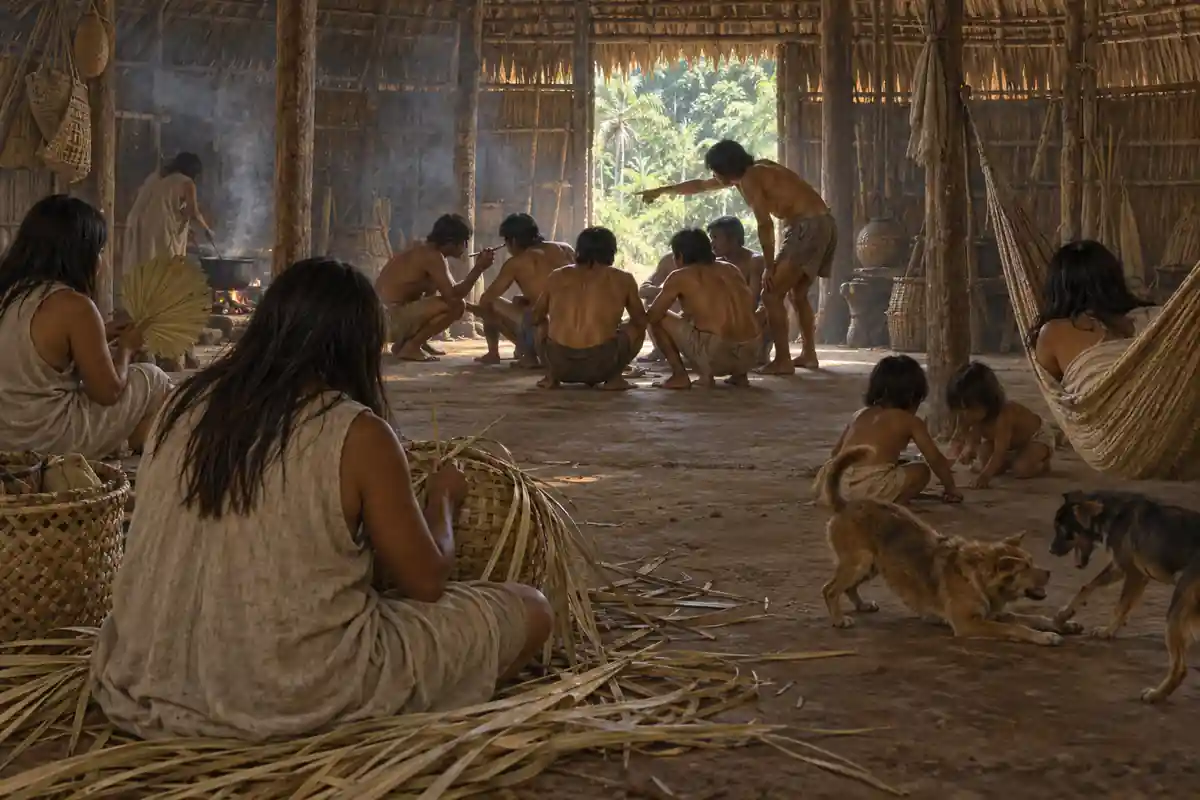
The Yanomami live in the forests of the northern Amazon, on both sides of the border between Brazil and Venezuela. Their territory covers roughly 192,000 square kilometers. In 2011 their population was estimated at about 35,000, divided into at least four subgroups that speak related languages. [2]
Yanomami shamans inhale a powder called yãkoana, which comes from the resin of Virola trees. Through it, they say, they see and call down the xapiri: beings who heal the sick, fight off harm, and keep the forest and the sky in order. According to Davi Kopenawa, a shaman from the community of Watorikɨ and the best-known Yanomami spokesman, the xapiri themselves have their own name for the powder: raxa yawari u, "the juice of the water beings' peach palm fruit." [2, 5, 6]
Images from the first time
In the Brazilian Yanomami account, the xapiri are utupë, "images," of beings from the first time: the age before humans, animals and invisible beings had become separate kinds. The animals of today descend from those first beings, who took on animal bodies. Their images remained, and those images are the xapiri. The creator Omama left them on the earth to care for human beings, and his son was the first shaman. [2, 5]
Shamans see the xapiri as tiny human-like figures covered in bright ceremonial ornaments. Their entrance is often compared to the noisy, cheerful arrival of richly decorated guests at a reahu, the large feast held between communities. [2]
Almost every part of the world has its xapiri:
- mammals, birds, fish, frogs and insects; - trees, leaves, vines and wild honey; - water, stones and waterfalls; - the moon, the sun, thunder and lightning.
There are modest household xapiri too, such as the spirits of the dog, the fire and the clay pot. There are even xapiri of white people and their chickens, cattle and horses. Shamans call on these white-people spirits to fight epidemics, on the principle that like works against like. The xapiri live on mountaintops and dance on shining surfaces that the Yanomami call their "mirrors." [2]
Kopenawa has objected to the usual translation. "I can't call the xapiri spirit," he said in 2024. "Spirit is a word white people and the church use; it's different from xapiri." He offered a shorter definition instead: "Xapiri, for the Yanomami, means health." [4]
Food for the xapiri
Taking yãkoana requires at least two people. The shaman crouches in the communal house while a companion blows the powder into his nostrils through a tube. The relationship is described as one of mutual dependence: the xapiri need the shaman to feed them yãkoana, and the shaman needs yãkoana in order to see them. [5]
"We do not become shamans by eating game or the food from our gardens," Kopenawa says in his autobiography, "but through the trees of the forest." In his account, yãkoana is the xapiri's food. It enters the shaman through his nose, "the entrance to their house inside his chest." So many xapiri feed on it at once that the shaman does not fall over: "By drinking the yãkoana, he simply enters a ghost state." Once they have eaten, the xapiri come down onto their mirrors, "spreading the sweet odor of their annatto body paint all around." [6]
Shamans describe this state as dying. When "their eyes die," they gain a kind of sight that ordinary people lack. Ordinary people are called kua përa thëpë, and their perception is understood to be illusory. With dead eyes, the shaman reaches the essence of things and the time of their origins, and so gains the power to change how events turn out. He calls the xapiri down and becomes one with them, copying each one's song and dance. Shamans are called xapiri thëpë, "spirit people," and shamanic work is xapirimu, "to act as spirit." The shaman is also known as the "father" of his xapiri. [2, 6]
One tree, many names
The trees behind yãkoana are species of Virola, a genus in the nutmeg family. They include Virola theiodora, which was collected among the Yanomami in 1967, and V. elongata, which is named in Kopenawa's own accounts. [2, 6, 7]
In Brazil, Yanomami distinguish several kinds:
- Yãkoana a is the most common. - Haare a is the strongest. - Xioka a is the weakest, and it burns the nose badly. [5]
Not every kind grows near every house, so communities trade with one another to obtain them. Of haare, Kopenawa warns: "If you inhale it without being prepared, its spirit will strike your skull with an axe and violently throw you to the ground." [2, 5, 6, 7, 9]
On the upper Orinoco in Venezuela in the late 1960s, the same tree was called yakoana, or nyakwana in some dialects. Ebene (or epene) was the name for any prepared snuff, and people often mixed powders from whatever plants were at hand. [1]
Many villages valued the seeds of another tree, hisioma (Anadenanthera peregrina), more highly than yakoana, because "it is truly the strongest." These seeds reached villages through trade networks. When shifts in warfare and alliances in 1967–68 cut off the supply, some men began carrying hisioma seedlings home and planting them in their gardens. By 1969 the young trees were producing seeds, and the planters believed they were the first ever to raise the tree. [1]
Analyses of snuffs from that period found that yakoana's main active compound was 5-MeO-DMT, a close relative of DMT, while hisioma seeds contained bufotenine. For all the trouble taken to obtain snuff, men did not crave it. They could do without it for weeks and not remark on it; tobacco was another matter. One man explained: "When we are out of tobacco we crave it intensely and we say we are hori—in utter poverty. We do not crave ebene in the same way… But yakoana is everywhere, and we can always find some if we want to take ebene." [1, 7]
Becoming a shaman
As Yanomami described it in 2024, the path to becoming a shaman begins in dreams, when the xapiri pick out a person. Whether to accept is still that person's choice. Most shamans are men, but there is no rule about gender or age, and training may begin between the ages of about eleven and fourteen. People say that the younger a shaman starts, the stronger his knowledge becomes. In the Brazilian account, the path can also open when the sisters of the yawarioma, water spirits, seduce a young hunter and drive him mad. [2, 4]
The xapiri are thought to prefer people who keep a certain discipline. Kopenawa remembers what an elder shaman told him: "you must not eat, you must not take a bath, you cannot eat meat, no fish, you have to remain in silence, and you have to feel hunger," because "in our stomachs we have rot." He has written that the first task of the elders who pass on their xapiri is to clean the initiate of every smell of game and burned meat, and also "of every smell of penis." He advises a young man to walk in the forest and think about hunting rather than women, so that the spirits will "come to him thinking he belongs to them."
In 2024 one shaman added that a candidate must not have had sex and should eat light food, though he also said that the rules differ from one community to the next. Initiation can include fifteen to thirty days alone in the forest, where the guide decides when the initiate may eat. [4, 5, 10]
The initiate takes yãkoana for many days under the direction of elders, and learns to "see" the xapiri and to "answer" their songs. At first nothing happens. "When you start drinking the yãkoana, you do not see anything at all," Kopenawa recalls. "Your head is seized by a strong pain and your thought remains closed." After several days without sleep, "the yãkoana spirits have devoured your flesh and your eyes are dead," and a blinding light begins to break.
His first sight of the xapiri frightened him: "I truly knew what fear was!" The spirits then cut his body apart and put it back together upside down. They replaced his throat with a tube "so that I could continue to deftly learn their songs and speak clearly." When the work was finished, they stood beside him, "impatient to build a house in which to settle." [2, 6]
In the early 2010s, young Yanomami researchers from Watorikɨ interviewed six of their community's shamans for a book written in their own language. The shamans described their first visions, the fear they felt and the prohibitions they kept, and one spoke of how much he had wanted to become a shaman. While the book was being made, three of the researchers went through initiation themselves. In 2024 a shaman who began at eleven recalled the cousin who taught him: "When the spirit does harm to your grandchildren, your children, it's you who will cure them. I asked to learn, but it was no joke." [4, 8]
Sessions and cures
In the Brazilian account, illness comes either from people or from other beings:
- People cause it through sorcery, through hostile shamans, or through attacks on a person's rixi, an animal double that lives in the distant forest. - Other illnesses come from harmful beings called në waripë. [2]
Kopenawa explained in 2014 that the spirits strike the disease until xawara, the bad spirit, falls to the ground. The shaman then throws it far away and cleans the body with special water. [10]
### A session in Venezuela
A detailed description of sessions comes from two small communities in Venezuela's Amazonas state, observed in 2004 and 2006. There the shaman was called shapori, the spirits hékura, and the snuff yopo.
A session, called hékuramou, took place every day and often several times a day. Around midday, when the men came back from their gardens, from hunting or from fishing, they gathered in a circle and took yopo for two or three hours. Usually someone who was ill would turn up.
The shapori called his helper hékura one at a time, using the sounds and gestures of the hummingbird, the howler monkey or the armadillo. Each one was said to enter through a particular part of his body and settle in his chest. A shaman needs a strong personal hékura to bear the weight of the others, and calling too many is considered deadly. Sometimes he fell to the ground, lay still as if dead, and then got up again. [11]
The healing itself was done by hand. The shapori:
- covered the patient's head; - pressed on the belly; - sucked at the chest or eyelids and spat out what he had drawn; - closed his fists around the illness and threw it out of the village or into the earth with a shout. [11]
Tense moments alternated with relaxed talk and laughter. The men around him agreed with his diagnosis by saying aui, and added what they had seen themselves. Women and children went on with their work outside the circle; women took part only as patients. A single session seldom completed a cure. [11]
### Present-day claims and limits
Shamans in 2024 said they could also treat malaria and pneumonia brought by outsiders, as well as animal bites, and could call game to hunters. One shaman, who also works as an Indigenous health agent in his community, said city diseases are much harder. [4]
Holding up the sky
A shaman's work reaches beyond the sick. Shamans are said to calm the anger of thunder and storm winds and to keep day and night, drought and rain, in their proper order. They look after the supply of game and the fertility of gardens. They also hold up the sky so that it does not fall, since the present earth is understood to be an older sky that once fell. [2]
Gold mining has given this role a new urgency. After a 1975 survey detected mineral deposits, prospectors entered Yanomami land in growing numbers. Between 1987 and 1990, an estimated 30,000 to 40,000 miners worked in Yanomami areas of the Brazilian state of Roraima. In 1990 Kopenawa described the epidemics that followed as xawara. Omama had buried the metal deep in the ground, he said, and smoke rose from it when miners dug it up and burned it. In his account, xawara is so rubbery that the xapiri's weapons cannot cut it. He also warned that the spirits of dead shamans might take revenge by cutting the sky to pieces. "There are no shamans among the whites," he said, and "we shamans also work for you, the whites." [2]
The Watorikɨ shamans spoke in similar terms. One described how some xapiri are aging and disappearing. Among them is Në ropeyoma, who is responsible for the fertility of the land; when it is gone, food grows scarce. They spoke of signs that the chaos of mythic times will return: extreme droughts, floods, endless darkness, and storms that tear down houses and forest. The book ends with their warning that if the shamans die out, everyone will die, Yanomami and white people alike, and no one will come back. [8]
Gatherings, and the question of successors
Some of this work has been done collectively, in large gatherings. Many deaths in late 2012 and early 2013, a number of them sudden, alarmed communities around the Catrimani mission. A gathering held there in 2013 included long sessions to heal the sick and to drive away the harms affecting the forest and the cosmos. [3]
In November 2024 more than 500 people from eighteen regions met at Palimiú, an area that miners had attacked in 2021. The occasion also marked twenty years of the Hutukara Yanomami Association. The shamans' session lasted about five hours inside a large house built for the event. Each shaman presented his songs and dances, and three women shamans took part. Afterward they formed one large circle around a shaman, Kopenawa and two children. [4]
Palimiú itself shows how the number of shamans has fallen in some places. Catholic and evangelical missions set up the first permanent contact points in Yanomami territory between the 1940s and the 1960s. [2] At Palimiú, Kopenawa said in 2024, there had been "two very strong xapiri" forty years earlier, before evangelical pastors arrived. They called the xapiri satanic and banned yãkoana: "you prohibited yãkoana, prohibited xapiri, and the xapiri became afraid." He said the community now had only one shaman. [4]
The editors of the Watorikɨ book wrote that shamanism is still vigorous at Watorikɨ, but that the lack of new shamans being trained in other regions threatens its future. They wrote the book for Yanomami readers, particularly students in Yanomami schools. [8]
Willing teachers do not guarantee willing students. A shaman who had offered to teach his son said many young people are afraid of the responsibility. Kopenawa said he hoped the Palimiú gathering would inspire young people and children to take up the work. [4]
What is uncertain
A good deal is known about this tradition, including recent accounts in the shamans' own words and reports of large shamans' gatherings. Most of the recent detail, however, comes from one village and the organizations it works with. Newer scholarly writing mostly reinterprets older studies rather than reporting fresh fieldwork.
Sources disagree on what the snuff is made from: most name the resin of a Virola tree, one Venezuelan study names seeds of a different tree, and an early study found that mixtures vary with whatever plants are at hand. [1, 2, 5, 11]
The tree is identified as one Virola species in some sources and as another in the chemical analyses, and no source settles which species are used in which areas. [2, 6, 7]
Researchers in the 1960s disagreed over whether the seed-bearing tree grows naturally in Yanomami forest or was brought in from distant savannah. [1]
Sources disagree on whether women can be shamans: a 2024 report says there is no gender restriction and three women shamans took part, while earlier accounts describe the practice as men's alone. [4, 5, 11]
How far shamanism is declining is unmeasured: the community book warns that few new shamans are being trained outside one village, and a 2024 report says young people are afraid to train, yet large gatherings continue. [4, 8]
An early study said the snuffs are not habit-forming, contrary to missionaries' claims, but no source reports a later study of long-term health effects. [1]
Recent first-hand accounts from the Venezuelan side and from most Yanomami subgroups are lacking, so regional variation is little known. [2, 8, 11]
The two news reports give different dates for the gathering in the Catrimani region: one says it took place in 2012, the other reports it in early 2013. [3, 4]
11 sources. Each claim checked by AI against the saved sources; every finding reviewed by Jim Davis beside the cited passage, 30 October 2026. How the articles were checked
Timeline of dated events (20)
- About a thousand years agoancestral Yanomami are thought to have settled the headwaters of the Orinoco and Parima, and their languages began to diverge about 700 years ago. [2]
- First half of the 19th centuryYanomami probably began spreading out from the Serra Parima into the surrounding lowlands. [2]
- 1910s–1940sfirst direct encounters in Brazil with extractive workers, soldiers, officials and travellers. [2]
- 1940s to mid-1960sgovernment posts and Catholic and evangelical missions set up the first permanent points of contact. [2]
- 1967–68shifts in warfare and alliances on the Venezuelan side cut off trade in snuff seeds from wild trees. [1]
- April 1968 to March 1969four widely separated villages obtained seedlings of the seed tree for the first time, all from the same man. [1]
- Late 1968cultivated snuff herbs were traded in the opposite direction, separately from the seedlings. [1]
- By 1969transplanted trees were producing usable seeds, and new seedlings were being exported to distant villages. [1]
- 1973–76a section of the Perimetral Norte highway was opened through southeastern Yanomami lands. [2]
- From 1987a gold rush began, with about a hundred clandestine airstrips opened between 1987 and 1990. [2]
- About 40 years before 2024evangelical missionaries at Palimiú called the xapiri satanic and forbade the snuff and shamanism. [4]
- 1991the Yanomami territory in Brazil was demarcated. [5]
- 25 May 1992the Yanomami territory in Brazil was confirmed by presidential decree. [2, 5]
- 2004the Hutukara Yanomami Association was founded at an assembly in Watorikɨ. [4]
- 2012according to a 2024 report, the last major shamans' gathering before 2024 was held in the Catrimani mission region. [4]
- By April 2013shamans gathered in the Catrimani region for healing sessions after many sudden deaths in late 2012 and early 2013. [3]
- By 2014two shamans' gatherings had been held and filmed at Watorikɨ, and three of the village's young researchers went through shamanic initiation while making the community book. [8]
- May 2021gold miners carried out gun attacks on communities at Palimiú. [4]
- From 2023the federal government began operations against illegal mining in the territory. [4]
- 9–11 November 2024more than 500 people from 18 regions gathered at Palimiú for a shamans' gathering marking 20 years of the Hutukara association. [4]
Sources
CSL-JSON imports into Zotero, Mendeley and other reference managers.
Chagnon, N. A., Le Quesne, P. & Cook, J. M. (1971). Yanomamö hallucinogens: anthropological, botanical, and chemical findings. Current Anthropology 12(1): 72–74.
Research report in a peer-reviewed journal by an anthropologist and two chemists (1971), based on fieldwork on the Venezuelan side. It identifies the plants used in snuffs, shows that mixtures vary with whatever is at hand, documents how a snuff seed tree came to be cultivated and traded in 1968–69, and argues the snuffs are not habit-forming.
Albert, B. (1999, last modified 2018). Yanomami. Povos Indígenas no Brasil, Instituto Socioambiental (ISA).
Encyclopedia entry on the Yanomami by a long-time anthropologist, written for an environmental and Indigenous-rights institute (1999, updated 2018), including a 1990 interview with a Yanomami shaman. It describes initiation, the xapiri spirits, the shaman's work, origin stories and the history of contact.
Instituto Socioambiental (2013, 18 April). Xamãs realizam novo encontro na Terra Indígena Yanomami. ISA news (with information from Corrado Dalmonego).
Short news item from the same institute (2013). It reports a shamans' gathering held to heal the sick and ward off illness after a wave of deaths.
Portal Amazônia (Redação) (2024, 21 November). Após 12 anos, Yanomami fazem encontro sagrado de xamãs. Portal Amazônia.
Regional news report (2024) by a reporter who attended a three-day gathering. It covers the event, shamans' accounts of how one becomes a shaman, women shamans, missionary suppression and young people's reluctance to train.
Lutaif, T. & Modernell, B. (2022). O uso ritual do pó de yãkoana entre os Yanomami: um novo olhar para as interações humano-vegetais. Revista Ponto-e-Vírgula (PUC-SP) 31: e55989.
Journal article by an anthropology graduate student and a lawyer (2022), based on a literature review. It summarizes the plants and objects tied to the snuff, the restrictions placed on initiates, and the snuff's role in feeding the spirits, drawing mainly on earlier botanical work and one shaman's published book.
Costa de Freitas, J. C. (2026). Yanomami cosmoperceptions: entheogenic teachings of an Amazonian shaman for decolonial philosophers. Canadian Journal of Indigenous Studies 2(1): 20–42.
Journal article by a philosopher (2026) offering a philosophical reading of a leading shaman's published account of his initiation. It quotes that account at length on the snuff, the spirits and the stages of initiation.
Agurell, S., Holmstedt, B., Lindgren, J.-E. & Schultes, R. E. (1969). Alkaloids in certain species of Virola and other South American plants of ethnopharmacologic interest. Acta Chemica Scandinavica 23: 903–916.
Chemical study in a journal by pharmacologists and a botanist (1969), using snuffs and plants collected on the Brazilian side in 1967. It identifies the active compounds in the snuff trees and shows that snuffs from different communities differ markedly in strength and make-up.
Ɨramari Yanomami, M. & Machado, A. M. A. (orgs.) (2014). Xapiri thëã oni: Palavras escritas sobre os xamãs Yanomami. São Paulo: Instituto Socioambiental; Boa Vista: Hutukara Associação Yanomami.
Community-made book (2014) by young researchers from one Yanomami village, working with advisers from the environmental institute and the Hutukara association. It contains interviews with six shamans on their initiation, descriptions of individual spirits, and warnings about what will happen to the world if shamans disappear. It was read only in part, as most of the text is in Yanomae.
GBIF Backbone Taxonomy (n.d., retrieved 2026). Species name match: Virola theiodora. GBIF API.
Online taxonomic database record (undated). It confirms the accepted scientific name and plant family of one snuff tree and says nothing about the practice itself.
Survival International (2014). Q&A with Davi Kopenawa (excerpts from a Reddit 'Ask Me Anything', April 2014).
Excerpts from an online question-and-answer session with a leading Yanomami shaman and spokesman, published by an Indigenous-rights charity (2014). He describes his own initiation under an elder (fasting, silence, avoiding meat), how spirits heal, and his views on earlier anthropologists.
Acuña Delgado, Á. (2009). Cuerpo y representación en los rituales chamánicos yanomami. Boletín Antropológico (Universidad de Los Andes, Mérida) 27(75): 7–30.
Journal article by an anthropologist (2009), based on fieldwork in 2004–06 in two Venezuelan communities and read in part. It gives a detailed description of near-daily healing sessions, the role of gesture, dance and body paint, the snuff as the author understood it, and men's exclusive role.
Related
Cite this page
Psychoactive Traditions. “Yanomami Yãkoana Snuff.” Last reviewed 30 October 2026. https://psychoactive-traditions.org/traditions/yanomami-yakoana-snuff