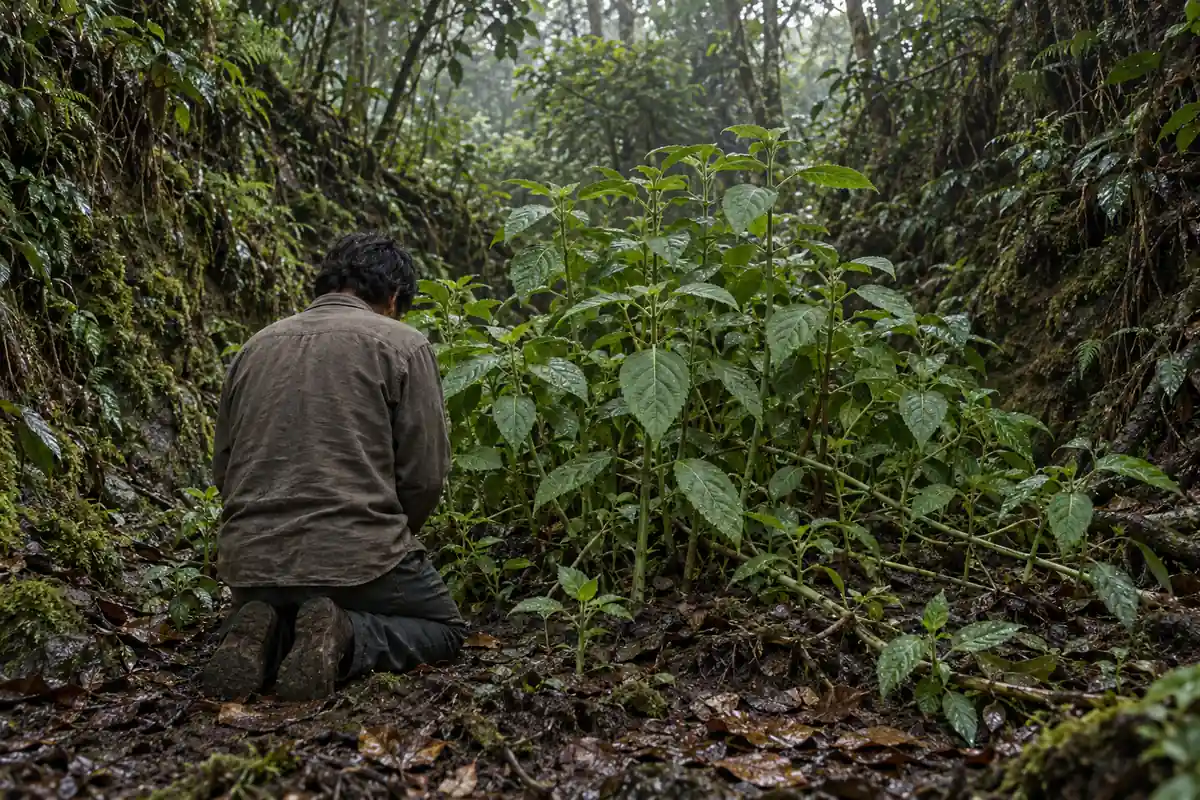
The Mazatec people live in the Sierra Mazateca, the mountainous northern part of the Mexican state of Oaxaca, and in the lowlands below it. Alongside the better-known sacred mushrooms of the region, they use the leaves of a mint found nowhere else. In Mazatec it is called ska Pastora, "leaves of the Shepherdess." Botanists know it as Salvia divinorum. Healers and patients take the fresh leaves at night, in darkness, before a household altar. They use them to learn the cause of an illness, to find what has been lost or stolen, and to treat a long list of complaints of body and spirit. Mazatec people describe the plant as a female doctor who works inside the body to restore health. [1, 3]
The Shepherdess and her family
Spanish-speaking Mazatecs call the plant hojas de la Pastora or hojas de María Pastora, "leaves of the Shepherdess" or "leaves of Mary the Shepherdess." Another name is hierba de María, "Mary's herb." In the Mazatec name, ska (written xkà in a newer spelling closer to its sound) means herb or leaf. Mazatec is a tonal language, and early writers had to mark the low tone of that syllable to record it. The names refer to the Virgin Mary, and many Mazatecs hold that she is present in the plant. [1, 3]
The name raises a historical question that remains open. In Christian tradition the Virgin is not a shepherdess, and there were no shepherds in Mexico before the Spanish arrived. In 1962 the American researcher R. Gordon Wasson wondered whether "the Shepherdess" preserved an older figure, the "lord of the animals" of Mesoamerican folk belief, given sanctity by the Virgin's name. Other scholars have suggested that the plant itself arrived after the conquest, or that an original Mazatec name was replaced under Christian influence. No sixteenth- or seventeenth-century writer is known to mention the leaves. In 2018 one researcher was still asking whether any Mazatec elder remembered a native name for the herb. [1, 3]
The Shepherdess does not stand alone. In 1962 Mazatecs described her as the most important member of a family of related plants, all mints. Salvia divinorum was la hembra, "the female." A plant of European origin was el macho, "the male," and two forms of a common ornamental mint were el nene, "the child," and el ahijado, "the godson." Some people insisted that these relatives also produced visions; others said they were only medicinal. [1]
People describe the experience itself in the same feminine terms. In fieldwork published in 2018, Mazatec participants spoke of feeling a loving and gentle feminine presence during ceremonies and of hearing a soft female voice that answered or advised them. They did not agree on who she is. Some believe she is the Virgin Mary; others say she is the goddess of plants and animals, or the soul of Mother Nature. [3]
A plant kept out of sight
In the early 1960s the plant was familiar to virtually all Mazatecs, and many families, perhaps most, kept their own supply. They planted it from cuttings pushed into black, steadily moist soil, and they set it far from houses and trails, where passers-by might see it. No one would show Wasson's party where the plants grew, although people brought them specimens. Mazatecs seem to have spoken about the leaves more readily than about the mushrooms, but no one could tell the visitors about seeds. Researchers later grew the plant from seed outside Mexico, and some Mazatecs told visitors in the 1980s that it grows wild in the Sierra and sets seed there. [1, 3]
Cutting the leaves has its own rules. In the early 1950s a man from the Mazatec town of Jalapa de Díaz described how a healer who went to the mountains for the plant had to kneel and pray to it before cutting. Only two or three specialists in his town knew the remedy, he said: "They are not witch-doctors; but the leaves are cut only when they are needed, after praying." Sixty years later Mazatecs gave much the same instruction: anyone who takes the plant, even only to get to know it, must ask the spirit of the plant for permission before cutting the leaves, give thanks, and show respect for its power. [1, 3, 6]
Speaking what is hidden
The oldest written accounts present the leaves above all as a way of finding things out. In 1938 the anthropologist Jean Bassett Johnson visited Huautla and learned that shamans and other people used hierba María, the "Virgin's seed" (morning glory), or the mushrooms to find lost objects. In the procedure he recorded, which was for the mushrooms, the person who has taken the plant falls into a sleep-like state and begins to speak while another person listens. No animal that might cry out and disturb the speaker may be kept nearby. The speaker tells where the lost animal or thing is, and the next day, the account says, they go to look and find it there. [3, 6]
An account from Jalapa de Díaz, published in 1952, shows the same principle applied to the leaves and to illness. When someone was sick "and the doctors do not know what is the matter," the healer used the plant to divine the disease. At midnight the healer took the patient and one other person to a quiet place, such as an isolated house, where the patient drank the leaves in water. Then "the patient himself begins to state the kind of sickness from which he suffers," speaking as if in a trance while the others listened carefully. He shook his clothes as if, with the plant's help, he could rid himself of the little animals believed to be causing the illness. At dawn the healer bathed him with the same water he had drunk. People said the bath ended the drunken state, and with it the patient was cured. Theft was handled the same way: the healer listened to what the person who had consumed the plant said, "and thus the facts are disclosed." [1, 6]
In these early accounts, the person who speaks is the one who has taken the plant, and the healer listens. In the same years the German-Mexican naturalist Blas Pablo Reko wrote of a "divination leaf" used by Mazatecs and neighboring Cuicatecs. The botanists who finally described the species in 1962 named it divinorum, "of the seers." [1, 2]
Illness and balance
The ceremonies make sense in light of Mazatec ideas about what causes sickness. According to Mazatec healers, disease comes from an imbalance, a break in the established order, or a violation of the unspoken agreement between people and the beings of the supernatural world. Negative thoughts and feelings can cause it, and so can the beings who live in nature. Mazatecs keep relationships of exchange with sacred beings and with all other beings, living and dead, to maintain the balance among the forces that share their land. [3]
A paper from 2017 describes in more detail what Mazatecs say about these beings. The chikones are owners of the land, the water, and the hills. The la'a take the form of children and live in natural places. Both can protect people, and both can cause sickness and death. The body, ya ona, holds six spirits in a man and seven in a woman. These spirits are at risk whenever a person meets a chikon or la'a or trespasses on their ground. The chjota chjine, "people of knowledge," act as intermediaries who recover lost spirits. Mazatecs turn to the mushrooms or the ska Pastora when the break is serious. The same paper notes that the plant is used mainly in the lowland Mazateca. [5, 8]
The night ceremony
Fieldwork published in 2018 describes night ceremonies with the leaves, held in complete darkness in front of an altar and lasting four or five hours. The healer, the chjota chjine or, for one who cures with plants, chjota chjine xkà, serves as mediator between worlds. As in the older accounts, it is the patient who speaks. The healer chants and prays and asks the patient questions, and the patient says aloud what they are discovering about the problem that brought them. In the Mazatec view, healers use the plants to help the sick person become aware of the origin of the imbalance and recover through their own will. [3]
Healer and patient both follow a strict regimen beforehand. For several days to several weeks they avoid certain foods, alcohol, cold drinks, sex, and situations such as funerals. On the altar are beeswax candles, flowers, a mixture of lime and powdered tobacco called San Pedro, and cacao beans, which are considered a spiritual payment for the healing received. [3]
Wasson's accounts of two ceremonies from the early 1960s add details of the setting. In one town the healers took care to face the altar toward the east and never toward the west, which was considered sinister. In another, the healer passed the leaves through copal smoke before preparing them. The leaves are taken in pairs, which Mazatecs say represent man and woman and the dual principle of creation. Wasson found that the effects of the leaves came on sooner than those of the mushrooms, were less sweeping, and lasted a shorter time. [1, 3]
Leaves for everyday ailments
The leaves are not reserved for night-long ceremonies. In the same 2018 account, Mazatecs used them for arthritis and inflammation, headaches, digestive problems, and alcohol addiction, and as a tonic for the sick, the anemic, and the dying. They applied them as poultices for insect bites and skin complaints. Women told the researcher that the plant is good for women's ailments, including infections and menstrual cramps. People drank the leaves just before sleep for internal ailments, so that the plant could work through the night, and reported vivid dreams. They also ate a few fresh leaves in the morning for low spirits, a use the researcher compared to treating depression. A well-known healer treated his son's addiction over a month with ceremonies and with fresh leaves. Asked about addiction or harm, Mazatecs said that they and their ancestors had used the plant for centuries without such problems. For them the plant is a source of healing. [3]
The healer's first teacher
The plant also has a place in how healers learn. In early reports, ska Pastora was the training herb for a future healer. It was considered the easiest to handle and the least powerful. The apprentice moved next to the morning-glory seeds, called naxole natjaoná in Mazatec, and finally to the mushrooms. In 1962, Wasson's informants told him that the leaves were used when mushrooms were not available. He described them as a less desirable substitute, though his informants also seemed to prefer the leaves to the morning-glory seeds for divination. [1, 3]
In practice, specialists work with different means. The 2017 paper describes how a healer acquires a specialty through experience with the mushrooms or the ska Pastora. Through the same experience a person learns whether they will become a healer or a te'ej, one who does harm, and the line between the two is thin. The paper also notes that not all people of knowledge have the wisdom to handle the mushrooms or "la Pastorita." Some instead read candles, cards, copal smoke, an oracle, or grains of maize. A 2015 study adds that many healers use both mushrooms and Salvia in the night ceremonies called veladas. [4, 5]
The regimen that precedes a ceremony reflects a wider concern with ritual purity. Across the region people insist that breaking the taboos around veladas, especially the rule against sexual relations for days before and after, can cause illness, madness, or death. A person who has abstained is tsje, clean, and only then fit to contact divine sources. Because healers never know when they will be needed, many live in a continuing state of sexual abstinence. A 2023 study of Mazatec ritual finds that being married makes it hard to keep the required periods of fasting and abstinence, and that healers are more often widowed or older. [4, 7]
Secrecy belongs to the same respect. In 1961 a healer in the town of Ayautla described the use of the leaves to Wasson's party and even chanted the words of the ceremony. She would not let them attend an actual ceremony, because her neighbors, and probably she herself, would have considered it a desecration to perform it before outsiders. When the session ended, she burst into tears, fell to her knees, and begged forgiveness for what she had done. [1]
Leaves that should not be burned
The plant left the Sierra soon after it was named. Living specimens collected in 1962 were taken to the United States and propagated among botanists and friends. That single strain became the plant now grown around the world. Its active compound was isolated in 1982, and laboratory research since then has drawn wide interest. Outside Mexico, people usually dry the leaves and smoke them, often as concentrated extracts. When fresh leaves are chewed in the Mazatec way, the effects come on slowly and last much longer. [3]
Mazatecs are aware of this. In the 2010s some said that smoking the plant is wrong and against the spirit of a plant that should never be burned. They believe the practice lies behind misunderstandings about the herb and may be why some countries have banned it. For them, any use, even simple curiosity, calls for an honest intention to heal oneself or another or to do good. It also calls for a ritual with a beginning and an end, and for permission and thanks given to the plant. [3]
These objections belong to a longer history. From the late 1950s, outside interest in the mushrooms drew researchers, then crowds of foreign visitors, to Huautla. Their disregard of ritual taboos was so disruptive that in 1968 the town's municipal president asked the government to intervene, and army roadblocks closed the region to outsiders until 1976. Mushrooms and veladas were drawn into cash exchanges, which some Mazatecs sharply condemn. A 2015 study suggests that, in local thinking, sacred plants such as mushrooms and Salvia depend on, and are nourished by, local social relations, while cash crops are not subject to the same restraints. By the 2010s visitors were booking veladas online or being approached at the bus station, and the exchange of mushrooms, ska Pastora, and veladas, once governed by reciprocity, had been reshaped by tourist demand. [4, 5, 8]
The leaves were touched by these changes from the start. By 1962, the plant had begun to acquire a cash value. A new highway had reached the town of Huautla in 1958–59, and a trade in sacred mushrooms for visitors had grown up there. Landowners who had once ignored the plants on their property became aware of a possible market for the Salvia, and several had recently enforced their right to the plants. [1]
The 2015 study found the trade in Salvia only beginning and the outcome too early to judge. Many people it interviewed already spoke of the new interest in the plant by recalling what had happened to the mushrooms, and worried that the leaves too would be cut off from the relationships that give them meaning. One person put the difference in a single sentence: "They just take our xka pastora away and treat it like marijuana, like a drug." [4]
What is uncertain
One recent account by a researcher who did fieldwork with Mazatec people describes how the leaves are used today in healing and night-time ceremonies. Most of the rest comes from eyewitness and second-hand reports from the 1930s to the early 1960s, and recent studies of the region mention the plant only briefly.
Sources disagree on how old the practice is: one says the leaves have been used for centuries, while another view holds that the plant may have arrived after the Spanish conquest or had its name reshaped by Christian influence. [1, 3]
No 16th- or 17th-century writer is known to mention the plant, so there is no early written record of its use. [1]
Sources disagree on whether the plant grows wild or exists only in cultivation; some Mazatecs say wild plants exist and set seed. [1, 3]
Sources describe its place in different ways. One calls it a less desirable substitute when mushrooms are unavailable. Another calls it the first training plant for new healers and a powerful plant spirit in its own right. [1, 3]
One source says almost all Mazatecs know the plant, while a later one says it is used mostly in the lowland part of the region. [1, 5]
Whether related mint-family plants that Mazatecs group with it are also mind-altering has not been tested. [1]
Whether people in neighbouring areas, such as Cuicatec, Chinantec or Otomí communities, use the plant in a similar way has not been studied. [1, 6]
It is not known whether chants specific to these ceremonies exist, or whether any elder still remembers an older native name for the plant; recorded early chanting had not yet been translated by 1962. [1, 3]
The healing results Mazatec users report rest on interviews, and the long-term effects of use within Mazatec communities have not been studied. [3]
It is too early to say how growing outside demand for the plant will affect local life and ritual. [4]
8 sources. Each claim checked by AI against the saved sources; every finding reviewed by Jim Davis beside the cited passage, 29 October 2026. How the articles were checked
Timeline of dated events (19)
- 1938 (summer)An anthropologist visiting Huautla records that a plant called "Hierba María" is used, like mushrooms, to find lost animals and objects. [3, 6]
- 1945A naturalist reports a visionary "divination leaf" among Cuicatecs and Mazatecs but cannot identify it. [1, 3, 6]
- 1952An anthropologist publishes an informant's account of the leaves being used in a Mazatec town to divine the cause of illness and to uncover thefts and losses. [1, 3, 6]
- 1953An outside researcher begins visiting the Sierra Mazateca and soon learns of a plant used when mushrooms are unavailable. [1]
- 1957A Mexican botanist collects specimens known as ska Pastora and notes their effects, but without flowers he can identify them only to genus. [3, 6]
- 1958–59The highway reaches Huautla, which becomes the focus of a new trade in sacred mushrooms. [1]
- 1960 and 1961Specimens are sent to botanists but prove unsatisfactory for identification. [1]
- 12 July 1961An outside researcher takes the leaves at a healer's ceremony in Ayautla. Another healer refuses to admit outsiders to a ceremony, treating it as a desecration. [1]
- In the years before 1962Landowners near Huautla, newly aware of a possible market, begin enforcing their rights to the plants. [1]
- September–October 1962Flowering specimens are collected, and a healer performs a divination ceremony using only the leaves for a visiting party. [1, 2]
- 28 December 1962Botanists publish the plant as a new species, Salvia divinorum, "of the seers." [2]
- 1962Living plants are taken to the United States, becoming the strain that later spread worldwide. [3]
- 1968–1976After disruption caused by visiting outsiders, army roadblocks close the region to outsiders. [4]
- 1982The plant's main active compound is isolated for the first time, in Mexico. [3]
- 1993The plant's botanical description is corrected after extensive fieldwork in the Sierra. [3]
- 2002Australia becomes the first country to outlaw the plant. [3]
- 2010A DNA study finds that the plant's closest known relative is a rare sage from the Colombian Andes. [3]
- By the 2010sOutside interest in the plant grows, and some Mazatecs object that outsiders smoke it and "treat it like marijuana." [4]
- By 2018Some Mazatecs say smoking goes against the plant's spirit and may be behind its being banned abroad. [3]
Sources
CSL-JSON imports into Zotero, Mendeley and other reference managers.
Wasson, R. G. (1962). A new Mexican psychotropic drug from the mint family. Botanical Museum Leaflets, Harvard University 20(3): 77–84.
Field report by an outside researcher on psychoactive plants, published in a Harvard botanical leaflet (1962). It gives eyewitness accounts of two ceremonies, local names and their meaning, how families keep private plantings, and quotations from earlier reports.
Epling, C. & Játiva-M., C. D. (1962). A new species of Salvia from Mexico. Botanical Museum Leaflets, Harvard University 20(3): 75–76.
Formal species description by two botanists (1962). It names and describes the plant and explains that the name refers to its use by Mazatec seers.
Maqueda, A. E. (2018). The use of Salvia divinorum from a Mazatec perspective. In B. C. Labate & C. Cavnar (eds.), Plant Medicines, Healing and Psychedelic Science, pp. 55–70. Cham: Springer.
Book chapter by a pharmacology researcher who did fieldwork in the Sierra Mazateca (2018). It describes present-day medicinal and ceremonial uses, ceremony settings and Mazatec views on the plant, along with the history of outside study and laboratory findings.
Faudree, P. (2015). Tales from the land of magic plants: Textual ideologies and fetishes of indigeneity in Mexico's Sierra Mazateca. Comparative Studies in Society and History 57(3): 838–869.
Journal article by a linguistic anthropologist based on long fieldwork (2015). It focuses mainly on mushroom rituals and writing, but notes that healers use the plant in night ceremonies and records local unease about outsiders' growing trade in it and smoking of it.
Piña Alcántara, S. (2017). En búsqueda del Ndi Xijto: Chamanismo y neochamanismo en la sierra mazateca, Oaxaca. Paper presented at the V Congreso de la Asociación Latinoamericana de Antropología, Bogotá, 6–9 June 2017. Posted by NEIP.
Unpublished conference paper by an anthropology graduate (2017). It is about tourism and new forms of shamanism, and notes briefly that the plant is used mostly in the lowlands and can shape a healer's specialty.
Valdés, L. J. III (undated; not before 2001, as it cites Gómez Pompa 2001). The Early History of Salvia divinorum. Web essay hosted by Erowid.
Undated web essay (no earlier than 2001) by a researcher on the plant. It translates and discusses the earliest reports from 1938 to 1957 and raises unanswered questions about use beyond the Mazatec heartland.
Suárez Ortiz, A. A. (2023). Los lenguajes del ritual mazateco. Master's thesis, Programa de Maestría y Doctorado en Estudios Mesoamericanos, UNAM.
Master's thesis on Mazatec ritual language, read only in part (2023). It centres on mushroom ceremonies and divination, with a single mention of the plant in a present-day remedy for breathing complaints.
Piña Alcántara, S. (2019). Turismo y chamanismo, dos mundos imbricados: el caso de Huautla de Jiménez, Oaxaca. Cuicuilco 26(75): 43–66.
Journal article on tourism and shamanism by the same author as source 5, read only in part (2019). It lists the plant only briefly among the visionary plants healers use.
Related
Cite this page
Psychoactive Traditions. “Mazatec ska Pastora.” Last reviewed 29 October 2026. https://psychoactive-traditions.org/traditions/mazatec-salvia