In the mountains of Oaxaca, in southern Mexico, Zapotec, Mixtec, Mazatec, and Chinantec communities have used the seeds of two morning glories to learn what cannot be found out by ordinary means: why someone is sick, who is responsible, where a lost thing has gone. The Aztecs called such seeds ololiuhqui. In Zapotec they are badoh, and in Spanish the seed of the Virgin. A person drinks a preparation of the seeds at night, in silence, and after a time begins to talk. In two Mixtec villages where the practice was documented in 2010, people describe this moment in three words: "the seed speaks." [1, 3, 6, 8]
The vine and its rules in Yodohino and Nundó
The fullest recent account comes from those villages, Santo Domingo Yodohino and Santo Domingo Nundó, in the Huajuapan de León district of the Mixteca, where the anthropologist Antonella Fagetti carried out interviews during two periods of fieldwork in 2010. People there use the Virgin's herb, Ipomoea violacea, together with the seeds of a cultivated datura they call san José. [3] Names for the morning glory often refer to Mary. Spanish speakers call the seed semilla de la Virgen, and in Yodohino and Nundó the vine is yukú iá sií, "herb of the Virgin," and also "mantle of the Virgin." [1, 3] Secrecy surrounds the practice, and Fagetti notes that it is very hard to witness a healing. What follows about these villages rests on what people remembered and told her. [3]
Older women recall the early twentieth century as a time of mule tracks and no cars, when "many women died in childbirth." The Virgin's herb was what they had: "pure herb, what doctor, no doctor at all!" one said. Fagetti does not attribute the seeds' survival to scarcity alone. She also credits their power, as people understand it, and the knowledge handed down about how to use them and how to care for the person who drinks. [3]
People say both plants have temperaments. The san José grows only in the yards of those who plant it, and even there it may fail, because "it is like God, that is why it grows where it pleases." It can take offense and leave. The seeds must also be paid for. "If I go and gather it myself and don't buy it," one woman explained, "it won't make a remedy." According to one specialist, the seller tells the herb: "You are going with this sick person, but you will heal her!" The seeds then rest beneath the robe of the Virgin of Solitude or the patron saint in the church, or on the household altar, where, the same specialist says, "it takes the sign." [3]
The rules are specific. No one should find out. The seed is taken on a "good day, when the doors of hell are closed," preferably a Sunday, and at night, because it is timid: "if the dog barks, if the donkey brays, it takes fright, the talk is cut off, the seed is frightened and goes away." A pregnant woman may neither drink nor prepare it, since it "cuts short the pregnancy"; Fagetti links this to a substance in the seed that stimulates the womb. The chemist Albert Hofmann's analysis found ergometrine, used in obstetrics, in the black seeds. [3, 6]
The rainy season brings a related restriction. While the vine is growing, the plant is understood to be pregnant, and its seed behaves like a fretful child whose mother is expecting another. Anyone who drinks then risks madness, so the seed is kept for Lent, after the vine has dried. [3]
The knowledge belongs to women. Fagetti reports that the specialists appear always to have been women, some of them also midwives and healers, and that the work of preparation excludes men. The essential qualification is a "good hand." "If they don't know how to give it, they end up mad," said one specialist, who learned as a girl by spying on the women who made the drink. Another said the woman giving it must be "energetic," because "if she is placid, it does nothing." She hires herself out for the task, and much of her skill lies in repeating exactly what the antecesores, those who came before, have always done. [3]
When the seed speaks
The specialist makes the sign of the cross and offers the drink: "In the name of God I am going to give you this medicine." She anoints the sick person, who lies down on a mat under a blanket. Then she sits behind, listening, and waits "very quietly." Vomiting is a good sign, because the seed "cleans the stomach." If nothing happens, the drink has to be repeated at a later time. [3]
When the effects take hold, the person begins to talk. "It is the herb itself that makes us speak." What it says often comes in the first person plural, as if drinker and plant had become one speaker. Drinkers also see what is being described: "it goes by like a television," "like a film." Because they may remember little afterward, the attendant has to report what was said. [3]
One woman told how she brought her daughter, six or seven years old, to a specialist after a doctor's pills failed to stop the swelling in the child's body. The child got up and began to speak:
> "Oh, how badly our hand has swollen... Why is our foot like this? It is that we took fright beside the fire. The atole spilled and the ash jumped up at us; that is why it is white."
She went on to say that "we" had been pushed into the deep part of the river and nearly drowned, and that all the water was still in "our" body. She named a third place, where "we" had broken a little jug. Her mother gathered earth and ash from those places, heated them, and bathed the girl in the vapor. "And with that," she said, "a holy remedy." [3]
Fright, malice, and what follows
Two explanations recur in these accounts, and the girl's words had already named one of them. Espanto, or susto, is fright: something in a particular place has seized the person's spirit. The remedy therefore has an address. Because the seed shows the place, an offering can be carried there so that whatever holds the spirit will let it go. If that is not done, Fagetti writes, there is no recovery, and the herb will have spoken in vain. [3]
A woman recalled her sister, gravely ill and no longer recognizing anyone. Given the seed, the sister began to brush at herself and said "we" were lying by the highway, covered with the dust thrown up by passing cars. The woman who gave the drink declared it fright and turned to the husband. He remembered the roadside where, in a fit of temper, he had struck his wife. "You know where you frightened her," she told him. "Now go and lift her up, because I don't know." He went in the night with food, liquor, and cacao to "pay the place." By morning his wife had turned on her side and was asking for atole. [3]
The second explanation is malice, the witchcraft that the seed is said to expose by showing the guilty person. A woman in her thirties with a persistent cough drank and saw a little red ant. Then she saw her mother-in-law pressed against the door outside, a woman she remembered as bad-souled. That night she went out and vomited. "The sickness came out," she said. Fagetti notes that such revelations usually cannot be checked. [3]
The seed may also speak of what is still to come. A man recalled that his father, drinking for an illness, saw how he would be cured and also warned that a young man would shoot a rival over a girl. About a month later, by the son's account, the rival was shot in the leg. [3]
People also read signs of recovery throughout the process. A generous yield during preparation shows that the seed "will make a remedy"; "when it is not for healing, it doesn't abound," one specialist said. In trance a wasted person may see herself fat: "very plump my fingers were, and I felt my cheeks round." [3]
The madness that the rules guard against also governs how the rite ends. When the seed has finished speaking, the person is washed and wiped down. The next day comes a steam bath, which, one specialist explains, must "cook" the head so that no one is left mad. She remembered a woman who ended up "a little crazy" because no one had warned her helper to light the bath in time. She also recalled a man who drank, then ran off to stone his brother, whom he accused of bewitching him over land. She had buckets of cold water thrown in front of him and behind him, and he came back quietly and lay down. [3]
The woman who listens
For all she manages, the specialist in these villages does not cure. She listens, asks a question if needed, and makes sure the herb's instructions are carried out. It is the sick person who sees, understands, and learns what must be done. Fagetti treats this as the feature that sets the practice apart from rites in which a specialist takes the plant on another's behalf. She argues that the drink temporarily gives the drinker the seeing and knowing a shaman holds permanently, making this a form of shamanism and an act of self-healing. Whether the absence of shamans produced this arrangement, or whether its ease made them unnecessary, she leaves open. [3]
Her reading of the mechanism is explicitly conjecture. In cases of fright, she suggests, the trance may let forgotten and painful events surface. She finds witchcraft and foretelling harder to explain, and says only that these processes cannot yet be interpreted in their full complexity. The people she interviewed offer their own evidence: the sick got well, and what was foretold came to pass. [3]
Round seeds, black seeds
The two Mixtec villages are one corner of a much wider and older record, in which the seeds go by many names. Ololiuhqui is a Nahuatl word meaning "round thing," and it names the seed rather than the plant. The plant, a climbing vine now usually classified as Turbina corymbosa and long known as Rivea corymbosa, was called coaxihuitl, "snake plant." Its seeds are small, brown, and oval. The second species, Ipomoea violacea, the Virgin's herb of Yodohino and Nundó, has long, angular black seeds that could hardly be called round. The researcher R. Gordon Wasson proposed that they are the tlitliltzin named in a colonial text, a word built on the Nahuatl root for "black" with a reverential ending. In Zapotec the two are badoh and badoh negro. [1, 3]
In the Zapotec villages surveyed in the 1950s, the black seed was widely considered the stronger. In some places it was called macho, "male," and taken by men, while the brown seed, hembra, "female," was for women. [1]
From the Inquisition to the laboratory
Spanish writers of the sixteenth century recorded the seeds in some detail. The physician Francisco Hernández reported that priests ate them and, in a delirious state, received messages from the supernatural and communicated with their gods. The seeds also served as medicine, for pain and tumors among other troubles, and were believed to possess a deity of their own who worked miracles if properly propitiated. People consulted them over long illnesses that would not heal, and to find missing people, objects, and animals, whether lost or stolen. [2, 6]
Churchmen tended to accept that the seeds produced knowledge and to dispute its source. In 1591 Juan de Cárdenas wrote that someone who took peyote or ololiuhqui would be "warned (so they say) of things to come," and that all of it must be the "tricks and lies" of Satan. The Inquisition prosecuted specialists and users alike. Fagetti argues that this persecution drove the sacred plants out of public ceremony and into private rites, kept in the family and in distant regions. In the first century of evangelization they were still being kept in baskets on household altars and treated as divine beings. [1, 3, 7]
Scientific interest arrived late. Wasson obtained both kinds of seed, gathered by a Zapotec collector, and passed them to Hofmann. In 1960 Hofmann announced that their main active compounds were lysergic acid amides, close relatives of LSD. Such compounds had previously been found only in lower fungi, and many of the scientists in his audience plainly doubted the result. [1, 6]
By 1963 Wasson could write that the seeds were perhaps the best known and most widely used of Mexico's divinatory plants among Indigenous people and the least known outside. He reported finding them in almost all the villages of Oaxaca, used in vigils that invoked the Virgin, the saints, and Christ. [1]
Who drinks
Twentieth-century accounts differ on who takes the seeds, and the difference shapes what the rite is. A description from the 1930s concerns professional soothsayers called piuleros, after piule, another name for the seeds and their drink. The piuleros usually drank it themselves and then advised their clients. Sometimes they gave it to the client instead, who answered their leading questions under its influence and so discovered the illness, for which the piulero then found medicines. [6]
Among the Mazatec of Huautla in 1938, shamans and other people used mushrooms or, in some cases, the Virgin's seed to find what was missing. The person who had taken them fell asleep and spoke while someone else listened. No animal that might cry out was allowed nearby. The sleeper said where the lost thing was, and the next day, as the account has it, there it was. [5]
In the Zapotec town of San Bartolo Yautepec around 1959, a healer dictated an account of a routine vigil, which Wasson published in paraphrase. The sick person drank after a vow to the Virgin; without the vow, she said, the seed would have no effect. A freshly bathed child of seven or eight, of the opposite sex from the patient, carried the bowl with a censer and stayed to hear what the patient would say. Prayers asked the Virgin to "tell us" what was wrong. There was to be no noise at all. "And so everything is revealed," the account ends. "You are told whether the trouble is an act of malice or whether it is illness." [1]
Wasson saw the child as part of a wider pattern. He had met young girls preparing sacred mushrooms and sage in Mixtec and Mazatec towns, and a seventeenth-century priest had written of ololiuhqui and peyote that they must be prepared by a maiden's hand. In Fagetti's 2010 interviews in the Mixtec villages, no one mentioned the custom. [1, 3]
The vine in the yard
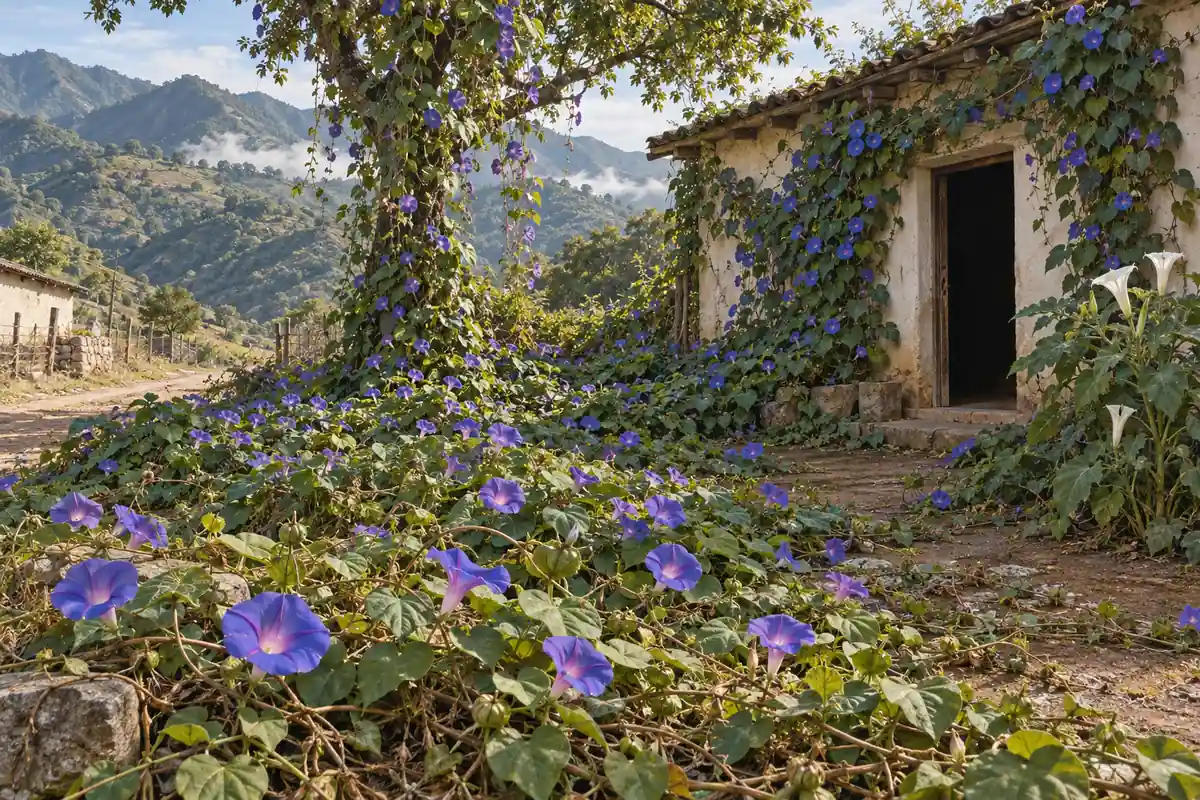
In 2010, two elderly women in one of the villages were still known as specialists. Two women grew the san José and sold seed to those who needed it. People said the vine used to grow everywhere, but now that "everything has changed" it is not easy to find near the village, and households often clear it from their yards with the other weeds. In one yard that October, a woman had let it climb freely, its flowers filling the patio, so that she could collect the seeds when the flowering ended. [3]
What is uncertain
Spanish colonial writings and twentieth-century studies show clearly that these seeds were long used to divine and heal, especially in Oaxaca. The only detailed recent account, however, comes from interviews in two villages around 2010, and the researcher did not see a ceremony herself.
Sources differ on who takes the seeds, with one saying professional diviners usually take them and sometimes give them to clients, and others describing the sick person as the one who takes them. [1, 3, 6]
Scholars can debate whether the Mixtec practice counts as shamanism, because the sick person takes the seeds and the specialist does not; the main study argues that it does, but presents this as its own view. [3]
Early self-experiments and trials gave conflicting results, and the explanation that failed trials used poorly prepared seeds was not tested in any of these sources. [1, 6]
Mixtec users take these seeds together with those of another plant, and no source separates what each contributes to the experience. [3]
A child or young woman was reported as taking part in the rite in the mid-twentieth century, but people interviewed around 2010 did not mention this custom, and it is unclear whether it has faded or varies by place. [1, 3]
The identification of the black seeds with a plant named in a colonial text rests on a rare mention of that name and on inference. [1, 3]
One review states plainly that the Maya consumed these seeds, while another source describes ancient Maya use of the plant as a proposal, based on colonial sources, an image on a vessel and oral tradition. [2, 7]
Links between the tradition and very old carved stones and grinding stones depend on interpretation, not direct evidence of seed use. [1]
No recent survey shows how widespread the practice is, since a 1963 account placed it in almost all Oaxacan villages while the 2010 fieldwork covered only two villages. [1, 3]
It is not known whether younger women are learning the specialist role, since the study names only two specialists in one village, both elderly, and does not address successors. [3]
Reports of cures and fulfilled predictions rest on the testimony of participants, and the researcher herself says they cannot be explained or, in witchcraft cases, verified. [3]
Folk names overlap between different plants, so some older reports, such as one of a "Yerba de la Virgen" among the Otomí, cannot be securely assigned to a species. [3, 4, 5]
The seeds' scientific name has been disputed, and later sources use a different name from the one defended in 1963. [1, 3]
8 sources. Each claim checked by AI against the saved sources; every finding reviewed by Jim Davis beside the cited passage, 30 October 2026. How the articles were checked
Timeline of dated events (24)
- 200 BC–AD 300Ololiuhqui seeds were placed in a human burial in the present-day State of Mexico. [3]
- Prehispanic timesThe Aztecs and related peoples used the seeds in religious ceremonies and medicine. [6]
- 16th and 17th centuriesFriars and other colonial writers recorded the seeds and condemned their use. [1, 3, 7]
- 1570–1575A Spanish physician researching Mexico's plants and animals gathered material describing ololiuqui and its use by priests, published in 1651. [6]
- 1591A chronicler attributed visions from ololiuhqui and peyote to the devil. [7]
- Toward the middle of the 17th centuryA churchman recorded that a maiden had a required role in the rite. [1]
- Colonial periodChurch persecution and the Inquisition pushed use into private settings and remote regions. [1, 3]
- 1897Ololiuqui was identified as the morning glory Rivea corymbosa. [6]
- First decades of the 20th centuryElderly Mixtec women recall a time without roads or doctors, when the seeds were a main remedy for serious illness. [3]
- 1926 (the note's reference list gives 1936)Zapotecs of Mitla were reported to use a seed for divination. [8]
- 1937A pharmacologist in Stockholm tested the seeds but could not isolate definite crystalline compounds. [6]
- Summer of 1938Anthropologists in a Mazatec town recorded "semilla de la Virgen" as one of the plants used to find lost things. [5]
- 1939Plantings of Rivea corymbosa were found among the Mazatecs and Chinantecs, and samples were taken. [8]
- 1941A Harvard botanist's monograph settled the plant's identity. [1, 6]
- 1950sA researcher found the black seeds in wide use among the Zapotecs. [1]
- 1955A Canadian psychiatrist reported effects from taking the seeds himself. [6]
- 1958Trials with eight volunteers were published reporting no effect. [6]
- 1959A Zapotec healer dictated an account of a healing vigil that was also photographed. [1]
- 1959A Swiss chemist began analysing seeds from Oaxaca sent to him by Wasson. [3]
- 1960The second seed's use in Oaxaca was published. [1]
- August 18, 1960The chemist announced that the seeds' active substances are related to LSD. [1, 3, 6]
- 1962A Zapotec colleague of the researchers visited six Chatino villages, where use of the black seeds was then recorded. [1]
- 1979Wasson and other scientists coined the word "entheogen" for such plants, stressing their sacred use. [3]
- 2010Fieldwork found the seeds still used for divination and healing in two Mixtec villages, with knowledge held by women. [3]
Sources
CSL-JSON imports into Zotero, Mendeley and other reference managers.
Wasson, R. G. (1963). Notes on the present status of ololiuhqui and the other hallucinogens of Mexico. Botanical Museum Leaflets, Harvard University 20(6): 161-193.
A Harvard botanical research fellow's field-based survey (1963), contributing mid-century Oaxacan use, a healer's dictated account, a map of villages, the black seed's role and links to colonial texts.
Fagetti, A. & González Chévez, L. (2012). Introducción [Dossier: El uso ritual de enteógenos en México]. Cuicuilco 19(53): 149-?.
Two anthropologists' introduction to a journal dossier (2012), contributing a brief overview of colonial records and continued use, plus a summary of a proposal about ancient Maya use; it shares an author with source 3.
Fagetti, A. (2012). Cuando "habla" la semilla: adivinación y curación con enteógenos en la Mixteca oaxaqueña. Cuicuilco 19(53): 229-255.
An anthropologist's journal article (2012), based on 2010 interviews in two Mixtec villages, contributing the main recent account of who uses the seeds, for what purposes, what users experience and how the practice is interpreted.
Piña Alcántara, S. (2019). Turismo y chamanismo, dos mundos imbricados: el caso de Huautla de Jiménez, Oaxaca. Cuicuilco 26(75): 43-66.
An anthropology researcher's journal article (2019) on mushroom tourism in a Mazatec town, contributing the wider setting of Mazatec healing and a passing note that Mazatecs know the seeds.
Valdes, L. J., III. The Early History of Salvia divinorum. Online text, Erowid Salvia divinorum Vault (original publication details not verified).
An undated online essay on the early history of Salvia divinorum by a researcher with fieldwork in Mexico, with publication details unverified, contributing quoted 1930s reports of seed use and a correction about a Zapotec plant name.
Hofmann, A. (1971). Teonanácatl and Ololiuqui, two ancient magic drugs of Mexico. Bulletin on Narcotics 23(1): 3-14.
A Sandoz chemist's article in a UN drug bulletin (1971), contributing the seeds' chemistry, conflicting early trials, local plant names and a summary of the plant's history and use.
Carod-Artal, F. J. (2015). Hallucinogenic drugs in pre-Columbian Mesoamerican cultures. Neurología (English Edition) 30(1): 42-49. Publisher page shows DOI 10.1016/j.nrleng.2011.07.010 and copyright 2011 (first online 2011).
A neurologist's review article (2015, first online 2011), contributing a broad overview with colonial quotations and a general statement that healers still use the seeds.
Untitled note on ololiuqui (author not shown). Boletín de Antropología, Universidad de Antioquia, c. 1969 (year inferred from departmental news on the next page of the same PDF), p. 181.
An unsigned note in a Colombian anthropology bulletin (c. 1969), available only in part, contributing a list of peoples and districts where the seeds were used and an early report of Zapotec divination.
Related
Cite this page
Psychoactive Traditions. “Ololiuqui and Badoh Seed Divination.” Last reviewed 30 October 2026. https://psychoactive-traditions.org/traditions/oaxaca-ololiuqui-seeds