Names
In Western countries, the medicine goes by kava or kava-kava. The word "kava" comes from Polynesian languages, where it names the plant, and in some of them, such as Māori and Rarotongan, it also means "bitter."
Pacific peoples have many other names for it. In Fiji, the iTaukei (Indigenous Fijians) call the drink yaqona. They also call it wainivanua, "water of the vanua," a word that takes in people, land and culture. In Vanuatu, the Bislama word redimed ("ready-made") refers to one particular form: the kava sold in town kava bars, called nakamals, as opposed to customary kava.
Its scientific name is Piper methysticum. Piper is the pepper genus, and methysticum comes from a Greek word meaning "intoxicating."
What it is
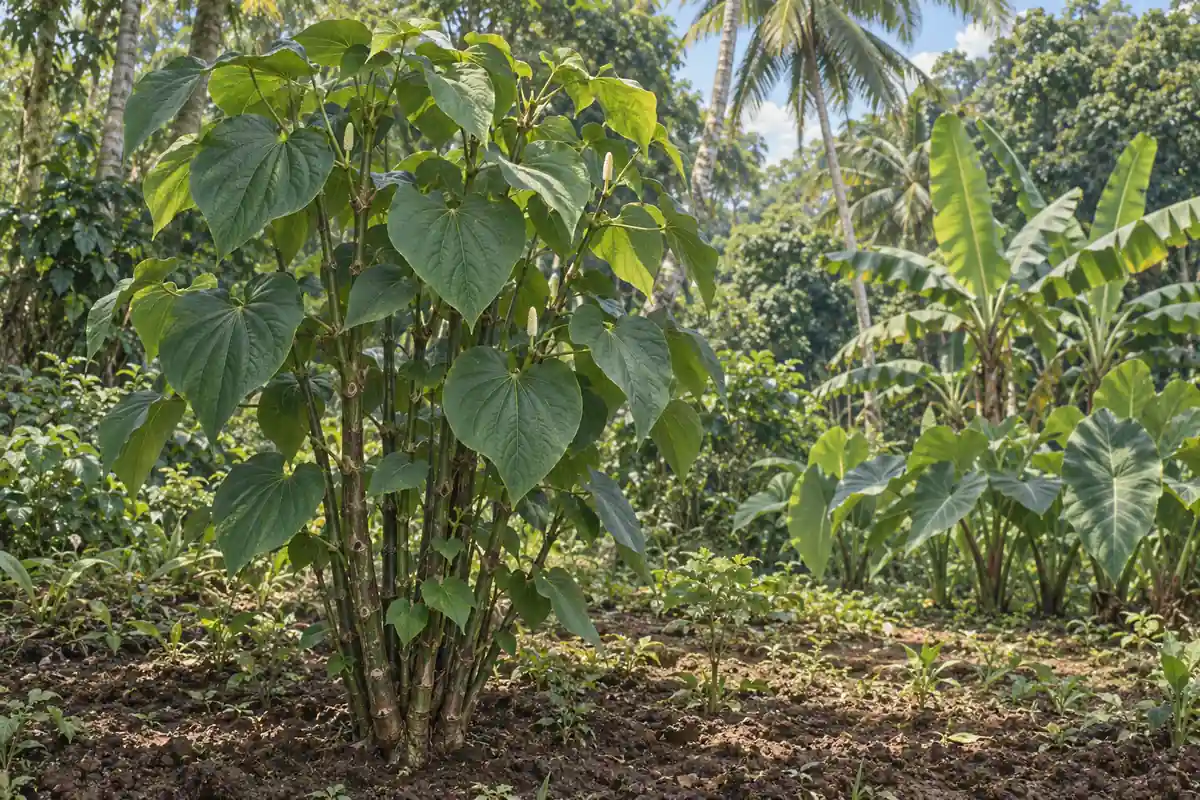
Kava is a leafy shrub in the pepper family, with jointed stems, large heart-shaped leaves and a thick, knotted rootstock. It grows on the warm, moist islands of the tropical Pacific, where people have developed many named varieties.
Cultivated kava is fully domesticated and found only in cultivation, though botanists have classed its wild ancestor as a variety of the same species. Because it doesn't reproduce by seed, it depends on people to plant it from cuttings. Botanical and genetic studies suggest it was domesticated from a wild pepper, probably in northern Vanuatu.
To make the drink, the plant's underground parts are mixed with water, though the methods differ across the Pacific. In Vanuatu, the rootstock and roots are chewed or ground, depending on the area. The iTaukei pound the roots before mixing them with water. The result is a cloudy, muddy-looking liquid with an earthy, bitter taste. It isn't fermented and contains no alcohol.
How it works
Kava's active compounds are kavalactones (also called kavapyrones), a family of related substances concentrated in the root. No single kavalactone is known to be responsible for the effects, and the mix varies from one variety to the next.
How they work isn't fully settled. In laboratory and animal studies, kavalactones act in several ways. They boost the effect of GABA (gamma-aminobutyric acid), a chemical messenger that quiets nerve cells, and they partly block channels in the nerve cell's surface, the tiny gates that help it fire. Which of these actions matters most in people is unknown.
Effects on the mind
Kava is a relaxant, not a psychedelic. People commonly describe feeling calm and at ease, in a sociable or quietly contented mood, and they say their thinking usually stays clear. It doesn't ordinarily bring visions or a loss of contact with one's surroundings.
The effects generally last a few hours, though a long session of shared drinking can stretch them out. The experience varies. Some newcomers say they notice little at first. Some drinkers, particularly after long sessions, describe feeling dull, withdrawn or slow-witted, and some feel mentally foggy the next morning.
In tradition
In both Fiji and Vanuatu, kava marks public occasions and plays a part in settling conflict. Ni-Vanuatu share it at weddings, funerals and official welcomes, while the iTaukei use it to welcome visitors and install chiefs. In Vanuatu it is exchanged with pigs and mats to settle disputes; in Fiji it seals apologies.
Its recorded meanings, however, differ. The iTaukei understand yaqona as a drinkable form of the vanua: the land, its people, chiefs and customs. Presented and shared, it is believed to carry mana, often glossed as spiritual power, and it is used to begin a healer's treatment. In Vanuatu, accounts from around 1990 describe kava as a way to reach the ancestors.
Both traditions carry on amid change. Vanuatu has town bars and a cash trade that grew after independence in 1980. Even so, custom reconciliations involving kava, along with gifts such as mats or pigs, were still being reported in 2018 and more recently. In Fiji, kava remains central to ceremonial and daily life, though some Pentecostal churches reject it.
Today
Kava is now also used well beyond the traditions it comes from: in bars in some Western cities and as a commercial extract. Kava extracts have also been studied in clinical trials for anxiety, but those trials tested extracts, not the customary drink.
Traditions that use it
Cite this page
Psychoactive Traditions. “Kava.” Last reviewed 4 November 2026. https://psychoactive-traditions.org/medicines/kava