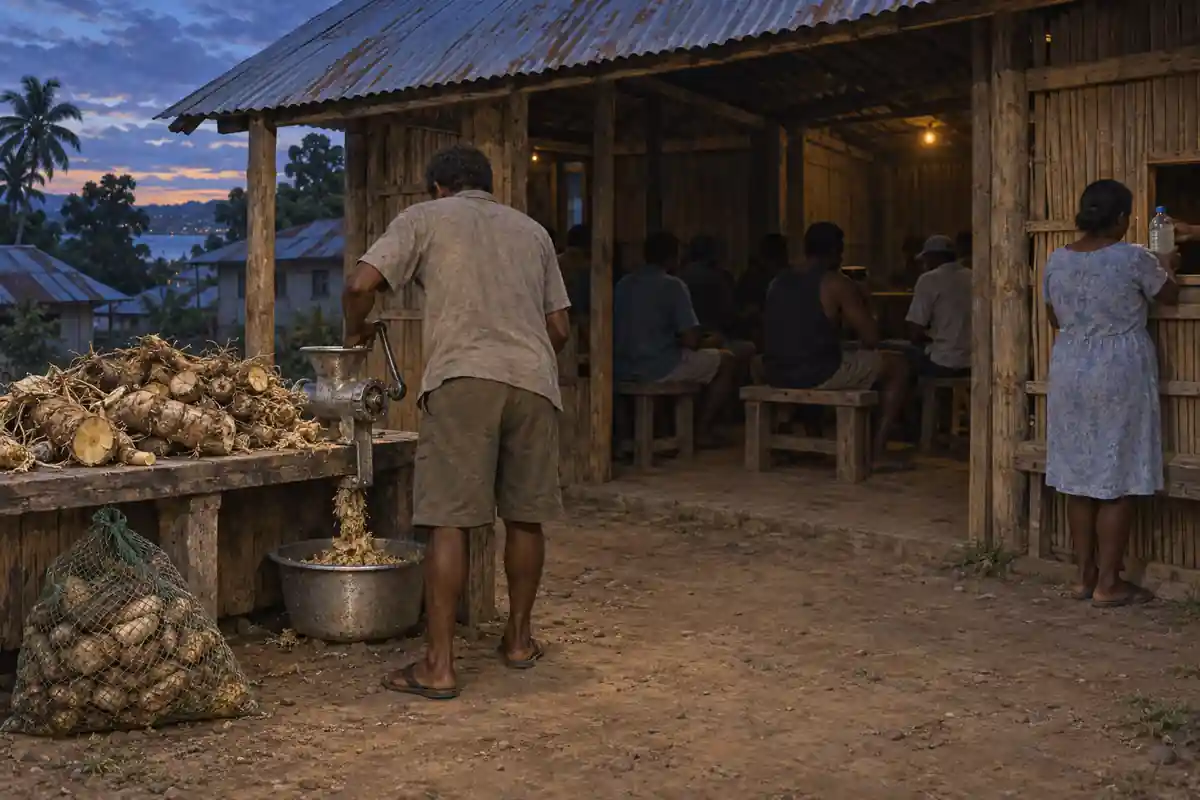
In the islands of Vanuatu, in the southwest Pacific, people make a drink called kava from the rootstock of a pepper shrub, Piper methysticum. Around 1990, in most rural areas, adult men gathered at the end of the day to drink it from coconut shells, bringing roots to share with relatives and neighbors. The same roots passed between families at births, circumcisions, marriages and deaths, and were given to settle quarrels. Kava was also understood to join the living and the dead. On the island of Tanna, drinkers spat out their last mouthful with a prayer to the ancestors buried around them on the kava-drinking ground. [3, 5]
Quiet and the voices of ancestors
Kava is not a hallucinogen. Writing in 1991, an ethnographer of Tanna described its usual effects as relaxed sociability and "a delicate emotional serenity." Drinkers in Vanuatu distinguish between noble kava, prized for a mellow, clear-headed effect, and tudei, or "two-day" kava, which can leave a person groggy for a day or more. [1–3] The varieties used in Vanuatu, and the way the drink is made there, seem to favor stillness followed by deep, restful sleep. An anthropologist who drank mostly in Fiji, where the drink is weaker, recorded a gradual change. Conversation that had flowed freely became "burdensome," while light and sound grew irritating. In the state just before sleep, he wrote, the mind stays open to its surroundings but is "free to weave them into its own imagery." [1, 3]
In Vanuatu around 1990, kava served two purposes in people's dealings with the unseen. Sometimes it was a gift to the gods, poured out as a libation or spat into the air. At other times it was closer to "a passkey to the supernatural realm," an altered state in which men might overhear the voices of their ancestors. Kava drunkenness was understood as a meaningful experience that brought new knowledge. [3]
On Tanna after independence, all men were said to be in contact with their own ancestors. Important men were buried on the kava-drinking ground, while other people were buried in the village. Ancestral ghosts might leave for a land called Ipai, or they might stay near their old homes and be seen in gardens and the forest. Across the kava-drinking Pacific, ancestors are typically seen as the source of knowledge and power, as helping their descendants and keeping land and sea fertile, and as able to punish those descendants with failure, sickness or death. One anthropologist argues that this channel to the ancestors, and to the spiritual power called mana, was what spread with the plant from northern Vanuatu. [1, 5]
Chemical and genetic evidence suggests that kava was domesticated in northern Vanuatu about 3,000 years ago, when early farmers selected and cloned plants from a wild relative, Piper wichmannii. At least one scholar has argued otherwise, but the northern islands remain the most widely accepted point of origin. From there, voyagers and settlers carried cuttings east to Fiji and Polynesia, north to Pohnpei and Kosrae, and west into parts of New Guinea. Vanuatu still has more varieties than anywhere else in the Pacific. [1–3]
Drinking grounds and roads
Who could drink varied from place to place. The more informal practice described for Vanuatu around 1990 tended to stress equality among men, whereas Polynesian societies often used a formal drinking order to display chiefly rank. Tanna's adult men followed that principle of equality within a society still ordered by sex and age. In southern Vanuatu, boys made the drink for their elders. Across the country, women traditionally drank kava in only a few communities. In parts of northern Vanuatu the circle was much narrower: only men of the highest ranks in the graded societies, men's organizations with a ladder of ranks, were permitted to drink. [1, 3, 6]
On Tanna, the kava-drinking ground has also been a basic unit of social life. As recorded in a reference account from after independence, two or more lineages were based at each ground, and the men of neighboring grounds formed one of about 115 named regional groups. Traditional "roads" linked the grounds across the island, and men sent messages, goods and spouses along them. Because this network connected every village to all the others, Tanna shared a common culture despite its many languages. [6]
Every Tannese ceremony in that account combined exchange, kava drinking and dancing that lasted through the night. Most ceremonies marked events in a person's life. For these, the family gathered pigs, food, kava, woven goods and cloth to present to the person's mother's brothers, and an equal amount came back when the exchange was later reversed. A Christian pastor would typically officiate at a burial, but the traditional funeral a month or so later was the final exchange between the dead person's family and those same uncles. The largest ceremony, the nakwiari, drew several thousand people, and after a night and a day of song and dance, two regions exchanged pigs and kava. [5]
Settling what has gone wrong
The exchanges that hold people together can also divide them. On Tanna, most conflict was traced to imbalance in exchange, especially in the agreements by which families exchanged sisters as brides, and to disputes over land. Police and island courts operated there, but most disagreements were handled unofficially, and people often began by avoiding one another. [6]
Sickness could set a settlement in motion. On Tanna, islanders believed that ancestors displeased with conflict might make people ill, so a serious illness led people to try to settle outstanding disputes. [3, 6] When differences had to be resolved, the parties met at a local kava-drinking ground, where influential men and third parties tried to reach a consensus that would hold at least for a time. An exchange of pigs and kava between the two sides marked the resolution. [6] The gift itself also carries an expectation drawn from the drink's effects. In one ethnographer's reading, kava's power to reconcile reflects what people expect it to do to their bodies: calm them and make them peaceable. [3, 6]
Reconciliation ceremonies predate Christianity and are found throughout Vanuatu. In Bislama, the country's most widely spoken language, they are known as sori ceremonies. They need the consent of both parties and usually involve speeches and an exchange of food and mats, often with a pig that is killed, cooked and eaten together. Kava is one element among several, and practice differs by island. A chief who mediates disputes in Port Vila, the capital, said in 2018 that some islands require a pig and others only a mat. He also described what a gift does for the person who brings it. When he simply came to talk, he said, people tended not to listen, but a mat or kava made all the difference. "If I put a mat there, when I talk, everyone listens," he said. "If you just talk without any culture, there is no authority." [4]
The same chief said that the ceremonies supplement the courts without replacing them, and he contrasted them with the win-or-lose outcome of a ruling. Even the losing party in a land dispute may receive a token portion. "In our kastom," he said, using the Bislama word for Vanuatu's customs and traditions, "you cannot forget anyone." On Ambrym, a man translating an interview explained how custom and church could sit side by side: "According to the culture, the pig is the only object that is effective for reconciliation, but in the church it is prayer." People sometimes did both, he said, "and that is justice and grace." [4]
Prohibition and return
Kava produces no viable seed, so each plant grows from a stem cutting taken from another. If people in a place stop replanting it, kava is likely to disappear from that place in time. Its survival is tied to the survival of the reasons for drinking it. [1, 3]
That dependence left kava exposed when missionaries on Tanna banned kava drinking along with dancing and reworked local political and economic arrangements. There, Christianity merged with the older concern for ancestors and spirits, and some communities gave up kava and took it up again more than once after contact. Elsewhere the outcome depended partly on what kava was attached to. On Ambae, where kava drinking belonged to the men's graded society, the practice disappeared from the west of the island when the society was abandoned there in the twentieth century, while both continued in the east. In general, the more narrowly kava was restricted, the more easily it could be lost. By the late 1980s, people in northeast Malakula were avoiding it because of its association with sorcery. [1, 5]
One study summarizes the period as more than fifty years of religious prohibition, ending around the 1970s, when kava drinking reappeared as islanders moved to town and settled there. After independence in 1980, the practice changed quickly. People drank more often and in greater numbers, and the traditional drinking places themselves changed. [7]
Port Vila shows the speed of that change. In 1980, imported Australian beer was the town's preferred intoxicant, and only a handful of kava bars were doing business. By about 1991 there were more than 60, many of them bamboo-walled, tin-roofed shelters, and many people had given up alcohol for kava. These bars took the name nakamal, a word that also refers to a council of chiefs and the place where it meets. They kept the coconut shell and some older manners, but they prepared kava in bulk, charged money for what had always been a gift, and opened their doors to anyone, kin or not. Kava's ancestral functions receded there, and drinkers adopted a new word for what the bars served, redimed, "ready-made," to distinguish it from customary, sacred kava. [3, 4]
Spirit, cash and emblem
The town bars created a market for rural growers, mainly on Pentecost and Tanna, and kava brought a higher return for a day's work than copra, cacao or coffee. Vanuatu's urban nakamals were estimated to use 400 metric tons a year in the late 1980s, and another 50 tons went regularly to European pharmaceutical buyers. Not everyone was at ease with this trade. In a letter to the government newspaper, a man who often drank in Port Vila complained about a middleman selling kava in plastic or net bags. "Please don't follow the bad practices of other countries in kava business," he wrote, "because kava is the produce of Vanuatu and there is a spirit in it." [3]
During the same years, kava became a national emblem. Shells of kava were drunk at the opening of Parliament, at the welcoming of ambassadors and on independence day, and tour companies sold excursions to the nakamals. Government policy favored kava over alcohol, with cheap nakamal licenses and substantial taxes on imported drink. Then in 1990 the government took shares in a new national brewery, and a prominent kava wholesaler feared that "business may collapse." [3]
One ethnographer of the time listed dry skin as the only proven effect of heavy use and called kava's side effects in Vanuatu financial rather than medical. Women in Port Vila did sometimes visit the nakamals, most often to buy bottled kava to drink at home, but most customers were men. "The women are complaining they don't have enough money for school fees, books and things for the family," the coordinator of the National Council of Women said around 1990. "The money has all gone on kava." [2, 3]
Vanuatu's tourism office now describes kava as a major source of income for rural families and an export that must meet international quality standards. It warns that excess can cause liver problems and cautions that poorly managed cultivation can bring deforestation and soil erosion. It also says kava is still shared at weddings, funerals, official welcomes and village meetings. Visitors to a nakamal are asked to keep their voices low and to treat the shell as "a shared moment rather than a bar crawl." [2] The older uses also continue. In 2018, a senior member of Aneityum's Council of Chiefs said that custom reconciliations were still taking place, and that another was due that month "between different tribes, where both will bring pigs and kava." [4]
What is uncertain
Kava's long history and its place in Vanuatu life are widely described, but the most detailed first-hand account of drinking and exchange is more than thirty years old. Recent sources either touch on kava only briefly or come from tourism promotion, so present-day practice is thinly documented.
Sources favour northern Vanuatu as the place where kava was first domesticated, but an opposing view exists. [1, 3]
Scholars disagree on whether the word "kava" predates the domesticated plant and first referred to other plants with mind-altering effects. [1]
Very old plant remains from a Lapita site may point to early kava use, but they cannot be identified as kava itself. [1]
It is unresolved whether kava's absence from most of the Solomon Islands means it was bypassed there or was grown and later abandoned. [1]
Sources differ on who could drink in the past, with accounts of use reserved for chiefs or high-ranking men and of informal drinking among adult men as equals. [1, 2, 3, 6]
How widely and evenly the religious ban applied across the islands is unclear, because the evidence ranges from a general claim about Vanuatu to island-level cases of abandonment and revival. [1, 5, 7]
Sources disagree on whether town kava drinking still carries ritual meaning or has become mainly recreational. [2, 3]
Sources disagree on the health risks of heavy drinking, with one naming liver problems and an older one naming dry skin as the only proven effect. [2, 3]
Some anthropologists have questioned whether kava's reputed effects come from the drink at all, though others reject this view. [1]
How much kava matters in reconciliation compared with pigs and mats, and how this varies by island, is not settled. [3, 4, 6]
Improvements credited to reconciliation ceremonies are hard to confirm or to attribute to the ceremonies themselves. [4]
No recent study shows whether the everyday rural drinking and exchange described in the older sources continues in the same way. [3, 5, 6]
No source measures how much women now drink kava, or how much spending on kava strains household budgets, as was reported in 1990. [3]
No source shows whether the national beer launched in 1990 drew drinkers away from kava as one wholesaler predicted. [3]
7 sources. Each claim checked by AI against the saved sources; every finding reviewed by Jim Davis beside the cited passage, 30 October 2026. How the articles were checked
Timeline of dated events (16)
- About 3100–3000 B.P. (before present)Lapita peoples settled the Santa Cruz area and, at about the same time, northern Vanuatu. [1]
- Around 3000 B.P. / about 3,000 years agopeople in northern Vanuatu probably began selecting and cultivating the plant that became kava. [1, 3]
- Within 200 to 300 years after thatthe plant began to spread to other areas. [1]
- Thirteenth centurya ruler arrived in Vanuatu, and oral tradition recorded that men buried with him were first made insensible with very strong kava. [1]
- For more than fifty years before the 1970skava drinking was under religious prohibition, with missionaries banning it on Tanna. [5, 7]
- Twentieth centurykava drinking disappeared from western Ambae when the men's graded society was abandoned there, while both continued in the east. [1]
- Around the 1970skava drinking re-emerged as islanders migrated to and settled in town. [7]
- 1980Vanuatu became independent, with only a handful of kava bars then trading in Port Vila, and independence brought rapid change and growing popularity for kava drinking. [3, 7]
- 1987–88an agricultural survey found that town kava bars had become a large market for the crop. [3]
- 1990a national brewery opened in Port Vila, pricing its beer to compete with kava. [3]
- By about 1991Port Vila had more than 60 kava bars, and many drinkers had given up alcohol for kava. [3]
- 2009Erromango held a reconciliation ceremony with descendants of a missionary killed in 1839, though the account does not say kava was exchanged. [4]
- 2011Aneityum held a reconciliation ceremony with the Congregational Church of Samoa over Samoan missionaries who died in 1841, though the account does not mention kava. [4]
- 2013a reconciliation ceremony on Ambrym addressed the 1913 volcanic eruption, with the account mentioning mats and a pig but not kava. [4]
- 2016a group from Aneityum went to Tanna for a reconciliation over past killings, though the account does not mention kava. [4]
- July 2018a chief reported a reconciliation due that month between tribes on Aneityum, with both sides bringing pigs and kava. [4]
Sources
CSL-JSON imports into Zotero, Mendeley and other reference managers.
Turner, J. W. (2012). Listening to the Ancestors: Kava and the Lapita Peoples. Ethnology 51(1): 31–53.
University anthropologist's journal article, 2012, read in full; it gives the fullest account of kava's likely origins, spread, drinking restrictions and links with ancestors, though it is not a first-hand account of Vanuatu practice today.
Vanuatu Tourism Office (n.d.). KAVA: The Drink at the Heart of Vanuatu. vanuatu.travel.
Vanuatu's government tourism office, undated web page aimed at visitors; it outlines kava's current social, ceremonial and economic roles and its varieties, in promotional terms.
Lindstrom, L. (1991). Kava, Cash, and Custom in Vanuatu. Cultural Survival Quarterly 15(2).
Ethnographic magazine article by a kava researcher, 1991; it gives first-hand detail on rural drinking, gift exchange, the rise of town kava bars, kava as a national symbol, and local objections to its commercial sale.
King, P. (n.d., after July 2018). Justice and Grace: A Case Study of Three Reconciliation Ceremonies in Vanuatu. Presbyterian Church of Aotearoa New Zealand.
Church mission coordinator's case study, undated but after July 2018 and based on more than thirty interviews; it shows how reconciliation ceremonies work today and how they combine custom with Christianity, with only brief mentions of kava.
Tanna: Religion and Expressive Culture. Encyclopedia of World Cultures (Gale Group), online copy at everyculture.com (© 2008 Gale Group; print edition date not shown); author not shown on the copy.
Encyclopedia entry on religion and culture on Tanna, undated online copy with no author shown; it describes prayers to ancestors during drinking and kava's place in ceremonial exchange and funerals.
Tanna: Sociopolitical Organization. Encyclopedia of World Cultures (Gale Group), online copy at everyculture.com (© 2008 Gale Group; print edition date not shown); author not shown on the copy.
Companion entry from the same encyclopedia on Tanna's social and political organization, undated with no author shown; it describes kava-drinking grounds as the basis of local groups and kava exchange as a sign that a dispute is settled.
Chanteraud, A. & David, G. (2011). Le kava au Vanuatu, des rites ancestraux aux bars à kava de l’urbanité domestiquée : une lecture diachronique. Journal de la Société des Océanistes 133: 267–284. Abstract only, read via the National University of Vanuatu research portal (which dates it 2012-01-05).
French-language journal article by two authors, 2011, read only as an abstract; it reports the long religious prohibition, the revival around the 1970s, and rapid modernization and growth in drinking after independence.
Related
Cite this page
Psychoactive Traditions. “Vanuatu kava drinking and exchange.” Last reviewed 30 October 2026. https://psychoactive-traditions.org/traditions/vanuatu-kava