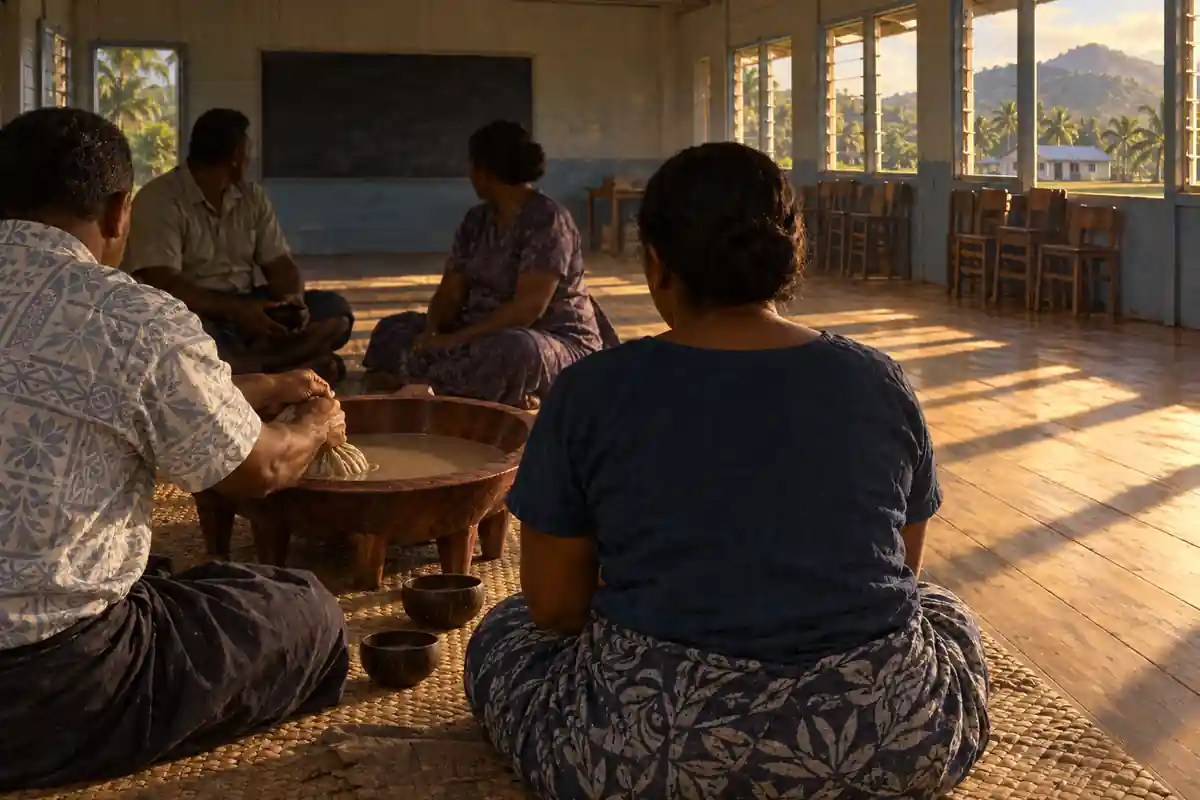
Across Fiji, the roots of a pepper plant, Piper methysticum, are pounded and mixed with water in a wide wooden bowl, and the drink is served in cups made from half coconut shells. Elsewhere in the Pacific the plant and the drink are called kava. Fijians call them yaqona, and in formal speech wainivanua, "the water of the land." For the iTaukei, the Indigenous people of Fiji, yaqona is presented and drunk at almost every event from birth to death, and many drink it together every evening. It is used to welcome visitors, install chiefs, ask forgiveness, open school events, begin a healer's treatment, and talk over the day's work. [2–4]
The water of the land
The formal name carries the drink's meaning. Vanua can mean land, but the Fijian scholar Asesela Ravuvu explained that it reaches well beyond soil. It means the people bound to a territory, their kin groups and chiefs, and the customs, values, and beliefs that hold them together. Yaqona, as wainivanua, is understood as a drinkable form of all of these. Drinking it confirms a person's identity and place. Once mixed, it is treated with respect and is believed to carry mana, spiritual power. A former researcher at Fiji's iTaukei Institute of Language and Culture wrote in 2007 that for iTaukei, yaqona is a link to past generations and a custom that cannot be separated from Fijian life. He added that Fijian ceremonial life would not be whole without it. [3, 4, 8]
The plant's history adds to this standing. Kava cannot set seed and grows only from cuttings. It is thought to have first appeared in northern Vanuatu and to have spread with the first seafaring settlers of the Pacific roughly 2,500 to 3,000 years ago, carried along their routes of exchange. Pacific people ask who other than the ancestral gods could have planted and tended it before those settlers arrived, and so kava is spoken of as a plant of the gods. [8, 11]
Kava is not alcoholic. Its active compounds, kavalactones, relax people without strong euphoria, producing what researchers describe as a calm but clear-headed state. Its botanical name, meaning "intoxicating pepper," was given in the 1770s by Johann Forster, a naturalist on Captain Cook's voyages, and researchers now consider the name misleading. Fijian still has a word, mateni, for being overcome by yaqona. The everyday English word for yaqona in Fiji is "grog," borrowed from the rum ration of the British sailors who were among the first Europeans to stay in the islands. [1, 4, 11]
Sevusevu: presenting the root
Before yaqona is drunk, it is often given. The formal presentation is called sevusevu, a word related to i sevu, "first fruits," which also named a small libation poured from the first cup as an offering to the Vu, the ancestral gods. Writing in 1915, the anthropologist A. M. Hocart described the kava root a chief received on visiting a subject people as "an earnest of the land." [1, 7]
In the village of Waitabu on Taveuni, studied between 2010 and 2012, visitors still entered the community this way. They brought a bundle of roots and offered them to the village chief through a set speech, followed by pounding, mixing, and drinking together. Drinking with the visitors marked that the gift had been accepted. The speech was given in the local dialect and kept a deliberately humble tone. In one version taught to a visitor, the speaker says that the offering is very small, and those receiving it answer at once, "Levu!", "It is big!" The speaker apologizes that the speech has been too long. Each time, the speech is addressed to the village's chiefly title, Tui Nasau. [7]
The title was often addressed when no chief was present. After the titleholder died in 2010, visitors made their presentations to whichever relative or elder was available, and the words did not change. The anthropologist Hao-Li Lin connects this to the village's history. Its ancestors had moved down from inland settlements, and their numbers had very likely been reduced by the measles epidemic of 1875, which killed about a fifth of Fiji's Indigenous population. Lin argues that each time the title is spoken, the remade community is tied back to an older, stable past. One elder taught a visitor to address two titles when entering another village. One had no holder at the time; the other belonged to a community that had taken refuge there in the 1860s. To him, naming both confirmed that both communities were legitimate and whole. [7]
A root can also be offered outside the formal entrance ceremony. In 1844 a missionary whose infant had died on Taveuni was visited by a neighboring chief, who brought a yaqona root "as a proof" of sympathy. A root could also carry political meaning: in 1874, when the paramount chief Cakobau ceded Fiji to Britain, he broke off a piece of yaqona root and placed it in the hand of Britain's representative. In nineteenth-century records, European visitors frequently received roots, rather than giving them, when they traveled with high chiefs. Lin suggests that the standard entrance ceremony, in which visitors bring yaqona, may have taken shape as more and more outsiders entered Fijian communities. The Fijian researcher Unaisi Nabobo-Baba wrote in 2006 that she presents sevusevu before each interview, even to close relatives. [7]
Chiefs and the bowl
Yaqona has long been bound up with chiefly rank. In the 1850s, the missionary Thomas Williams recorded that a new king was first named when leading men drank yaqona with him, presenting him with the first cup and the royal title at the same moment. At Somosomo, the herald stood each morning before the royal house and shouted "Yaqona!" Everyone within hearing answered, and chiefs, priests, and leading men gathered at the bowl to discuss public affairs and plan the day's work. [9]
The bowl itself is called the tanoa. A small carved point on its rim, the matanitanoa, "face of the tanoa," faces the chiefly position. Fijian bowls with many legs are carved on Kabara Island from vesi hardwood. From the late eighteenth century they circulated as gifts through Fiji and Tonga, and the largest ones went to chiefly households; earlier, pottery bowls or leaves were used. According to one museum account, yaqona was once drunk only to honor chiefs and guests on formal occasions. Williams found chiefs on some islands drinking it as regularly as Europeans drank coffee, and noted that use was less common on Vanua Levu and parts of Viti Levu. [1, 9, 10]
Describing the installation of the Tui Nayau, the paramount title of the Lau islands, the anthropologist Marshall Sahlins called the kava presentation the high point of the ritual. Yaqona, a product of the land, is mixed with water and given to the incoming chief, who drinks it, passes into mateni, and is then understood to rise again as chief, united with the land. The title was filled again in July 2025, more than twenty years after it was last held, when Ratu Tevita Uluilakeba Mara was installed at Lakeba. A sea-cleansing rite came first, then the formal chiefly yaqona ceremony. People traveled from across Lau to attend. "Some of us thought we would die before we saw a Tui Nayau again," said one woman who had come from Suva. "Now our grandchildren know." A woman who helped prepare meals from two in the morning said, "We work quietly but with purpose – it's our way of honouring the Tui Nayau." In his address the new chief said, "This is not mine alone. It belongs to you all." [6, 7]
Yaqona also accompanies apology. In the 1850s, Williams listed among the forms of soro, or atonement, one called mata ni gasau, used by minor chiefs and officials accused of failing in their duties. Today the matanigasau is a formal apology accompanied by yaqona. The two parties meet, yaqona is presented and mixed, the cause of the rift is discussed, and sharing the drink shows that the relationship has been restored. In May 2023, on the Chiefly Island of Bau, the government presented a matanigasau to the vanua and the church, and the head of All Nations Church presented a second to the vanua on behalf of Fiji's churches. Church leaders then sought forgiveness for decisions that had caused division, and the paramount chief of Bau accepted their apology on behalf of the vanua. Many Fijians hold that another drink could not carry the same weight in such a ceremony, because yaqona is tied to the land and its mana. [1, 5, 8, 9]
Around the tanoa at night
Most yaqona is drunk on ordinary evenings. In many villages, once the day's work is done, men and often women sit around the bowl to go over what has been done, plan the next day, and share news. Women in parts of Fiji have drunk yaqona for generations, while in Vanuatu, Tonga, and Samoa it was until recently reserved mostly for men. The gathering is often a setting for talanoa, the Pacific practice of talking a matter through without a fixed end point. Sessions often run past midnight. [4, 8, 11]
The circle has its own humor and its own marks of status. Communities linked by tauvu, a bond based on shared ancestral gods, meet each other with license and joking. Former enemies may engage in teasing, tricks, and bole, playful challenges in which heavy drinkers compete. Long heavy use leaves a mark of its own, drying and scaling the skin. People call the condition kanikani, and some jokingly call it a "badge of honour" that shows a drinker's stamina. Kanikani fades within a week or two of drinking less. The morning after brings lomaloma ca, a heaviness and lack of energy, which people describe as far milder than an alcohol hangover and partly the result of lost sleep. [1, 4, 11]
Spirits, healers, and the churches
The power people attribute to yaqona can be turned to harm. Fijian has words for sorcery that uses the drink. Sova yaqona, "pouring yaqona," is a libation meant to strengthen malevolent spirits. Drinking alone, gunu taudua, is believed to be an act of witchcraft. In healing, the same power is called on for good: the formal presentation and shared drinking of yaqona by a traditional healer and patient commonly begins treatment and is understood to give it mana and spiritual effect. [1, 3]
Fiji's older churches have absorbed the drink. Methodists and Catholics use yaqona in their gatherings, and some ministers compare the chiefly yaqona ceremony to the Last Supper, with Christ seated at the head of the bowl. Several Pentecostal churches, including the New Methodist Church, the Assemblies of God, and All Nations, see the same connections to the old spirits and conclude instead that yaqona must be rejected. In a 2016 sermon, Pastor Atu Vulaono of the New Methodist Church said it was better for Fijians to drink Fiji Gold beer than yaqona, because "yaqona shakes your brain and takes you to the world of worshiping devils." A 2020 paper prepared for an Assemblies of God doctrinal committee called yaqona "entirely evil in light of the Biblical truth." Some congregations replace it with fruit juice at ceremonies and give cloth instead of whale's teeth, describing these customs as belonging to "the old times" a Christian leaves behind. [4, 8]
Yaqona in the schools
In Fiji's schools, the drink's place in daily life and the arguments over it can be seen side by side. Pupils do not drink it, but they are taught to mix and present it, and they serve it to guests at sports days, fundraisers, and graduations. Parents and teachers drink it at board and parents' meetings, and teachers often gather around a bowl in the school hall after classes. Many schools are owned and run by village or church communities with government support. Parents bring yaqona to thank builders and former students, some pay fees in yaqona, and some schools grow it for income. Teachers said that parents often stayed away from meetings where yaqona was restricted. [2, 4]
Around 2000, some in the Ministry of Education began to ask whether long evenings at the bowl were dulling teachers in the classroom. A 2000 education review acknowledged that yaqona "is important in ceremonial Fijian culture" but said excessive drinking "substantially inhibits performance" in teaching. Cognitive tests carried out in 2009 found slower processing among teachers who had drunk the night before. Drinking teachers also reported poor motivation, memory lapses, lateness, sick leave, and low productivity, which added to their colleagues' workloads. The researcher could not separate the effect of yaqona from lack of sleep, and some heavy drinkers were among the most capable teachers. A 2010 policy banned alcohol, tobacco, and marijuana from school grounds. It allowed yaqona "only to be used at ceremonial purposes in moderate amounts," while forbidding government employees to drink it during office hours. Around the tanoa, teachers asked what counted as ceremonial, and how ceremonies held during school hours could be allowed and forbidden at once. [1, 4]
Indo-Fijians, descendants of laborers brought from India under colonial indenture, also drink yaqona, and some Indo-Fijian schools have adopted sevusevu. Among teachers surveyed in 2009, rural iTaukei insisted that they drank more than anyone. The figures showed otherwise: urban iTaukei and rural Indo-Fijian teachers drank for longer. The researcher read the claim as a statement of identity. Rural iTaukei saw themselves as the keepers of tradition at a time when urban life and Indo-Fijian success in business and property seemed to threaten it. [4]
Teachers in the study spoke plainly. "No one will be able to stop us drinking yaqona," one senior teacher said; many would try, but they would never succeed, because it was part of "our way of life and our vakaturaga," the chiefly, respectful conduct expected of every person. Another called yaqona the foundation of their culture. Most said that talanoa, held around the bowl, was the right way to settle the question. [4, 8]
In January 2020, the Minister of Education, Rosy Akbar, said she did not want yaqona at official school functions, and a senior ministry official, Timoci Bure, told teachers to throw their mixing cloths and kava "away in the bin," citing scripture and tired staff. The comment about the bin hurt many people. "Who are we if we don't have our culture?" some asked. Others supported the minister. One teacher answered, "It's not just grog. What, are the Ministry also going to stop us from watching our TV till late, stop us on the computer, make us go to bed early? They can't." Many teachers repeated what the researcher had heard from teachers ten and twenty years earlier: that nothing would stop them drinking yaqona, because it was part of who they are. [4]
What is uncertain
Detailed recent studies, first-hand reports and nineteenth-century accounts all show that formal kava presentation and drinking remain central to Fijian ceremony and identity. Much of the recent detail comes from one researcher and his colleagues, and mostly concerns schools and teachers.
It is unclear whether teachers' sluggishness the morning after drinking comes from the kava itself or from lack of sleep after late sessions. [4]
How schools should regulate kava remains unresolved: the 2010 policy was ambiguous, and officials renewed calls for restrictions in 2020. [4]
Some Pentecostal churches treat kava as linked to evil spirits, while older churches accept it as compatible with Christianity, and one source describes the rejecting group as small but growing. [4, 8]
The sources differ on how often kava was drunk in the past. One says it was once consumed only on formal occasions to honour chiefs and guests, while a nineteenth-century missionary described chiefs drinking it daily. [9, 10]
The welcome ceremony performed for visitors today may have taken its standard form only after contact with Westerners, but this is a hypothesis that has not been tested. [7]
Nineteenth-century observers recorded disagreement among older Fijians about which way of preparing the drink was the original Fijian one. [9]
The sources date the arrival of kava with the first Pacific settlers differently, at about 3,000 years ago or about 2,500 years ago. [8, 11]
Teachers in the study believed rural indigenous Fijians drank the most, but the measurements showed otherwise, and the sample was small. [4]
Women's drinking in Fiji is described as long established in only one short popular article and has not been studied directly in these sources. [11]
The role of kava in traditional healing is mentioned only briefly in one popular article. [3]
11 sources. Each claim checked by AI against the saved sources; every finding reviewed by Jim Davis beside the cited passage, 30 October 2026. How the articles were checked
Timeline of dated events (19)
- About 3,000 years ago (one source says about 2,500)kava is thought to have first been cultivated in northern Vanuatu and spread across the Pacific by early settlers. [8, 11]
- Before the late eighteenth centurypottery bowls or large leaves were used for kava. [10]
- Since the late eighteenth centurycarved wooden kava bowls circulated through gift exchange in Fiji and Tonga, the largest ending up in chiefly households. [10]
- 1770sa naturalist on Cook's voyage gave kava its botanical name, meaning "intoxicating pepper". [11]
- 1840smissionaries in Lakeba and Taveuni recorded kava roots being given as tokens of sympathy and as requests for favour. [7]
- 1856–1875Western visitors travelling with high chiefs were received with presentations of kava root. [7]
- By 1858a missionary described chiefs gathering around the kava bowl each morning and kava drinking as the first stage of installing a new king. [9]
- October 1874at the cession of Fiji to Britain, the paramount chief placed a piece of kava root in the hand of Britain's representative. [7]
- 1875a measles epidemic killed about one-fifth of the indigenous population, and one anthropologist argues that the resulting losses later shaped the meaning of the village welcome ceremony. [7]
- From the 1960sPacific communities in New Zealand began drinking kava there. [4]
- 1993 and 2007Fiji's Public Service Commission issued memos on yaqona. [1]
- 2000the Ministry of Education's review raised concern that heavy kava drinking was hampering teachers' work. [4]
- Early 2000sseveral countries banned kava sales after liver-damage scares. [11]
- 2008a newly founded church's leader was reported in the press as calling kava evil. [8]
- 2010the Ministry of Education's drugs policy allowed kava for ceremonial use in moderate amounts but banned drinking it during office hours. [4]
- 2016a WHO assessment found kava drunk as a water-based beverage carries an acceptably low health risk. [11]
- January 2020the education minister said kava should not be served at official school functions, prompting wide public debate. [4]
- May 2023the government presented a formal traditional apology to the chiefly establishment and the churches on Bau. [5]
- July 2025a new holder of the Tui Nayau title was installed in Lakeba with a formal chiefly kava ceremony, more than 20 years after the title was last held. [6]
Sources
CSL-JSON imports into Zotero, Mendeley and other reference managers.
Aporosa, S. (2012). Yaqona (kava) and education in Fiji: Investigating 'cultural complexities' from a post-development perspective. PhD thesis, Development Studies, Massey University, Palmerston North.
A doctoral thesis on kava and education in Fiji (2012), of which only the front matter, abstract and glossary were available. It contributes the study's main findings in brief and a detailed glossary of kava terms.
Aporosa, S. A. & Vunibola, S. (2023). Na yaqona kei na i tikotiko ni veivakarautaki vakavuli: Na veisataki ni i tuvatuva vakalawa kei na veiqaravi raraba [Fijian translation of Aporosa 2022]. In Our Language: Journal of Pacific Research, 1–12. doi:10.15663/JPR.vwi1.article2
A Fijian-language translation (2023) of source 4. It adds no new evidence but makes the school study available to Fijian readers.
Aporosa, A. & Perrin, R. (2024). Supernatural curses in Pacific communities: A challenge for modern healthcare. Research Outreach, 140, 36–39.
A short popular article (2024) by a health lecturer about curses and healthcare. It notes kava's role in traditional healing and in community discussion.
Aporosa, A. S. (2022). Yaqona (kava) and the school campus: Regulation versus facilitation. The Australian Journal of Indigenous Education, 51(1), 1–20.
A journal article (2022) by a researcher of Fijian descent, based on 2009–2013 fieldwork. It covers teachers' kava drinking, its effects, its many roles in running schools, and government policy up to 2020.
FBC News (2023, 24 May). Showers of blessings follows Matanigasau presentation. Fijian Broadcasting Corporation.
A Fijian broadcaster's news report (2023) on formal apology presentations on Bau. It shows the apology ceremony used at national level.
The Fiji Times (2025, 12 July). TUI NAYAU INSTALLATION | Fiji, the vanua and the chiefly installation.
A Fiji Times feature (2025) on a paramount chief's installation. It includes participants' own words and mentions the formal chiefly kava ceremony.
Lin, H.-L. (2019). More than a "Petty Chief": Understanding Fijian Chiefship through the Entrance Ceremony and Local History. Anthropologica, 61(2), 213–226.
An anthropologist's journal article (2019) based on village fieldwork in Taveuni. It analyses the kava welcome ceremony, its link to chiefly titles and local history, and nineteenth-century records of kava gifts.
Aporosa, S. A. & Gaunavou, U. (2021). Na yaqona kei na ivakatakilakila vakavanua ena yatu Pasivika [Fijian translation of Aporosa 2019, 'Kava and ethno-cultural identity in Oceania', Palgrave Handbook of Ethnicity]. In Our Language: Journal of Pacific Research, 1, 1–11. doi:10.15663/JPR.vwi1.article1
A Fijian translation (2021) of a handbook chapter on kava and identity across the Pacific, available in substantial part. It covers kava's origins, its place in Fijian identity, teachers' views and church opposition.
Williams, T. (1858). Fiji and the Fijians. Vol. I: The Islands and their Inhabitants (ed. G. S. Rowe). London: Alexander Heylin.
A Methodist missionary's book on Fiji (1858), available as excerpts. It describes chiefly kava sessions, kava's role in installing a king, and formal apologies.
Los Angeles County Museum of Art (n.d.). Chiefly Objects – Tanoa and Other Valuables. Collection web page.
An undated museum collection page. It describes kava bowls, their origin and exchange history, and the presentation of kava as a gift of respect.
Aporosa, A. & Foley, E. (2020). De-mythologizing and re-branding the traditional drink kava. Research Outreach, 113, 106–109.
A short popular article (2020) by a kava researcher. It reviews kava's botany, effects and safety findings, and challenges common misconceptions.
Related
Cite this page
Psychoactive Traditions. “Fijian Yaqona (Kava).” Last reviewed 30 October 2026. https://psychoactive-traditions.org/traditions/fiji-yaqona