Names
The tree is Mimosa tenuiflora, also known by the synonym Mimosa hostilis. In English it's often called jurema or black jurema, and in Mexico it goes by tepezcohuite. The word "jurema" doesn't point to just one thing: it can refer to more than one plant, and it's also part of the name of a religion, Jurema Sagrada.
In Portuguese, the tree is jurema-preta ("black jurema") and the ritual drink is vinho da jurema ("jurema wine"). Both names are used by Indigenous peoples of northeastern Brazil and by practitioners of Jurema Sagrada, who are known as juremeiros and juremeiras. The drink has other names too: ajucá among the Pankararu, and anjucá among the Atikum and Kambiwá.
What it is
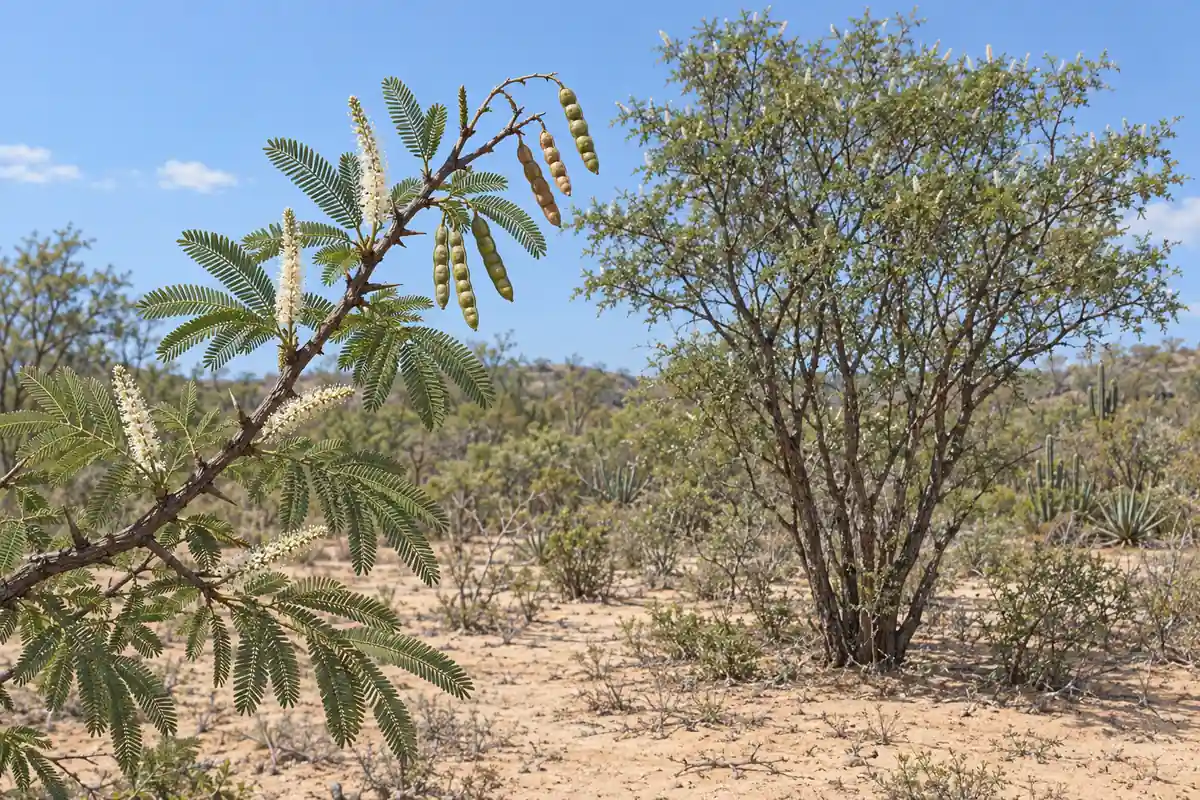
Black jurema is a thorny shrub or small tree with feathery leaves, each divided into many tiny leaflets, and small white flowers that grow in slender spikes. It's common in the caatinga, the dry scrubland of northeastern Brazil, where it easily takes hold on cleared land. It also grows in other dry parts of the Americas, as far north as southern Mexico.
The medicine is taken as a drink. Indigenous peoples of the region make it mainly from this tree, though some communities use other plants called jurema. There's no single recipe, and some uses of the drink are kept secret.
Several other plants also go by the name jurema, and not all of them are firmly identified. The name white jurema (jurema branca in Portuguese) has been applied to several plants, including Piptadenia stipulacea, Mimosa verrucosa, and the chaste tree (Vitex agnus-castus).
How it works
The main active compound known from black jurema is DMT (N,N-dimethyltryptamine), which resembles serotonin, one of the brain's chemical messengers. Its changes to perception and thought are linked mainly to its action on one type of serotonin receptor, a site on nerve cells that responds to that messenger.
It's an open question whether, and how, the drink produces psychedelic effects on its own. That's because enzymes in the gut normally break down swallowed DMT before it can reach the brain. Researchers have proposed that other compounds in the plant may interfere with this breakdown, but that hasn't been established. The drinks also differ from one another, so one explanation may not fit all of them.
Effects on the mind
Black jurema contains DMT, which is generally classed as a classic psychedelic: a type of substance that alters perception, thought, and the sense of self.
DMT experiences can include vivid inner imagery, a changed sense of time, strong emotion, and a feeling of meaning or of contact with other beings. They can also include fear, confusion, or a loss of contact with one's surroundings. Experiences vary from person to person, and a sense of insight isn't proof that something is true.
The traditional drink itself has been little studied. Not every account describes strong visions, and how long its effects last isn't well documented.
In tradition
Indigenous peoples of northeastern Brazil, such as the Pankararu and Kariri-Xocó, drink jurema to reach the encantados, or enchanted ones, beings understood to offer healing, counsel, and protection. The drinking takes place mostly in closed ceremonies, and sometimes in the toré, a circular dance.
Jurema Sagrada is an Afro-Indigenous religion of Brazil's northeastern coast, often practiced within or alongside Umbanda and Candomblé in terreiros, or houses of worship. In Jurema Sagrada, the jurema-preta is a sacred tree that supplies both a ritual drink and the consecrated trunks on the altars. At ritual sessions called tables (mesas), mestres, understood to be the spirits of dead healers, are held to come down to cure illness and settle troubles of money and love.
Today
Jurema is now also used outside its traditions, though how widely isn't well documented. Small early clinical studies are examining DMT for depression, but they use the purified compound and say little about the traditional drink.
Traditions that use it
Cite this page
Psychoactive Traditions. “Jurema.” Last reviewed 4 November 2026. https://psychoactive-traditions.org/medicines/jurema