On every jurema altar in the terreiros of Recife sits a piece of tree trunk. It comes from the jurema-preta (Mimosa tenuiflora), a thorny tree of the dry backlands of northeastern Brazil. After ritual consecration it is understood to hold a mestre, the spirit of a dead healer who works with the juremeiro at that altar. The religion is Jurema Sagrada ("Sacred Jurema"), practiced in Pernambuco, Paraíba and neighboring states by men and women known as juremeiros and juremeiras. It draws on Indigenous ritual, popular Catholicism, European magic and Afro-Brazilian religion. People turn to it above all for help with illness, money and love, troubles the mestres and other spirits are believed to resolve. [2, 6]
A tree, a drink, a kingdom
The word jurema has many meanings: it names a tree, the drink made from it, the religion as a whole, a female spirit, and an enchanted realm. That realm, the Reino da Jurema, is said to be divided into "cities," each of them also a "science." In Alhandra, Paraíba, juremeiros name seven: Vajucá, Junça, Catucá, Manacá, Angico, Aroeira and Jurema. Researchers since the 1930s have recorded different numbers and different names for these cities, but Jurema and Vajucá appear in every list. Several of the names are those of trees and plants of the northeastern flora, and one juremeiro-scholar has argued that this makes the religion a cult of sacred trees. [6, 7]
The tree's sanctity has its own story. A widely sung toada, a ritual song, says the jurema is sacred because it gave shade to Jesus. Today that origin story is passed on almost entirely through this one song. One mãe de santo cited it to explain why she would never invite Exu, an Afro-Brazilian spirit, into her jurema: "Exu didn't go under the jurema. Who went under the jurema was Jesus." [6]
A mãe de santo in Goiana described the kingdom itself as a sacred place where jurema trees are woven together overhead and the ground is lined with soft grass, so dense that "not even the birds pass." Only certain beings may enter. "We go there in dreams," she said; the strong caboclos take people there "so we can see what the Kingdom of Jurema is like." She also said that after death a juremeiro's spirit goes first to the jurema. In Alhandra, people said the cities could be reached by drinking the jurema wine. A granddaughter of one of the town's celebrated mestras had never made the journey herself, but she repeated what her grandmother had told her: "it is the most beautiful thing in the world," and only the strong arrive. [6]
The beings who live in these cities fall into rough ranks. Caboclos are Indigenous or forest-dwelling spirits who belong to mythical time; most of them do not speak. Mestres and mestras are people who once lived, often healers and herbalists, and sometimes drinkers, gamblers or prostitutes, who return after death to help the living. Above them are the reis, or kings. Two of the reis were historical figures. Canindé led Indigenous resistance in the Guerra dos Bárbaros and died in 1699. Malunguinho was the title of the leaders of the Catucá quilombo, a community of escaped slaves in Pernambuco, the last of whom died in 1835. One juremeira said Malunguinho "is king of the forest... the caboclo who dominates the other caboclos." In Recife he is sung to first at every session and is called the guardian who holds the key between the worlds. [2, 6, 7]
The table: consultation and healing
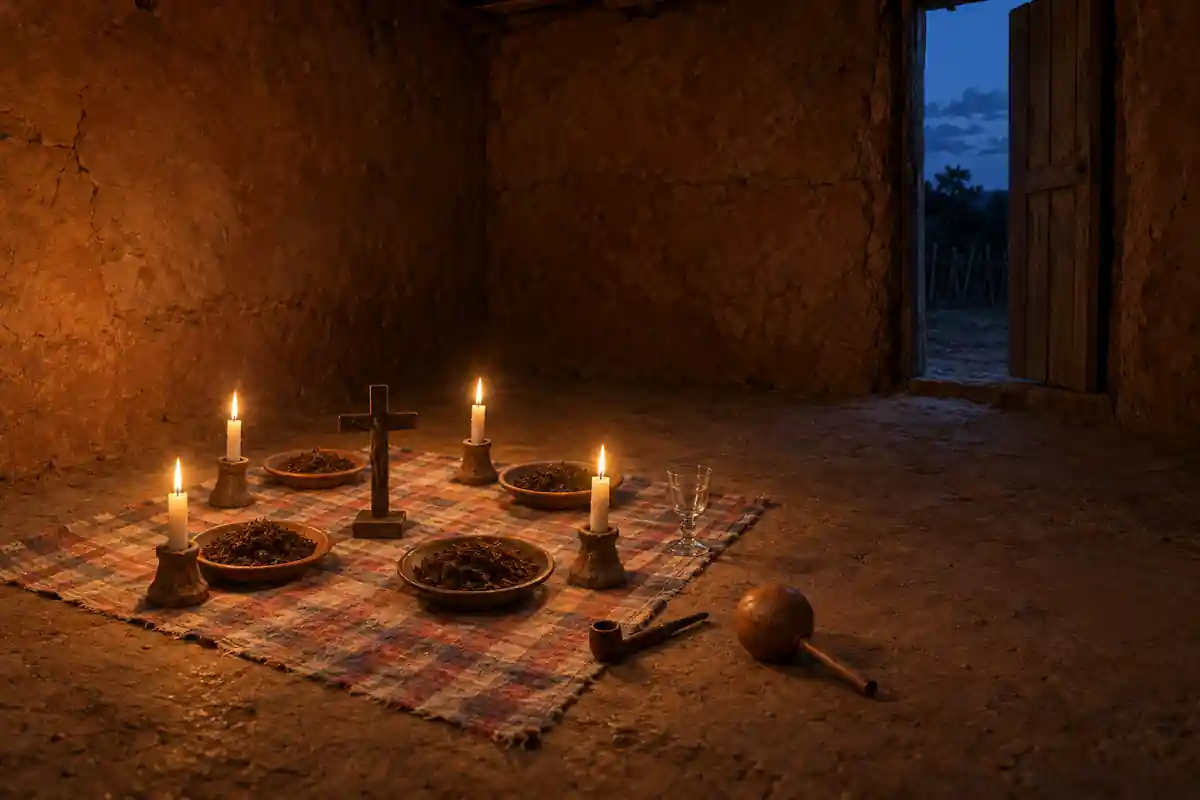
The older form of the tradition, which twentieth-century writers called catimbó, centered on the mesa, the table. In the 1930s a session might be held on a cloth laid on a dirt floor, with candles, a crucifix, pipes and the jurema drink set out, and still be called a table. The sessions were consultations. A person came seeking a cure for physical, mental or spiritual ills, or a solution to "every sort of problem" in daily life, and the session's leader called down a mestre to diagnose and treat it. In Paraíba and Pernambuco, health, money and love remain the most common reasons for coming. [2, 6]
Smoke carries much of the work. Juremeiros turn their pipes around, put the bowl in the mouth and blow smoke out through the stem. In Recife, people say the smoke cleanses, carries the wishes of the faithful upward and brings back the wishes of the spirits. One observer at a gathering wrote that "the jurema speaks through the smoke," and that juremeiros know how to read it. [2]
Many of the mestres who answer were often healers in life. "Those mestres who cured you with herbs... They went away, traveled to the other side of life. Today they keep coming down," one leader explained. The healing itself is described in practical terms. A pai de santo in Goiana said a table is "to cure, for everything": reuniting couples, settling quarrels, treating someone who "goes to the doctor, has several exams, and nothing is resolved." He gave the example of a woman who "even went to a psychiatrist" and got well "with a simple bath" prepared under the direction of his mestre. [6]
Consultations cost money, and people do not hide it. Many priests live on these fees and regard the work as a social service like any other profession. How busy a healer is counts as proof of power, and clients compare one healer with another. One mãe de santo in Condado described how a client would weigh her against a rival: "I went to so-and-so, she prayed and didn't cure; I went to her, she prayed and cured." [6]
The mestre is a closer and more familiar presence than the African orixás. A pai de santo in Goiana put the difference this way: "Jurema is body, jurema is a crowd. The orixá doesn't need us. We need the orixás. Jurema is different... One arrives, grabs someone, hugs, talks." Another described his mestre as "my father, my brother, my friend." Jurema work also has a right side and a left. The right serves healing and charity. The left serves defense, and sometimes harm. Many juremeiros insist they work only "to the right." In everyday northeastern speech, "catimbó" itself means sorcery. [6, 7]
How much the drink matters
Accounts of the jurema drink and its effects disagree. The drink has been used both as an agent of visions and as an almost purely symbolic sacrament. Among the Kamuru-Kariri, a man recalled in 1938 that "the jurema shows the whole world to whoever drinks it," including the red-backed sky, the luminous house of God, and the field of flowers where the souls of dead Indians live. Colonial missionaries described drinkers falling "as if dead." [6, 10]
The catimbó of coastal Paraíba was different. The ethnographer René Vandezande, working in Alhandra in the 1970s, saw no session in which jurema was drunk in any quantity that mattered. He concluded that the jurema had become "a simple religious symbol." Older residents remembered the drink being taken in tiny amounts. An elderly mestre of Alhandra said that in the old rites for making a mestre, the jurema wine stood at the center of the ritual but was never actually drunk, and he himself never touched it. In Alhandra in the 2000s, the drink was used little or only at baptisms. [6]
In the Pernambuco towns studied in the same period, by contrast, the drink went around at every session, and no two houses made it the same way. Some people valued it for its taste, and others for its medicinal properties. Even so, mediums in trance drank only when their incorporated mestre asked for it, and leaders kept consumption controlled. The anthropologist Sandro Guimarães de Salles warned against treating the drink as the cause of trance. In his view, music, memory and the bond between a medium and a spirit carry trance more than any chemistry does. [6]
Since the late 1990s, further from the terreiros, small groups in Brazil have combined jurema with another plant so that jurema's psychoactive compound acts when swallowed. Scholars call the result juremahuasca; its users call it simply jurema and use it in meditative and therapeutic rituals. The juremeiro and researcher Alexandre L'Omi L'Odò writes that the religion "dispenses with the chemical effects of jurema" to reach the spirits. [7, 8]
What juremeiros emphasize instead is ciência, science. It is the power a juremeiro carries, and it is usually understood as inborn rather than conferred. "Science is not seen. It is lived," one Recife juremeiro said, and he located it in waters, stones, leaves and trunks. Several leaders who never had a teacher call themselves juremeiros "by birth." One priest in Recife told L'Omi L'Odò: "Whoever has it, has it." Old catimbó had no formal initiation; disciples learned by assisting a master. [6, 7]
Persecution and the turn to Umbanda
The earliest written records of the drink come from persecution. Sources differ on which record came first, citing a 1724 letter, the 1739 council or a 1741 letter. In 1739 the Board of Missions of Pernambuco discussed how to stop Indigenous people in Paraíba from consuming "certain drinks they call Jurema." An attempt to arrest a man identified as the leader of the practice in Mamanguape ended in a revolt that left people dead and wounded. In 1741 the governor of Pernambuco wrote to the king that most of the Indigenous people in the villages drank a drink called jurema, "losing their senses," and that the others believed their visions "as oracles." A Pombaline law of 1757 banned its use entirely. No archaeological evidence for the drink has yet been found, and one scholar suggests the cult may be relatively recent. [7, 10]
Persecution continued after independence. A municipal ordinance in Paraíba in 1832 targeted sorcerers and healers. Recife newspapers in the early 1900s mocked the "catimbozeiros" and reported their arrests. Older juremeiros in Alhandra remembered police forcing an arrested mestre to carry his own table on his head to the station. In Pernambuco in the 1930s, the state's Mental Hygiene Service helped move Candomblé out of police jurisdiction by treating it as religion. Jurema was not included, and it went on being prosecuted for its healing work as charlatanism and false medicine, so juremeiros hid their altars inside Afro-Brazilian terreiros. [2, 4, 6]
In 1966 Paraíba passed a law granting freedom of worship. Under it, each terreiro needed police authorization, renewed every 180 days; a psychiatric report on its leader; and membership in a federation modeled on Umbanda. Police persecution ended, but the old tables declined through the 1970s. Juremeiros joined Umbanda houses and took on drums, the circle dance, initiations and animal sacrifice. One leader in Itambé dated the change precisely: "The drum appeared in sixty-three... then the orixás appeared, then came the message of people going into seclusion, doing obligations." Older juremeiros generally described the change as an extension of their religious knowledge, not a break with the tradition. A pai de santo in Goiana compared it to embroidery: "Tomorrow I'll try to improve that embroidery." [4, 6]
Most houses in the region now keep the two worlds side by side but separate, with an orixá room and a jurema room. A Recife saying holds that "the smoke does not mix with the orixá." Where the boundary lies is still disputed. In 2010, among fourteen terreiros in the Paraíba–Pernambuco border region, six rejected Exu in jurema sessions altogether, six thought he was necessary, and two invited him only reluctantly. [6, 7]
The cities that were cut down
Older practice in Alhandra had a material form that has now almost disappeared. A living jurema tree could be consecrated to a deceased mestre and so become a "jurema city." Some mestres were buried beneath their trees. An elderly mestre of the town explained that a tree has value only once it has been ritually "shod" and seeded: "If it is plain, it is worth nothing, just any old tree." In the 1970s Vandezande counted ten such cities. Most were already abandoned, and one tenant farmer said he would let a sacred tree regrow only "if it brings me money." By 2010 all the old cities had been cut down, several to make way for sugarcane. A coastal city of jurema, people say, was swallowed by the sea, and in Alhandra many claim the sea roars whenever a mestre dies. [6, 7]
The best-known loss came in August 2008, according to the fullest account, though other sources date it to 2007 or mid-2009. A landowner leveled a historic property in Alhandra, and its jurema trees went with it. The property had belonged to a family of mestres descended from the last regent of the local Indigenous village. Photos spread online, and juremeiros in Recife and João Pessoa organized marches and media campaigns "without precedent." The surviving chapel and a mestre's tomb, marked by a concrete jurema trunk, were listed as state heritage in 2009. In the cities, the consecrated trunk on the altar now stands in for the living tree. A Recife juremeira described what urban life has done to practice: "Today the world is very violent. We can't go to the forests anymore... We have to stay inside the terreiro and ask forgiveness of the enchanted ones for the lack of the things they like." [4, 6, 7]
Into public view
Since the 2000s, Jurema has moved into public life. A 2010 federal survey of 1,261 terreiros in Greater Recife found that 896 identified as practicing Jurema, most of them alongside orixá worship. The Quilombo Cultural Malunguinho, founded in Recife in 2004, has held the Kipupa Malunguinho each year since 2006 on lands of the former Catucá quilombo. The event brings together juremeiros, scholars and schoolteachers for a forest ritual and the coco, the dance "that the mestres dance." At the Kipupa in 2011, one of its leaders told the crowd: "Our phase of being seen as folklore is over." Inclusion is still contested. That same year, organizers of Recife's street procession of terreiros refused jurema a place in the march itself, arguing that the pipes and smoke would compromise the praise of the orixás. [2, 7]
Recognition has followed. In 2025 Paraíba's legislature declared Jurema Sagrada intangible heritage of the state, and Law 13.760 was signed that July. The bill's justification called the tradition "a science of the earth, of magic and of smoke." It noted that "each juremeiro has his own science," and that complaints of religious intolerance in Brazil were still arriving at nearly seven a day. Later that year, at the prosecutors' office in Alhandra, practitioners formally submitted a request to Brazil's national heritage institute to register Jurema's sacred places as national heritage. An ialorixá at the ceremony said it brought "a reaffirmation of our struggle." [4, 5, 9]
What is uncertain
Several detailed field studies from about 2000 to 2016 describe how Jurema is practised today in and around Recife and in towns along the Pernambuco–Paraíba border, though the two most recent are closely tied to a single activist group. Its earlier history is known mainly from colonial persecution records, older folklore studies and practitioners' memories.
Sources disagree on whether the drink's psychoactive effect matters in traditional ritual. One thesis says it is drunk in tiny, alcohol-heavy doses and is mainly symbolic, while another describes elders "travelling" to the enchanted cities after drinking it. [6, 7, 8]
No archaeological evidence shows how old the practice is, and one historian suggests the drink may be a fairly recent discovery. [7, 10]
No source settles which Indigenous people first used jurema ritually. [6]
The earliest written record is dated differently in different sources: a 1724 letter, a 1739 council, or a 1741 letter (the letter may be the same governor's correspondence misdated). [4, 7, 10]
Practitioners disagree whether Exu and Pombagira belong in Jurema sessions. [6]
Practitioners also disagree whether a priest's initiation is needed, or whether the "science" of Jurema is simply inborn. [6, 7]
Which plant counts as "jurema" varies between houses and between sources. Black jurema is generally preferred, but some houses use only white jurema, and the sources identify white jurema as different species. [2, 6, 7]
The number and names of the enchanted "cities" differ in every account, and the origin and meaning of the sacred tree "cities" has not been explained. [6]
"Catimbó" may be a researchers' label rather than practitioners' own name for a distinct cult. [6]
The figure that Jurema is present in over 70% of Recife-area terreiros rests on a single 2010 survey. [7]
The order of events around the 2008–2009 destruction of the sacred trees in Alhandra differs between accounts. [6, 10]
8 sources. Each claim checked by AI against the saved sources; every finding reviewed by Jim Davis beside the cited passage, 30 October 2026. How the articles were checked
Timeline of dated events (43)
- 1593–1595The first Inquisition visitation to Pernambuco and Paraíba records witchcraft accusations. Later scholars trace European magical elements in Catimbó to this background. [6]
- 1724 (as given in the bill)A governor's letter reports the arrest of "Indian sorcerers" whose jurema drink brought visions and trance. [4]
- 1739A Missions council in Pernambuco discusses Indigenous jurema drinking. An arrest attempt in a Paraíba village provokes a revolt in which several people die. [7, 10]
- 1741The governor of Pernambuco writes to King João V about the jurema drink, the earliest record according to one source. [7]
- 1743–1759A missionary repeatedly denounces the spread of the cult in Paraíba and gives the first description of a rite. [10]
- 1757The colonial Directory of the Indians bans jurema use. [6, 10]
- 1758An Indigenous man dies in jail in Natal after arrest for a jurema gathering. [7, 10]
- 1781–1782An Indigenous captain-major and his sons are denounced to the Inquisition for jurema rites in Pernambuco. [7, 10]
- 1788A priest reports jurema drinking before war among a people of the Piauí–Maranhão border. [10]
- 1816A traveller describes secret dances and jurema drinking near Olinda. [10]
- 1817–1835The Quilombo do Catucá operates under Malunguinho, later a central Jurema deity. [2, 6]
- 1832A Paraíba municipal ordinance represses sorcerers and healers. [4]
- 1836–1838A messianic movement in Pernambuco serves "enchanted wine" of jurema; it is crushed in 1838. [10]
- 1860A newspaper reports a healer's arrest for curing with wine, maracas and songs. [4]
- 1865The last regent of the Indians of Alhandra receives land where an old jurema tree stands. [6]
- From 1893Some accounts mention jurema use in the Canudos movement. [10]
- 1902 and 1918The Recife press ridicules Catimbó houses, and police make arrests. [6]
- c. 1910A renowned juremeira settles on her family's estate in Alhandra. [6]
- 1933Pernambuco's Mental Hygiene Service treats Candomblé as religion but leaves Jurema classed as magic and charlatanism. [2]
- 1934A newspaper reports a caravan from Maceió travelling to the Alhandra estate for healing. [4, 6]
- 1937The renowned Alhandra juremeira dies. [4, 6]
- 1938The Folklore Research Mission records Catimbó sessions in Paraíba. [4, 6]
- 1938Recife police raid catimbozeiros under a ban on "African sects". [7]
- 1950s onwardUmbanda federations spread through the region. [6]
- 1959Her son, the last family juremeiro on the estate, dies and is buried there. [4, 6]
- 1963 (as recollected by a practitioner)Drums enter Jurema sessions. [6]
- Up to about the 1960sPolice persecution of catimbozeiros continues. [6]
- 1966A Paraíba law allows Afro-Brazilian cults, subject to police authorisation and federation membership. [4, 6]
- 1970sThe old Catimbó "tables" decline, and practice becomes umbandized. [4, 6]
- 1980s (as recollected)A Pernambuco town has 47 terreiros, later reduced as Pentecostal churches grow. [6]
- 1997The first juremahuasca rituals begin in Brazil. [8]
- 2004The Quilombo Cultural Malunguinho is founded in Recife. [2, 7]
- 2006The first Kipupa Malunguinho gathering is held in Abreu e Lima. [2]
- 2007The state "Malunguinho Law" creates a week of Afro-Pernambucan culture. [2]
- August 2008The new owner of the Alhandra estate destroys its buildings and sacred jurema trees. [6]
- 2009The Paraíba heritage institute lists the estate sites, and the listing is published in 2015. [4, 6]
- 2010A federal survey finds Jurema in 896 of 1,261 terreiros in the Recife area. [7]
- 2011The National Network of the People of Jurema is founded after a dispute over Jurema's place in Recife's terreiro march. [2]
- 2014A juremahuasca group is institutionalized as a spiritual centre. [8]
- 2018An entheogenic church using jurema is founded in Ceará. [8]
- 19 February 2025A bill is filed to declare Jurema Sagrada intangible heritage of Paraíba. [4]
- 16 July 2025Law 13,760 recognizes Jurema Sagrada as Paraíba's intangible heritage. [5, 9]
- Later in 2025A request for national heritage registration is delivered to IPHAN at an event in Alhandra. [9]
Sources
CSL-JSON imports into Zotero, Mendeley and other reference managers.
Rodrigues, Michelle Gonçalves; Campos, Roberta Bivar Carneiro (2013). Caminhos da visibilidade: a ascensão do culto a jurema no campo religioso de Recife. Afro-Ásia 47: 269-291. Universidade Federal da Bahia. https://www.redalyc.org/articulo.oa?id=77026210008
Peer-reviewed journal article by two anthropologists (2013), based on 2011 participant observation in Recife. It describes Jurema rituals, the Kipupa gathering and the terreiro march, and Jurema's rising public and political visibility.
Ramos, Cida (2025). Projeto de Lei nº 3.738/2025: Declara a Jurema Sagrada como patrimônio imaterial do Estado da Paraíba (with justificativa). Assembleia Legislativa do Estado da Paraíba, 19 February 2025. https://sapl.al.pb.leg.br/media/sapl/public/materialegislativa/2025/130467/pl_jurema_sagrada_1.pdf
Paraíba state deputy's bill with its justification (2025). It summarizes colonial persecution, the Alhandra lineage, the 1966 law, the decline of Catimbó and current intolerance.
Estado da Paraíba (2025). Lei nº 13.760, de 2025: declara a Jurema Sagrada como patrimônio imaterial do Estado da Paraíba. Assembleia Legislativa da Paraíba. https://sapl.al.pb.leg.br/media/sapl/public/normajuridica/2025/17810/lei_13.760.pdf
The Paraíba state law declaring Jurema Sagrada intangible heritage (2025). It confirms the formal recognition.
Salles, Sandro Guimarães de (2010). Religião, espaço e transitividade: Jurema na Mata Norte de PE e Litoral Sul da PB. Tese de doutorado em Antropologia, Programa de Pós-Graduação em Antropologia, Universidade Federal de Pernambuco, Recife. https://attena.ufpe.br/handle/123456789/867
Doctoral thesis in anthropology (2010), based on fieldwork in 14 terreiros of northern Pernambuco and southern Paraíba. It is the fullest account of Catimbó history, sacred tree "cities", rituals, pantheon, music and the drink.
L'Odò, Alexandre L'Omi [Alexandre Alberto Santos de Oliveira] (2017). Juremologia: uma busca etnográfica para sistematização de princípios da cosmovisão da Jurema Sagrada. Dissertação de mestrado em Ciências da Religião, Universidade Católica de Pernambuco (UNICAP), Recife. 276 f. http://tede2.unicap.br:8080/handle/tede/933
Master's thesis by a Jurema priest and activist (2017). It gives an insider's account of Jurema cosmology in Recife and transcribes colonial documents on early persecution.
Grünewald, Rodrigo de Azeredo; Savoldi, Robson (2020). Cada jurema é uma jurema: continuidade, rupturas e inovações em religiosidades no Brasil. Revista del CESLA. International Latin American Studies Review 26: 221-244. https://doi.org/10.36551/2081-1160.2020.26.221-244
Review article by two academics (2020). It traces Jurema from Indigenous rites through Catimbó and Umbanda to new urban juremahuasca circles.
Ministério Público Federal, Procuradoria da República na Paraíba (2025). MPF, MPPB e MPC promovem evento sobre liberdade religiosa e proteção ao culto da Jurema Sagrada em Alhandra (PB). News release. https://www.mpf.mp.br/o-mpf/unidades/pr-pb/noticias/mpf-mppb-e-mpc-promovem-evento-sobre-liberdade-religiosa-e-protecao-ao-culto-da-jurema-sagrada-em-alhandra-pb
Federal prosecutors' news release (2025). It reports an event in Alhandra on religious freedom and the request for national heritage registration.
Samorini, Giorgio (2018). El culto a la Jurema en los documentos históricos. Cultura y Droga 23(25): 33-47. Universidad de Caldas. https://doi.org/10.17151/culdr.2018.23.25.3
Historian's article (2018) compiling 18th- and 19th-century documents, mainly Inquisition records, on jurema use. It questions how old the practice is.
Related
Cite this page
Psychoactive Traditions. “Jurema Sagrada and the Jurema-Preta.” Last reviewed 30 October 2026. https://psychoactive-traditions.org/traditions/jurema-sagrada