Indigenous peoples of northeastern Brazil, among them the Pankararu, Atikum, Kariri-Xocó, Pankararé, and Potiguara, hold sacred a small tree called jurema, from which they make a drink usually known as jurema wine. They use it to reach the encantados, or enchanted ones, beings understood to offer healing, counsel, and protection. The drink may appear in the toré, a circular dance with song and rattles that is often public, but it is more central to closed ceremonies. Asked about its role at a ceremony in 2023, a Pankararé chief paused before answering: "The jurema is what Our Lord blessed for the population to drink." He said little more. [1, 7, 8]
A tree, a drink, and a being
The tree most associated with the drink is black jurema, Mimosa tenuiflora, native to the semi-arid scrub of the Northeast. The drink's names vary: the Pankararu call it ajucá, the Atikum and Kambiwá anjucá, and other groups simply jurema or jurema wine. [1, 5]
Which tree is used can matter. A Pankararé chief insisted that white jurema "is not used in our traditions because it is from Umbanda," referring to the Afro-Brazilian religion. The Xucuru-Kariri, by contrast, have been reported to use white jurema alongside the black for medical and religious purposes. [7]
The word itself reaches well beyond botany. It can refer to a plant, a drink, a ceremony, a spiritual being, a plane of existence, or a line of spiritual work. [1, 5] Pankararé and Kariri-Xocó accounts show part of that range. In the Pankararé account recorded in 2008 and 2009, jurema is revered as one of the enchanted. It is associated with a powerful entity called Mestre Juremeira, an enchanted Indigenous being who guides people and promotes healing during ritual. A story told by a Kariri-Xocó pajé, or spiritual leader, presents Jurema as a creator deity who, in the mythic past, taught one of the first women to make a special drink. In that telling, knowledge of the drink comes from Jurema itself. [1, 7]
People who did not die
The encantados give the drink its purpose. The Potiguara of the Paraíba coast say that the encantados live in the forest and at the bottom of rivers and the sea. They are invisible and immortal, and they are "not people like us," though they once were. Older Potiguara told of unbaptized children who were abandoned in the forest or on riverbanks, carried off by animals, and transformed. Having never passed through death, the encantados keep something human, including a body with blood in its veins. [2]
The Kiriri of Bahia draw a similar line. The enchanted, they said in the 1990s, are alive, and a spirit of the dead belongs to white people's practices. For them, the kingdoms where the enchanted live can be reached only by drinking jurema. The Tuxá likewise treat drinking it as the condition for evidence of the enchanted. Other peoples describe the encounter differently. Among the Atikum, the enchanted appear through a subtle possession combined with a vision of the spiritual plane, and some enchanted beings are said to have passed through death. Kariri-Xocó participants have said that jurema brings visions and dreams of another world without taking a person out of a normal state of consciousness, and that it cleanses the body of evil spirits. [2, 3, 7]
The arrow and its removal
For the Potiguara, the enchanted are both protectors and a danger. Their lords can grant abundant fishing and hunting, but an enchanted being who takes a liking to someone may strike that person with an arrow, called a flechada, delivered by a look. In one account, a mother dreamed that the water mother had taken a fancy to her son and asked that he be kept from the river. The aunt caring for him took him there anyway, and he came home with a high fever. The mother went to a prayer healer. Speaking through the healer in a strange voice, the water mother said the boy had been struck, and a master spirit confirmed that she was his "owner" but would not take him. When the water mother returned, she drew a blue feather from the boy's navel and said it was her arrow. [2]
Potiguara prayer healers treat fevers, body pains, the evil eye, and snakebite with prayers, green branches, baths, and honey-based remedies, and people often prefer them to doctors. Specialists labeled catimbozeiros use many of the same methods, but they also work with jurema, pipe smoke, and possession, and they are said to travel to the enchanted or receive them in the body. Catimbó is a regional religious practice long associated with sorcery, and the label is an accusation. Two ritual specialists so labeled were killed in Potiguara territory, and accounts linked the killings to accusations that their work bred conflict and illness. Few admit to consulting such a specialist, and people also say that "every Indian has catimbó," meaning that the capacity to deal with invisible beings, and to do harm with it, is widely shared. [1, 2]
The closed table
Jurema is most central in the discreet ceremonies known as mesas, or tables, which are held mainly for healing and also for advice. Accounts from several peoples describe similar arrangements on the ground: crosses, vessels of jurema, pipes, candles, saints, and songs, with masters and encantados called to the work. The leaders hold what is known as the ciência do índio, the "science of the Indian," a body of sacred knowledge closed to non-Indigenous people and to other Indigenous groups. Even within one village, leaders may work with different spiritual currents, so their ceremonies differ. [1, 7]
Among the Pankararé, the science is a secret ritual open only to members of the people. An entity is received in the body of a participant, speaks through that person, and carries out healing. Because such ceremonies are closed, written accounts of them remain limited. [7]
The dance in the open
The toré is more visible and often takes place without jurema. The Potiguara call it a brincadeira, a form of play, in which enjoyment and reverence are mixed. Dancers wear seed necklaces and feathers, and their body paint is inspired by fish, birds, and armadillos. The dance is also spiritual work. Masters must "lock the currents" so that spirits do not attach themselves to dancers and disrupt the event. When someone was possessed at a toré, onlookers said the person lacked the strength to hold firm, while masters used smoke, the laying on of hands, and song to send the spirit away. Certain powerful songs are withheld from performances outside the villages and from places such as schools. To call a toré master a catimbozeiro is the gravest insult. [1, 2]
Songs still bring jurema into the dance:
> Jurema, oh Jurema, my Jurema, Jurema > We are the feathered caboclas, daughters of Tupinambá [2]
The Kariri-Xocó give the word toré two meanings: "sacred sound" in Xocó and "silent whisper" in the Kipeá dialect. The dance also marks a boundary. Non-Indigenous people may join the circle, while the Ouricuri, the people's closed ceremony held on sacred ground about every fifteen days, remains permanently forbidden to them. Invited members of other Indigenous peoples, including the Fulni-ô, attend. For the Kariri-Xocó, jurema there is linked to the origin of life and to renewing what it means to be Kariri and Xocó. [2, 6, 7]
Suppression and secrecy
Jurema's early history survives largely through those who tried to suppress it. There are no archaeological records of its use. The earliest known written mention dates from 1739, in records from Pernambuco and Paraíba, by which time it was already being prosecuted. One review of the plant says that use began long before colonization, while a historian reads the late and sparse evidence as a sign that the cult is relatively recent. [1, 4, 5]
Missionaries left a clearer mark in memory. A Kariri-Xocó tradition keeper recounts that around the seventeenth century, his ancestors were led to burn their feathered headdresses, rattles, and necklaces in front of a church. One researcher suggests that these objects belonged to the toré and that the materials of the Ouricuri stayed hidden. Xokó memory recalls a friar who banned the toré, and people danced in secret, sometimes hiding boats so that he could not cross to them. Later, according to the same Kariri-Xocó keeper's mother, police on their street forbade the dance and beat residents. Moving onto a city street after losing their land did not end the Ouricuri. "The white man gave us names to divide us and tried to eliminate our culture and religiosity," the keeper wrote in 2018. "But we survived." [6]
In this history, secrecy can serve as protection. The Potiguara's reluctance to discuss catimbó has been linked to violent persecution by the Paraíba state government, and the silence itself has been read as resistance. [2]
A dance that proved a people
In the twentieth century, practices that had drawn prosecution and police violence acquired a legal importance. From the 1930s onward, the toré and jurema spread among Indigenous communities of the Northeast, and they became a general mark of Indigenous identity for peoples long dismissed as mixed. The Atikum of Pernambuco's backlands, known until the 1940s as caboclos, sought recognition from Brazil's Indian Protection Service as a way to stop the seizure of their land. The agency treated the toré as evidence of Indianness, so the Atikum needed to perform a dance they did not know. They learned it from the Tuxá of Bahia, who also taught them to make the drink. A post was established in 1949, though the land was not demarcated until the 1990s. By 2004, the Atikum were dancing toré at least weekly, and they described the Encantos as central to their religion. Even when no one drinks jurema, it remains present in the songs. [1, 3]
Exchanges of this kind continue to raise questions about what belongs. At a toré in a Potiguara village in 2007, a master served jurema that he had brought back from a gathering among the Pankará in Pernambuco. Some drank it, and no trance followed. Smoke was blown over a war club planted in the center of the circle, and two mediums led a song to the "brothers of light," deceased leaders and healers recently counted among the protective spirits. Some masters and dancers said that these practices made the toré more powerful. Some spectators said that outside mixture weakened it, and they saw in the jurema songs a resemblance to pipe work and Umbanda circles. The masters answered that the drink strengthened the work and protected the dance against enemies. [2]
Beyond the villages
Outside the villages, the plant has entered other settings. Around the turn of the twenty-first century, Kariri-Xocó and Fulni-ô groups began offering toré workshops in large Brazilian cities, initially without jurema. At the request of participants, they later created rituals using white jurema. Other groups, also from the late 1990s on, have drunk jurema mixed with Syrian rue, a plant from Central Asia, North Africa, and the Middle East, and some borrow Indigenous songs and ritual forms. In their own descriptions of the plant's history, Indigenous people appear unanimous in seeing themselves as jurema's traditional keepers. [1, 7]
What the drink does chemically remains unresolved. Black jurema contains DMT, the psychedelic compound also found in ayahuasca, but the body breaks the compound down when it is swallowed unless something blocks the enzyme responsible. Researchers have looked for a "secret of jurema," an added ingredient that might make the drink active, and have reached no conclusion. Reported effects vary from one preparation to another, and how far traditional experience depends on DMT is unknown. Most traditional users do not think of the plant in these terms. [1, 5, 8]
The Amaro festival
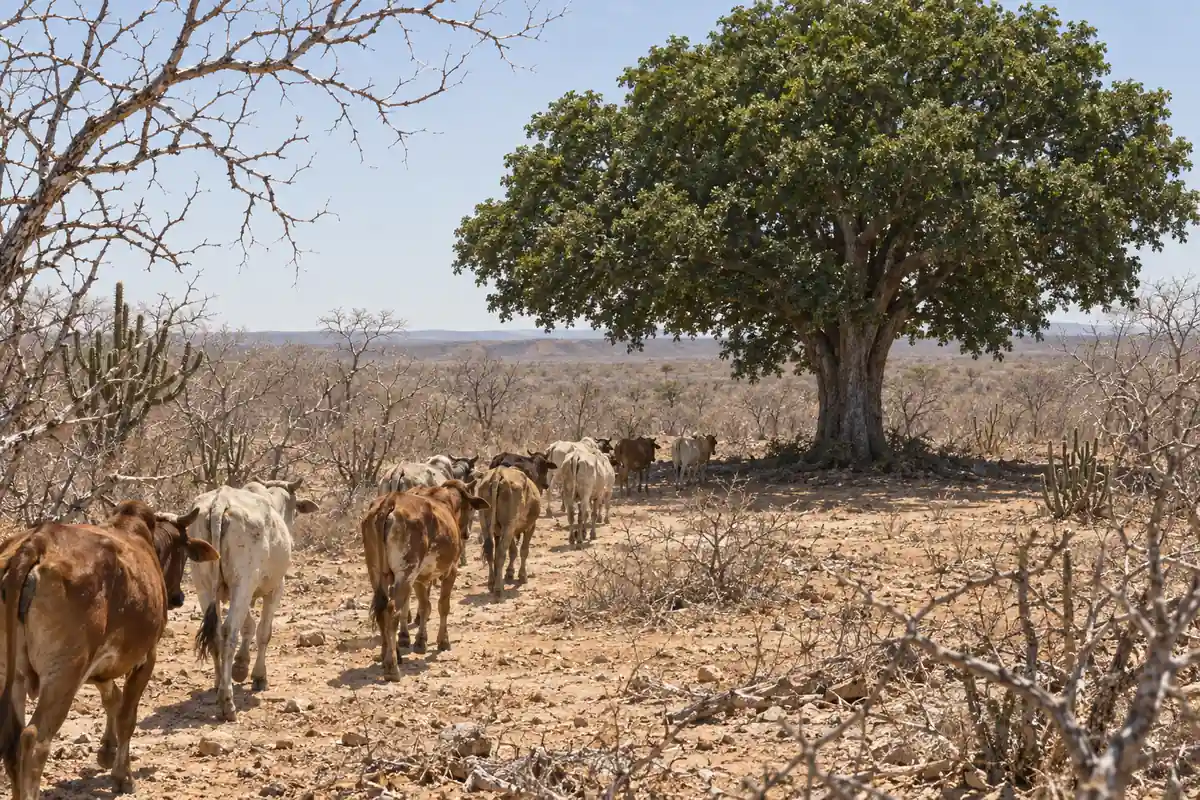
The Pankararé of the Raso da Catarina region in northeastern Bahia show how closely ceremony and land can be tied. In 1979, during the struggle over demarcation, a chief was killed in an ambush. The conflicts made ceremonies hard to hold, and rituals survived largely through songs passed on orally. A later chief was herding cattle when he stopped to rest under a jatobá tree, the only green shade in the parched scrub. The cattle returned on their own and licked his feet, and there he first saw Caboclo Aboiador, the enchanted figure at the center of the festival that grew up around that tree. "All the strength we had came from here," he said of the fight for the land. In 2023, 47,500 hectares were approved for about 2,400 Pankararé, while another 13,000 hectares were demarcated and still awaited the Ministry of Justice's approval. [8]
The Festival of Amaro has been open to the public since 1995 and takes place on the last Saturday in October. Its syncretism is visible on the chapel altar, where Caboclo Aboiador stands among Jesus, Saint George, Iemanjá, and Father Cícero. During the day, an elder arrives with a delegation from the village, and people receive enchanted beings in prayer, including one whose proper name the Pankararé do not reveal. Parts of the festival are restricted. Jurema is kept in an enclosure around the sacred tree. Only men over sixteen may enter it, and they gather there before the night's dancing. [7, 8]
After dinner, the praiás appear from the forest. These dancers represent the enchanted forces of the woods and are covered head to foot in fiber costumes and masks. A line of women leads the songs. At the 2023 festival, young apprentices danced in the twilight before them, wearing the same fibers. [8]
A journalist who drank the wine at a Pankararé festival in 2023 noticed no psychedelic effect, then wept when the ceremony's elder embraced him. A Pankararé woman told him that the entity, not the elder, had embraced him. He observed that communion with the enchanted seemed to arise from the ritual as a whole: songs, rattles, pipe smoke, prayer, and shared meals. [8]
Between festivals, residents return to care for the trees, put up buildings such as a women's house and a children's shed, and hold the closed ceremonies known as science tables. [8]
What is uncertain
Detailed studies and a recent eyewitness report describe jurema in dances and ceremonies among several Indigenous peoples of Northeastern Brazil, so the broad picture is fairly solid. Closed ceremonies are kept secret, however, and sources disagree about how old the practice is and do not settle what the drink itself does.
Sources disagree on whether ritual use of jurema began long before colonization or has a fairly recent history. [4, 5]
No archaeological evidence settles how jurema was used before the colonial period. [1, 4]
Sources disagree on the toré's age, with some describing a centuries-old tradition and others a major spread or adoption from the 1930s and 1940s. [1, 3, 6]
It is unresolved whether the drink as traditionally made has strong effects by itself, and no source has established what might make it active. [1, 5, 8]
No one knows how far the mystical experiences of traditional users come from the plant's chemistry rather than the ritual as a whole. [1, 7, 8]
Potiguara people disagree on whether toré and catimbó are one practice or separate ones, and on whether outside elements strengthen or weaken the toré. [2]
The movement of jurema knowledge between inland Indigenous peoples, coastal groups and Afro-Brazilian religions remains little studied and hard to trace. [1]
Many plants are called jurema, and peoples differ in which they accept, so the sources do not give a full picture of which plants each group uses. [1, 5, 7]
Much about the closed rituals remains undocumented because they are secret and largely closed to outsiders. [2, 6, 7]
8 sources. Each claim checked by AI against the saved sources; every finding reviewed by Jim Davis beside the cited passage, 30 October 2026. How the articles were checked
Timeline of dated events (30)
- By about the 17th centuryKariri people in mission villages were induced to burn their ritual objects in front of a church. [6]
- Colonial periodthe Portuguese Inquisition persecuted jurema cults, producing the earliest surviving information about them. [1, 4]
- 1739the first known written mention of the jurema drink was recorded, by which time its use was already being prosecuted. [4]
- Second half of the 18th centuryreforms expelled the missionary orders and turned Potiguara mission villages into official Indian towns. [2]
- 18th and 19th centuriesother peoples joined the Kariri, forming the Kariri-Xocó and sharing the toré and Ouricuri rituals. [6]
- 1873Indigenous villages in Alagoas were officially abolished, and dispossessed Kariri-Xocó families moved to a town street while keeping up their rituals. [6]
- 1910Brazil's Indian Protection Service was created. [6]
- 1913an official of that service recorded Potiguara festivities with Indigenous songs, dances and instruments. [2]
- Early 20th centurythe toré became an affirmation of Kariri-Xocó identity. [6]
- From the 1930sthe toré and jurema use spread vigorously among Northeastern Indigenous peoples and became central to claims of Indigenous identity. [1]
- 1938the first well-structured record of a jurema ritual was made at a Pankararu festival, and a folklore mission recorded Pankararu and Potiguara toré and regional catimbó. [1, 2]
- 1940the Atikum began seeking official recognition, learning the toré and jurema from the Tuxá because the state required the dance as proof of Indigenous identity. [3]
- 1942a chemist returned to the Pankararu and identified DMT, first called nigerine, in jurema-preta. [1]
- 1949an official Indian post was set up on Atikum land. [3]
- 1950scatimbó, in which jurema was central, was still being described as sorcery. [1]
- Mid-20th centuryumbanda reached catimbó in the Northeast, and jurema gained a place within umbanda houses. [1]
- 1966a Paraíba state law allowed free practice of African-derived cults under official controls, but it did not mention Indigenous cults. [1, 2]
- 1970scatimbó practitioners on the Paraíba coast were locally known as juremeiros, and a process of absorption into umbanda was documented. [1]
- 1970s and 1980sthe toré became the main public sign of Kariri-Xocó ethnic identity. [6]
- 1979a Pankararé chief was murdered in an ambush during the fight for land demarcation. [8]
- 1980sofficial demarcation work began on Pankararé land, amid attacks and conflict. [8]
- 1990sAtikum lands were demarcated. [3]
- 1995the Pankararé Amaro festival opened to the general public. [8]
- Early 1997the first Brazilian groups began rituals with juremahuasca, a new drink combining jurema with a foreign plant. [1]
- Turn of the 21st centuryKariri-Xocó and Fulni-ô groups began presenting toré workshops in large cities, later adding white jurema at the request of city participants. [1]
- 2002a juremahuasca group was institutionalized as a religion, though it lasted only a few years. [1]
- 2006an annual gathering of juremeiros from across the Northeast began under a cultural movement linked to Jurema Sagrada. [1]
- 2007at a Potiguara toré, some people drank jurema brought from an intertribal meeting, without trance, and participants disagreed about these new elements. [2]
- 2014a juremahuasca religious centre was formally institutionalized. [1]
- 2018the first church in Brazil to take DMT as its sacrament was founded. [1]
Sources
CSL-JSON imports into Zotero, Mendeley and other reference managers.
Grünewald, R. de A. & Savoldi, R. (2020). Cada jurema é uma jurema: continuidade, rupturas e inovações em religiosidades no Brasil. Revista del CESLA 26: 221–244.
Two university-based researchers' journal article, 2020, combining a literature review, observation and testimony; it traces jurema from Indigenous rituals through catimbó and umbanda to modern entheogenic groups and distinguishes public toré from closed rituals.
Vieira, J. G. (2019). Catimbó e toré: práticas rituais e xamanismo do povo Potiguara da Paraíba. Vivência: Revista de Antropologia 54: 41–64.
Anthropology professor's journal ethnography, 2019, on the Potiguara; it gives the fullest account of spirit beliefs, ritual specialists and the links and tensions between toré, catimbó and jurema, including a 2007 ritual.
Albuquerque, M. A. dos S. & Aureliano, W. de A. (2006). Toré Atikum: etnofotografia do "encantamento". Tellus 6(11): 173–179.
Short photo essay by an anthropology doctoral student and a sociology graduate, 2006, on an Atikum toré; it shows how the Atikum learned toré and jurema while seeking official recognition.
Samorini, G. (2018). El culto a la Jurema en los documentos históricos. Cultura y Droga 23(25): 33–47.
Scholar's journal article on jurema's history, 2018, read only as an abstract and reference list; it contributes the 1739 first mention and the argument that the cult may be recent.
Souza, R. S. O. de, Albuquerque, U. P. de, Monteiro, J. M. & Amorim, E. L. C. de (2008). Jurema-preta (Mimosa tenuiflora [Willd.] Poir.): a review of its traditional use, phytochemistry and pharmacology. Brazilian Archives of Biology and Technology 51(5): 937–947.
Biology and pharmacy researchers' literature review, 2008; it summarizes the plant's chemistry, pharmacology, names and reported uses, and shows how unsettled the drink's effects remain.
Suzart, E. C. (2019). Toré: um fenômeno da tradição do povo Kariri-Xocó. Grau Zero – Revista de Crítica Cultural 7(2): 37–53.
Master's student's journal article on the Kariri-Xocó, 2019, drawing on observation and a tradition-keeper's accounts; it presents the toré as resistance and identity, interprets its songs and explains the closed Ouricuri, but says little about jurema itself.
Santos, E. A. dos, Santos, J. M. dos & Santana, A. E. G. (2014). Ethnographic notes on the use of jurema (Mimosa tenuiflora (Willd.) Poir.) by the Pankararé Indians (Northeast Brazil). Revista Ouricuri 4(3): 103–113.
University researchers' ethnographic notes in a journal, 2014, based on fieldwork in 2008–09 among the Pankararé; they describe jurema's sacred role in the Amaro festival and restricted rituals and compare its use among other peoples.
Leite, M. (2023, 29 December). This is how jurema, a DMT-containing tree, helped the Pankararé people recover their land in Brazil. Chacruna Chronicles.
Journalist's eyewitness web report, 2023, first published in a Brazilian newspaper; it gives a recent account of the Pankararé Amaro festival, the land struggle and the writer's own experience of drinking jurema.
Related
Cite this page
Psychoactive Traditions. “Jurema and Toré of Northeast Brazil.” Last reviewed 30 October 2026. https://psychoactive-traditions.org/traditions/jurema-tore