Names
In Western countries the plant (Tabernanthe iboga) usually goes by iboga, which is also spelled eboga or eboka. The name can refer either to the shrub itself or to the root that people eat.
The Mitsogho call it eboghè in their language, Getsogho (Tsogho), and the Fang call it eboka.
What it is
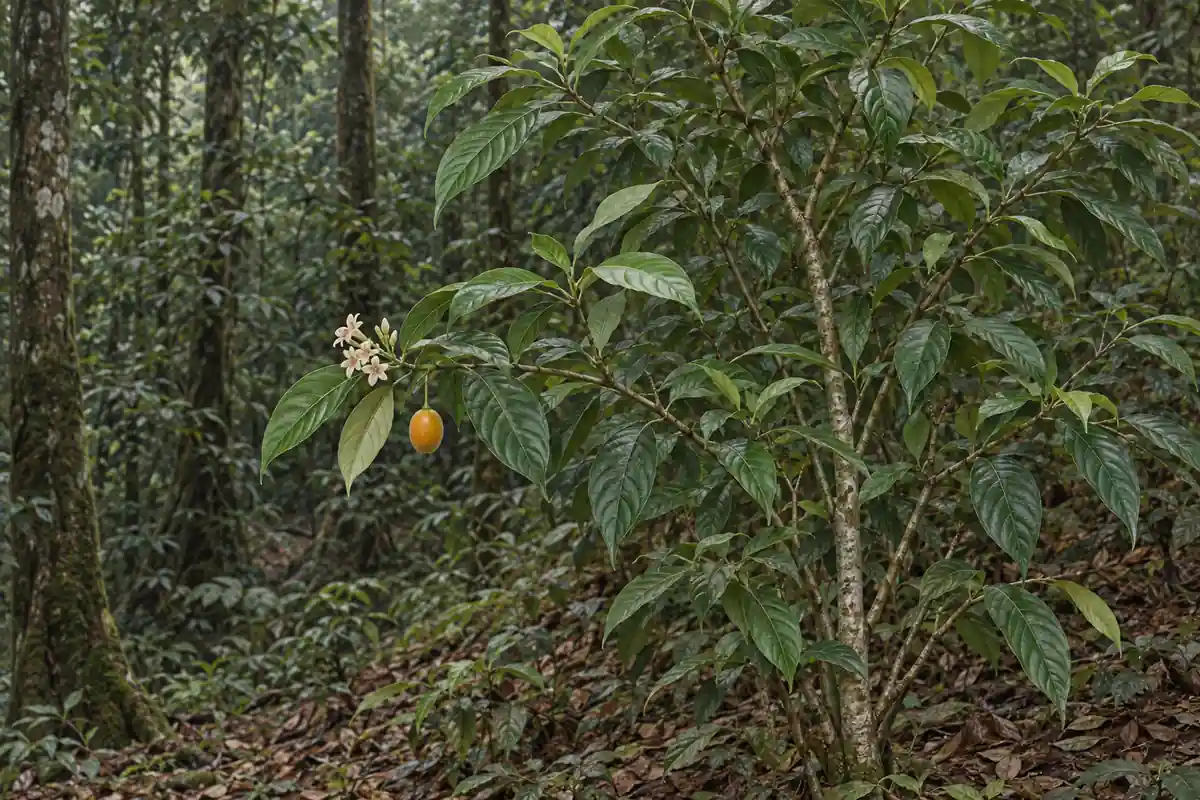
Iboga is an evergreen shrub in the dogbane family (Apocynaceae), native to the forest undergrowth of west-central Africa, including Gabon and neighboring countries. It often stands about head height but can grow taller. Its oval leaves grow in opposite pairs, its small flowers range from white to pinkish, and it bears small orange-yellow fruits.
The part people use is the yellowish root. Mitsogho initiates are described as eating the root bark, and Fang Bwiti members as eating the root.
How it works
The best-studied active compound is ibogaine (12-methoxyibogamine), which takes its name from the plant. It is one of many alkaloids in the shrub. Alkaloids are a class of nitrogen-containing plant compounds, and in iboga they are especially abundant in the root bark.
The body converts ibogaine into noribogaine (12-hydroxyibogamine), which is also active and lingers longer. Laboratory studies show that these compounds act on several brain systems at once. Among them are the systems that use the chemical messengers serotonin, which is involved in mood and perception, and glutamate. They also act on opioid receptors, the sites where the body's natural painkillers act.
No one knows how these actions produce the experience. And because most research has used purified ibogaine, the whole root, with its mix of alkaloids, is less well understood.
Effects on the mind
Iboga, and purified ibogaine in particular, is often described as an atypical psychedelic. It alters perception and thought, but people often compare the experience to dreaming while awake, and it is sometimes called an "oneirogen," meaning a producer of dreams.
Many people report dreamlike visions, especially with their eyes closed, and these may include figures, scenes, and episodes from their own past. Others report few visions. As the visions fade, a long, quieter stage of reflection often follows, in which people go over what they saw and think about their lives. The whole experience can last many hours and may stretch to a day or more.
The experience can also be difficult. People report fear, confusion, distressing images or memories, and losing contact with their surroundings. Some value what they come away with as insight into themselves, though such insights are personal accounts, not established discoveries.
In tradition
Iboga is eaten in several traditions in and around Gabon. Two of the best documented are Bwete Disumba, also called Mitsogho Bwiti, in the south-central part of the country, and the Bwiti of Fang communities in northern and northwestern Gabon and neighboring Equatorial Guinea.
Both concern contact with the dead, though their stated purposes are described differently. Mitsogho initiates, who are all men, eat the root bark to meet the ancestors and to be reborn as sons of the mythical woman Disumba. Fang members, on the other hand, eat the root to see the dead and learn from them.
The Mitsogho, along with many peoples who adopted Bwete after them, regard Bwete Disumba as its oldest trunk. Fang Bwiti, by contrast, is a religion that took shape in the early twentieth century.
The record of where each stands today is uneven. Fieldwork in 2000–2002 found Bwete Disumba stable or declining and largely a village practice, and reports from 2016 and 2022 show it was still being practiced at those times. Bwiti is a living religion, though recent fieldwork often covers Gabon as a whole rather than the Fang alone.
Today
Iboga and purified ibogaine are now also used outside these traditions, including in Europe and the Americas. Research centers on ibogaine, especially for opioid dependence, but the studies are small and mostly uncontrolled, and large controlled trials are lacking. In Gabon, wild iboga is reported to be under pressure from overharvesting, driven in part by demand from abroad.
Traditions that use it
Cite this page
Psychoactive Traditions. “Iboga.” Last reviewed 1 November 2026. https://psychoactive-traditions.org/medicines/iboga