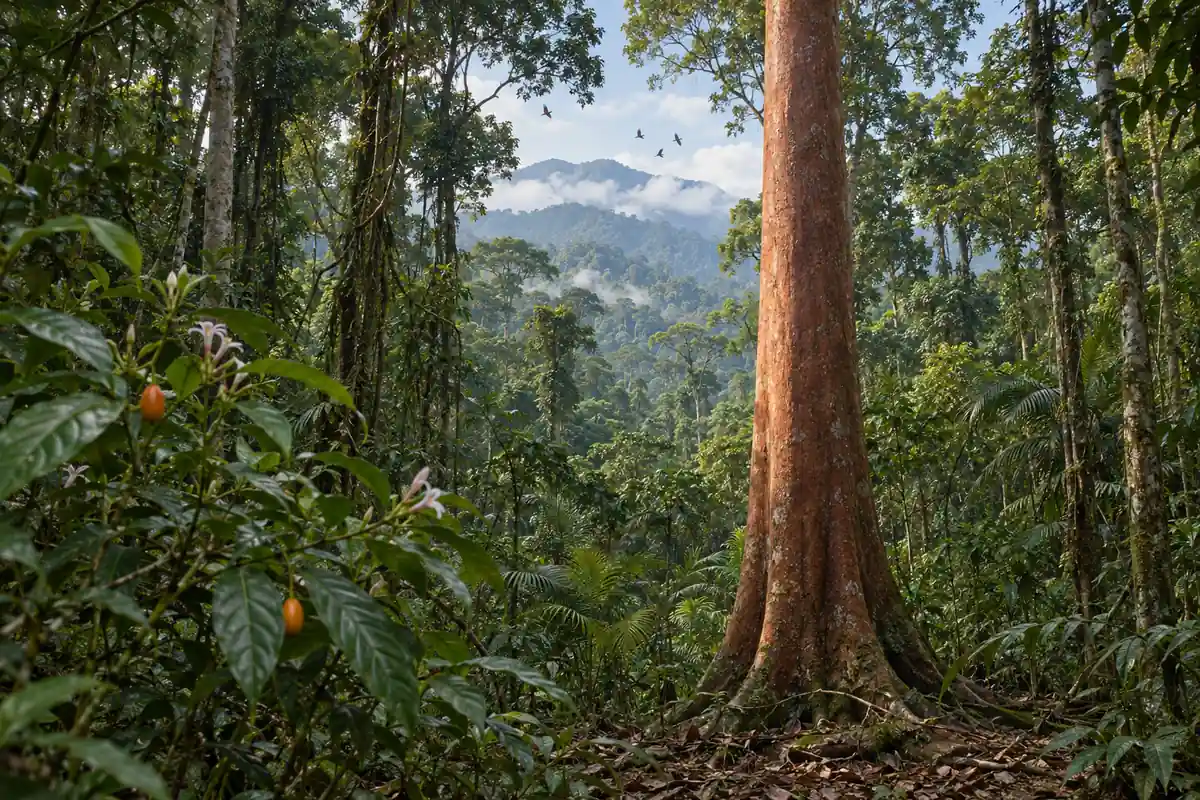
The Mitsogho live in the mountainous forest of south-central Gabon, a country on the Atlantic coast of Central Africa that straddles the equator. Most live between the Ngounié and Ikoy rivers. For more than a century, observers have reported that almost every Mitsogho man has passed through the same rite in his youth: initiation into Bwete, a men’s society whose members eat the root bark of the iboga shrub (Tabernanthe iboga). In the vision that follows, the initiate travels to the village of the dead. A Gabonese priest who traveled among the Mitsogho in 1910 put it simply: "Eating iboga is synonymous with being initiated." Bwete has several branches. Its own practitioners regard the oldest, Disumba, as the trunk from which the others grew, and so do the many other Gabonese peoples who later took up Bwete. [1, 6]
The trunk and its branches
Iboga is eboghe in Getsogho, the Mitsogho language. In local French it is often called bois sacré, "sacred wood." The society is called Bwete in Getsogho; other peoples came to call it "Bwiti." A Tsogho linguist interviewed in 2016 traced the name to bo-hete, from a verb meaning "to turn something over so as to pour out its contents." In his account, the mystical aim of Bwete is rebirth: a person who wants to stop suffering must be born again by emptying himself of his impurities, so that he can be filled with something pure. The same idea appears in a gesture of ordinary courtesy: before drinking, a little palm wine is poured on the ground as the ancestors' share. [2, 10]
Bwiti in its non-Christian forms has spread to at least twenty ethnic groups in Gabon. Most of them say it began with the Mitsogho, although the neighboring Apindji claim it as their own. Written records reach back only about a century and a half, and the cult's age is unknown. The Fang of northern Gabon adopted Bwiti in the early twentieth century and combined it with Christianity. Among them a common phrase is "disumba c'est l'origine": Disumba is the origin. A Misoko healer interviewed in Libreville in 2016 described Bwiti as "a tree with several branches whose trunk is Disumba," and said that Disumba is strictly reserved for men. [1, 2, 5]
"After death one becomes a Bwiti"
In Mitsogho understanding, as recorded in the second half of the twentieth century, a person is made of three parts: a silhouette or shadow, a life force that resides in the heart, and a spirit, the ghedidi. At death the silhouette vanishes, the life force leaves through the nose, and the spirit leaves through the fontanel, the soft spot at the crown of the head. The spirit then travels to the village of the dead, where it joins the mighonzi, the spirits of the departed. As the living remember them, these dead become ancestors: mombe in the worship of a family, bwiti in the worship of the whole people. "After death one becomes a Bwiti," the Mitsogho say. Bwete appears to have grown out of an older ancestor cult, Mombe, once knowledge of iboga was added to it. One of the first scholars to record its teaching described it as an ancestor cult raised from the family to the scale of the people. Its spiritual aim, in his account, was to approach the divine and to establish humanity's exact place in the cosmos. [1, 9]
Initiation therefore shapes what becomes of a person after death. The spirit of a man who was never initiated into Bwete or another initiatory society is believed not to reach the village of the dead. It passes instead through water and joins the mighesi, a community of water genies. For those who do reach the village of the dead, conduct in life is believed to decide what follows. A good life leads to rebirth as a person. Misconduct leads to rebirth as an animal or to a stay in a tree, and grave wrongs lead to permanent confinement in a stone. [1]
The ancestors are present in the temple itself. The temple, the ebanza, is understood as the body of a man, with its spaces and posts standing for his head, arms, heart and legs. The two front posts are often carved with Nzambe Kana and Disumba, the first male and female ancestors. In 1910 the priest noted a niche in the back wall holding small wooden figures painted red and black, each with its own name, resting on the skulls of ancestors. In later decades family worship shrank to a few brief ceremonies, and Bwete took over ancestor worship at the level of the whole people through a ritual cycle held at times such as the start of farm work. [1, 6]
The journey to the village of the dead
Accounts differ on whether initiation is compulsory. Ethnographers working from the late 1960s onward wrote that it was never mandatory but was sought as a means of social acceptance. Fieldwork in 2000–2002 described it as close to obligatory: in villages where Disumba is practiced, a boy who remains uninitiated cannot take part in the decisions of the men. Still, no age is fixed. The boy himself decides one day to go and "eat the wood," often with friends. He leaves without telling his parents and informs at most his maternal uncle. In 1910 boys were usually initiated at ten to twelve, and almost all the men of a village went through it because they wanted to know "how things in the world work." Until at least the 1990s almost all Mitsogho men were initiated, preferably between nine and twelve. [1, 6, 10]
Eating the iboga takes the novice several hours, and his body gradually grows numb and cold. He vomits repeatedly, and the vomiting is considered necessary. In Disumba he must vomit until he brings up a whitish substance, believed to be a drop of the breast milk he drank as a newborn. After that, an ethnographer explained, he is no longer his biological mother's child and "can be reborn as the son of the mythical woman Disumba." [1, 6]
The novice's body was marked as well. In the 1920s initiates were painted half red and half white and wore parrot feathers in their hair. Drops that "burn like pepper" were put into the novice's eyes. The parrot feathers recall an alliance between the Mitsogho and the parrot. In the story of that alliance, a woman alone in the forest was threatened by a cannibal man-tiger and cried for help. The parrots in a nearby tree imitated her cry in unison and frightened him off. [1, 6]
When the novice lies curled up, the temple master shakes a rattle beside him and recites a long initiatory narrative. In the vision the novice meets the beings of the village of the dead: the sun, Kombe; the moon, Ngonde; and Nzambe Kana and Disumba. Initiates call these beings "the roots of the Bwete." One vision recounted to the priest in 1910 began with a ghost who took the novice by the hand. The ghost led him by many detours to a vast village made of a single house with one door. Inside, a long procession of thin, gaunt dead passed before him. The head of this city of the dead asked why he had come. "I come to see Bwiti," the novice answered. "Well, Bwiti is me." In the 1920s initiates said Bwiti appeared as a small, fire-colored human figure that danced and grimaced. During the journey the novice also receives a new initiation name from the beings he meets. [1, 6]
What he saw is then tested. When he wakes, the elders take him to the nzimbe, a fenced clearing outside the village reserved for initiates, and ask what he saw, including the name he was called. If they judge the account satisfactory, they applaud together and he is admitted; otherwise he must undergo initiation again. The questioning rests on the expectation that everyone should see the same vision. In the early 2000s Disumba novices were not required to narrate continuously, as they are in the healing branch Misoko. Instead they told their vision all at once at a fixed moment, while the initiates around them performed mimes and scenes. [1, 6, 10]
Yet the expectation of a shared vision has never been fully met, and Bwete's own explanation of its divisions begins here. Different visions arise and are interpreted differently. "Not everyone has the same dream," Bwete initiates say, accounting for the existence of several branches. [1]
Two further rites mark the rebirth. Right after waking, the new initiate enters a river and passes through an oval wooden arch, facing the current. A few months later comes the "exit of the banzi," which closes the initiatory cycle. It takes place in the forest at the foot of a motombi, one of the tallest trees of the primary forest. A narrow tunnel is dug at its base, and the new initiates crawl through it as though climbing down from the tree. An antelope horn hung with a bell is dragged around the trunk. Among the horn's contents is a piece of the white mycelium of the kuna mushroom, a sign of longevity meant to keep the novice from an early death. In 1968 an ethnomusicologist recorded spoken answers about this second rite of passage in the village of Eteke. [1, 4]
The night vigils
Initiation happens once in a man's life. Bwete communities, however, hold night ceremonies almost all year round, and also on particular occasions: for mourning, at the start of the dry season, to inaugurate a temple, or to consecrate a new bell. At these ceremonies participants take small amounts of iboga, mainly for its stimulating effect, which carries them through the long dances and the playing of instruments. [1]
In the early 1920s two colonial officials described vigils that began around midnight. Men came singing out of the forest, others joined them from their houses, and torches were lit everywhere. After circling the village, the group entered the temple, where two fires burned inside and a third in front. The dancers wore strips of palm leaf on their legs, arms and foreheads. At one point a man leapt through the crowd with a burning torch in each hand, scattering sparks, and then disappeared into the forest. Later in the night only the harp and the harpist's song could be heard. Near dawn, one observer wrote, a carved figure emerged from the back of the temple through smoke, and an officiant spoke the oracles of Bwiti in a hoarse voice. [1]
The figures who appear during the dances and then vanish into the forest wear white masks and represent the mighonzi, the spirits of the dead. An antelope horn is blown at the start of vigils to call them. The instruments carry meanings of their own. The eight-stringed harp, the ngombi, is a woman's body. The mouth bow, the mongongo, is the link between the earth and the village of the dead. A struck wooden beam represents the spine of Nzambe. Initiates paint their faces with white kaolin and touches of red from padouk wood. [1]
"Bwete never ends, except on the day of death"
Initiation is only the start. The Mitsogho hold that White people keep their knowledge in "paper," in books, while Black people keep theirs in iboga. In Bwete, the officiants gradually pass on to the new initiates, in the nzimbe, the meaning of the secret ritual language, the objects, the symbols and the teaching. Before each session the novices are given a mixture of honey, kola nut, and the leaves of a plant called tangimina. The plant's name means "to remember," and the undersides of its leaves resemble a human tongue. Initiates describe learning as lasting a lifetime: "Bwete never ends, except on the day of death." Another saying from Disumba communities puts it differently: "The basket of the new initiate is full of iboga; that of the elder is full of initiatory vision." [1, 9]
That gradual accumulation of knowledge is reflected in rank. Above the simple initiates, the banzi, stand the officiants, the nima, and the highest leaders, the nima na kombo. One officiant also serves as povi, the master of the temple and holder of knowledge. [1, 9]
A tradition under change
By the 1970s several Mitsogho branches had disappeared. Two ethnographers wrote that Ndea, a branch with martial themes linked to old wars with the Bakélé, had practically replaced Disumba. In 2000–2002, Disumba appeared stable or declining, while Misoko, the healing branch, was growing and innovating. Misoko differs from Disumba in purpose. A person enters it after repeated misfortune, usually not to meet the ancestors but to identify, through visions in a mirror, the relative believed to be responsible. Misoko initiates sometimes claimed to see more: "In disumba one sees only one night, while in misoko one sees every day." Misoko spread readily in Libreville and along the roads around it, while Disumba remained largely a village practice. Other accounts disagree. One writer in 2005 called Disumba still the most widespread branch among the Apindji and Mitsogho. The healer interviewed in 2016 said it was much practiced among the Gisir and Vungu of Ngounié province. [1, 2, 8, 10]
Outsiders have long misrepresented the society. In the early twentieth century a missionary claimed that the Mitsogho leader of a revolt against French concession companies had used Bwete initiation to make his followers invulnerable to bullets. One scholar treats much of that account as invention. He allows, though, that there may be some truth in a later account of a warrior Bwiti, in which the 1904 rebels learned invulnerability to bullets. The colonial persecution of Bwiti from the 1930s to the 1950s fell most heavily on the Fang. [1, 5]
The risks of initiation are acknowledged within the tradition. An ethnographer initiated in the early 2000s noted that eating iboga in such quantity can, rarely, end in lasting madness or death. When it does, the family usually interprets the death as sorcery and accuses the initiator. Initiating is therefore a heavy responsibility: an initiator answers for the novice's life "as long as the child of another has not come back to earth." Such cases sometimes reach the courts. In 2022 a Gabonese newspaper reported that a thirty-year-old man had died in Lambaréné about two weeks after an initiation into Bwiti-Disumba, and that three initiators had been detained while an investigation proceeded. [7, 10]
The state has since moved to regulate the plant. On 30 April 2026 Gabon's Council of Ministers declared iboga and its derivatives "strategic national heritage." Under the decree, research, processing, sale and export of iboga require prior authorization from the Minister of Culture. The decree also provides for legal protection of ancestral knowledge and control over patents on derivatives such as ibogaine. It creates a sovereign iboga fund intended to share benefits between the state and the communities that hold the traditional knowledge. [3]
What is uncertain
Missionaries, colonial officers and anthropologists wrote detailed descriptions of this men's initiation society between about 1910 and the 1970s. Recent knowledge is much thinner: one researcher's review, a study from the early 2000s of a related healing branch, and a few Gabonese news stories.
Whether Disumba initiation was ever obligatory for Tsogho boys, or only expected as a route to social acceptance, is disputed. [1, 10]
Sources disagree on Disumba's present vitality. One view is that the Ndea branch had largely replaced it by the 1970s; another is that it is still the most widespread form; a third is that it is stable or declining. [1, 2, 10]
Who first created the cult is unsettled; candidates are the Mitsogho, the neighbouring Apindji, and Pygmy groups, as claimed in many oral accounts. [1, 2, 5]
Whether the cult arose only in the 19th century or is older is unknown, because no written record predates 1861 and no archaeological evidence has been published. [5, 6]
How many branches once existed, and when most of them disappeared, is told differently in different accounts. [1, 2]
Whether the cult played a real part in the 1903–1913 anti-colonial revolt, or whether missionaries invented that link, is unclear. [1]
Whether a second visionary plant is still taken alongside iboga at Disumba initiation is not known. [1]
How the Misoko healing branch relates to Bwete Disumba, and whether it truly belongs to the same cult, is contested among scholars and practitioners. [8, 10]
How Disumba is practised today in Tsogho villages has not been studied in depth since the early 2000s. [1, 10]
How often initiations end in harm has not been studied. [7, 10]
What effect Gabon's 2026 iboga decree will have on ritual use is unknown. [3]
11 sources. Each claim checked by AI against the saved sources; every finding reviewed by Jim Davis beside the cited passage, 30 October 2026. How the articles were checked
Timeline of dated events (21)
- By 1840 (proposed date)latest point by which the cult had formed among the Apindji, according to one scholar's estimate. [1, 5]
- 1861first published use of the word "mbuiti", for an idol among the Nkomi; it is uncertain whether this refers to the cult. [6]
- June 1865first known Western eyewitness account of a nocturnal Bwiti ceremony, held in a Masango village. [6, 10]
- 1887a "Bwiti house" is recorded among the Nkomi of Fernan-Vaz. [1, 6]
- 1893first evidence of Bwiti among the Eshira, from a missionary's visit published in 1894. [1, 6]
- 1897a Bwiti temple is noted among the Nkomi near Lake Alombié. [1, 6]
- By the end of the 19th centuryper one Tsogho linguist's account, only three branches, Disumba among them, survive out of eight. [2]
- 1899–1956a Catholic mission among the Apindji meets persistent passive resistance and eventually closes. [1]
- 1903–1913Mitsogho revolt against concession companies; missionaries later claim Bwiti drove it. [1]
- 1910a Catholic priest's description of Mitsogho Bwete, after earlier notes by an explorer in 1865 and a Spiritan in 1893, reporting that almost all men are initiated, usually as boys. [1, 6]
- c. 1910 (or c. 1890 in oral accounts)the cult reaches the Fang, who later reshape it with Christian elements. [5, 10]
- 1923–1925colonial officials describe public night ceremonies among the Mitsogho. [1]
- 1927Bwiti is first noted in Equatorial Guinea. [1]
- 1930s–1950smissionary and colonial persecution of Bwiti, aimed mainly at Fang groups. [5]
- 18 June 1968a recording is made of the second Motombi rite of passage in a Tsogho village. [4]
- 1970sresearchers report that several branches have vanished and that Ndea has largely replaced Disumba. [1]
- Until at least the 1990salmost all Tsogho men are initiated. [1]
- 2000–2002Disumba is observed to be stable or declining, while Misoko is growing. [1, 10]
- 2016a practitioner describes Disumba as a men-only branch that is popular in the Ngounié province. [2]
- February–March 2022a man dies after a Disumba initiation in Gabon, and three initiators are placed in custody. [7]
- 30 April 2026Gabon declares iboga a national strategic heritage and regulates its trade. [3]
Sources
CSL-JSON imports into Zotero, Mendeley and other reference managers.
Samorini, G. (2025). Studies on the iboga cults. VII. The traditional Bwiti. Antrocom Online Journal of Anthropology 21(2): 75–97.
Peer-reviewed journal review (2025) by an independent researcher of iboga cults. It is the main synthesis on Mitsogho Bwete: history, cosmology, ranks, initiation, branches and scholarly disagreements.
L'Union (2016, 31 March). Dossier 'Rites et croyances: Le Bwiti est-il une religion ?', Société et Culture, p. 5. Libreville.
Gabonese newspaper dossier (2016) with interviews of a Misoko healer, a Tsogho language specialist and a pastor. It gives a community view of the branches, the origin of the name, and Disumba as the men-only "trunk" of the cult.
Mondjo Mouega, M. (2026, 1 May). Gabon : le gouvernement encadre l'exploitation et la commercialisation de l'Iboga. Gabon Media Time.
Gabonese news report (2026) on a government decree regulating iboga as national heritage. It provides legal context, not ritual detail.
CREM-CNRS sound archives (n.d.). Item CNRSMH_I_2007_012_049_06: 'Bwiti Motombi. Deuxième rite de passage'. Collection 'Musiques du Gabon, mission Pierre Sallée, 1968'.
Sound-archive catalogue entry for a 1968 field recording of spoken questions and answers about the second Motombi rite of passage among the Tsogho. Only the metadata was available.
Samorini, G. (2025). Studies on the iboga cults. V. Historical aspects. Antrocom Online Journal of Anthropology 21(1): 103–128.
Journal article (2025) by the same author as source 1, read in part. It covers theories of origin and spread, ritual language evidence, and colonial persecution.
Samorini, G. (2024). Studies on the iboga cults. I. The ancient documents. Antrocom Online Journal of Anthropology 20(1): 93–114.
Journal article (2024) by the same author, read in part. It reviews the earliest written mentions of Bwiti and iboga from 1861 to 1938.
Gabon Media Time (2022, 11 March). Lambaréné: il meurt après une initiation dans un temple de Bwiti.
Gabonese news report (2022) of a death following a Disumba initiation and the arrest of the initiators.
Samorini, G. (2025). Studies on the iboga cults. VI. The divinatory practices. Antrocom Online Journal of Anthropology 21(2): 53–74.
Journal article (2025) by the same author, read in part. It covers divination with iboga, the Misoko branch, and its disputed link to Bwete.
Sillans, R. (1966 [Annuaire 1967–1968]). Motɔmbi récits et énigmes initiatiques des Mitsɔghɔ du Gabon Central. I : La route de la vie [summary of a thesis defended 13 June 1967]. Annuaire de l'École pratique des hautes études, Section des sciences religieuses 75: 255–256.
Published summary of Sillans's defended doctoral thesis (1967) on the Motombi initiatory teachings. It describes Bwete as a men's fraternity rooted in ancestor worship and taught in a secret ritual language. Only the abstract was available.
Bonhomme, J. (2003). Le miroir et le crâne. Le parcours rituel de la société initiatique Bwete Misoko (Gabon). Doctoral thesis in anthropology, École des Hautes Études en Sciences Sociales (EHESS), Paris, defended 24 November 2003. 577 pp. Open-access deposit HAL tel-00801512 (2013).
Anthropologist's doctoral thesis (2003), based on fieldwork in 2000–2002 that included his own initiation, read in excerpts. It covers the Misoko branch, comparisons with Disumba (described as a quasi-obligatory boys' initiation), branch history and diffusion.
Bonhomme, J. (2008). Des pleurs ou des coups. Affects et relations dans l'initiation au Bwete Misoko (Gabon). Systèmes de pensée en Afrique Noire 18: 133–163. HAL halshs-00801596.
Journal article (2008) by the same anthropologist, derived from source 10. It analyses emotions and relationships in Misoko initiation and adds little directly on Disumba.
Related
Cite this page
Psychoactive Traditions. “Bwete Disumba Iboga Initiation.” Last reviewed 30 October 2026. https://psychoactive-traditions.org/traditions/mitsogho-bwiti-iboga