Fang communities in northern and northwestern Gabon and in neighboring Equatorial Guinea practice a religion called Bwiti, which took shape in the early twentieth century. Its members eat the root of Tabernanthe iboga, an equatorial forest shrub known in Fang as eboka, in order to see the dead and learn from them. Bwiti draws on an older Fang ancestor cult, on an initiatory society of the Mitsogho people of central Gabon, and on Catholicism. As described in the early 1970s, members took communion with eboka in place of bread and said it was the more powerful of the two because it gave visions of the dead. [3, 4, 5, 9]
The Plant and Its Origin
The Fang came into the rain forest from the savanna to the north, and they credit the Pygmy people already living there with showing them how to survive in it. They credit them with eboka as well. In a Fang story recorded by James Fernandez, Zame ye Mebege, the last of the creator gods, "saw the misery" in which people were living. Looking down, he saw a Pygmy man named Bitumu high in a tree gathering fruit, and he made him fall. Zame took the man's spirit, cut off his little fingers and toes, and planted them around the forest, where they grew into the eboka bush. [5]
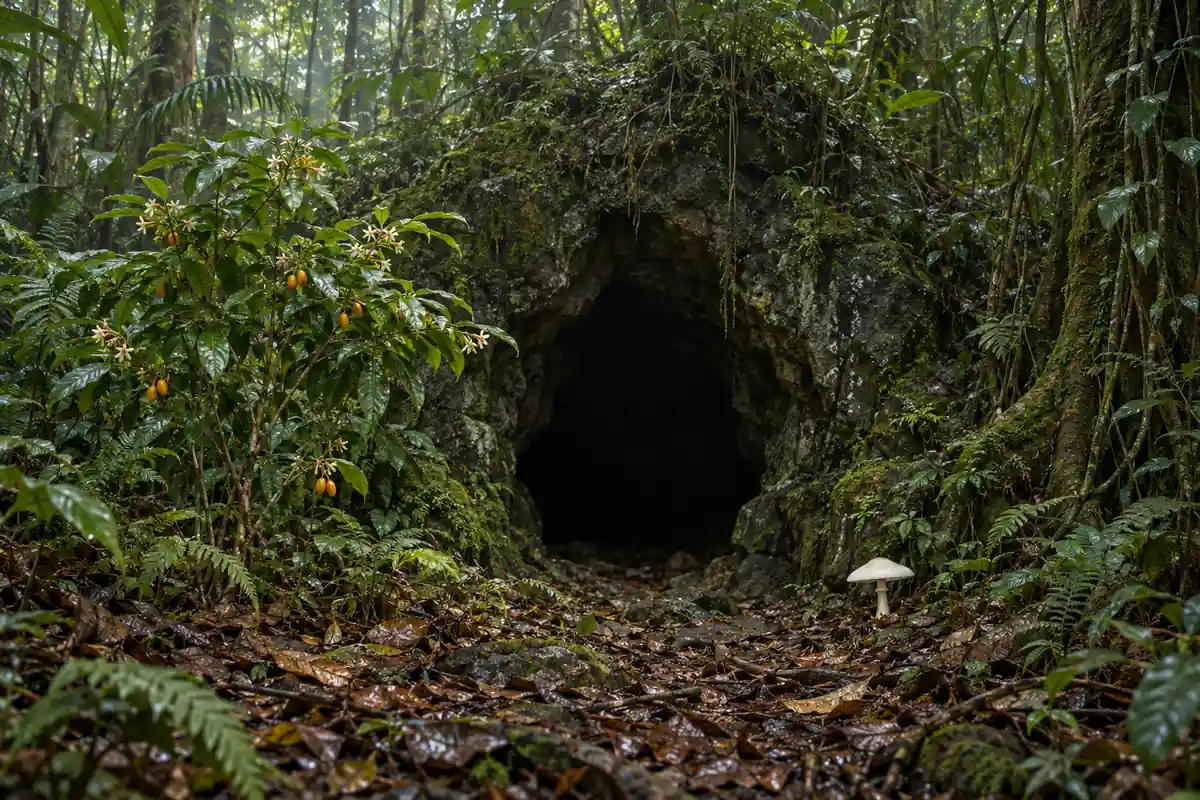
The dead man's wife came looking for him. A disembodied voice told her to eat the root of an eboka plant growing to the left of a cave's mouth and a mushroom growing to the right. When she did, the bones that filled the cave came to life and showed themselves to be her husband and other dead relatives. They told her she had found the plant that would let members of Bwiti see the dead. [5]
Fernandez drew several meanings from the story. It ties eboka to the Pygmies and to the deep forest, which holds the secrets of death, and it makes the plant the means of passing from the village into that forest. Because a woman finds the plant, the story also speaks to women's place in the religion. Initiation in Bwete, the Mitsogho initiatory society, belonged to men. Among the Fang as described in the early 1970s, women dominated a separate curing cult, Mbieri, while men and women held an equal place in Bwiti. Bwiti itself was directed toward a female principle, Nyingwan Mebege, author of procreation and guarantor of a prosperous life. Eboka is the left-hand plant, and the left side of the chapel is female; the mushroom stands on the right, the male side. [1, 4, 5]
Seeing the Dead
In the same early 1970s account, members took eboka in two ways. Smaller amounts, eaten before and during the first hours of a ceremony, brought a dream state in which a person traveled outside the body to the Otherworlds, where the ancestors live and where one learns to do their work. A far larger amount, taken once or twice in a member's life for initiation, was meant to "break open the head" and establish contact with the ancestors. [5]
In the Mitsogho Bwete, this experience is what binds initiates to one another: what unites them is the lived sight of the Bwete rather than faith. [4] Ondřej Havelka, a theologian whose research in Gabon between 2001 and 2019 covered Bwiti generally rather than the Fang alone, reached a similar view of the role of experience: "one does not learn but observes." He placed the emphasis elsewhere, however, describing Bwiti as a matter of self-discovery and insight into the nature of reality, with ancestors and purification among its more general elements. It took him some time even to learn of Zame ye Mebege. Whether the contrast with earlier accounts reflects change over time, differences among branches, or the questions each researcher asked is not clear. [3]
Havelka's account of present-day initiation also covers Gabon broadly, and he stresses that the ritual is not the same everywhere. It usually lasts three to seven days and includes repetitive music, fasting, purification, vomiting, and censing. Initiation most often takes place at around fifteen, though a child of a healer's lineage who is destined for that role may be initiated at about seven. The person overseeing it is a nganga, a word used across Central Africa for healers. On the penultimate night, the initiate symbolically dies and sheds the old self, the body lying unconscious while the consciousness is understood to travel through the universe. After initiation, a person may take iboga at festivities, in treatment, or for spiritual development, though Havelka found the motive to be above all spiritual. [3]
Iboga is toxic in very high amounts, and deaths have been reported, among the Fang and in Gabon more widely. Havelka writes that the nganga uses the days of the ritual to judge how much a person can withstand and wishes to withstand, and that no one has to go through the phase of unconsciousness who does not want to. The ngangas he spoke with also give their own explanation for these deaths. They say iboga powerfully amplifies a person's basic attitude toward the ritual, toward themselves, and toward others. Someone who comes seeking the art of harming others, they say, has that evil multiplied until it engulfs and kills them. [3, 5]
Conquest, Migration and the Making of Bwiti
The origin story places the plant in the deep forest. The religion that formed around it can be traced to the colonial conquest and to the labor migrations of the early twentieth century.
Before the conquest, Fang religious thought ran along two lines, as it did among the neighboring Bulu and Beti. Ancestor cults, called byeri, placed human action within the order of the clan. Evur, a substance a person could possess, was associated with magic and sorcery and allowed its holder to go beyond that order or stand against it. Across Fang country, the conquest was understood as something close to a final defeat of the ancestors, overwhelmed by the number and strength of sorcerers. Responses varied: the Beti turned quickly to Catholicism, while the Ntumu and Fang formed secret societies meant to expose or neutralize sorcerers. [8]
Bwiti arose from the same upheaval. In the first decades of the twentieth century, timber companies in southern Gabon needed labor, and Fang workers moved south, lodging in Mitsogho villages or at Catholic missions. The Mitsogho had Bwete, the word from which "Bwiti" derives: a male initiatory society rooted in ancestor worship, in which eating iboga allowed an initiate to see the founders of the clan. The practice was close to what the Fang already knew, since entry into Byeri also involved a drink with hallucinogenic properties. By the time of the First World War, young people were reportedly leaving Byeri for the new cult. Around the 1930s, with the missions well established, prophets spoke for the "martyrs" of missionary repression and called for a religion for Black people. Workers carried the movement home as they returned, and it spread north into Fang country. Fernandez, who studied it for some twenty years, read its growth as an effort toward unity and conciliation after a period of conflict. [1, 4, 8, 9]
Repression in Spanish Guinea
The movement also took hold in Spanish Guinea, now Equatorial Guinea, where it was present by 1923 and where some missionaries at first confused it with the older ancestor cult. Missionaries destroyed ritual objects, denounced native cults, and urged the colonial administration to act against them. Persecution in neighboring Gabon in 1927 reportedly pushed practitioners across the border, where the movement grew. [9]
In December 1939, the subgovernor of the mainland territory sent a report warning of the growing visibility of Bwiti around Kogo, which he blamed on French tolerance next door. He admitted that he knew of no human sacrifices and that the cult was limited to a dance and the drinking of the juice of a plant he called evoga. What he feared was the hold that sorcerers had over people. He also complained of how hard it was to get testimony, given people's resistance to explaining the secret of their "medicine," which he acknowledged formed "an integral part of their life." He proposed public hanging in the village, to give "a general example that impresses," and within ten days he was authorized to take whatever extraordinary measures he thought fit. In 1948, seven followers of Bwiti were condemned to the gallows. [9]
Court records from the island of Fernando Poo, now Bioko, show how repression worked from 1940 to 1951. Mainland laborers had brought Bwiti with them, and the first case dates from 1940. In one case that year, a colonial guard objected that practitioners were "tempting the Catholics" to break the commandments. Officers seized ritual harps, a cap, and tablets of white and red substances. Sentences included prison, a disciplinary brigade, fines, beatings, and deportation, a notable step on an island always short of labor. In one 1941 case, three men received six months and expulsion and four women received three months, all for belonging to the sect and practicing it. [9]
Accusations often came from inside communities as well. In 1947 a daughter brought a complaint against her mother, who with two Bwiti practitioners had pressed her against a Catholic marriage. In 1950 a village chief who was resigning his post complained that his opponents wanted to turn the village into a "lodge" of Bwiti. The same families reappear across the records, which point to prolonged pursuit of particular households. The records also leave a question open: Bwiti cases stop after 1951, although prosecutions of other cults continued, and no one has established why. [9]
The Bible and the Skull
Missionaries fought Bwiti, but Christianity was also part of its making. The anthropologist Filipa Duarte de Almeida locates the meeting point of Christianity and the ancestor cult in the idea of the speaking word. Missionaries said that the Bible is the word of God; members of Bwiti said that the skull is the word of the ancestors. Both objects were understood to project the voice of the sacred. In her account, the Bible could take the place of the relics in Fang Bwiti because the two already shared this function, and Jesus Christ entered Fang religious thought as an ancestor. The Bible became a "fetish," her term for an object able to act on its own through powers gained by ritual. She reads this against the colonial setting, in which whatever belonged to white people carried inflated value, and a religion "of Africans and for Africans" could join the magical power of both. [4]
Eboka itself raised a related question. Fernandez saw in the planting of Bitumu's fingers and toes a form of communion with the Pygmy founder. He suspected that much of this came from Christianity, noting that some of the more Christian branches called eboka a "more perfect and God-given representation of the body of Christ." Peter Furst doubted that Christian influence explained all of it, pointing to a Colombian story in which a dismembered child becomes a sacred vine. The origin of the idea remains unsettled. [5]
In Gabon in the early twenty-first century, some Catholics who practice Bwiti attend the same Mass as other Catholics, with no difference in the liturgy. The difference appears in initiation, where the Sacrament of Penance forms part of the purification, Holy Communion follows the completed ritual, and Christian prayers accompany the process. Zame ye Mebege is identified with God the Father. Some people take small amounts of iboga before a service or on major Catholic holidays. Official statistics cannot show how many do this, since a person may profess Catholicism or Bwiti but not both. Havelka, writing as a theologian, concluded that the combination does not fundamentally contradict Christian life, with the exception of amounts that endanger life or health, on which each person must judge in conscience. He added that defying local custom for the sake of conscience is extremely difficult for a Gabonese believer. [3]
Bwiti and Iboga Today
Bwiti now counts as one of Gabon's official religions and, by Havelka's account, part of its national identity. Estimates of up to three million practitioners in Gabon and nearby countries are very rough. [3]
As foreign interest in iboga has grown, some Gabonese practitioners have answered it directly. In 2017 three healers from a Gabonese music and arts collective published a statement on the subject. Their words speak for their own circle rather than for Fang Bwiti as a whole. They practice a Dissumba (Vungu) form of Bwiti, which one of them distinguishes from Fang Dissumba, although two of the three have Fang backgrounds. They too look to the Pygmies, attributing Bwiti to them as the forest's first inhabitants, and they describe it as tied to that forest, its plants, and its entities. "Iboga is a sacred plant," they wrote. "It is sacred because it belongs to a particular environment and a spiritual tradition." A traditional initiation, they say, may take a year of preparation, which forms the candidate's humility and patience. [2]
They object to the isolation of ibogaine, iboga's main active alkaloid, as a treatment. "To eat ibogaine is not the same as eating iboga," they wrote, because the plant is understood to treat all levels of a person, not the physical body alone. They cite a Gabonese saying that a plant's power is half the prayer of the one who picks it and half the prayer of the one who receives it. In their view, the spiritual understanding of Bwiti "can and must spread around the world," while its rites belong to their people, environment, and history. They told people abroad that they understood the "need and desire for healing" and were ready to advise anyone who wished to know more. On keeping the ritual context, they quoted their spiritual leader: "It's not obligatory, but it's necessary." [2]
The Gabonese state has since moved to assert control over the plant. A decree of May 22, 2026, regulates access to iboga, its use, research, processing, and sale, along with the traditional knowledge attached to it. Under the decree, any activity involving iboga requires prior authorization from the ministry responsible for culture, following the opinion of an interministerial commission. The rule applies to Gabonese and foreigners alike, and to work done abroad that concerns iboga or associated Gabonese knowledge. Officials present it as a way to preserve the plant's sacred character and protect the rights of the Indigenous communities they recognize as its guardians. In June 2026, the ministry told everyone concerned to contact its technical services without delay or face sanctions. A press report from that month does not say how the decree will apply to ordinary ceremonies. [7]
What is uncertain
Fang Bwiti's colonial-era history is fairly well documented, including through court records and a major study published in 1982. Its present-day practice is much less clear, because recent first-hand accounts mostly describe Bwiti in Gabon generally or a different branch, and sources disagree about how it began and what it is mainly about.
Sources differ on origins, crediting Pygmy peoples, the Mitsogho, or a colonial-era blend of traditions, and these claims may refer to different stages of the tradition's history. [1, 2, 3, 4, 8]
The Fang form is dated variously to the first decades of the 20th century, to the First World War, or to the years after that war. [4, 8, 9]
One recent study says Bwiti is about self-discovery, with little interest in deities or spirits and no body of doctrine, while others centre it on ancestors or describe a rich body of secret teaching. [1, 3, 4, 5]
Sources give different ages and lengths for initiation, partly because they describe different branches, and none settles what is usual among the Fang today. [2, 3, 4]
Fang Bwiti is described as giving men and women an equal place, but the Mitsogho and Disumba forms are described as male societies, and no recent source settles current Fang practice. [1, 4, 5]
It is unclear whether the communion-like meaning of eating iboga was borrowed from Christianity or has older roots. [5]
No source gives a count of Fang followers, and the only overall estimate is a rough one that cannot say how many followers are also Christian. [3]
Deaths during initiation are reported, but no source says how often they happen. [3, 5]
It is unclear whether the groups prosecuted among the Bubi of Fernando Poo were practising Bwiti or a parallel cult called Mbiri. [9]
No source explains why Bwiti cases disappear from the court records on Fernando Poo after 1951. [9]
A reviewer of the main ethnography questions the validity of some of its psychological conclusions. [8]
It is not yet known how Gabon's 2026 rules on iboga will be enforced or how they will affect ceremonies. [7]
8 sources. Each claim checked by AI against the saved sources; every finding reviewed by Jim Davis beside the cited passage, 30 October 2026. How the articles were checked
Timeline of dated events (26)
- The 1800sEuropean explorers first reported the ritual use of iboga in Gabon and the Congo. [5]
- 1857The explorer Paul du Chaillu reached the Mitsogho, an encounter one source calls their "discovery". [1]
- Last decades of the 19th centuryThe German colonial administration of what is now northern Gabon encouraged iboga as a stimulant on marches and labour projects. [5]
- Around the turn of the 20th centuryFrench medical scientists studied ibogaine intensively. [5]
- First decades of the 20th centuryDemand for timber labour drove Fang people south to live in Tsogho villages or Catholic missions, where they met the Mitsogho Bwété. [4]
- During the First World WarYoung people were reported leaving the traditional ancestor cult for the new one. [9]
- After the First World WarThe Bwiti movement arose in southern Gabon and spread north to Fang country, according to one account. [8]
- 1920–1930Bwiti saw its greatest expansion in Gabon, carried home by returning workers. [9]
- 1923Bwiti was mentioned as present in Spanish Guinea, where some missionaries confused it with the traditional ancestor cult. [9]
- 1925A repressive governor replaced a more conciliatory one in Spanish Guinea. [9]
- 1927Persecution in neighbouring territory pushed the cult across the border, and it grew in Spanish Guinea. [9]
- Around the 1930sA movement of prophets emerged, calling for a religion for Black people. [4]
- Around the 1930s–40sThe Bwété Misôkô, a healing and divination branch of the Mitsogho Bwété, arose as an alternative suited to modern urban life. [4]
- 4 December 1939The sub-governor of continental Spanish Guinea asked for extraordinary measures against Bwiti, including public hanging for killers, cult members and village sorcerers. [9]
- About ten days later (December 1939)The colonial government authorised whatever extraordinary measures the sub-governor saw fit. [9]
- 1940The first court reference to Bwiti on Fernando Poo appeared, and practitioners were sentenced to prison. [9]
- 1941–1942Further cases brought prison terms and expulsions, and ritual objects including harps were seized. [9]
- 1946A dispute over debts for healing exposed Bwiti practice in one village, and the accused received prison terms, fines or beatings. [9]
- 1947A large group was prosecuted after a child's death, though the court admitted it did not know whether the treatment had caused it. [9]
- 1948Seven followers were sentenced to hang, the harshest episode of the repression. [9]
- 1950A village chief resigned after about twelve years in office, complaining of hostility from neighbours who followed Bwiti. [9]
- 1951The last Bwiti cases appeared in the Santa Isabel court, and none were found from then until 1962. [9]
- 1966A psychiatrist reported his first results using ibogaine in psychotherapy. [5]
- December 2017Gabonese Bwiti healers publicly objected to extracting ibogaine and exporting Bwiti rites outside their traditional setting. [2]
- 22 May 2026A Gabonese decree regulated access to iboga, its derivatives and related traditional knowledge, including use, research, processing and sale. [7]
- 8 June 2026A ministry statement said all iboga-related activity now needs prior authorisation, including activity abroad, on pain of sanctions. [7]
Sources
CSL-JSON imports into Zotero, Mendeley and other reference managers.
Sillans, Roger (1967 [Annuaire 1967–1968; Persée/DOI volume label 1966]). Motɔmbi: récits et énigmes initiatiques des Mitsɔghɔ du Gabon central. I: La route de la vie [thesis summary]. École pratique des hautes études, Section des sciences religieuses, Annuaire 75 (1967–1968): 255–256.
Summary of a doctoral thesis defended in 1967 by a researcher in religious studies; it describes the esoteric teaching, myths and ritual language of the Mitsogho Bwete, the men's society that later fed into Fang Bwiti, but not the Fang form itself.
Zion High (Rodzeng, El Joackim Nfeya) (2017). We are Bwitists and Healers in Gabon. Here's What We Think of the Global Interest in Iboga. The Ibogaine Conversation, Part 4. Psymposia, 11 December 2017. Translated from French by J.-N. Dénarié.
Web statement from 2017 by Gabonese Bwiti healers in a cultural collective, translated from French; it gives insiders' views on initiation, sacredness, ibogaine and export, but from the Dissumba Vungu branch, which it calls distinct from Fang Dissumba.
Havelka, Ondřej (2022). The Syncretism of the Gabonese Bwiti Religion and Catholic Christianity from a Theological and Theological-Ethical Perspective. AUC Theologica 12(1): 143–159.
Journal article from 2022 by a Catholic theologian, with field research between 2001 and 2019; it describes initiation and Bwiti-Catholic blending in Gabon generally, and leans heavily on earlier literature for its background.
Duarte de Almeida, Filipa (2022). A “voz” dos objectos. O processo de sincretização no Bwiti Fang do Gabão. Revista de Teologia Ad Aeternum 1(5): 43–56.
Journal article from 2022 by an anthropologist working in Gabon; it explains the ancestor-cult basis of Bwété, traces the colonial making of Fang Bwiti from earlier scholarship, and argues that the Bible and relics share the role of carrying sacred speech.
Furst, Peter T. (1976). Ibogaine and the Vine of Souls: From Tropical Forest Ritual to Psychotherapy. Chapter 4 in Hallucinogens and Culture. San Francisco: Chandler & Sharp, pp. 39ff.
Book chapter from 1976 on hallucinogens and culture, read only in part; it summarises a 1972 paper on Fang iboga use, including the origin myth, the roles of men and women, Christian parallels, and the plant's early European history.
Arambo, Déogracias (2026). Iboga : désormais, aucune exploitation sans le feu vert de l’État gabonais. Gabonreview, 9 June 2026.
Gabonese news article from 2026 by a journalist; it reports the new decree and ministry statement requiring state authorisation for iboga-related activity and framing this as protection of a sacred heritage.
Boyer, Pascal (1984). [Review of] J. W. Fernandez, Bwiti. An Ethnography of the Religious Imagination in Africa. L'Homme 24(1): 112.
One-page scholarly review from 1984 of the major 1982 ethnography of Fang Bwiti; it gives a short account of the movement's southern origin, its spread, and its roots in the crisis of colonisation, with some reservations about the book's psychological conclusions.
Sánchez-Azañedo, Jesús (2016). La represión del Bwiti en la Guinea Española: el caso de Fernando Poo (1939–1962). Éndoxa: Series Filosóficas 37: 363–383. UNED.
Archival study from 2016 by a researcher in Afro-Hispanic studies; it sets out colonial court cases from Fernando Poo and a 1939 official report, showing how Bwiti spread with migrant workers and how it was repressed, while leaving open whether some cases were Bwiti at all.
Related
Cite this page
Psychoactive Traditions. “Fang Bwiti Iboga.” Last reviewed 30 October 2026. https://psychoactive-traditions.org/traditions/fang-bwiti-iboga