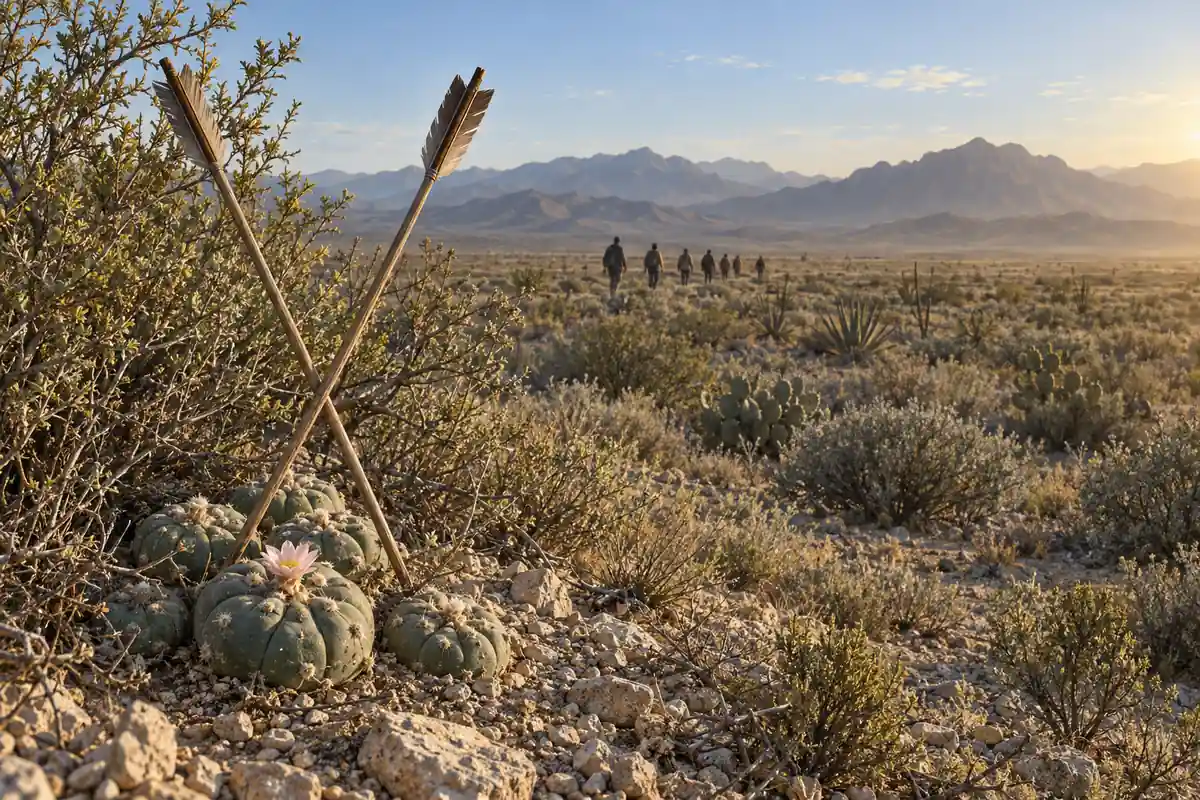
The Wixárika, known in Spanish as Huichols, live in the Sierra Madre Occidental of western Mexico, in parts of Jalisco, Nayarit, Durango and Zacatecas. Each year, groups set out from their ceremonial centers and family temples on a pilgrimage to Wirikuta, a stretch of high desert in San Luis Potosí, roughly 400 kilometers (about 250 miles) to the east, across the central Mexican plateau.
In Wixárika cosmology, Wirikuta is the sacred land of the east, where the Sun was born and the world began. It is the most important of five sacred places that mark the edges and center of their world. The pilgrims follow the route their ancestor-deities walked in the first pilgrimage at the beginning of time. Walking the route renews that original journey, and they believe it keeps the Sun rising, the rains coming and life continuing. In Wirikuta they gather hikuri, the small peyote cactus (Lophophora williamsii). Hikuri is eaten in ceremonies to receive visions, messages from the gods, and healing, and it is regarded as a guide and a teacher. Pilgrims do not simply pick it: when they find it, they shoot arrows at it, as they would at a deer. [1–3]
The road the ancestors walked
In the early 2010s, pilgrims from ceremonial centers in the Jalisco highlands traveled a route of roughly 650 kilometers to reach the desert. The route follows the journey of the kakayari, the deified ancestors, who walked toward Wirikuta before there was light. Along the way, some of them became hills, caves, springs, rivers and the sea, and those places are the sacred sites pilgrims visit today. Each group is guided by a mara'akame, a singer, dreamer and traditional healer. At each stop, the mara'akame sings around the fire at night about what happened there at the creation of the world. [2]
Who makes the journey depends on where it starts. A pilgrimage from a ceremonial center is made up of the people who hold religious offices there; one from a family temple includes the whole resident family. Participants are called jicareros, after the ceremonial gourd bowl (jícara) each one keeps. The bowl ties its keeper to a particular creator deity or ancestor, so on the pilgrimage each person stands in for one of the first travelers. The group walks in single file, ordered by rank. [2]
The journey is an initiation and a retelling of origins, and also a petition for rain and for the well-being of the world. It falls in the dry season and is tied to the agricultural year: after the pilgrims return, further ceremonies call for the rains. Pilgrims describe the most important aim more simply: they go to find the gods, they say, in order "to find life." [2, 3]
More than a century earlier, the Norwegian explorer Carl Lumholtz heard a version of the same idea. Wixárika told him that long ago the gods had gone out to seek hikuri, grew tired, and remained out there. Pilgrims therefore met their deities all along the road, in the form of mountains, stones and springs. In the 1890s, Lumholtz wrote, the journey took forty-three days, and each main temple sent a delegation of eight to twelve people. On the morning of departure, each man placed his right hand on his wife's left shoulder and said, "Good-bye! We shall meet here again." Everyone wept, he wrote, men and women alike. [8]
Arriving pure
Only those who are pure may enter Wirikuta. In the 2010s, pilgrims passed through five "doors" of purification on the way. Which sites served as doors varied from one ceremonial center to another, but there were always five. [2]
The night before reaching the first of these sacred springs, each pilgrim takes a cord and ties a knot in it for every sexual fault he or she has committed, and the cords are then burned in a fire. From that point on, people making the pilgrimage for the first time walk blindfolded. At the spring, two people accompany each novice and brush a branch over his or her body while the novice urinates as a bodily purification. Then the blindfold comes off, and the newcomer is told to look toward the sacred site. The goddess of that spring is said to give each child kupuri, the life force, placing it through the soft spot on the crown at birth. For this reason, people ask there for protection for their children and families. They bathe in its water or are sprinkled with it, and they carry some home. [2]
Other accounts emphasize different means of reaching the same state. A 2019 account, for example, describes purity as achieved through confessing one's faults, abstaining from sex and from food, and making offerings to Tatewari, Grandfather Fire. [5]
The deer that becomes peyote
In Wixárika accounts, the deer opened the road to Wirikuta, and on the pilgrimage the deer becomes peyote. [1]
In the 2010s, when the pilgrims reached the hunting ground, the mara'akame looked for five peyotes growing together, which represent the deer, maxa. Five do not always appear, and he may instead choose a "family" of hikuri with more or fewer plants. He shoots it as one would a deer. Then, with his staff and his muwieri, a feathered wand used to heal and to listen to the gods, he points toward where the wounded deer-peyote has run. The others follow its tracks, which are the peyotes scattered across the desert. Each pilgrim's role in the hunt has been assigned by the mara'akame on the basis of dreams he had before the journey. The hunt ends when officers sound a horn, and the pilgrims then walk back to camp in a winding file that imitates a serpent. The serpent is linked to the underworld and to rain, and the file is meant to draw the clouds to their communities. [2]
Lumholtz had recorded much the same hunt. In his account, the leader pointed to a high mesa and said, "Yonder is the deer, standing at the first altar," but only he could see it. Each man shot two arrows so that they crossed above a plant without striking it, because the plants had to be taken alive. [8]
An elderly mara'akame from a community in Jalisco explained in 2019 that the grandfather deer decides whether a person may eat hikuri. For those he accepts, the plants are easy to find; for others, "they hide." [5] Another mara'akame, speaking in 2011, located a moral division within the plant itself. Two deer brothers, Kauyumarie and Paritsika, competed to create the things of the world, and their rivalry lives on in hikuri: "when someone eats it, it can serve for good or for evil. The knowledge that comes from Kauyumarie is gained quickly, but it only serves to get bad things. When one follows the path of Paritsika one learns more slowly, but good things." [2]
The maize of the ancestors
A widely held Wixárika saying is that "peyote and maize are the same," or that hikuri is the maize of the ancestors. In 2012, a woman from San Andrés Cohamiata explained how that came to be through a story about the first farmer, Watakame. [4]
Watakame had nothing to plant and nothing to eat. He went in search of food and came to the house of the mother of maize, who fed him a few small portions; to his surprise, they filled him. She let one of her daughters, the blue maize girl, go home with him, on condition that she not be scolded or put to work. While he was in the fields, however, Watakame's mother grew angry that the young woman did nothing and set her to grinding or cooking maize. Her hands bled, or her body burned, because she was the maize. In some versions she fled; in others a wind carried away the young woman and all the grain. In the San Andrés version, the ancestral ears then turned bitter and took the form that peyotes have today. Watakame was given only the chaff from shelled corn to sow, and from it grew the maize people eat now, which satisfies less, runs out, and will not grow without human labor. [4]
Earlier ethnographers, from Lumholtz onward, described a "deer–maize–peyote complex" at the heart of Huichol religion. The anthropologist Héctor Medina argues that this is an outsider's simplification. The triad matters on the eastward journey to Wirikuta and at the feast of peyote and toasted maize. Pilgrimages also travel to the other directions and to the center, however, and on those routes other stories take precedence, among them the story of the canoe in which Watakame survived the great flood. [3, 4]
Obligation, sight and cure
In accounts gathered in 2004–2006, health meant completeness. A person was healthy when four conditions held:
- the "five children" at the front of the head were all present; - the kupuri stayed moist; - the body's centers were connected; - the person kept the costumbre, the cycle of ceremonies, offerings and pilgrimages.
Health in this sense covered more than the body. It included the household's livelihood, the well-being of the whole family, and success in whatever the person undertook. The most common cause of illness was a failure toward the gods: a skipped ceremony, or a favor received and never repaid. Children were the most frequent victims. In one example, children fell ill with the "deer sickness" when their parents had not hunted deer or held the corresponding feast. The cure was for the parents to carry out the hunt, hold the ceremony, and take blood-anointed gourds and arrows to the sacred site the mara'akame named. [6] A 2012 study of Wixárika names for illnesses found that most of those it could classify were attributed either to sacred beings or to sorcery. [10]
Mara'akate themselves fall broadly into those who cure and those who also sing the myths at the ceremonies. Both have nierika, the "gift of seeing," but the singer's is more developed: he hears the words of the gods and speaks with them. Nierika is gained through self-sacrifice and austerity, including pilgrimages, night vigils and fasting. It is tied to the iyari, the heart, which is also understood as the seat of memory and thought. Eating peyote and going through the long initiation strengthen the iyari. [2, 6]
Peyote enters healing most directly in the hardest cases. To cure sorcery, a singing mara'akame undertakes long fasts and eats hikuri during the cure, asking the gods to show what afflicts the person and who caused it. [6]
The elderly mara'akame interviewed in 2019 described the plant itself as a healer and as the source of his own skill: "Hikuri teaches you a lot … it teaches you to cure, to relieve people, hikuri teaches you everything." Anyone may take part in the ceremonies, he explained, provided it is done ritually and with respect, after the mara'akame's blessing, "so that it doesn't drive you mad." In his community, children may eat hikuri only after age fifteen and after making the walk to Wirikuta. He himself first ate it at about twelve, exhausted on the road, when his grandfather told him to eat it to regain strength. [5]
Dreams, including those brought by peyote, carry a similar authority: they are understood as messages from Hikuri and the ancestors, to be carried out almost as divine commands. [3] In the 1890s, the dreams pilgrims had on the road settled the religious arrangements for the coming year, including who would make the fires at the peyote feasts and who would sacrifice cattle for rain. [8]
Others on the road
The tradition began opening to mestizos in the early 1970s. In the 1980s and early 1990s, a Wixárika mara'akame who had walked to Wirikuta five times with a scholar of Huichol art began holding ceremonies for groups of urban mestizos, whom the Wixárika call tewari. A participant recalled a ceremony in Wirikuta in the 1990s at which the mara'akame described a dream in which very ancient gods came to say that those present were "the new Huichols." The participant added a condition: "provided they have that Huichol consciousness." [3]
Mestizos who stayed describe commitment as the core obligation. "For them everything is based on commitments," one said. "If you want to know something, you have to commit; they can't just tell you." In 2019–2021, a mestizo who had received permission from a Wixárika mara'akame led one such group. Its members sang in Spanish and Lakota, used pulque in place of the maize beer of Wixárika rituals, and timed their pilgrimage by dreams rather than by the dry season. "As tewaris we have the freedom to bend things a little," one member said, but "if we go to the desert, we know where we have to stop, where the doors are." [3]
The meanings attached to the plant have also shifted. In these groups, people said that "Hikuri is god" and "Hikuri is everything," and credited it with healing illnesses and repairing families. The anthropologist who studied them notes that in Wixárika thought, hikuri is one of many interconnected beings, not an all-powerful god. Alongside these long-term relationships, peyote ceremonies with mara'akate are now advertised on social media and open to anyone who pays, with no commitment required. [3]
Wirikuta in dispute
The desert itself has become contested ground. In 2013, the Wixárika Regional Council for the Defense of Wirikuta filed a federal injunction against unpermitted exploratory drilling for gold and silver. The council described Wirikuta as territory "inhabited by our deities and in which we conduct our pilgrimages to recreate the origin of the world." It reported that some Wixárika had been told they could be refused access, and that there had been attempts to limit their use of hikuri unless they accepted mining and agribusiness. [7] At one sacred hill, a spring where pilgrims once collected water has become an air vent for the mine that operates there. "What was here has already risen to the sky," a mara'akame said. "It is in the air now: the mountain is already weak." [2] By 2022, rising demand for peyote and land clearing for industrial agriculture were making the cactus scarce. [9]
On July 12, 2025, UNESCO declared the Wixárika Route through the Sacred Sites to Wirikuta a World Heritage Site. The listed route runs more than 500 kilometers across five states and links twenty sacred sites, from the Pacific coast to the desert. Mexico's national institute of anthropology described the nomination as the first in Latin America to officially recognize a living Indigenous cultural landscape. The institute's description of the route lists peyote among the central objects of veneration, alongside maize, the deer and the golden eagle. It also notes that Tatewari, the ritual fire, is lit at the start of each pilgrimage and carried in portable braziers to guide the way. [1]
What is uncertain
One detailed first-hand study from the early 2010s and a recent interview with a healer describe the pilgrimage and peyote ceremonies, and they agree with older studies going back more than a century. Most of the recent detail comes from that single study, which followed a few ceremonial centres in one area.
Scholars disagree on whether the linked symbols of maize, deer and peyote form the centre of Wixárika religion, or simplify a much wider web of sacred associations. [3, 4]
The origin stories told at each sacred site vary between ceremonial centres and narrators, and no source treats any one version as standard. [2, 4]
Around 1900, peyote seekers travelled in October and November, while the recent fieldwork followed pilgrimages in March. No source says whether the timing has changed or simply varies by group. [2, 8]
The amount of damage that mining, farming and peyote demand are doing to the plant and to sacred sites has not been measured in these sources. [7, 9]
Wixárika communities respond to non-Indigenous people taking part in the ceremonies with both acceptance and hostility, and how widely either view is held is unknown. [3]
One healer said younger family members refuse to learn healing, but no source shows whether this is common. [5]
It is unclear how far the healing practices recorded in 2004–2006 still hold today. [6]
About half of the recorded Wixárika illness terms could not be classified for lack of information. [10]
10 sources. Each claim checked by AI against the saved sources; every finding reviewed by Jim Davis beside the cited passage, 29 October 2026. How the articles were checked
Timeline of dated events (17)
- About five hundred years before 2022Spanish conquerors tried to suppress peyote use, which pushed ceremonies into secrecy. [9]
- A few years before 1902the neighbouring Tepecano people stopped gathering peyote themselves and began buying it from the Wixárika. [8]
- By 1902parties of eight to twelve people sent from the main temples made a 43-day journey to the peyote grounds in October and November. [8]
- Early 1970sa government development programme brought health workers into Wixárika communities, which began opening the tradition to outsiders. [3]
- Throughout the 1970san outside researcher made five walking pilgrimages to Wirikuta with a Wixárika healer. [3]
- Early 1980sgroups linked to an international spiritual association began taking part in Wixárika ceremonies, and a Wixárika temple was built in their community. [3]
- 1980s to early 1990sa Wixárika healer began holding ceremonies for non-Indigenous groups near Guadalajara. [3]
- 1990sat a ceremony in Wirikuta, the same healer reported a dream calling the non-Indigenous participants "new Huichols." [3]
- 2006a non-Indigenous apprentice began making the pilgrimage under a Wixárika healer. [3]
- At least since 2010Indigenous-inspired rituals, including peyote ceremonies, became popular among non-Indigenous Mexicans. [3]
- 1 March 2013a Wixárika regional council began petitioning the government to stop mining exploration in Wirikuta that lacked permits. [7]
- 28 June 2013a regional assembly of Wixárika communities restated its opposition to mining concessions. [7]
- Early July 2013Wixárika leaders filed an injunction in federal court to halt the exploration drilling. [7]
- March 2014pilgrims from one ceremonial centre found again a sacred hill on the route that had long gone unvisited. [2]
- By 2015a sacred spring that pilgrims once visited on the route had disappeared and become an air vent for a mine. [2]
- By 2022peyote was reported to be growing scarce because of rising demand and land clearing for agribusiness. [9]
- 12 July 2025UNESCO listed the Wixárika Route through the Sacred Sites to Wirikuta as a World Heritage Site. [1]
Sources
CSL-JSON imports into Zotero, Mendeley and other reference managers.
INAH, Lugares INAH (n.d., after July 2025). Ruta Wixárika por los sitios sagrados hasta Wirikuta (Tatehuarí Huajuyé). Instituto Nacional de Antropología e Historia.
Mexican national heritage institute, undated web page written after July 2025. It gives an official overview of the World Heritage route, its sacred sites and the ritual elements, including peyote, the deer and the ritual fire.
Olvera Galarza, F. & van 't Hooft, A. (2015). La ruta ancestral del pueblo wixarika a Wirikuta. Revista Chilena de Antropología Visual 26: 20–45.
Anthropology graduate and professor, journal article, 2015. Based on fieldwork from 2011 to 2014, including service as a pilgrim, it describes the sacred sites, purification rites, offerings and the peyote "deer hunt", with myths told by healers.
Arias Yerena, A. (2023). Los nuevos huicholes: peyoteros contemporáneos. Ciencias Sociales y Religión 25: e023021.
Social scientist, journal article, 2023. It reports fieldwork from 2019 to 2021 among non-Indigenous groups who adopted Wixárika peyote rituals, and traces how the tradition opened to outsiders from the 1970s.
Medina Miranda, H. M. (2013). Las personalidades del maíz en la mitología wixarika o cómo las mazorcas de los ancestros se transformaron en peyotes. Revista de El Colegio de San Luis III(5): 164–183.
Anthropologist, journal article, 2013. It analyses myths told by Wixárika narrators that explain peyote as the ancestral maize, and argues against treating maize, deer and peyote as the core dogma.
Calderón, M. / Notimex (2019, 13 January). Hikuri, la medicina ancestral con la que curan los mara'akáme. La Razón de México.
News agency reporter, newspaper article, 2019. It records an interview with an elderly healer about peyote as medicine and teacher, his training, and the pilgrimage, and adds general background drawn from a university reference work.
Islas Salinas, L. E. (2009). Persona sana, persona enferma. Cuerpo, enfermedad y curación en la práctica del chamán huichol. Gazeta de Antropología 25(2), artículo 42.
Graduate researcher, journal article, 2009. Based on fieldwork from 2004 to 2006 with healers, it covers ideas of the body, illness and curing, including the use of peyote when curing witchcraft.
Barnett, T. L. (2013, 5 July). Campaign Update – Mexico: Injunction filed to halt illegal exploration drilling in Wirikuta. Cultural Survival (originally posted by Frente en Defensa de Wirikuta).
Journalist, web post by an advocacy organisation, 2013, reposting statements from a Wixárika council. It reports the mining dispute in Wirikuta, the court injunction and threats to pilgrims' access.
Lumholtz, C. (1902). Unknown Mexico, Vol. 2. New York: Charles Scribner's Sons.
Explorer-ethnographer, book, 1902; only an excerpt was read. It describes the peyote seekers' season, the rules of the journey and the ceremonial "shooting" of peyote as deer.
Busby, M. & Virdi, J. (2022, 13 July). El peyote, cactus sagrado psicodélico de México, amenazado por el agronegocio. openDemocracy (democraciaAbierta).
Journalists, online news feature, 2022; only the opening was read. It notes Spanish suppression of peyote and the plant's growing scarcity from demand and agribusiness.
Verdín Amaro, K. I. & Santos García, S. (2012). Red semántica de las enfermedades del pueblo wixárika o huichol. Alteridades 22(43): 97–110.
University researchers, journal article, 2012. It classifies Wixárika illness terms using earlier studies and interviews with 52 speakers, and links many illnesses, including one named after peyote, to failing sacred obligations.
Related
Cite this page
Psychoactive Traditions. “Wixárika Hikuri Pilgrimage.” Last reviewed 29 October 2026. https://psychoactive-traditions.org/traditions/wixarika-hikuri-peyote