Names
Peyote's scientific name is Lophophora williamsii. Its common name comes from peyotl, a word in Nahuatl, the language of the Aztecs. Peyotl is often translated as "silk cocoon" or "caterpillar's cocoon," possibly after the cactus's woolly tufts, but the word's meaning remains uncertain. The Wixárika call the cactus hikuri.
Peyote is also known as "buttons" or "mescal buttons," after its disc-shaped crown. Despite that second name, it has nothing to do with mescal, the Mexican spirit.
What it is
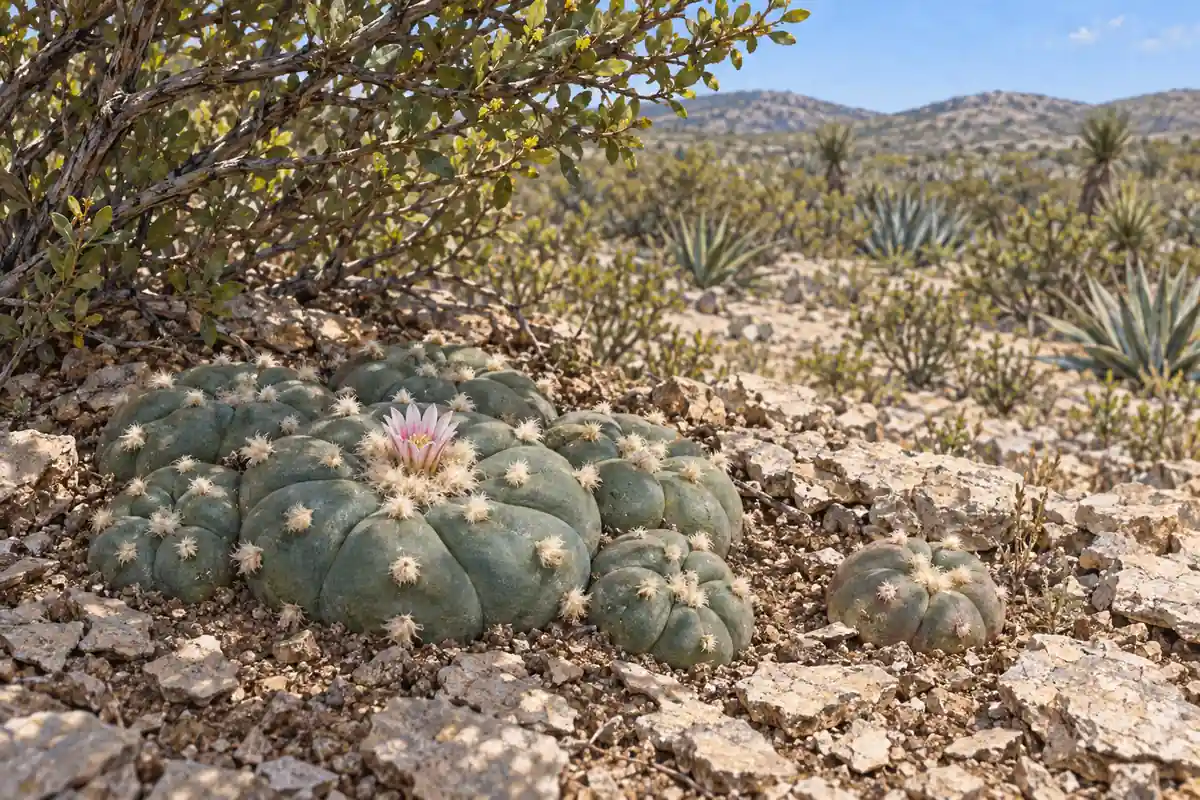
Peyote grows low to the ground, and most of the plant is hidden below the surface in a thick, carrot-shaped root. All that shows above ground is a rounded, blue-green crown, divided into soft ribs with tufts of pale wool. Small pink or whitish flowers grow from its center.
It is a slow grower, often taking many years in the wild to reach flowering size. Its range runs from southern and western Texas into northern Mexico, including the Chihuahuan Desert and the Tamaulipan thornscrub of South Texas. There it typically grows in scrub on limestone or other calcareous soils.
The medicine is the cactus itself. Wixárika pilgrims eat it fresh, and forms of use vary by occasion.
How it works
Peyote's main active compound is mescaline (3,4,5-trimethoxyphenethylamine). Mescaline belongs to the alkaloids, a family of nitrogen-containing plant compounds. It acts on serotonin receptors, the sites on nerve cells that respond to the brain chemical serotonin. One of these, the 5-HT2A receptor, is considered central to mescaline's effects on perception and thought, although how activity at this receptor produces the experience isn't fully understood.
The cactus also contains dozens of other alkaloids. It isn't well established whether, or how, they shape the experience of eating whole peyote compared with taking mescaline on its own.
Effects on the mind
Peyote is a classic psychedelic: a substance that alters perception, emotion and the sense of self, usually while the person remains aware of what is happening. The experience builds gradually and commonly lasts around ten hours, though this varies.
People describe intensified colors, shifting geometric patterns and visions, often with their eyes closed. Time may seem to slow down or lose its usual meaning. Many report awe, joy, a feeling of connection, or insights that seem deeply significant. Such insights can feel certain to the person having them, but that feeling isn't proof they're true.
The experience can also be difficult, bringing fear, anxiety, confusion or a frightening sense of losing oneself. The same person may pass through both kinds of state, and what people report varies widely.
In tradition
The Wixárika of the Sierra Madre Occidental make pilgrimages to Wirikuta, a high desert, to gather hikuri, which is eaten in ceremony for visions, messages from the gods, and healing. But gathering the cactus isn't the journey's only aim. Pilgrims say they go to find the gods "to find life," and to ask for rain.
The tradition continues today; a 2019 account describes a healer curing with hikuri. The pilgrimage has also drawn people who aren't Wixárika. Groups described as mestizo, a term generally used in Mexico for people who don't identify as Indigenous, made the journey in 2019–2021.
Today
Beyond the Wixárika, peyote is used by other Indigenous peoples in Mexico, the United States and Canada, as well as by non-Indigenous people. In parts of its range, including southern Texas and northern Mexico, over-harvesting and habitat loss have put wild peyote under pressure.
There is little research on peyote's effects on people, and most recent work has focused on mescaline. Small controlled studies in healthy volunteers have described mescaline's effects on perception and mood. And while people in some surveys report feeling better after using peyote or other forms of mescaline, surveys like these can't show that the substance was the cause.
Traditions that use it
Cite this page
Psychoactive Traditions. “Peyote.” Last reviewed 4 November 2026. https://psychoactive-traditions.org/medicines/peyote