The Warao live mainly in the wetlands of the Orinoco Delta in northeastern Venezuela, where they have long fished and foraged among river channels and moriche palm swamps. Tobacco stands at the center of their shamanic practice, and its smoke is understood as food: the gods are said to live on it, with honey as their water and palm sago as their source of energy. Three kinds of shaman, the wisiratu, the joarotu, and the bajanarotu, mediate between people and the beings believed to send illness. [1, 6, 7]
In the early 1990s the Warao numbered about 30,000, roughly three-quarters of them in the middle and lower delta. They had never organized themselves as a single political body. The largest group a person felt part of was a regional cluster of four or five bands, each averaging fifty to sixty people. Much of the detail below comes from particular villages and families. [7]
Feeding the gods
The Warao world, as described in the early 1990s, is held in balance among all forms of life, each of which shares the root word arao, "life." Humans have no special rank in this order. Any action that disturbs this balance calls for correction, and the largest correction follows when people fail to give the gods tobacco smoke, honey, and sago: the gods are then expected to send epidemics. [7]
The wisiratu, whose title has been translated as "master of pain," carries much of this obligation. He or she is understood to bear in the body six spirit children of the cardinal gods, who act as guardians and serve as lifelong reminders of a vow to keep providing tobacco smoke and sago. In return, the gods reduce deaths among children and give the wisiratu the power to cure. When rules are broken, children and the elderly are considered the most vulnerable to the illnesses sent in reprimand. [1, 6]
Tobacco smoke also connects the levels of the universe. In one account of Warao cosmology, the spirits of the wisiratu, joarotu, bajanarotu, canoe makers, and grandmother weavers live at the top of the cosmos and guide souls to and from the earth along an axis of tobacco smoke. The bajanarotu's power is said to come in part from the "spirit of tobacco." These accounts say little about how the plant acts on a shaman's body and mind. A wisiratu is said to enter a trance and chant, but the connection between trance and tobacco is not spelled out. [6, 7]
The forest, the stone, and the rattle
The wisiratu's authority reaches beyond curing. Shamans have traditionally overseen the rules of community life, and the wisiratu also advises people and leads ritual celebrations. In the early 1990s, exchanges between human beings and plants were understood to pass through him as well. Trees are counted as a society of living creatures, governed by the Mother of the Forest, and a canoe maker needed her permission, obtained through the shaman, to fell a large one. That permission could be refused, depending on his skill and his record as a responsible member of society. If granted, it resembled a marriage license: it joined the man to the tree, one of her daughters, with responsibilities that lasted as long as the boat. [1, 6, 7]
The highest-ranking wisiratu guards the sacred stone in which the principal spirit, Jebu Kanobo ("our grandfather"), is said to reside. This wisiratu is described as both an incarnation of a deity and its main protection. In the delta in the early 2010s, small temples were often found near homes, holding sacred rattles and moriche starch set aside for ritual feasts. The rattles' power was attributed to benevolent spirits lodged in the quartz fragments inside them, which were believed able to drive off lesser spirits that cause sickness. [1, 8]
Which illnesses belong to whom
Not all sickness was traced to the gods or spirits. Warao healers in the 1980s and early 1990s divided sickness by its origin, and the language marked the difference: illnesses of spiritual origin carry the qualifier jebu (also written hebu), meaning "spirit," while natural ailments lack it. Natural disorders, of which fifty-five were recognized, were attributed to foul gases from stagnant water and to filth. They were treated mainly by women herbalists, who approached the forest with the respect due to someone being asked for help. Spiritual illness went to the shamans. [7]
The cardinal gods are also associated with particular kinds of affliction. Fevers such as malaria and measles belong to the god of the south, respiratory illnesses to the north, gastrointestinal illnesses to the east, and hemorrhagic illnesses to the west. Warao mythology also accounts for diseases that arrived during the colonial era. The spirit owners of these diseases are said to have lived among the ancestors disguised as ordinary people, gradually infecting them, until shamans recognized what they were and drove them out to the four directions of the universe. [6, 7]
Each of the three shamans treats a different kind of harm. The wisiratu examines the patient, identifies the spirits in the body, and removes them. The joarotu treats joa, described as a hard black air that lodges in the stomach, moves violently, and is linked to bleeding. Only the joarotu is held to be able to cure it, by singing and drawing it out by hand. The bajanarotu removes bajana, objects lodged in the body, often in the back or abdomen. The objects named in one recent account include small stones, moriche fiber, buttons, and a soda bottle cap. [6, 8]
People do not regard the three in the same way. The wisiratu has often been characterized as essentially benevolent, though one description holds that he too can bring harm through spirits. The joarotu and bajanarotu are spoken of with more unease, because each is believed able to cause as well as cure the affliction he treats. The joarotu is nonetheless considered a Warao doctor, and in one recent account he is the first person consulted when someone is bleeding. Shamans have generally been men, but women can hold these roles after menopause. [6, 7, 8]
Naming the spirit
Encounters with bush spirits, forest predators often compared to the jaguar, offer the most detailed record of what a healing involves. In the early 1990s, residents of Morichitos, a central delta village of ninety-two people, gave forty-seven personal accounts of meeting them. Such encounters were expected four or five times in a lifetime. [7]
Most encounters took place at dawn or dusk, during ordinary work. One woman arrived at her garden by canoe and saw a human figure sitting atop a large tree, facing east. She began to tremble and her vision blurred. A man harvesting in his garden was approached by a woman who seemed to be his wife, until he noticed that her hands were too large and that she was hiding her feet in the peat. Omens included a human cry where no people were, rustling leaves without wind, and a drop of blood falling from the forest canopy. Residents stressed that an omen by itself is only a potential danger. "If you do not think 'bush spirit,'" they said, "no spirit will appear." [7]
The rule people emphasized was to avoid the spirit's eyes. Looking into them was said to bring possession, and none of the recorded accounts reported eye contact. Those affected described fear, chills, trembling, fainting, or a sensation that the head had grown enlarged. A shaman was then summoned to identify which of sixteen known spirits was responsible. The protective chant was understood to be specific to each spirit, though only the name differed; the chant itself stayed essentially the same. Once the shaman had named the spirit, it was said to withdraw. Recovery usually came within hours, or at most a day, and the person returned to ordinary life without being regarded as frail or mentally ill. In all but two of the recorded cases the chant was reported to succeed, and the symptoms listed in the accounts include death. [7]
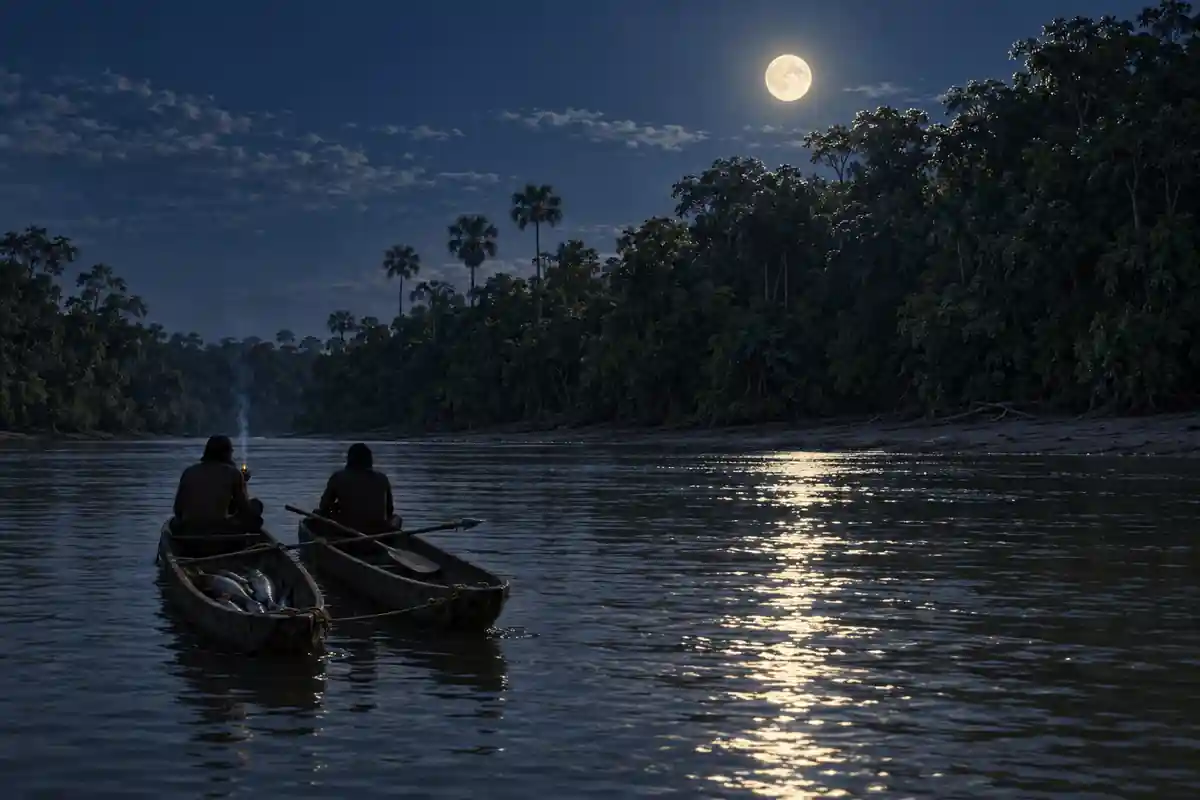
One shaman gave an account from his youth. He was fishing under a full moon with his brother-in-law when a woman's long-drawn-out call came from high in the trees. The two men waited, smoking, until the call sounded again and he became frightened. His companion tied their canoes together and paddled them both home. That night they woke the wisiratu, who chanted until the vulture spirit Hebu Bure spoke through his voice. "I was not after the people," the spirit said. It had only been calling its mate. [7]
Werner Wilbert, the anthropologist who recorded these accounts, interpreted such encounters as stress-triggered hallucinations and psychosomatic disorders, a way of coping with hunger, floods, high child mortality, crowded living conditions, and the burden of keeping the world in balance. He described this as a hypothesis. The people who told him the stories understood them as meetings with predators who live in the forest. [7]
Two doctors
Warao people have long recognized that Creole medicine can cure Creole illnesses, while giving priority to the diagnoses of their own shamans and herbalists, who may themselves send a patient to a clinic. A cholera epidemic in 1992, which killed about 500 Warao, made the need for outside medicine urgent and drove thousands toward the cities. Doctors in the delta, for their part, have often called Warao patients negligent for arriving late and for stopping medicine once they feel better. [6]
In the mid-2010s, the two systems met inside a hospital in the delta, where a young doctor was serving his rural internship. Patients who had been bitten by the venomous mapanare snake saw their symptoms worsen and told him, "Doctor, I want to go to the wisiratu." Fearing that those who left would hemorrhage, he brought wisiratu into the hospital. "They are happy, and I am happy," he said. [1]
One woman wisiratu worked alongside him, singing and massaging patients to remove the spirits of snakebite, pneumonia, and diarrhea. Healers consider the snake song secret. By the doctor's account, patients felt calmer because they had "two doctors: that of the white man and the one of the Warao people," and fewer of them left. [1]
Patients still pressed to go home quickly. They thought the hospital was full of spirits, sprites, and the ghosts of people who had died there, and in the dark they reported hearing monsters and children crying. Darkness was common: fuel shortages left the hospital without electricity for about a week each month, and once for sixteen days, and births were attended by flashlight. [1]
Far from the delta
Warao groups have been moving across Brazil since 2014, and research among families in Belém, completed in 2021, shows how difficult it has been to continue these practices there. Keeping away from people they fear has proved easier than finding a wisiratu. One man described relatives and acquaintances who fell ill on the road, found no shaman, and died. "If a person feels a strong pain in the belly, that is no longer an illness, that is an evil spirit," he said, "and if there is no healer they may die." Another man recalled a wisiratu who treated everyone in his home community: "All who fall sick, he cures." The wisiratu who came to Brazil were old men, and some have died there. "When a good shaman dies it is painful," one woman said, "because he has saved lives." [6]
Ceremony has been harder to move than people. In Belém, palm starch comes up constantly in conversation, and with it the sacred dances offered to Jebu Kanobo to bring help and keep sickness away, but these dances are not performed there. One man explained why: "If we dance the Warao songs outside of ceremony, the children get sick." The dance must be done "with much respect," he said, with all its materials and special clothing, over three days in the dry season, by adults, beside a felled moriche palm. [6]
Other sources of help have grown up alongside the shamans. Some families have turned to Brazilian healers, including Candomblé priests, though as one healer observed, "they don't understand Portuguese." Pentecostal conversion has also divided some extended families, while other Warao refuse it. One man learned Catholic prayers for different ailments through WhatsApp messages from a relative in Venezuela, and on a boat journey he offered to treat a crying, feverish child. He is clear about what the practice is: "That is not Warao sorcery." [6]
Two shamans still practicing in Brazil have continued with what is available. One, an elderly wisiratu, treats people who seek him out. His relatives say he can identify an affliction by touch. He has not been able to obtain tobacco, and he uses cigarettes, his hands, and song. He does not use the sacred rattle, and none of his sons learned his work. [6]
The other, a joarotu, began learning his work because he wanted to be able to help his children. He has since treated people in both countries, using cigarettes in place of tobacco, along with joa songs and Christian healing prayers. "I go to him first if something hurts," his wife said, "and then I take a pill." He cannot draw out the spirits in his own body, and he wants to return to Venezuela to look for a wisiratu. [6]
What is uncertain
Recent first-hand accounts show these healers still at work in Venezuela's Orinoco Delta and among Warao migrants in Brazil, and an older village study adds depth on spirit illness. Close description of how tobacco is used today is thin, and much of what is written about the beliefs behind the practice traces back to a small group of earlier scholars.
Sources differ on whether the wisiratu is essentially a benevolent healer or can also bring illness on people. [6, 8]
Sources describe the specialists' methods differently, with one linking the bajanarotu to curing through songs while another ties healing songs to the joarotu. [6, 8]
Sources explain joa illness differently, as caused either by substances from plants and animals or by a dark air. [6, 8]
Sources give different names for the chief or most powerful spirit. [6, 8]
It is unclear how common women healers are today, since the 1992 study calls shamans predominantly male while later sources describe women in the role. [1, 6, 7]
The claim that a healer's presence kept patients in hospital rests on one doctor's impression, without figures, and he adds that patients still pressed to leave quickly. [1]
No source says whether the hospital arrangement lasted beyond the doctor's stay. [1]
The reading of bush-spirit encounters as a response to stress is the author's hypothesis, drawn from one village, and he warns against generalizing from the sample. [7]
It is unsettled whether the wisiratu's role can be kept up and passed on among migrants in Brazil, where families struggle to find one. [6]
Migrant families often do not say which kind of specialist they mean, so it is hard to tell how each of the three roles is faring in Brazil. [6]
It is not settled how far conversion to Pentecostal and other churches is changing reliance on these healers. [6]
No source counts how many of these healers are active today, in the delta or in Brazil. [1, 6]
No source studies the tobacco itself, such as which plant is used or what effects it has on healers. [1, 6, 7, 8]
4 sources. Each claim checked by AI against the saved sources; every finding reviewed by Jim Davis beside the cited passage, 1 November 2026. How the articles were checked
Timeline of dated events (12)
- Some six or seven thousand years agoWarao oral literature recalls a time when Trinidad was joined to the mainland, and archaeological evidence is said to support an ancestral Warao presence in the area then. [7]
- 1596Walter Raleigh's account reports several regional Warao groups in the Orinoco Delta. [7]
- Colonial eraOld World epidemic diseases reach the Warao and enter their understanding of spirit-caused illness. [7]
- From colonization onwardreligious missions are founded in the delta to change Warao society and language, though Warao beliefs persist. [8]
- As long as half a century before the 1992 studythe founders of one delta village give up seminomadic swamp foraging. [7]
- 1960sgovernment posts created in the delta begin to weaken the political authority of village founders. [6]
- By the early 1990staro has replaced palm sago as the staple food in the village studied, while shamans still provide ritual healing there. [7]
- 1992a cholera epidemic kills about 500 Warao, makes outside medicine urgently needed and drives thousands of people to the cities. [6]
- About 21 years before a 2017 studya Warao family starts an urban community in Venezuela that later becomes a stopping point for families heading toward Brazil. [6]
- Since 2014Warao groups move across Brazil through networks of kin and friends, carrying goods, information and knowledge with them. [6]
- After April 2014, reported in 2016a doctor brings a wisiratu into a delta hospital to work alongside Western treatment for snakebite, pneumonia and diarrhea. [1]
- By 2021wisiratu have come to Brazil and some have died there, and healers there report working without ritual tobacco because they cannot obtain it. [6]
Sources
CSL-JSON imports into Zotero, Mendeley and other reference managers.
Vitti, Minerva (2016). How Traditional and Western Medicine Are Working Together to Help Indigenous Patients in Venezuela. Global Voices, 19 August 2016 (adapted from SIC, Centro Gumilla; translated by Teodora C. Hasegan). https://globalvoices.org/2016/08/19/how-traditional-and-western-medicine-are-working-together-to-help-indigenous-patients-in-venezuela/
A journalist's magazine article, republished online in 2016, on a young doctor's work in a delta hospital; it shows a wisiratu treating patients alongside Western medicine and summarizes the three shaman types.
Reveles Martínez, Karla Pamela (2021). A donde quiera que voy me acuerdo de la mata de moriche: Prácticas de salud en la transitividad migratoria de indígenas warao en Belém, Pará. Dissertação de Mestrado, Programa de Pós-Graduação em Antropologia, Universidade Federal do Pará. https://repositorio.ufpa.br/bitstreams/26bbdcd1-f871-4560-af1b-4c0c39bd4567/download
An anthropology master's thesis from 2021 based on fieldwork with Warao migrants in Brazil; it gives the fullest recent picture of how healers and families adapt away from the delta and summarizes earlier scholarship on the three roles.
Wilbert, Werner (1992). Bush-spirit encounters in Warao life and lore. Antropológica (Caracas) 77: 63-92. https://biblat.unam.mx/hevila/AntropologicaCaracas/1992/no77/2.pdf
An anthropologist's 1992 journal article based on fieldwork in one delta village; it sets out Warao ideas of illness and the world order, records personal accounts of spirit encounters and shamanic treatment, compares them with folktales, and interprets them as responses to stress.
Rodríguez, María V. (2012). Creencias mágico-religiosas warao. In: Diseño de una ruta turística de interpretación cultural para la promoción y el desarrollo local de la etnia aborigen Warao en el estado Delta Amacuro, Venezuela. eumed.net. https://www.eumed.net/libros-gratis/2012a/1157/creencias_magico_religiosas_warao.html
A section on Warao beliefs from a 2012 online book designing a cultural tourism route; it gives a general overview of spirits, religious specialists and sacred objects, without describing observed practice.
Related
Cite this page
Psychoactive Traditions. “Warao tobacco shamanism.” Last reviewed 1 November 2026. https://psychoactive-traditions.org/traditions/warao-tobacco