Names
In Western countries the plant usually goes by tobacco, a word that came into English through the Spanish tabaco. Where the word ultimately comes from is debated. It's often traced to a Caribbean Indigenous word for a pipe or a roll of leaves, but Spanish and other European languages already had a similar, older word for certain medicinal herbs.
Indigenous peoples of the Americas have their own names for the plant in many languages. In Warao, for example, a Spanish–Warao dictionary gives the word for tobacco as aja, and a cigar is ajamara.
The scientific name, Nicotiana, refers not to a single plant but to a genus, a group of related species. It honors Jean Nicot, a 16th-century French diplomat who promoted tobacco at the French court, and the word nicotine takes its name from him as well. The two main cultivated species are common tobacco (Nicotiana tabacum) and Aztec tobacco (Nicotiana rustica). Still, the word "tobacco" on its own doesn't tell you which species a community uses.
What it is
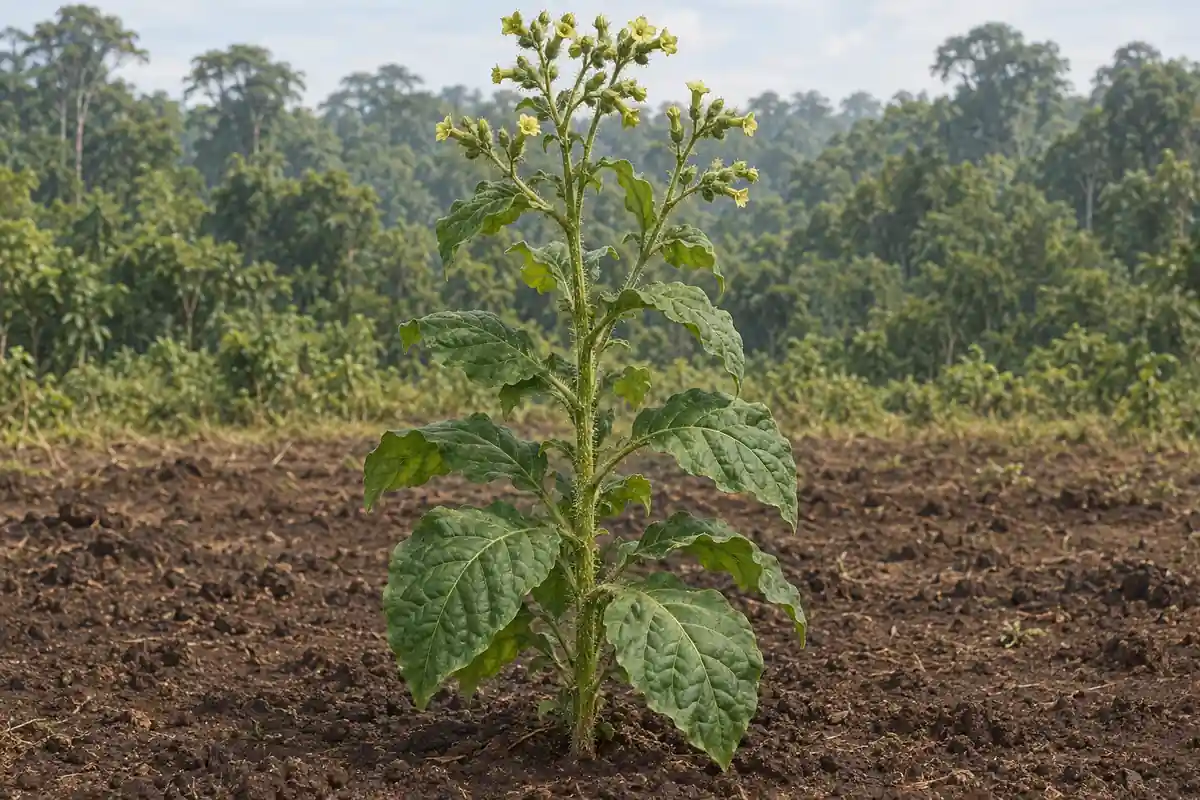
Tobacco is a leafy member of the nightshade family (Solanaceae), with broad, slightly sticky leaves and tube-shaped flowers. Common tobacco grows tall and has white to pink flowers, while Aztec tobacco is usually shorter, with yellowish-green flowers.
Wild Nicotiana species grow mainly in the Americas and Australia. Common tobacco is a hybrid of two wild South American species and is known only in cultivation. Archaeological evidence shows that people in the Americas were using tobacco plants thousands of years ago, long before American tobacco species were carried to other continents.
The leaves are usually dried. Across the Americas, people have smoked tobacco, chewed it, taken it as snuff and drunk it as a liquid, and the forms differ from one people to another. In the Warao tradition, it's the smoke that matters.
How it works
Tobacco's main active compound is nicotine. The plant makes it in its roots and stores it in its leaves, where it helps defend against insects. Nicotine resembles acetylcholine, a chemical messenger the body makes naturally, and attaches to some of the same receptors on nerve cells.
In the brain, this sets off the release of other messengers, including dopamine, which is involved in motivation and reward. These changes are known to affect alertness and attention. Inhaled nicotine reaches the brain quickly, which helps explain why its effects begin soon after smoking.
Tobacco smoke also contains many other compounds, but how much they contribute to the experience is less well understood.
Effects on the mind
Tobacco is usually classed as a stimulant, though its effects can be mixed, and it isn't a classic psychedelic. In everyday use, people commonly say they feel more alert and focused, and sometimes calmer. Some feel restless, anxious or uneasy instead.
Some anthropological accounts of shamanic use in South America describe a very different experience: intensive tobacco use leading to trance, with reduced contact with the surroundings and sometimes visions or a sense of traveling elsewhere. These states can also bring fear and confusion. The accounts don't describe every tradition or every person, and it's unknown how much of the experience comes from nicotine rather than from setting, expectation or other practices. How long these states last has been little measured.
In tradition
The Warao people of the Orinoco Delta in northeastern Venezuela, along with Warao migrants in northern Brazil, attribute serious illness to supernatural agents, including gods and spirits. For help, they turn to three kinds of shaman: the wisiratu, the bahanarotu and the joarotu. Tobacco smoke is understood as the gods' food, and providing it is held both to keep epidemics back and to earn the wisiratu the power to cure.
Research published in 2022 among Warao migrants in Belém, in northern Brazil, found wisiratu and joarotu healers in the city. Collective rituals there faced limits, but individual treatment played an important role.
Today
Most tobacco today is a commercial crop made into cigarettes and other manufactured products, and it's used worldwide, far beyond the traditions that first used it. Laboratory research on its mental effects focuses on nicotine and smoking rather than on the whole plant as used in ceremony. Studies in people suggest that nicotine can modestly improve attention in the short term.
Traditions that use it
Cite this page
Psychoactive Traditions. “Tobacco.” Last reviewed 1 November 2026. https://psychoactive-traditions.org/medicines/tobacco