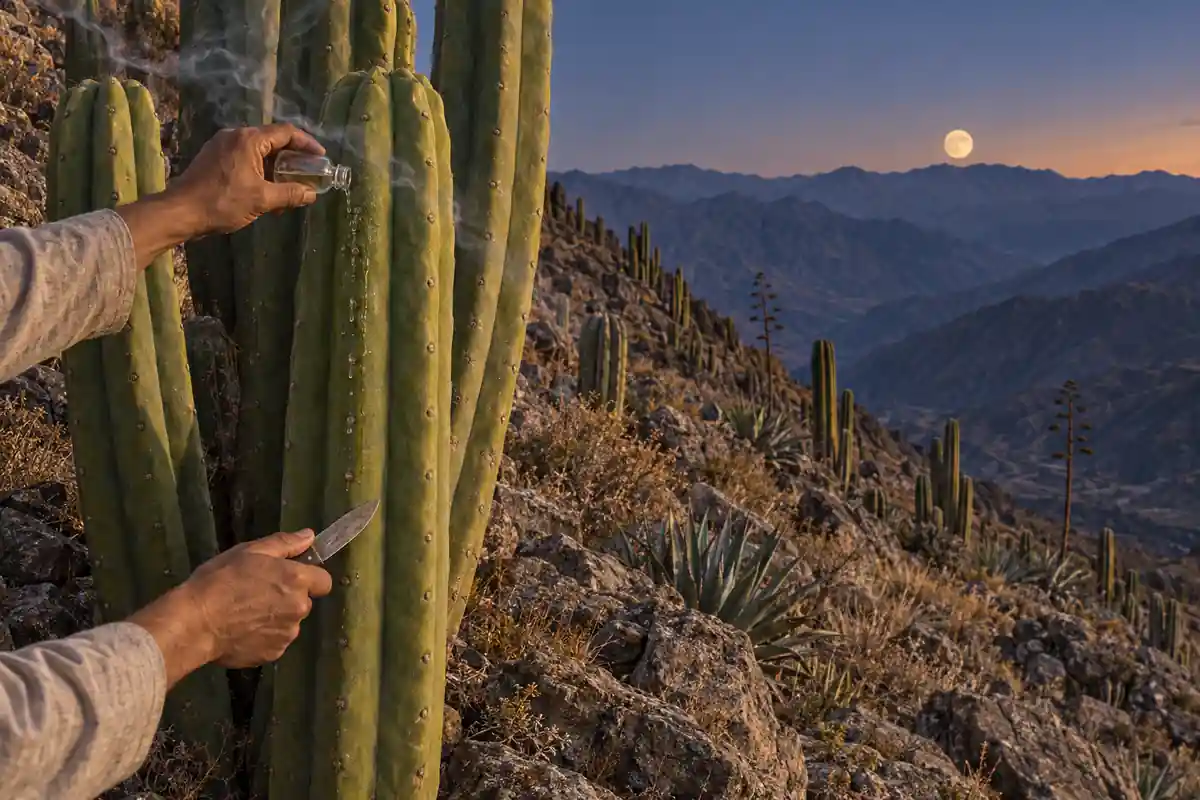
In northern Peru, healers known as maestros curanderos hold all-night sessions in which they and their patients drink a preparation made from the San Pedro cactus. One healer said the drink "clears the sight." It lets the maestro see the hidden cause of a patient's illness, bad luck or family trouble, and how to remove it. The session takes place before a mesa, a cloth spread out and set with swords, wooden staffs, stones, seashells, ancient pottery and images of Catholic saints. The tradition reaches along the coast and highlands from Tumbes and Piura, south through Lambayeque and La Libertad, and into parts of Cajamarca and Áncash. The healers studied in the early 2000s were mestizo and worked in Spanish, using only a few Quechua words. Most received patients at home. [1, 2, 4, 6]
A plant named for the keeper of the keys
The cactus has many names. Achuma, also written huachuma or wachuma, comes from Aymara, which suggests the plant was once used across a much wider area. Other names show the respect people have for it: hierba santa (holy herb), cardo santo (holy thistle), huando hermoso, or simply remedio, "the remedy." The Christian name has its own explanation. Saint Peter holds the keys of heaven, and the cactus is understood to open the way to a spiritual side of existence where an illness can be seen for what it is. The state it produces is sometimes called huanto, from the Quechua wantuq, "elevated," a word that refers to the healer's flight under its influence. [1, 2]
Because the plant is believed to be the home of a spirit, the healer treats it with respect from the moment it is cut. Before harvesting, the healer greets the cactus with prayers and songs, sprinkles scented water and blows tobacco smoke around it, and blesses the knife. The cutting is done at dusk under a full moon. The person who gathers the cactus is expected to live a correct life by traditional standards, which is why the maestro usually does it himself. The same person then prepares the drink, keeping watch and reciting prayers so that the plant's powers come "alive." Once that is done, the spirit of the cactus is said to guard the place where it was prepared. [1]
Where a cactus grows also matters. Healers prefer plants from wild, rocky stands in the mountains, known as huachumales, where the jaguar and a large boa called macanche are said to live. Both animals have been linked to the cactus since Cupisnique ceramics of the second millennium BCE. A nearly spineless, ripe, yellow-green cactus is called "female." A spiny, bluish one, the "wild San Pedro," is called "male" and is associated with maleros, specialists who use it to cause harm. In the early 2000s, one healer explained why cactus from house gardens is no good for curing: "they have listened to people and soaked up the smells of cooking." He added that such a cactus is actually stronger and "attacks more," because it draws on everything it has overheard. [1, 2]
Some stands are left alone. In the highlands of Piura in 1981, a respected maestro warned a visiting botanist about a huge stand of San Pedro that no one had harvested. He said an enormous serpent lived at its center as the plant's spirit guardian. It did not bite intruders but instead brought on a disease that covered the body in small bumps. That cactus was said to be the strongest in the valley, and no maestro dared to use it. [8]
Daño and the work of seeing
People come to the mesa with many kinds of trouble. In 2009, one healer on the north coast saw 227 people. About 43 percent came for health problems, many of them after conventional medicine had not helped. Nearly half came for work and fortune, and the rest came for serious family crises such as separation or children leaving home. In the highlands of Piura in 1981, patients arrived from coastal cities and from as far away as Argentina, Chile, Colombia and Ecuador. One night's group included a father and daughter: she had back pain and deep sadness, and the family had lost most of its cattle. The group also included a businessman who wanted to know who had embezzled from him, and a man who had collapsed into madness after another man cursed him. [3, 8]
Behind much of this lies daño, harm sent either by another person, often through a malero, or by spiritual beings. Daño can appear as bodily symptoms, bad luck, or trouble in love, family or work. Its spread is tied to talk. On the north coast, what a person says about themselves and what others say about them shapes how that person is received in the community. In curanderismo, these "accounts" (cuentas), along with prayers and gossip, are believed to have the power to make people sick. Part of the mesa's work is to "uncount" a patient's bad accounts and "count" the healer's good ones. [1, 2]
Not every trouble is daño, and telling the kinds apart is part of what the healer sees. "I see the causes of illnesses," one healer said of San Pedro. "One sees if there is something wrong in an organism, and one sees if it is an illness of God or if it is daño." Illnesses "of God" are outside the curandero's competence and belong to doctors or priests. Other troubles are thought to injure the sombra, a shadow or double that is part of the person and can act apart from the body. The sombra can be frightened away or held captive in a hill or ancient site. One healer in the early 2000s treated susto (fright) and pena (grief) with herbal drinks rather than San Pedro. [2, 6, 7]
The beings involved are called encantos: the powers of hills, lagoons, huacas (ancient sacred sites) and the objects on the mesa. They are not thought of as kind. One maestro kept stressing that the encantos "are interested." They grant favors in exchange for offerings and are moved by neither human need nor ethics. They like fresh, sweet things: perfumes, white wine, honey, sugar, white maize and limes. The healer sprays these from his mouth, because saliva and breath are thought to carry the giver's power. The exchange is risky, because a malero with better offerings may win over the very encantos a healer depends on. [6]
Health, in this view, is not a matter for the individual alone. A Trujillo archaeologist describes the curandero's task as restoring balance to the patient, the family and, by extension, the community. A major ethnography of the Piura highlands describes health as a balance among three spheres around a person: social life, a natural world inhabited by powerful beings, and the Christian religious world. Reciprocity holds the three together. [7, 10]
The mesa
The word mesa means both the healing session and the altar. The objects laid out on it, called artes, are chosen for their origin, shape or color. Healers rarely buy them. Some belonged to a respected healer or a dead relative, or were inherited from a teacher; others were found at a hill, lagoon, cave or huaca. Red, black and white are favored, and things that shine, reflect or are transparent are thought to have power. [1, 6]
The cloth is divided into fields, though accounts disagree about which side is which. Some put the ganadero field on the left and the curing (curandero or justiciero) field on the right, and others reverse them. The ganadero field holds stones and pottery from ancient sites, objects linked with the pre-Hispanic "gentiles" and used to attack and defend. The curing field holds saints, crystals and perfumes. One archaeologist links the ganadero side to water, the moon, the sea and the feminine, and the justiciero side to the hills and the masculine. In his account, a narrow middle field lets the maestro hold the two in balance, and the more a maestro knows, the steadier that balance. An ethnographer of the Piura highlands summarized what every good mesa must be able to do: "attack and defend; cure; make flourish." Catholic images sit on the mesa with the same standing as the mountain spirits. Many healers keep a staff for San Cipriano, whom curanderos regard as their patron saint. [1, 2, 6, 10]
Under San Pedro, healers say, the objects reveal what they really are. "Here I have a king of the Incas," one healer told the ethnographer, "but you, now, can't see anything, you see some stones, rough ones." He described a stone he had found on a hill and the harm it could throw off or inflict. Each healer arranges his artes in the way the cactus has shown him. When two healers were shown photographs of each other's mesas, one called the other a "spiritist," and the second called the first a "fetishist." [6]
A night before the mesa
Two accounts from the north coast, one from the early 2000s and one from 2009, describe sessions held on Tuesday and Friday nights, which are sacred days in Andean religion. The sessions began around ten and ended at dawn. In the first part, the maestro sprinkles perfumed water over the mesa and prays the Our Father, Hail Mary, Creed and Salve. He shakes a gourd rattle called a chungana, whistles, and sings tarjos, songs that call on his powers. The healer, his assistants and the patients take turns at levantar, or "raising": they draw tobacco soaked in alcohol and perfume up into each nostril from a small shell. One maestro sang: "we go remembering my lagoons, we go raising and remembering my good staffs, with good tobacco well planted, remembering my lovely dawns and my lovely crystals." Then the San Pedro is drunk. As each patient gives a name, the healer answers, "well named on my curing bench." [2, 3]
After midnight the healing work begins. The healer tracks the trouble (rastreo) and names its cause. In cases of daño, one healer in 2009 also recovered the patient's spirit from the harmful place where it had been "deposited." Clothes or photographs brought for absent relatives were examined too. The illness is drawn out, and assistants rub patients with staffs, swords and stones. Near dawn comes the florecimiento, or "flowering." Patients are sprayed with perfume and sweet scents, and talcum powder is blown over them. The flowering is understood as the start of a new period of health. For a day or more afterward, people avoid chili, onion, garlic, fried food and bathing. [1, 2, 3]
The 1981 highland session had its own gestures. After each inhalation, patients were sent to the open edge of the veranda to shake their bodies and "release the force." Just before dawn, the businessman who had come to learn who had embezzled from him ran to that edge with two wooden staffs, shouting, "Away evil, away things of the night!" [8]
How much is the cactus?
Observers disagree about what the drink itself does. In a 2006 account by two neurologists, some patients saw nothing, some saw lights or stars, and those who "saw" had intense visions. Many of these visions were of people who wished them harm, objects from the mesa, snakes, bulls or cats. When someone vomited, people said the San Pedro had cleansed more. The maestro calmed frightening visions by blowing scented water over the patient. The authors also note that people with epilepsy or depression are barred from drinking it, and that some who took large doses have died. They attributed the healing not only to mescaline, the cactus's main active compound, but also to the ritual, the songs and the perfumes. [2]
Others saw little effect at all. In 1981 the botanist noticed no intoxication in himself or any other participant, although he had felt strong effects from the cactus elsewhere. He suggested that the doses were simply low, and that the maestro controls access to the spirit world much as a priest controls the Eucharist. A team that included a practicing healer went further. Its chemist measured the drink, found alkaloid levels below the usual threshold, and saw no hallucinatory effects in 31 sessions. The team argued that researchers have wrongly understood the healer's "vision" as hallucination. For healers, they wrote, the drink has two properties: it gives the curandero vision, and it purges and cleanses the patient. The 2022 heritage declaration, by contrast, describes the plant as producing visual and auditory hallucinations. How much of the experience comes from the plant itself remains unsettled. [1, 3, 8]
Becoming a maestro
People come to the work in several ways. Healing knowledge is most often passed down within families, usually from father to son, but women practice too. Recovery from a serious illness, or a dream of initiation, can also reveal a calling. The most valued healers are those who are maestros "by birth," chosen by the encantos and the lagoons, which place the tools of the trade in their bodies. One such healer described what this means: "If your body is full of wild things, of medicinal herbs, of forests, of stones, of so much mystery, what are you going to do? What God writes upon you, you have to do." [1, 6]
An apprentice, called an alzador on the coast, usually serves about three years. He sets up and cares for the mesa, follows the maestro's songs, and learns the plants, the visions and the discipline of diet and conduct. When the maestro judges the apprentice ready, he holds a mesa to bless him and gives him artes and prayers to protect him from harm. A maestro is also "planted" (sembrado), dedicated to a protecting hill whose powers he can call on. When a maestro retires, he is expected to take his artes back to the lagoons so that maleros cannot take them. If a mesa passes to a successor after the maestro's death, it is first undone at a lagoon and then bound again to the new owner. [1, 2, 6, 10]
According to the heritage declaration, the ideal session would be led by a man and a woman together. Women healers appear on Moche pottery, sometimes hooded and owl-faced, holding slices of the cactus. In 2001, two Moche figurines were excavated near the Huaca de la Luna, apparently women and possibly healers. One of them held a disk. Soon afterward, a contemporary curandera on the north coast spoke about a round black stone that a patient had found in a tomb and given her. She had not yet seen the figurine. Drinking San Pedro, she had seen the stone's former owner, an ancient healer in a long robe whose dark mantle was "her power." In her account, that woman used one side of the stone for offerings before human sacrifice. The curandera herself uses the other side, the one marked with spirals that represent "the path of human life," for "the good of people." She named the stone "the bread," for good harvests, and called the relation between the two uses "almost a continuity." [1, 2, 9]
A long history, from persecution to recognition
Remains of the cactus found in Guitarrero Cave date to about 8,600 years ago. A stone carving at Chavín de Huántar from the first millennium BCE shows a figure holding a stem of it. After the Spanish conquest, its use was persecuted as idolatry and went underground. Jesuit records describe the Indigenous nobility drinking achuma in rites addressed to Saint James, who had inherited the attributes of the thunder god Illapa. Healers who used it were tried as witches in eighteenth-century courts. [1, 2]
In one trial in the Cajamarca region in 1782, witnesses described a healer who closed the doors at night and set a table with stones, crystals, shells, a stone bull and a cross. He gave a drink of gigantón, a columnar cactus, to everyone present, then sang in Quechua, calling on San Cipriano. He had participants sniff soaked tobacco and cleansed them with maize flour at sunrise. When no one felt anything, he explained that the gigantón "had not been fine." His patients included landowning Spanish families. [11]
Pressure on healers did not end with colonial rule. In 2010, researchers noted that traditional medicine in Peru was still informal and lacked official recognition, and that many patients felt ashamed to be known to attend a mesa. In November 2022, the Ministry of Culture declared the knowledge and traditional uses of San Pedro in northern curanderismo part of the Cultural Heritage of the Nation. The declaration explicitly excludes maleros and any use meant to cause harm. It distinguishes ritual use from recreational use and from mystical tourism, and notes that in cities the practice has moved toward profit and tourism. The ministry is to report on the tradition's condition every five years. In January 2024, the recognition was presented in Huancabamba at the province's anniversary celebrations. [1, 3, 5]
The tradition has absorbed other changes and faces other threats. Some healers took up New Age ideas in the 1990s, although observers judged that the practice itself changed little. The land is also under threat. In 2006, ethnobotanists warned that urban sprawl, climate change and especially large-scale mining threatened the high Andean ecosystems and sacred lagoons where many of the healers' plants grow. The 2022 declaration recorded a more immediate loss. Maestros traditionally had two alzadores, but in large areas where curanderismo is still practiced, they have found no apprentice to pass their knowledge to, not even among their own children. [1, 4, 6]
What is uncertain
Several detailed first-hand studies describe these night-time healing ceremonies, but the most thorough ones are now 15 to 40 years old. The recent material consists mostly of an official heritage declaration and a short interview.
Sources disagree about whether patients have strong visions: one study reports vivid visions, while two others report that participants were barely or not at all affected [2, 3, 8]. [2, 3, 8]
Sources give opposite left/right placements for the healing side and the opposing side of the altar, and some describe a third, middle field [1, 2, 6, 10]. [1, 2, 6, 10]
How directly today's practice continues pre-Hispanic use is disputed: some authors see clear continuity, while others stress colonial disruption and mixing with Christianity [2, 8, 9, 10]. [2, 8, 9, 10]
The age of the earliest depictions of the cactus varies between sources, from about 1500 BC to the first millennium BC [1, 2, 4, 8]. [1, 2, 4, 8]
Sources differ on whether the cactus drink is normally taken on its own or with other plants added [2, 3, 4]. [2, 3, 4]
What the local plant name "cimora" refers to has never been settled [8]. [8]
Whether the treatment helps patients has been studied by few authors: two earlier reports on patients, and a follow-up of one healer's patients by a team that included that healer [3]. [3]
Sources disagree on whether the tradition is declining for lack of apprentices or still thriving [1, 4]. [1, 4]
The role of women healers today is little studied, even though they appear often in ancient art [1, 9]. [1, 9]
How tourism, city practice and commercial use are changing the tradition has not been studied in any depth [1, 6]. [1, 6]
12 sources. Each claim checked by AI against the saved sources; every finding reviewed by Jim Davis beside the cited passage, 30 October 2026. How the articles were checked
Timeline of dated events (24)
- c. 8,600 years before presentremains of the cactus are left in a highland cave used by hunter-gatherers [1]
- c. 3000 BCthe earliest Andean experience with the cactus is thought to date from this pre-pottery period [2]
- c. 1500 BC (or first millennium BC)Cupisnique pottery depicts the cactus alongside felines and snakes [1, 2, 4]
- c. 1300–1000 BCstone carvings at Chavín de Huántar show a figure holding a section of the cactus [2, 8]
- 200 BC–AD 100stylised cactus images appear in Salinar art [2]
- AD 100–800Moche pottery shows hooded women, interpreted as healers, holding pieces of the cactus [2, 4, 9]
- Moche III periodtwo figurines of possible women healers are buried in a residential area at the Huaca de la Luna (excavated in 2001) [9]
- AD 750–1350Lambayeque art shows women healers holding the cactus tip [2]
- From the Spanish conquest onwarduse of the cactus is persecuted in evangelisation campaigns and continues in secret [1]
- 17th centurya Jesuit chronicler writes the first detailed account of the cactus's ritual use [2]
- 18th centurynorth-coast court records prosecute ritual healers as witches [1]
- 1776a townsman in Cajamarca province denounces a healer whom patients sought out from far away for cures and herbs [11]
- 1782a Cajamarca church trial records a night healing session with a cactus brew, a gourd rattle, ritual stones and invocations of Saint Cyprian [11]
- From 1911the first academic medical studies of the cactus's use begin [1]
- 1940sthe first scientific study of the cactus under one of its local names appears [4]
- 1977a Trujillo healer's ceremonies are filmed for an ethnographic record [12]
- 1979a woman healer begins practising and builds up her altar objects over the following decades [9]
- 1981researchers see that most wild cactus stands in a highland Piura valley have been cut for sale, except one stand protected by a local legend [8]
- 1990a national Institute of Traditional Medicine is founded [1]
- by the 2000ssome northern healers have begun adding ayahuasca to their ceremonies [4]
- 2009one north-coast healer holds 55 night sessions, mostly on Fridays, attended by 227 people [3]
- by 2010some northern healers have absorbed New Age ideas into their practice [6]
- 14 November 2022Peru's Ministry of Culture declares the traditional knowledge and use of the cactus in northern curanderismo part of the national cultural heritage, excluding harmful sorcery [1]
- January 2024the heritage recognition is formally handed to local authorities in a highland Piura province [5]
Sources
CSL-JSON imports into Zotero, Mendeley and other reference managers.
Ministerio de Cultura del Perú (2022). Resolución Viceministerial N° 000252-2022-VMPCIC/MC: Declaran como Patrimonio Cultural de la Nación a los conocimientos, saberes y usos tradicionales del cactus San Pedro en las prácticas del curanderismo en el norte del Perú. El Peruano, 17 Nov 2022.
Peru's Ministry of Culture, official heritage resolution (2022). Gives a broad official summary of the tradition: the altar, the healer and assistant, apprenticeship, the patient's preparation, the history of persecution, and current threats such as commercialisation and the shortage of apprentices.
Carod-Artal, F.J. & Vázquez-Cabrera, C.B. (2006). Mescalina y ritual del cactus de san Pedro: evidencias arqueológicas y etnográficas en el norte de Perú. Revista de Neurología 42(8): 489-498.
Two neurologists, peer-reviewed journal article (2006). Combines museum and site surveys of ancient cactus imagery with interviews and attendance at one healing session, describing the session's structure, the altar and the restrictions afterwards.
Reyna Pinedo, V., Carbajal Felipe, M. & Carbajal Rodríguez, J. (2010). Estudio etnomedicinal de las mesas de San Pedro II. Mesas de don Marco Carbajal F. año 2009. Cultura y Droga 15(17): 29-46.
Ethnomedical study by a chemist, co-written with a practising healer and his assistant (journal article, 2010). Records a year of one healer's sessions, the reasons people attend, and follow-up of patients; argues that the drink does not cause hallucinations in patients.
Bussmann, R.W. & Sharon, D. (2006). Traditional medicinal plant use in Northern Peru: tracking two thousand years of healing culture. Journal of Ethnobiology and Ethnomedicine 2: 47.
Botanist and anthropologist, peer-reviewed ethnobotanical article (2006). Based on market and fieldwork in 2001–2006; documents the regional plant medicine in which the cactus ceremony sits, new additives, and threats to plant habitats.
Rivera, A. (2024). Cactus San Pedro en Huancabamba es declarado Patrimonio Cultural. El Tiempo (Piura), 16 Jan 2024.
Regional newspaper report (2024). Reports the local handover of the heritage recognition and repeats the resolution.
Fernández Juárez, G. (2010). «Norte contra Sur». Análisis comparativo sobre ofrendas rituales andinas. Revista Española de Antropología Americana 40(1): 239-259.
Anthropologist's comparative journal article (2010), read only in part. Contrasts the northern cactus altar with coca-leaf ritual in the southern Andes, drawing on earlier ethnographies, and notes New Age influence.
Sánchez Benavides, Ó. (1997). Review of Polia Meconi, M. (1996), "Despierta, remedio, cuenta...": adivinos y médicos del Ande. Anthropologica 15: 375-377.
Book review (1997) of a major two-volume ethnography of highland Piura healing. Summarises that work's account of healers, the cactus, the altar and local ideas of illness.
Davis, E.W. (1983). Sacred plants of the San Pedro cult. Botanical Museum Leaflets (Harvard University) 29(4): 367-386.
Ethnobotanist's field report (1983) based on 1981 fieldwork in highland Piura. Describes a full night ceremony, collects plant specimens, records a protective folk legend, reports very low intoxication, and leaves the meaning of "cimora" unresolved.
Glass-Coffin, B., Sharon, D. & Uceda, S. (2004). Curanderas a la sombra de la Huaca de la Luna. Bulletin de l'Institut français d'études andines 33(1): 81-95.
Archaeologists and an anthropologist, journal article (2004). Links Moche figurines of possible women healers to a contemporary woman healer's own interpretation of them and of her altar.
Gálvez Mora, C. (2025). Maestros curanderos norperuanos [interview transcript]. Anti Podcasts 2(7), no. 14, March 2025. Centro de Investigaciones Precolombinas / Universidad Nacional de Río Cuarto.
Archaeologist's recorded interview (2025). Gives a recent overview of the altar's layout, the kinds of healer, the stages of a session, and blending with Christianity.
Dammert Bellido, J. (1974). Procesos por supersticiones en la provincia de Cajamarca en la segunda mitad del siglo XVIII. Allpanchis 6: 179-200.
A bishop's study of 18th-century church trial records from Cajamarca (1974). Describes colonial-era healing sessions, ritual objects and their uses, and their survival into the 20th century.
Smithsonian Institution, Human Studies Film Archives. Eduardo the Shaman: A Case Study of Culture and Hallucinogens, HSFA.1988.09 (collection record).
Smithsonian archive record (undated) of 1977 film footage of a Trujillo healer. Documents his daily life, his use of ancient art and the cactus, and his healing sessions.
Related
Cite this page
Psychoactive Traditions. “San Pedro Mesa Curanderismo.” Last reviewed 30 October 2026. https://psychoactive-traditions.org/traditions/peruvian-mesa-san-pedro