Names
In Western countries, this cactus usually goes by San Pedro, or sometimes huachuma. The name San Pedro refers both to the living plant and to the drink made from it.
In northern Peru, its names include San Pedro, achuma and huachuma. San Pedro is Spanish for "Saint Peter." Why the cactus carries the saint's name isn't firmly known, but a common explanation ties it to Saint Peter's keys to heaven. The other two names, achuma and huachuma, are recorded as Aymara.
Its scientific name is Echinopsis pachanoi. Because its classification has shifted, it also turns up as Trichocereus pachanoi or Trichocereus macrogonus var. pachanoi.
What it is
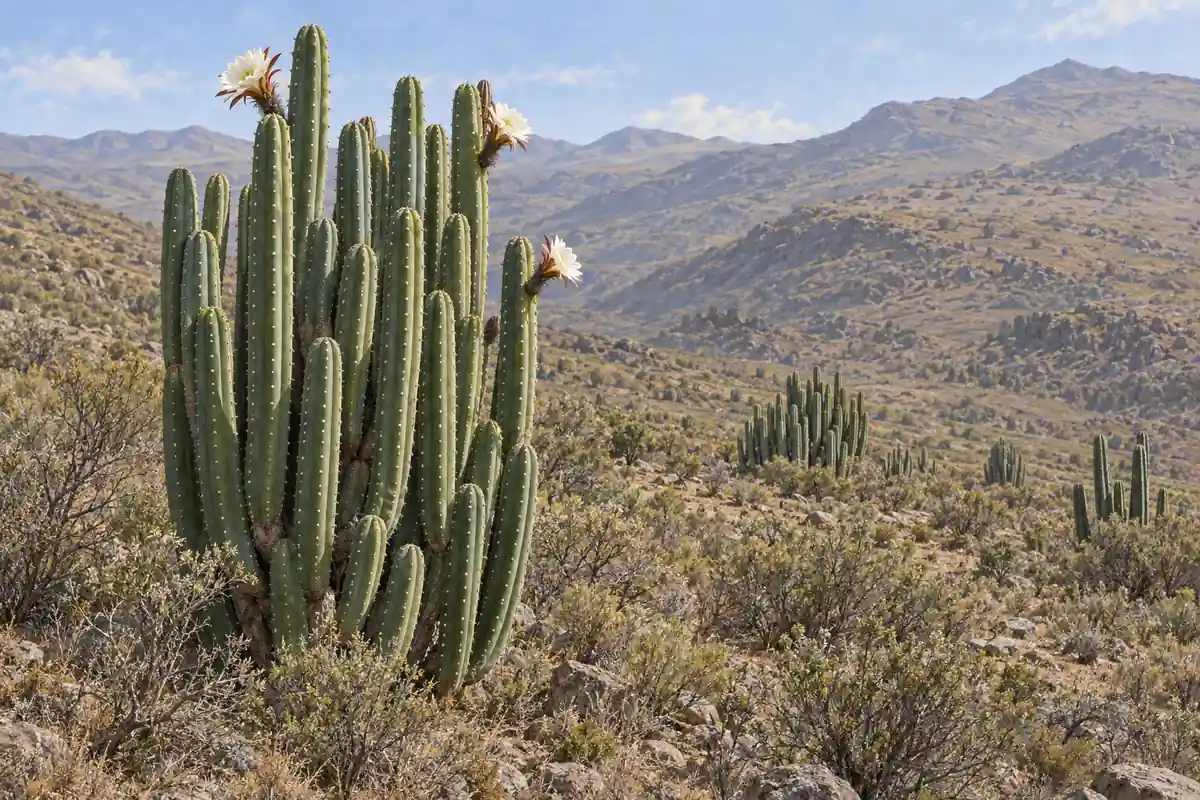
San Pedro is a fast-growing, column-shaped cactus native to the Andes of southern Ecuador and Peru. Its upright, ribbed stems range from blue-green to dark green and can grow several meters tall. It has few spines, and its large white flowers open at night.
In northern Peru, people take the cactus as a drink. A related cactus, the Peruvian torch (Echinopsis peruviana), may also be used in this tradition, though this is less certain.
How it works
The main active compound is mescaline (3,4,5-trimethoxyphenethylamine). It works largely through receptors on nerve cells for serotonin, a chemical messenger involved in mood and perception. One type of serotonin receptor, 5-HT2A, is thought to be central to mescaline's effects on the mind, just as it is for other classic psychedelics.
Exactly how this activity changes perception and thought isn't fully understood. The cactus also contains smaller amounts of related compounds, and it's unclear how much they shape the experience of the drink.
Effects on the mind
San Pedro is a classic psychedelic: a substance that alters perception, thought and emotion, usually while the person stays awake and can remember the experience afterward. When the drink is taken in its traditional setting, the effects come on gradually and last many hours, often much of the night.
The experience varies from person to person and from one occasion to the next. Colors and patterns may seem more intense, and images may appear when the eyes are closed. Time can seem to slow down, and the boundary between self and surroundings can seem to loosen. People also describe strong emotions, vivid memories, a heightened sense of connection to others or to nature, and insights that feel deeply significant, though that feeling doesn't show that an insight is true.
The experience can also be difficult. People report fear, confusion, suspicion and distressing memories, and some lose track of where they are for a while.
In tradition
In northern Peru, San Pedro is drunk during the all-night sessions of mesa curanderismo, a healing practice led by maestros curanderos, or master healers. The practice is found along the coast and in the highlands from Tumbes to La Libertad, and into parts of Cajamarca and Áncash.
Sessions take place before a mesa, an altar of power objects. Both the healer and the patients drink the cactus. Healers say it lets the maestro see and remove the hidden cause of a patient's illness, misfortune or family trouble. That cause is often attributed to daño, harm sent by another person.
A 2022 national heritage declaration describes the practice as still living, but short of apprentices in many areas.
Today
San Pedro is now also used outside its traditional settings, including in other countries. Research on the cactus itself is sparse; most scientific work focuses on mescaline. Small controlled studies in healthy volunteers have documented mescaline's effects on the mind.
Traditions that use it
Cite this page
Psychoactive Traditions. “San Pedro (huachuma).” Last reviewed 1 November 2026. https://psychoactive-traditions.org/medicines/san_pedro