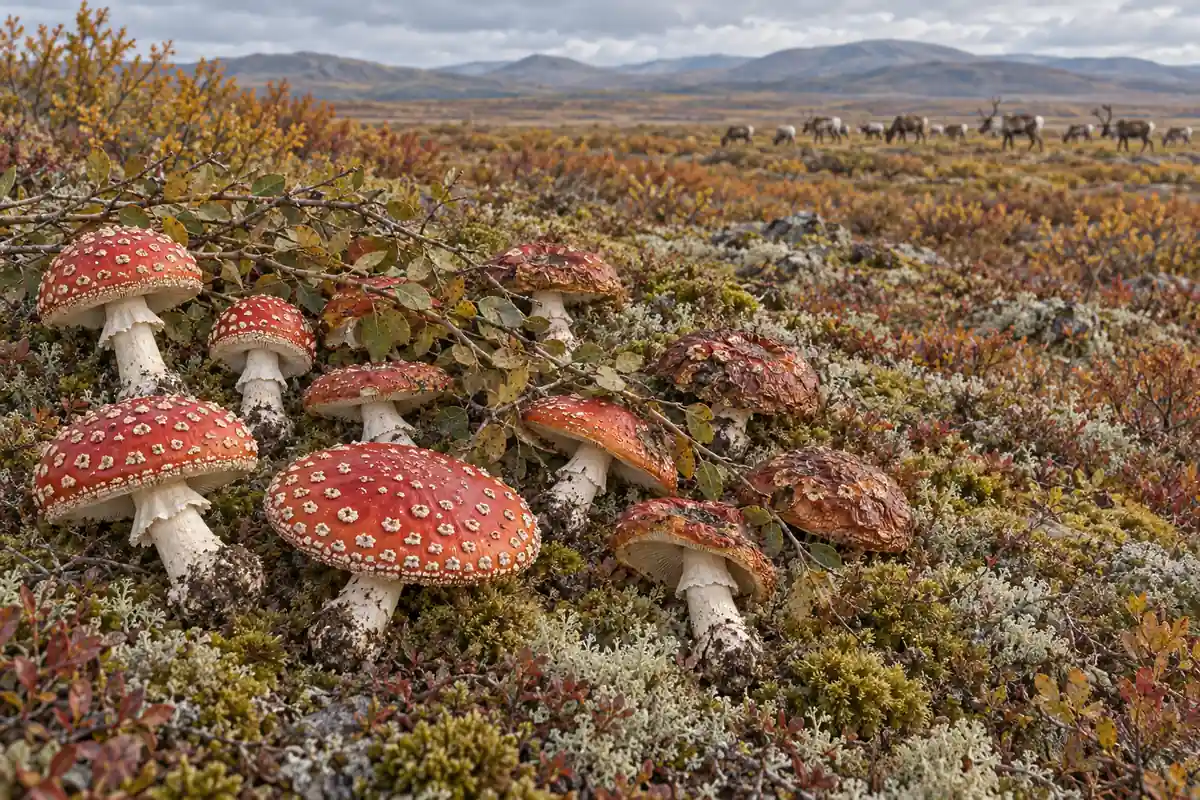
The Koryak live in the northern half of the Kamchatka Peninsula and along the neighboring coasts of the Sea of Okhotsk and the Bering Sea. Traditionally, some were reindeer herders who moved with their herds through the inland tundra, and others lived in settled coastal villages and hunted sea mammals. For centuries many of them have eaten the red-capped fly agaric mushroom, which they call wapaq or v'apaq. They eat it for strength and cheer, to see the future and the dead, and to ask what is wrong when someone is ill. Around 1900, one coastal village spent several days sending a slain white whale back to its home in the sea, and no one worked during that time. While the women and young people sang and drummed, the old men ate fly agaric. When the intoxication passed, they told the others where the Fly-Agaric Men had taken them and what they had seen. [1, 3, 4, 5]
A being with a will of its own
The mushroom's own origin story also turns on a whale sent home. In the version recorded around 1900, the creator figure Big-Raven had caught a whale and could not lift the bag of travel provisions needed to send it home. He asked the supreme being, Existence, for help. Existence told him to look on level ground near the sea for "white soft stalks with spotted hats," the spirits wapaq, and to eat them. Then Existence spat on the earth, and the agaric grew from his saliva. Big-Raven ate, felt cheerful, and began to dance. The mushroom asked him how such a strong man could fail to lift a bag. He lifted it at once and sent the whale home, and the agaric showed him the whale swimming back to its companions. Big-Raven then said, "Let the Agaric remain on earth, and let my children see what it will show them." In a version retold in the 2000s, Big-Raven tells his children that whoever eats the spirits will learn what ails them, have their dreams explained, see the upper or lower world, or learn their future. [2, 4]
The myth explains a conviction that runs through every period of the record: a person who has eaten fly agaric does what the spirits in the mushroom tell them to do. One old man, describing the mushroom to a visiting ethnographer around 1900, began with his own mood: "Here I am, lying here and feeling so sad; but, should I eat some agaric, I should get up and commence to talk and dance." The agaric might tell an old man, "You have just been born," and he would cry like a newborn. It might send a man to The-One-on-High, who would twist him like a thread until his bones cracked. "But when he came to, he would eat it again, because sometimes it is pleasant and cheerful." [4]
Other observers recorded the same belief. In the 1750s, among the Itelmen of southern Kamchatka, everyone who had eaten fly agaric affirmed that whatever follies they committed, they committed "by the order of the mushroom," which commanded them invisibly. In 1900 a diarist in a Koryak village described a man with shaking hands and shining eyes, beating a drum and nodding off: "Amanita tells him what to do. When under amanitas, people are not responsible for their actions." [5, 6]
The mushroom's will is not simply good; it has a dark side as well. Koryak accounts describe it as a cheerful helper and partner that grants strength, agility, and hidden knowledge. People under its influence are said to climb trees "like squirrels," walk on embers, and "fly" to other places and times. The mushroom can also deceive, punish, or kill, and it has servant spirits of its own. A Koryak man interviewed in the 2010s remembered three men and a woman who died after eating it, and he described how he himself nearly died when everything suddenly went black. The Koryak spirit world is not divided cleanly into good and evil, and the mushroom spirit is not assigned to either side. [5]
Fly-Agaric People
In the visions and in the stories, the mushrooms appear as people. Koryak tales recorded in 1900–1901 tell of the Fly-Agaric-Men, Wapaqalanu, who live and migrate like a people of their own. In one tale the hero Ememqut and his wives put on round, broad-brimmed hats with red and white spots and travel with them. In another, a woman who has left her husband marries into the Fly-Agaric people. Itelmen tales tell of beautiful fly-agaric girls in the forest; one husband forgets his family to live with them until hunger brings him home. [4, 9]
According to these accounts, the spirits look much like the mushroom and have neither neck nor legs. Their number matches the number of mushrooms eaten. They take the eater by the hand and lead them through the world, sometimes to the land of the dead. Rock carvings at Pegtymel in Chukotka, made between the first millennium BCE and the first millennium CE, show human figures with mushrooms on their heads, some of them holding hands with ordinary people. Scholars have linked the carvings to these beliefs, though the people who made them cannot be identified with certainty. [1, 5, 7, 9]
Who ate it, and for what
Outside the stories, the 18th-century records show the mushroom moving between neighbors. The Itelmen sold dried fly agaric to the Koryak, along with sables and fox furs. According to the same account, settled Koryaks valued it highly because it did not grow in their area and they had to obtain it from the Itelmen. The Itelmen themselves ate it at feasts, weddings, and celebrations after successful hunts. Women, the same observer noted, did not use it. [1, 6]
In the later Koryak record, the right to eat fly agaric was regulated socially. Those expected to eat it were people with sacred knowledge (shamans and their helpers, who were mostly older men) and men doing heavy work: tanning hides, hauling loads, searching for strayed reindeer. Others could eat it on special occasions. Young people and women who ate it generally met with disapproval, except for those who showed shamanic talent. Yet the regulation had limits: among the Koryak, unlike some West Siberian peoples, the mushroom was never reserved for a sacred class. Older sources also mention a practice in which women chewed the mushroom and men swallowed it. By the 1970s and 1980s this practice was no longer observed, and people had no memory of it. [1, 2, 5]
The rules about gender have continued to change. In the 1980s and 1990s, some communities still forbade women to eat it. In others, a first eating marked a kind of initiation, for women as well as men. A Koryak woman in her sixties described how her father's elder brother offered her the mushroom when she was already married with a child, and how she did not refuse because "you must not refuse old people." Afterward he told her to take it only rarely and only in small measure, and decades later she still followed his word. A study of a present-day Koryak village describes the mushroom as part of a relationship between generations, through which knowledge, care, and emotion pass, and traces how women's and men's roles in using it have shifted since the pre-Soviet accounts. [7, 8]
People gave many reasons for eating it. Herders ate it to run after reindeer, and workers to keep going. One mother arranged a first eating for her son, who was shy with girls at the village club, and people said the mushroom helped him. In the 1990s some Koryaks told visitors that it inspired them to compose their own songs. [7]
Approaching the mushroom
Because people regard the mushroom as a person, they approach it with courtesy. In one Koryak community, people looked for fly agarics in silence, but on finding them they had to sing a joyful song. A man recorded in 1991 explained that "you must greet fly agarics in a good mood and with a song, and even dance a little." His song opens with a child's cry of delight:
> Iki-ki, we found fly agarics! > Iki-ki, iki-ki! > Oh, how I want to eat them!
The mushroom, people said, "jumped out" of the ground only for good people, as a kind of gift. Angry people were not supposed to approach it at all, because such a meeting could bring misfortune on many others. The mushroom was not to be cut with a knife, turned upside down, or torn from its mycelium. People who used it for healing explained the illness to it beforehand: "You have to talk to it. Tell it what hurts. It is just like a person." [3, 7]
The purpose of eating is spoken aloud or silently each time. In accounts from the early 20th century, a man recited set words over the mushroom stating his wish to see the future, and the wish was answered in his dream. People often asked elders for permission, and after eating they were expected to lie down and sleep, because answers came in dreams. In one Koryak family, a woman whose sons kept dying followed the mushroom's advice and walked around the camp in a blizzard, without her outer clothes, beating a drum. The spirits could also forbid further eating. One man woke to see a reindeer herd circling in the sky and heard the mushrooms say that if he kept eating this way he would die and go where that herd was. [1, 7]
Songs of the ancestors
Koryak has its own word for what is sung under the mushroom: lylal'atqulikul, which roughly means "hallucination-song." Its root refers to the state of fly-agaric intoxication and has the same form as the word for "eye," reflecting the visions that come with it. Present-day Koryaks compare those visions to watching television. Some say the mushroom sharpens creative inspiration. In 1976 folklorists working among the Koryak were told that eating it came before composing the personal song that every person was expected to have. [3]
The mushroom songs themselves are built on these personal songs, which pass down through families. A person under the mushroom sings their own song or the song of an ancestor, and, as one tradition bearer said in 2019, "the fly agarics may ask the intoxicated person to sing someone's personal song, but they always sing their own." Opinions differ on whether the singing changes. One woman said the melodies are the same but "under the fly agaric there is much strength, they sing more powerfully, the voices are louder, the whole soul sings." Another said the songs are no different at all. A man from the same area said people sing "under their nose, somehow inside." [3]
In 2004, during actual use of the mushroom at a traditional fishing place, an elderly woman sang and danced with her female relatives for a long time and told legends and tales. One of her songs was her late husband's personal song, framed by lines describing the women dancing around her. In another, her dead brother reproaches his own daughter for sending him to the other world without a jacket. One researcher reads this as an instruction to send him the coat by burning it. Gifts had traveled to the dead by fire long before this: at a cremation around 1900, a village sent presents to its departed relatives, and two fly agarics went to an old man "who had been very fond of agaric intoxication." [3, 4]
Some songs include an exchange between the singer and a sober companion: "Am I really intoxicated?" "Yes, you are intoxicated!" The exchange helps the singer tell what is real from what is seen and return from the journey to the other world. A tale recorded in 1901 contains the same question. Raven-Man wakes from a fly-agaric stupor and calls for his wife, and a house post answers in her voice. "Have I become intoxicated with fly-agaric?" "Yes, with fly-agaric." Other recorded mushroom songs state their purpose directly: "I ate fly agaric so that everyone would live well. I wake up so that no one in the settlement falls ill." "I ate my fill of fly agaric so that the reindeer would live well, so that the calves would grow well." Folklorists have not settled whether these songs form a separate genre or are a variety of the personal song. [3, 4, 7]
Healing and seeing
In the Big-Raven myth, the agaric tells every person, "even if he were not a shaman," what ails them, explains their dreams, or shows them the upper and lower worlds. In shamanic séances held in complete darkness, a practitioner under the mushroom was said to seek control over the harmful spirits called nimvit. In the 1980s and 1990s the mushroom was also applied to the body: people used it on the edges of festering wounds and on skin disease, and used alcohol infusions of it as compresses for aching backs and joints. It was sometimes given to the mentally ill in the belief that it would ease their condition. A Koryak family chronicle tells of a grandfather who gathered and dried mushrooms for his blind stepmother, saying as he dried them, "She must see the light." After eating them, the story goes, she saw the sun, the land, and the people around her, and then became blind again. [1, 2, 4, 7]
The mushroom and vodka
Vodka reached the Koryak through Russian trade in the 18th century. In 1778 Koryak chiefs at the fort of Gizhiginsk were already being kept from drinking too much. By 1900 a member of an American-sponsored expedition wrote that people would trade masks and other objects only for "vodka, more vodka, for my head to go round," and that fly agaric was their other passion. In the early 1930s home-brewed alcohol and the mushroom were described as equally attractive, and at festivals people consumed both. [5]
The historian Lyudmila Khakhovskaya has argued that the two intoxicants were understood in the same way but regulated very differently. Koryaks explain both as the entry of an outside being into the body. In 2002 a drinking man on a road trip told her, seriously and with some shame: "This is not me acting, this is the vodka in me acting." In her view, the difference lies in form. The fly agaric has a shape, a color, a body, and a people of its own, and over centuries a code grew up around it. Vodka has no shape and no tribe, and no such code formed around it. Its use is not limited by age or gender, and no specialist mediates it. In the communities she studied, the only regulation of drinking came from a newer outside power: Pentecostal churches whose converts gave up alcohol and tobacco. [5]
Suppression and survival
Soviet rule struck at the tradition directly. Native religion was outlawed, and shamans were killed or sent to labor camps. Children were taken to boarding schools, often hundreds of kilometers from home, where they were taught contempt for their ancestors' practices. Reindeer herds were confiscated and coastal villages collectivized, and alcoholism became widespread. Many Koryaks still avoid speaking of their tradition in the vocabulary of shamanism. [2]
By the 2020s, Koryak cultural tradition was described as being in deep crisis. Some commentators doubt that present-day use can be called ritual in the strict sense, and young shamans are said to be less powerful than their predecessors. The same accounts note that some people still use the mushroom and that its use in folk medicine continues. [2]
Fieldwork from the 1980s onward shows that more than remnants survive. Folklorists who recorded songs in the 1990s and 2000s describe fly-agaric use and singing as a living tradition. In the 2010s, dried fly agarics hung in a Koryak reindeer herder's tent and in a farmhouse in the upper Paren' valley. The older generation, wrote an ethnographer who worked in Koryak villages for decades, keeps its understanding of the mushroom's sacred status. A study of one Koryak village in Kamchatka follows the mushroom from harvest to the interpretation of its visions, within a relationship between generations. [3, 5, 7, 8]
What is uncertain
Researchers who visited Koryak communities in recent years confirm that fly agaric is still gathered, dried and eaten. Reports from travellers and ethnographers go back almost three centuries. Recent first-hand accounts are few and short, however, and what is known of Itelmen use comes almost entirely from 18th-century visitors.
The rock carvings said to show "fly-agaric people" are dated anywhere from about one to more than three thousand years ago, and their link to the mushroom is an interpretation rather than a certainty. [2, 3, 5, 7, 9]
Scholars have disagreed over whether shamanic use of the mushroom was an ancient practice or a late, borrowed sign of decline. Some Siberian peoples held that shamans who did without it were stronger. [1, 2]
An older account says women did not eat the mushroom, and a recent study describes it as unwelcome for women and young people, yet recent records show women eating it and singing under its influence; how gender roles changed is not settled. [3, 5, 6, 7, 8]
One review describes the practice as declining and no longer ritual in a strict sense, while a recent field study calls it a living tradition. [2, 3]
An 18th-century observer says the mushroom did not grow where settled Koryak lived and was obtained from the Itelmen, whereas a modern review says it grows most abundantly on Koryak lands. [2, 6]
Tradition bearers disagree on whether songs sung under the mushroom sound different from ordinary singing. [3]
It is unresolved whether "fly-agaric songs" form a separate genre or are a variety of personal songs. [3]
How widely the mushroom is used as a remedy today, and whether such uses work, has not been studied; one review admits it had no interviews with present-day users. [2, 7]
9 sources. Each claim checked by AI against the saved sources; every finding reviewed by Jim Davis beside the cited passage, 30 October 2026. How the articles were checked
Timeline of dated events (27)
- 1st millennium BC to 1st millennium AD (estimates vary)carvings of mushroom-headed human figures made on rocks at Pegtymel in Chukotka. [3, 7, 9]
- 1658a Polish exile makes the first known written record of fly agaric eating in Siberia. [2]
- Late 1730sItelmen are observed taking fly agaric for merriment at feasts and trading the dried mushroom to settled Koryak. [6]
- 1740sItelmen are baptised in large numbers, and old customs are reported as being abandoned. [6]
- By 1778Koryak chiefs are already familiar with vodka. [5]
- By the end of the 18th centuryalcohol has become a regular part of Koryak life. [5]
- c. 1899a Koryak man dies after eating fly agaric, as recorded the following year. [5]
- 1900Koryak and visiting Chukchi hosts and guests are recorded under fly agaric at a gathering in Kamenskoye. [5]
- c. 1900old men eat fly agaric during a whale ceremony and afterwards recount where the "Fly-Agaric Men" took them. [4]
- c. 1900fly agaric is sent with other gifts to a dead elder at a cremation. [4]
- 1900–1901Koryak storytellers tell how the supreme being created fly agaric to help Big-Raven. [4]
- Beginning of the 20th centuryKoryak are reported to prefer fly agaric to vodka. [5]
- 1920sduring Koryak celebrations, spirits and fly agaric are consumed together. [5]
- 1930–1931fly agaric and home-brewed alcohol are reported as equally attractive to Koryak. [5]
- Soviet periodnative religious practice is banned and shamans are persecuted. [2]
- 1969a Koryak elder tells an anthropologist that fly agaric makes a man strong but deceives him. [5]
- 1970s–1980sa custom in which women prepared the mushroom for men is no longer seen or remembered. [1]
- 1976on an expedition, ethnographers learn that eating fly agaric preceded the composing of a person's own song; the recordings remain unpublished. [3]
- 1987ethnographers report that the custom is still alive in the far north-east. [1]
- 1980s–1990srules for gathering, healing uses and journeys to the dead under the mushroom are recorded among Koryak, Chukchi and Chuvan. [7]
- 1991fly-agaric songs are recorded among Nymylan Koryak, some performed as demonstrations without the mushroom being eaten. [3]
- 1994–1995Koryak tell visiting American mycologists that they eat it for inspiration and for composing songs. [7]
- 2004actual consumption is recorded at a traditional fishing site in northern Kamchatka, followed by long singing, dancing and storytelling. [3]
- 2008–2009a Chukchi engraver depicts the "fly-agaric people's camp" on walrus tusks for the first time. [7, 9]
- 2010–2011fly agaric is photographed drying in a reindeer herder's tent and in a village house in Magadan region. [5]
- Recent decades (before 2016)some Magadan Koryak communities give up alcohol and tobacco after joining a Pentecostal church. [5]
- 2019Koryak tradition bearers are interviewed about personal songs and fly-agaric songs. [3]
Sources
CSL-JSON imports into Zotero, Mendeley and other reference managers.
Saar, M. (1991). Ethnomycological data from Siberia and North-East Asia on the effect of Amanita muscaria. Journal of Ethnopharmacology 31: 157–173.
A mycologist's review article in a peer-reviewed journal (1991). It compiles 18th- to early-20th-century accounts and 1987 reports from ethnographers on uses, effects, rules and gender. Its own fieldwork was among the Khanty, not the Koryak.
Kulpa, E. (2022). Zwyczaje syberyjskich Koriaków. Użycie muchomora czerwonego (Amanita muscaria) w kamczackiej medycynie ludowej [The customs of Siberian Koryaks. The use of fly agaric in Kamchatka folk medicine]. Roczniki Kulturoznawcze 13(3): 119–142.
A cultural-studies graduate's review article in a journal (2022), without fieldwork and drawing heavily on sources 4 and 5 and on web material. It retells the Koryak origin myth, summarises the scholarly debate over shamanism, and argues the practice is declining.
Tiron, E. L. (2023). Мухоморные песни коряков-нымыланов [Fly agaric songs of the Koryaks-Nymylans]. Сибирский филологический журнал [Siberian Journal of Philology] 2023(1): 26–44.
An ethnomusicologist's reviewed journal article (2023), based on song recordings from 1991–2008 and interviews with tradition bearers in 2019. It gives song texts, native terms for fly-agaric singing, and beliefs about dancing fly-agaric women and messages from ancestors.
Jochelson, W. (1908). The Koryak. Part I: Religion and Myths. Memoirs of the American Museum of Natural History 10 (Jesup North Pacific Expedition 6). Leiden: Brill; New York: Stechert.
A Jesup expedition ethnographer's monograph on Koryak religion and myths (1908), available only in excerpts. It supplies the origin myth, tales of the Fly-Agaric people, a ceremony in which old men ate the mushroom, and a Koryak elder's description of its effects.
Khakhovskaya, L. N. (2016). Alcohol consumption practices in the Koryak community. Journal of Ethnology and Folkloristics 10(2): 47–63.
A historian-anthropologist's journal article (2016), based on Koryak fieldwork from 2002–2014 and archive records from 1778–1971. It describes the "amanita code" of who may eat the mushroom, its dangers, its continued drying and eating, and its comparison with alcohol.
Krasheninnikov, S. P. (1755). Описание земли Камчатки [Description of the Land of Kamchatka], vol. 2. Text of the 1949 Moscow–Leningrad edition, Russian Wikisource.
An 18th-century explorer-scholar's description of Kamchatka (1755), available only in part. It is the main source on historical Itelmen use: merriment at feasts, the belief that the mushroom gives orders, its effects on Cossacks, trade to settled Koryak, and an Itelmen word for "drunk from fly agaric".
Batyanova, E. P., & Bronshtein, M. M. (2016). Мухомор в быту, верованиях, обрядах, искусстве народов Севера [Amanita muscaria in the household, beliefs, rituals and art of the peoples of the North]. Сибирские исторические исследования [Siberian Historical Research] 2016(1): 46–58.
An ethnographer and an art historian's journal article (2016), based on fieldwork from 1984–1999 among Koryak, Chukchi and Chuvan. It covers beliefs, rules of behaviour, healing and festival uses, journeys to the dead, the Pegtymel carvings, and modern walrus-tusk engravings.
Barbier, A. (undated). Talking with “v’apaq”: conceptions and uses of fly agaric in a Koryak village (Kamchatka, Russian Far East). Conference abstract, Breaking Convention.
A doctoral candidate's undated conference abstract on fieldwork in a Koryak village. It traces harvesting, preparation, consumption and interpretation of visions as an intergenerational relationship, and notes changes in gender roles; it is only an abstract.
Lyashchenko, V. (undated). Engraved walrus tusk from Chukotka: fly-agaric people by artist Lidiya Teyutina. EastEast (translated from Russian by O. Bubich).
A film critic's undated web article, drawing on source 7. It describes an engraved walrus tusk, retells Itelmen tales of fly-agaric girls, and summarises older accounts and the rock carvings.
Related
Cite this page
Psychoactive Traditions. “Koryak Fly Agaric.” Last reviewed 30 October 2026. https://psychoactive-traditions.org/traditions/koryak-fly-agaric