Names
The Koryak call it wapaq. An early ethnographer transcribed it as wa'paq, and in Nymylan Koryak it's written в’апаӄ. In Russian it's mukhomor (мухомор), a name built from the words for "fly" and "kill."
In English it goes by fly agaric or fly amanita. "Agaric" is an older word for a gilled mushroom, and the "fly" is generally traced to a European practice of using the mushroom to attract and stun flies.
Its scientific name is Amanita muscaria, and muscaria comes from the Latin word for fly. Genetic studies suggest that this single species name covers several closely related lineages.
What it is
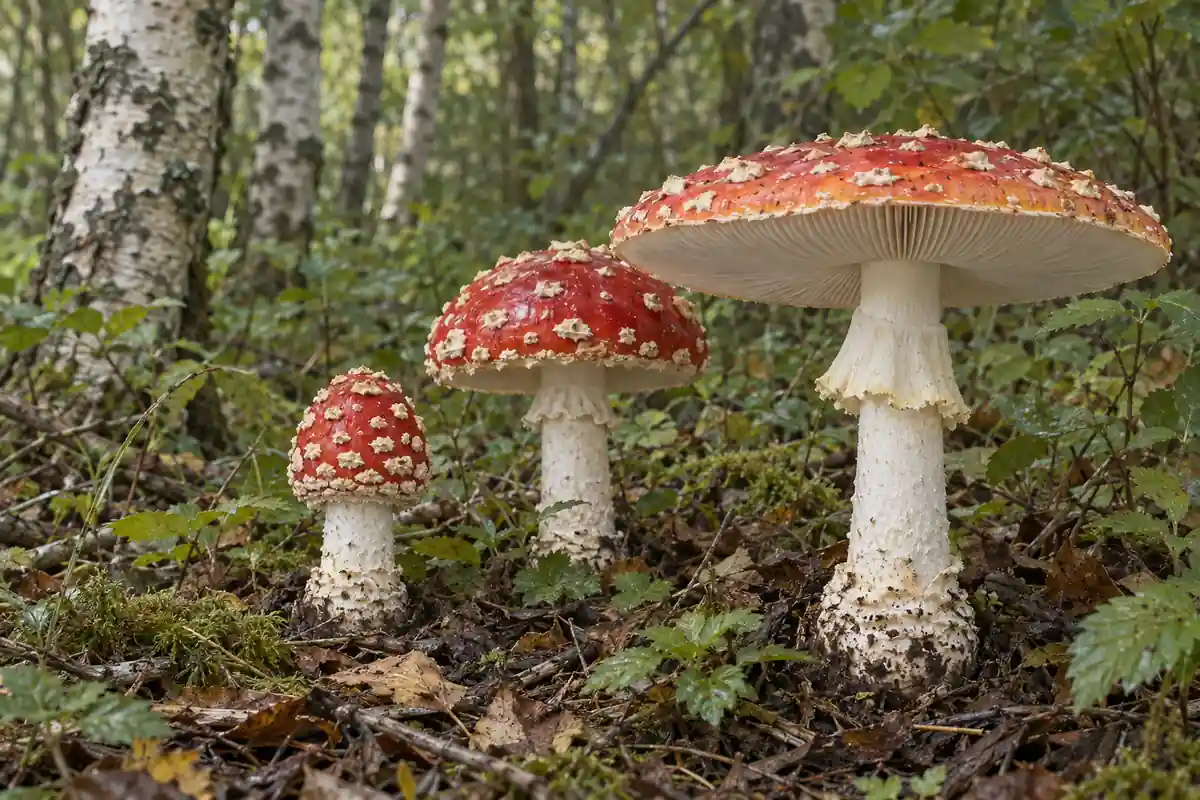
This is the large red, white-spotted toadstool familiar from storybook illustrations, though its cap can also be orange or yellow. The white flecks on top are what's left of a veil that covers the young mushroom. Under the cap are white gills, and the white stem has a ring and a swollen base.
The mushroom lives in partnership with the roots of trees such as birch, pine and spruce, trading nutrients with them. It's native to the cooler parts of the Northern Hemisphere and has spread to the Southern Hemisphere, mostly along with planted pines.
How it works
The mushroom's main active compounds are ibotenic acid and muscimol. Ibotenic acid resembles glutamate, a chemical nerve cells use to excite one another. Muscimol resembles GABA, the brain's main signal for damping down nerve activity, and it activates some of the same receptors — the sites on nerve cells where GABA normally acts. Classic psychedelics, by contrast, work mainly on serotonin receptors.
As the mushroom dries, some of its ibotenic acid converts to muscimol, and some is thought to convert after the mushroom is eaten. The balance between the two compounds varies from one mushroom to the next. Both are thought to contribute to the experience, but exactly how they produce it isn't well understood.
Effects on the mind
The fly agaric produces an altered, dreamlike state that's hard to categorize. It isn't a classic psychedelic. It shares some features with deliriants — substances that bring confusion and loss of contact with one's surroundings — but that label is only a partial fit.
Reports range widely. Some people describe feeling elated and talkative. Others describe drifting between sleep and waking, with vivid dreams or visions, or things seeming to change size. Reports can also include confusion, agitation, fear or losing track of where one is, and some people remember little afterward. A single experience may include several of these states.
The experience generally lasts several hours, though reports of how long it lasts vary. Most of what's known comes from individual accounts and case descriptions.
In tradition
Koryak communities in northern Kamchatka and along the nearby coasts of Russia's Far East have long eaten the fly agaric and treated it as a spirit-person. They understand it to give strength and cheer, to tell people what ails them, and to show them the future and the dead. In the 18th century, the neighboring Itelmen — called Kamchadal in accounts of the time — also ate the mushroom and sold it to the Koryak.
Today
The fly agaric is now also used outside the Siberian traditions that include the Koryak, but that use has received little scientific study, and controlled studies of the mushroom in people are largely lacking. Muscimol is better known as a laboratory tool: in animal studies, researchers use it to temporarily quiet a chosen brain region and find out what that region does.
Traditions that use it
Cite this page
Psychoactive Traditions. “Fly agaric.” Last reviewed 4 November 2026. https://psychoactive-traditions.org/medicines/amanita_muscaria