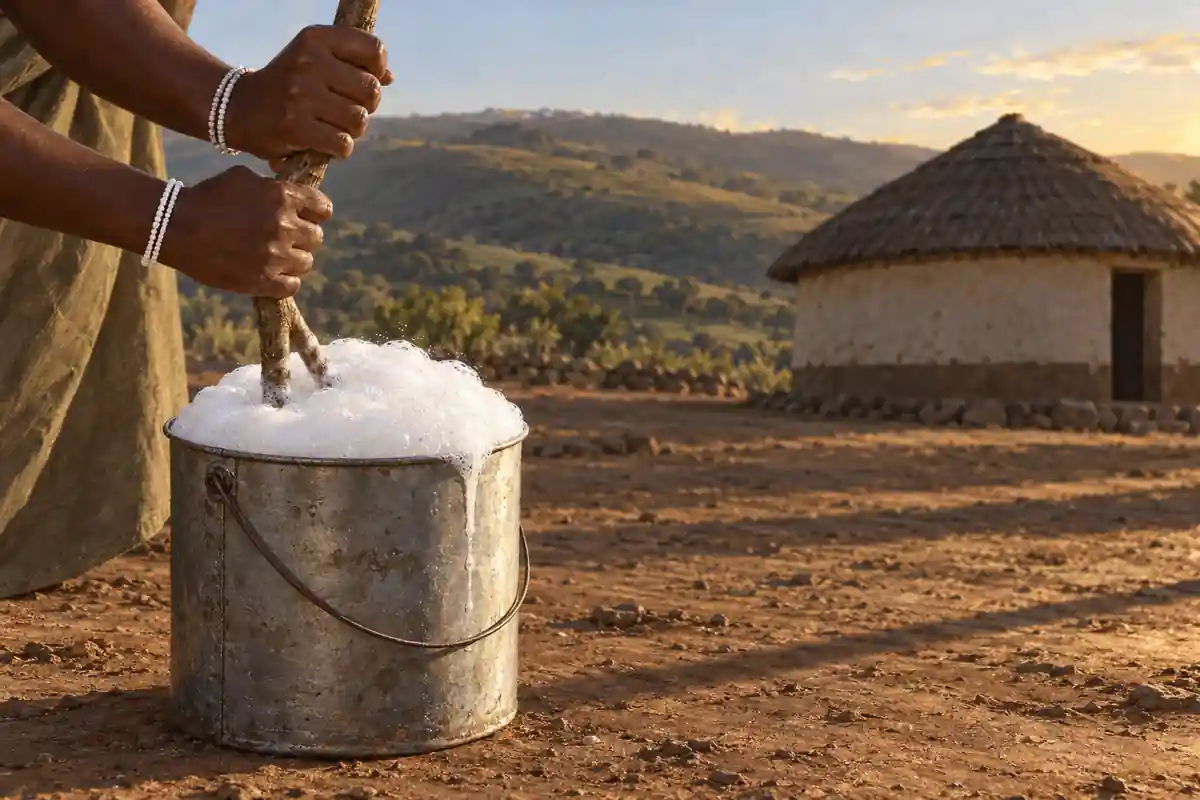
In the Eastern Cape of South Africa, Xhosa diviner-healers called amagqirha (singular igqirha) pass through a long initiation in which dreams serve as the main teacher. Most of them are women. Throughout that training, the initiate takes a billycan (a tin can with a wire handle) and whisks a mixture of roots and water with a forked stick until a head of white foam rises. She eats the foam, washes her body with it, and calls on her ancestors while she works. The medicine is ubulawu, and it is used so that the instructions of the ancestors will arrive clearly in dreams. [2, 3, 7]
A calling no one wants
The initiation is called ukuthwasa, a verb that also describes the appearance of a new moon and the process of becoming a new person. Among Xhosa people it is understood as an inborn gift that runs in families. No one can simply decide to undertake it; a person must have ubizo, a calling from the ancestors (iminyanya) of her lineage. The calling shows itself through trouble: accidents, deaths in the family, lawsuits that never end, palpitations, headaches, and sights and sounds that others do not perceive. For this reason people also call ukuthwasa inkathazo, "trouble." Because it depends on clear dreams and is associated with purity, it is also known as ingulo emhlophe, the "white sickness." [2]
Few people welcome the calling. In the 2000s a Xhosa woman who had herself trained and graduated as an igqirha wrote a doctoral study of the training, and every one of her informants agreed that no one appreciates the calling at first. An earlier survey had found that only six of 114 women questioned wished to become diviners. One healer described years of palpitations, chest pains, ringing in her ears and figures passing at the edge of sight. Several diviners treated her, each bringing temporary relief, while her father complained that the training was expensive. She accepted the calling only after a night when her family feared she had lost her mind. A diviner told her husband that the figures she had been seeing were ancestors. The trainer who would later teach her had appeared to her in a dream before they met. [2]
The diviners in that study objected to the way outsiders had described their experience. Earlier anthropologists had treated ukuthwasa as an affliction or a neurotic syndrome and had translated iminyanya as "shades." The amagqirha rejected that word: its Xhosa equivalent, isithunzi, means a shadow. In their account, the afflictions are not a disorder to be cured; they are the normal signs of a gift, and they press a person to accept it. Entering the initiation is what heals. [2]
A medicine named for dreams
The word ubulawu comes from the verb ukulawula. In everyday speech ukulawula means to give instructions; in this setting it means to tell of the dreams in which one has received instructions from the ancestors. The word is believed to derive from a Khoekhoe word, laula, meaning to apologize. For Xhosa people, dreams are a direct means of communication between the living and the dead. Good dreams are those connected with the ancestors; bad dreams are thought to be sent by someone who wishes the dreamer harm. Diviners also distinguish ordinary dreaming from amathongo (singular ithongo): clear, directive dreams in which ancestors give specific messages. [2, 3, 8]
Ubulawu is not a single plant but a class of plants (izilawu) used in several ways to help people communicate with their ancestors. Most are roots that foam when whisked in water. In the Eastern Cape the most commonly used is Silene undulata, a sticky herb of damp slopes whose white flowers open and release their scent toward evening. The particular ingredients are learned in training. During the doctoral fieldwork, diviners asked that the names of certain herbs and ubulawu not be made public, and one healer explained that this secrecy protects the profession. [2, 3]
The foam itself carries meaning. Contact with the ancestors requires ritual purity, and washing with ubulawu is a way of achieving it. The whiteness of the foam is said to show that the medicine is clean and pure, and people watch closely how it rises. A lack of foam is read either as a sign that the timing of the ritual is wrong or as the ancestors' disapproval. White runs through the diviner's life: in her beads and cloth, in the name "white sickness," and in the phrase umntu omhlophe, "white person," used for someone who has undergone the initiation. Diviners explain that the phrase means a person whose vision is bright and clear, as light removes darkness, and that it has nothing to do with race. [2, 3]
Dreams as the curriculum
"You as igqirha have to follow the dreams of umkhwetha," said the trainers in the doctoral study. "You are just a sledge." An umkhwetha is an initiate. All three trainers made the same point in different words: the initiate's dreams give the training its content and direction, and the trainer's task is to read them. In this lineage there was no fixed syllabus. An elderly trainer would rebuke initiates who brought her nothing: "If you do not have dreams, what must I do? I cannot give you my family divining gift." The researcher concluded that an initiate needs to be "a house of dreams." [2]
Ubulawu serves that need. In the training the researcher described, each day began with the interpretation of the night's dreams. Initiates who had dreamed felt relief; for those who had not, it was a time of anxiety. Chores followed: fetching fresh water, caring for the trainer, seeing clients, and gathering herbs. At the edge of the forest, before going in to gather, initiates burned incense, spilled snuff and recited clan praises to ask the ancestors' permission to enter. The day often ended with an intlombe (a night of drumming, singing and dancing) and with the eating of ubulawu, followed by washing outside with the foam. Purgatives and enemas were taken from time to time to "stimulate, awaken or nurture" dreams. One healer, recalling her training in the 1980s, put it simply: "We also ate ubulawu, washed, vomited, steamed and had enemas to clean ourselves so that the dreams could be clear." [2]
The stirring itself demands strict attention. When it is time, one igqirha begins a song and claps, and the others leave whatever they are doing to join. Only singing is allowed. The initiate is the only one who speaks, reciting her clan praises as she stirs, and the singing may be interrupted only when she licks the foam. Messages are passed by gesture. At one gathering, a diviner who had joined the singing without her head beads was signaled silently by her colleagues, and she paid a fine. [2]
Dreams are not the only thing the medicine is asked to open. Diviners also take ubulawu to stimulate umbilini, the intuition they rely on when they assess and diagnose clients. The same word also names the palpitations that are among the first bodily signs of a calling. [2]
Ubulawu in the rites of passage
A widely known myth, recurring in its essentials among the Nguni peoples, describes how a diviner is called. The candidate undresses on a riverbank and goes into the water "as if by magic." Beneath the river a snake lies coiled beside white clay, letting those who belong to the river pass and killing those who do not. Beyond it, in an enclosure resembling a healer's medicine hut, sits a very old woman, half human and half fish, who represents the ancestors of the candidate's clan. She tells the novice that the ancestors have called her: "Go home now. Heal your and other people." After three days, relatives find the novice covered in white clay. At home she is placed in a separate shelter with a tin beaker of freshly churned ubulawu, frothy and white. The initiating diviner tells her to drink, and afterward the novice relates what she experienced under the river. [7]
In practice, too, the medicine marks each threshold. The doctoral researcher entered initiation in 1998 at a night dance held in Cape Town. Beforehand she washed with a medicine of roots and bark and brought water in a new billycan. Her trainer added ubulawu to the water, and the researcher shook it with a forked twig and ate the foam, praising her ancestors and asking for their wisdom on the journey ahead. Then she was beaded with white beads and given a new name. [2]
Later, two rites are held together: the acceptance of the calling, and ukubekwa ephehlweni, which connects the initiate with her ancestors and which the researcher compared to a baptism. Before the sacrificial goat is slaughtered, it is brought to the diviners. An igqirha shakes ubulawu, lets the goat eat the foam, and smears foam on its body. The goats must bleat when they are slaughtered, and when they do, everyone present says Camagu, a sign that the ancestors have accepted the offering. The initiate sits beside the hearth facing east. The billycan is placed on her head while the igqirha shakes it and prays: "I request that you open [her] head and intuition so that she can assess and diagnose people's problems. Today, we initiate her, please enlighten her." Then the initiate shakes the billycan herself, saying her clan praises, eating the foam and smearing it on her body. She sits through the night at the far end of the house, stirring and eating, and at four in the morning she washes with ubulawu in the open space in front of the cattle enclosure. [2]
The same pattern returns years later, at graduation. On the eve of the ceremony, an ox is brought with others from the herd, and the initiate must point out the one she has seen in a dream. That night she rests, stirring ubulawu and eating its foam, while séances continue around her. At four the next morning she washes with ubulawu again and receives a new dress. She is now an ikrwala, a newly graduated igqirha, and the name umkhwetha is discarded. The ox must bellow when it is slaughtered. If it does not, the researcher wrote, questions and guilt remain, and people may hesitate to trust the new healer. [2]
A changing practice
Missionaries, colonial authorities and the apartheid state treated ukuthwasa as pagan and associated it with witchcraft. By the 2000s, the doctoral study found, Christians and university-educated people consulted diviners and entered initiation themselves, and white beads could be seen at church and at work. The researcher was a Methodist pastor, and during her training she recited the Lord's Prayer while stirring ubulawu. For her it was automatic; some other diviners felt it was not the time for prayer, and her trainer defended her. Another woman's calling was divided between ancestors who had been church faith healers and ancestors who had been diviners. A Bible was given to her as the tool with which she would heal, and in her account of what the diviners said, "the Bible is like ubulawu among the amagqirha." [2]
The training itself had changed by the 2000s. It had once lasted about eight years; now it took two, three or five. Fewer extended families were able to support an initiate who did not earn a wage, and most trainees worked and lived at home, visiting their trainers when rituals were due. The trainers were unhappy with the arrangement. "They will learn nothing," many said; "knowledgeable healers are diminishing." One trainer took the other side: trainees have to work, she said, because they must pay for their training. [2]
The roots in a wider world
Ubulawu is not confined to Xhosa diviners. Among Southern Bantu-speaking peoples more broadly, lay people also use it as a "lucky medicine." The ethnobotanist Jean-Francois Sobiecki began fieldwork among healers around Johannesburg in the late 1990s and later trained with a Northern Sotho healer. His teacher distinguished two broad kinds of mind-affecting plants. Plants such as ubulawu work subtly, slowly opening dreams, intuition and sensitivity. Stronger plants that produce visions are used specifically for divination. She held that the stronger plants did not give true visions, and she preferred ubulawu. In her view its first purpose was to clean the body so that the mind becomes receptive: "ubulawu will connect you with your ancestral spirits, to give you what you need, they open your way." [4–6]
Sobiecki has proposed that "luck" in this usage refers to the clarity of thought, vivid dreams and good feeling that users report, and he has looked for chemical explanations for these effects. These are his hypotheses, not the healers' own account, which concerns the ancestors. He also notes that some plants used in initiation cannot be named in public and are revealed only through training. [4, 5]
The plants themselves have become harder to obtain. In the mid-1990s the anthropologist Manton Hirst reported that the roots traditionally used to bring visions to novices were scarce. He attributed the scarcity to overharvesting by herb sellers and healers, drought and overgrazing. A company spokesman said that many diviners living in townships could not get many of the plants used in divining. Hirst also said that the plants could cause poisoning and even death. Some diviners he met had used a synthetic drug, 2C-B, as a substitute; until it was banned in South Africa, it had been sold in herbal shops as an ubulawu product for diviners. He described one initiate who had lacked confidence in her calling. After taking 2C-B, she found herself in a forest where wild antelope and carnivores told her they were the messengers of her ancestors. [1]
By 2013, Silene undulata was still harvested mainly from wild populations and sold in informal street markets and in muthi shops, which sell traditional medicines. The trade had raised concern about whether the wild plants could last. Near King William's Town, a project had begun growing the plant in home gardens to supplement the dwindling wild stands, and the cultivated roots were sold in the town's markets. The same plant was also being sold internationally online as a "meditation herb" under the name African Dream Root. [3]
The House of Dreams
Across all of these settings, ubulawu keeps the purpose its name describes: helping a person receive the instructions of the ancestors and tell of them. For the amagqirha it is whisked and eaten at every threshold of ukuthwasa, from the first night dance to graduation, because the training follows the initiate's dreams and those dreams must be clear. Its white foam marks the purity that contact with the ancestors requires.
The practice around it has changed. It has made room for Christian prayer and for shorter training that fits alongside wage work. It has also had to cope with wild roots growing scarce, while one of those plants is now cultivated in home gardens and sold online abroad as a meditation herb. The diviners' own account of what they are doing differs in emphasis from that of outsiders. They describe the trouble of the calling as a gift to be accepted, not a disorder to be cured, and they describe ubulawu as one of the means by which an initiate becomes, in the researcher's words, "a house of dreams."
What is uncertain
One detailed insider study by a Xhosa diviner describes how root foam is used throughout initiation, but it reflects practice up to the mid-2000s and only parts of it were available. Most later writing is general, comes from a single researcher who trained outside Xhosa practice, or is popular.
Whether the roots have real mind-altering effects, or work mainly through ritual, cleansing and expectation, has been proposed but not tested. [4, 5]
Sources disagree on how strong any effect is: one describes subtle effects without visions, another claims lucid dreaming. [4, 8]
It is unclear how far descriptions of drinking and vomiting the mixture, drawn from other Southern Bantu groups, apply to Xhosa initiation, where the insider account stresses eating the foam and washing with it. [2, 4]
Which plants Xhosa trainers actually use in initiation is deliberately kept private by diviners, so published plant identifications may not reflect initiation practice. [2, 3]
The origin and meaning of the word "ubulawu" are disputed: one source traces it to a Khoekhoe word for apologising, another renders it as "white path". [3, 8]
How widely diviners used a synthetic drug as a substitute in the 1990s rests on a single newspaper report. [1]
It is uncertain whether declining wild root supplies and shorter, part-time training are changing how ubulawu is used in initiation today. [1, 2, 3]
Practice among Xhosa diviners since about 2010 has not been studied first-hand in any of these sources. [2, 4]
8 sources. Each claim checked by AI against the saved sources; every finding reviewed by Jim Davis beside the cited passage, 29 October 2026. How the articles were checked
Timeline of dated events (9)
- By the mid-1990sroots traditionally used to bring on visions in novices had become hard to obtain, because of overharvesting, drought and overgrazing. [1]
- By 1996a commercially packaged "ubulawu" containing a synthetic drug had been sold in herbal shops and then withdrawn after its active ingredient was banned; some diviners reportedly used it as a substitute for traditional roots. [1]
- 1998the author of the insider thesis entered initiation, churning and eating ubulawu foam at her first ritual. [2]
- April 2000she graduated as a diviner after training that used ubulawu throughout. [2]
- By the 2000sdiviners reported that training had shortened from about eight years to two to five, and that novices now often lived and worked at home. [2]
- 2005–2006variations in preparatory rituals between training schools were observed during fieldwork. [2]
- 2012a researcher underwent an ubulawu medicine initiation with a Northern Sotho healer. [5, 6]
- By 2013a common ubulawu root was being grown in home gardens near King William's Town to supplement dwindling wild stocks, and was sold abroad as "African Dream Root". [3]
- By 2015ubulawu was available on international online marketplaces. [8]
Sources
CSL-JSON imports into Zotero, Mendeley and other reference managers.
Peterson, V. (1996). Traditional healers and synthetic entheogens [excerpt from a South African newspaper Sunday supplement article]. The Entheogen Review, Summer Solstice 1996, pp. 16–17.
Excerpt from a South African newspaper supplement article, reprinted in an entheogen newsletter (1996). It reports a synthetic substitute sold as ubulawu, an anthropologist's comments that the traditional roots were becoming scarce, and diviners' reported experiences with the substitute.
Mlisa, L.-R. N. (2009). Ukuthwasa initiation of amagqirha: identity construction and the training of Xhosa women as traditional healers. PhD thesis, Centre for Africa Studies, University of the Free State.
Doctoral thesis by a Xhosa woman who is herself a trained diviner (2009), read in substantial excerpts. It gives an insider account of the stages of initiation, ubulawu use in daily training and key rituals, secrecy around plant names, and recent changes in training.
Zikishe, V. (2013). Silene undulata. PlantZAfrica, South African National Biodiversity Institute (CREW Eastern Cape Node).
Plant information page from the national biodiversity institute, written by a conservation network staff member (2013). It describes the most common Eastern Cape ubulawu plant, its trade, cultivation and international sale, along with the meaning and origin of the word.
Sobiecki, J. F. (2014). Southern Africa: The forgotten cradle of psychoactive healing plants. In M. Horák et al., A Reader in Ethnobotany and Phytotherapy (pp. 161–165). Mendel University in Brno.
Book chapter by an ethnobotanist and trained healer (2014). It reviews research on psychoactive plants in southern Africa and proposes how ubulawu might work in diviner initiation.
Sobiecki, J. F. (2014). The intersection of culture and science in South African traditional medicine. In M. Horák et al., A Reader in Ethnobotany and Phytotherapy (pp. 166–178). Mendel University in Brno (reprinted from the Indo-Pacific Journal of Phenomenology).
Chapter by the same author (2014), reprinted from a journal article. It draws on his 2008–2012 fieldwork with a Northern Sotho healer and on plant chemistry to interpret ubulawu as "cleansing" and "bringing luck".
Sobiecki, J.-F. (2024, March 5). African psychoactive plants – Journeys in phytoalchemy. Chacruna Institute for Psychedelic Plant Medicines.
Web essay by the same author (2024). It recounts his fieldwork and his 2012 initiation, and outlines his idea of a sequence of plant medicines used in healer training.
Hirst, M. (2009). The healer's call. Imvubu (Amathole Museum newsletter), 21(2), 7.
Museum newsletter article by an anthropologist (2009). It retells the Xhosa myth of the diviner's calling under the river, which ends with the novice drinking freshly churned ubulawu.
Bagi, J. & Molnár, T. (2015). Álom-kutatások: fókuszban a dél-afrikai xhosák álom-tradíciói. Afrika Tanulmányok, IX(III–IV).
Hungarian-language journal article by a doctoral student and a parapsychologist (2015). It summarises earlier studies of Xhosa dreaming and presents ubulawu as a lucid-dreaming root, relying largely on secondary and web sources.
Related
Cite this page
Psychoactive Traditions. “Ubulawu in Xhosa Diviner Initiation.” Last reviewed 29 October 2026. https://psychoactive-traditions.org/traditions/xhosa-ubulawu